Structure
- Concept
- Composer O La Monte Young 2.1. Trio for Strings. 1958 2.2. Compositions. 1960 2.3. Drift Study. 1969 2.4. The Second Dream of the High-Tension Line Stepdown Transformer. 1984 2.5. Dream House. 1969–2014
- Location Whispering Galleries
- Score
- Conclusion
- Bibliography
- Image Sources
Concept
First, I chronologically analyze the works of La Monte Young, tracing the evolution of drone as a compositional technique within his art. Simultaneously, I comment on Young’s perception of music as a method of meditation and communication with the transcendent. In his practice, I find his teachings on the mysticism of listening and the ritualistic performance of sustained harmonic timbres. It is also significant how Young utilizes space as a musical instrument to immerse the listener in standing waves and the resonances of the sound stream itself.
In the second part, I examine ancient architecture through the lens of archaeoacoustics. This view considers places of ritual worship as a theatrical staging of mystical experience: by designing these spaces, we allow them to design us. I present several examples of historical research into how sacred sites conjure acousmatic sound.
Finally, I propose a plan for a group improvisation titled «The Second Dream of the High-Tension Line Stepdown Transformer» within the Gol Gumbaz temple in India. This allows me to contextualize Young’s work within the culture that inspired him; merge the psychoacoustics of the whispering gallery with the compositional score; and expand the experience of both performance and listening.
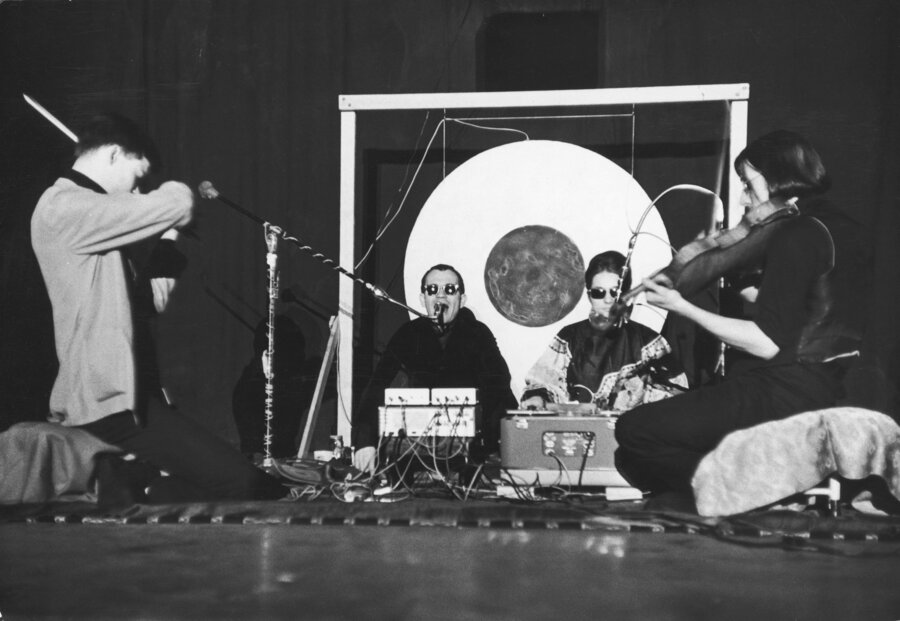
Photo by U. Macdarra. Performance of «Theater of Eternal Music» in 1965.
In his essay «Nature, ” the transcendental philosopher Ralph Emerson argues that through the knowledge of nature, man comes to know God. This process demands absolute solitude—a retreat from society into uninhabited wilderness and immersion in wild grasses. There, he writes in his own words, „the eye becomes transparent: I am nothing, I see everything, and all flows of being pass through me, and I am part of God.“
The artistic journey of La Monte Young can be viewed as the acoustic equivalent of Emerson’s transparent vision—dissolving the ego into an ocean of microtonal hum for religious reasons.
During improvisation, his musicians can experience this sensation when they confront their voice or instrument one-on-one, thereby becoming them. Space and time recede, and the music begins to play or sing through the performer.
La Monte Young for the performance of «The Well-Tuned Piano.»
Composer O La Monte Young
La Monte Young was a pioneer and champion of minimalism—a musical style that contrasts the rapid tempo of sonic changes with the slowness of complex harmonies. Minimalism’s focus on formal simplicity and audible processes sets it apart from the engineering complexity of serialism—where composing resembles solving a puzzle.
Photo by Maria Glissen. La Monte Young and Marian Zazeela. 1972
«I fail when my music doesn’t take people to paradise» — La Monte Young [2]
Christopher Otto, Reinhard Rott, Charles Curtis, and Eric Karlsson performed «Trio for Strings» in 2015.
Trio for Strings. 1958
for cello, violin, and violaFor 48 minutes, the Young Ensemble practices slow-motion techniques, holding notes for extended periods with brief pauses up to forty seconds. Each instrumental voice plays one of the pitch heights of the «dream chord”—G — C — C — D#—at varying durations, manipulating and transposing them with soft and subtle bow movements devoid of vibrato.
Instead of a sequential melody, Yang promotes harmonic parallelism. The image of cosmic timelessness enters his creative work. Yang understands sound and music as tools for meditation and as a language for communicating with the divine. This links his method to Sufi rituals, shamanic music, and Pythagorean harmony of the spheres. He uses the integer interval relationships from the raga to establish specific psychological states.
Florentine Manuscript from the 13th Century: «Magnus liber organi”—a repertoire of organum compositions.
In addition to the Indian raga, his teachings are also influenced by organum—a medieval compositional technique used by Guillaume de Machaut. Monastic chants, before the linear structures of drama, were based on stasis—the preservation of external form amidst changing details.
Organum often consisted of a two-voice choir: while one singer held long notes in a bass drone, another wove a simple melody in quivers and fifths through it with the tenor. Over time, their voices diverged in tempo and octave, but at the climax, they always merged into unison and faded into silence.
«One of the interesting properties of musical form for me is stasis—the idea of an undirected and non-climactic form that allows the hands of a clock to stop.» — La Monte Young [3]
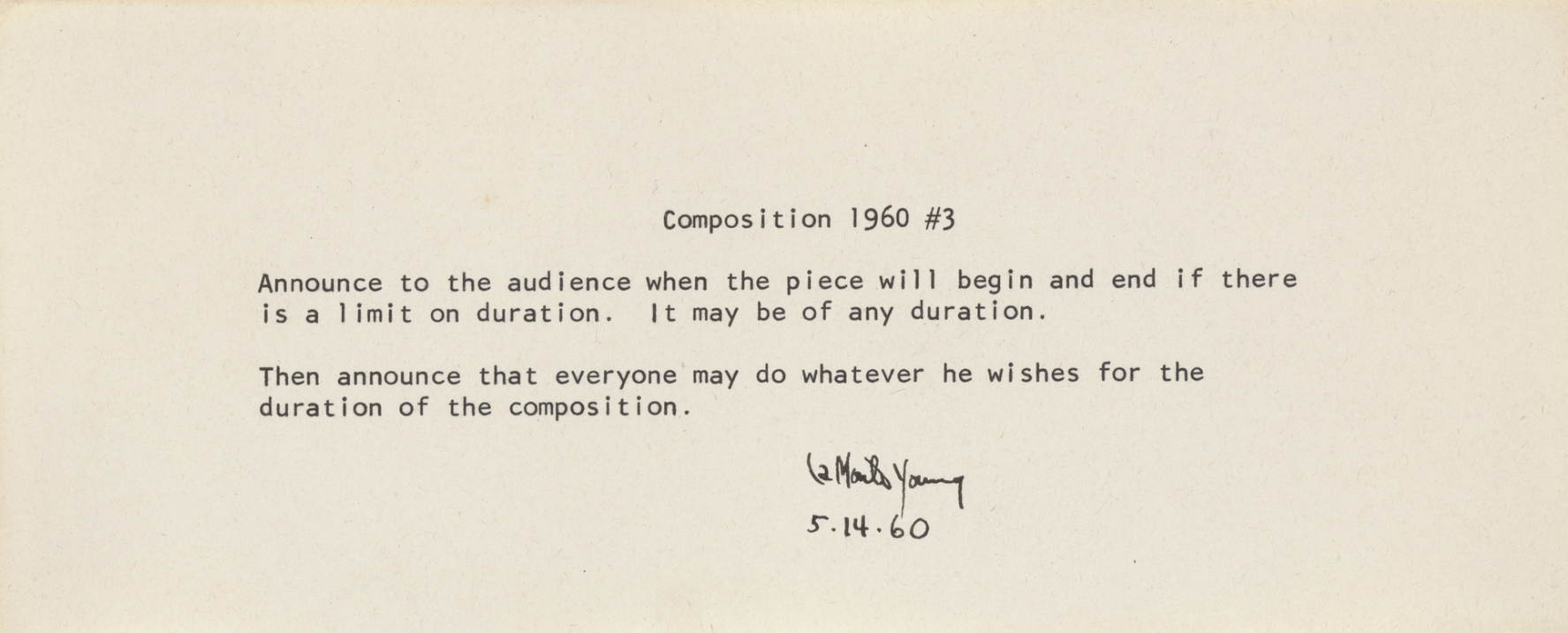
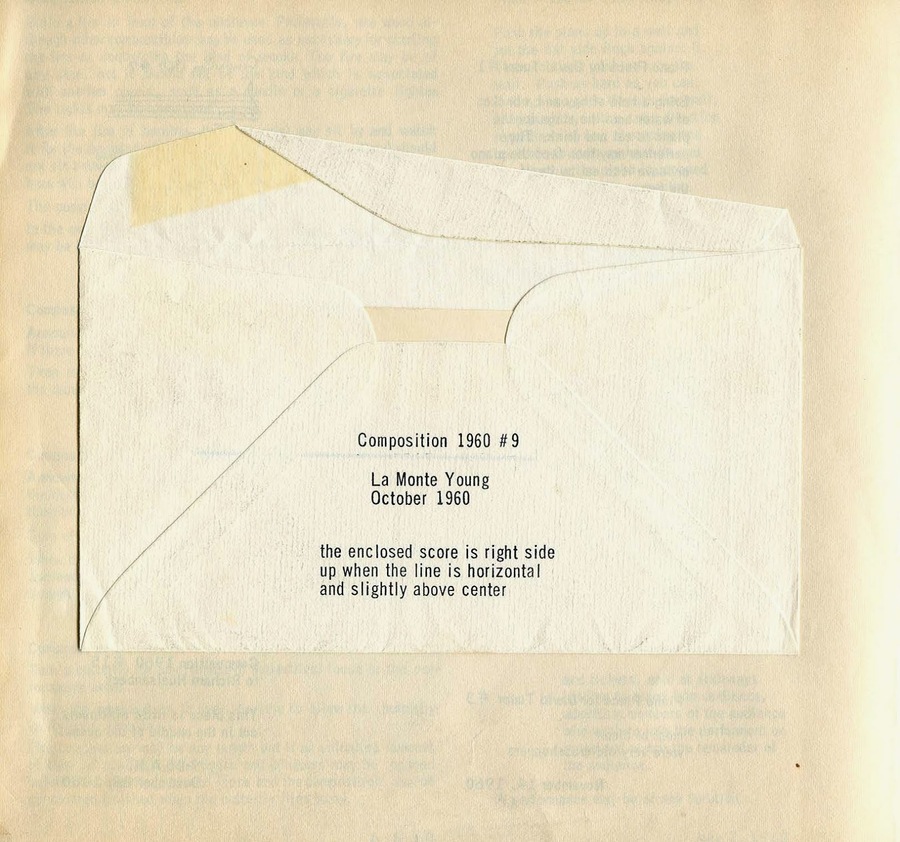
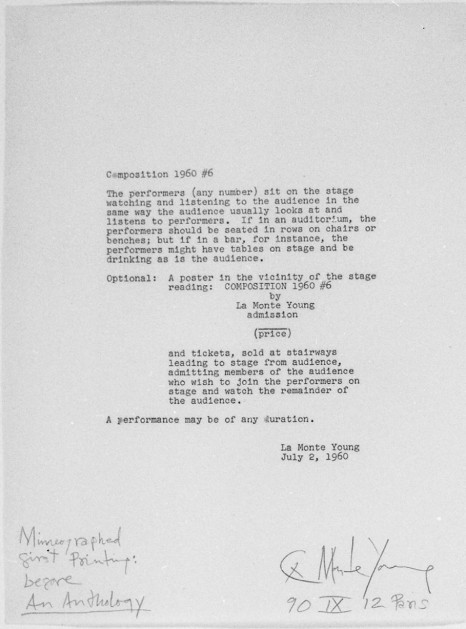
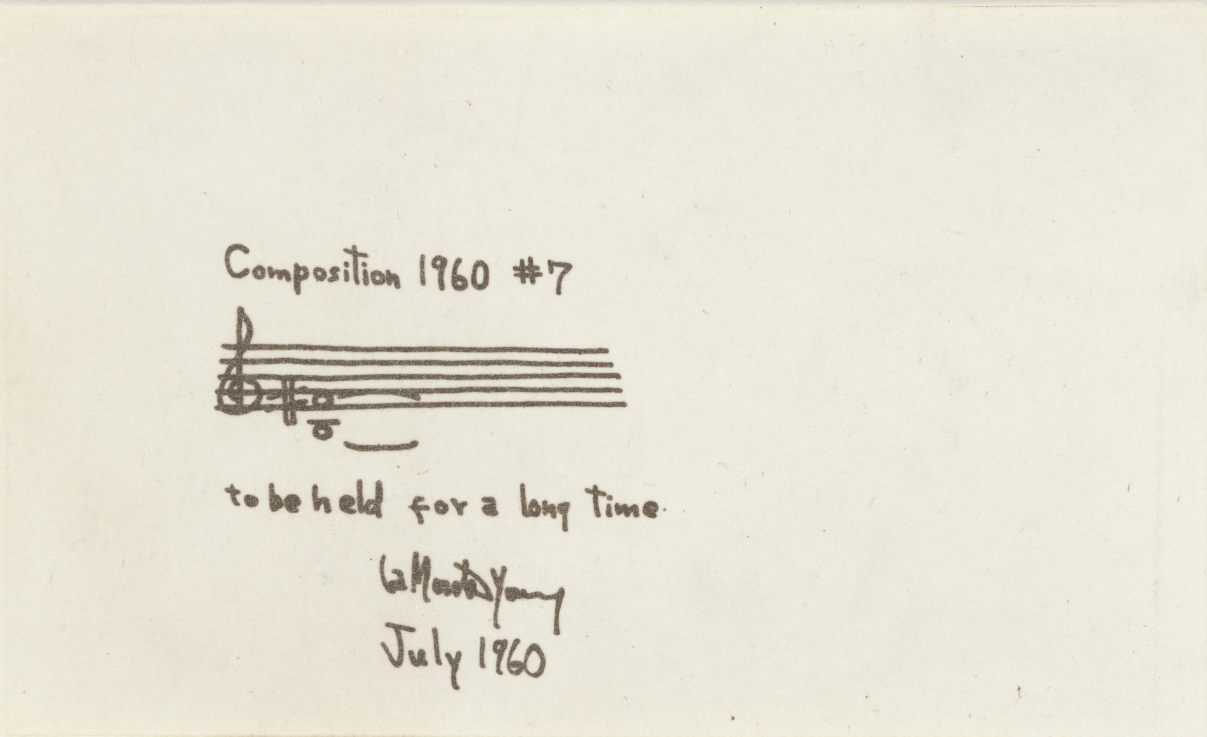
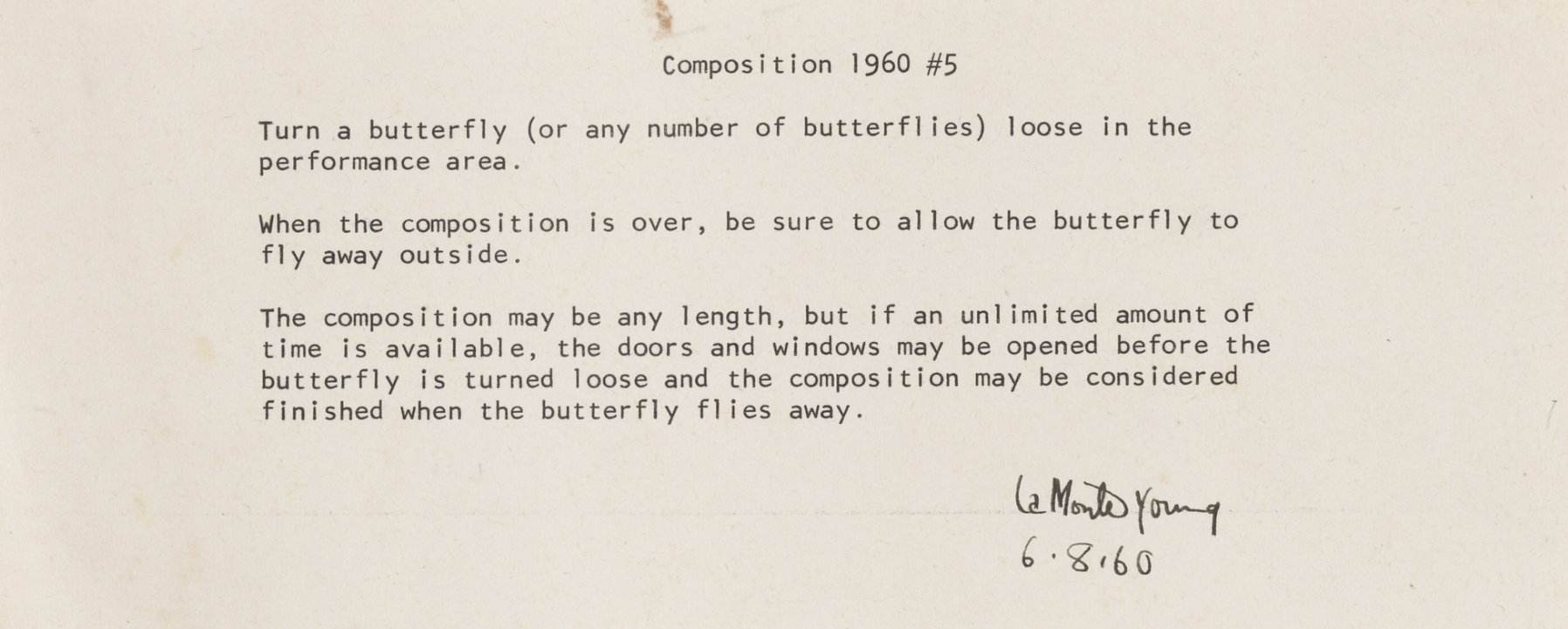
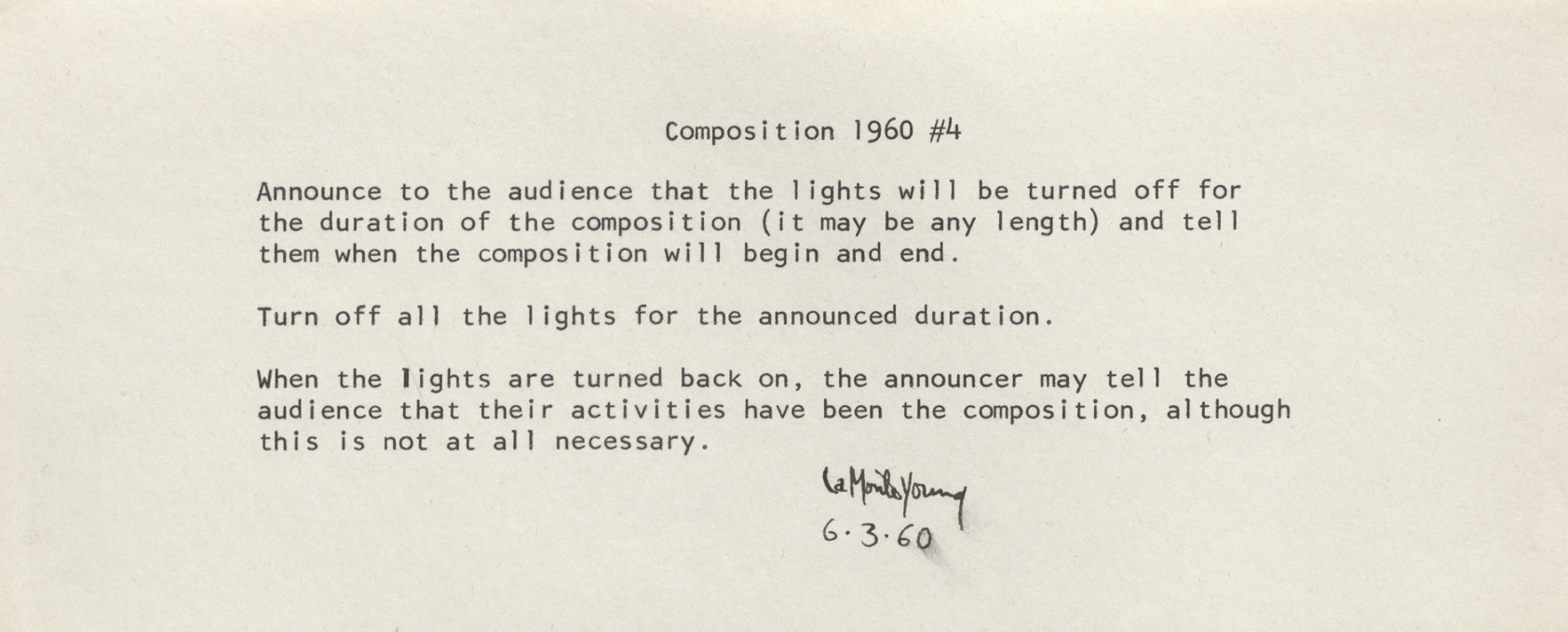
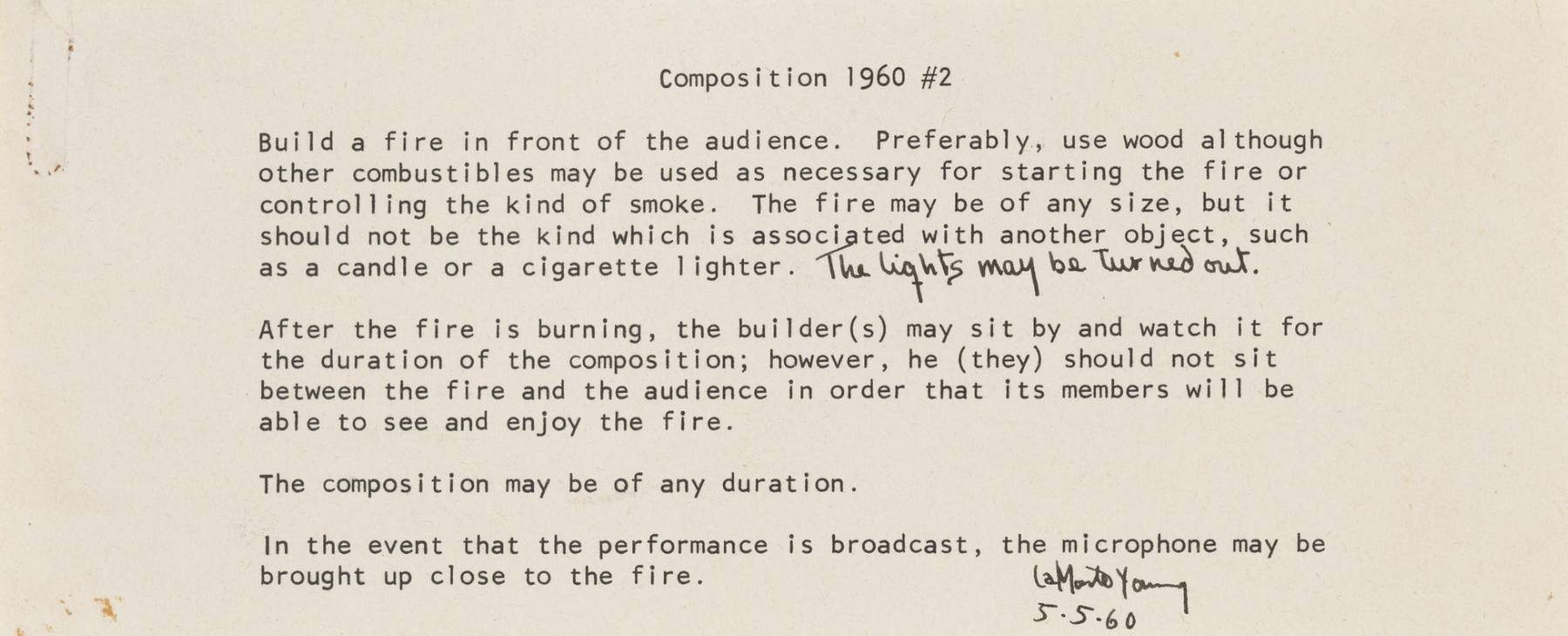
Compositions. 1960
score-instructionsAfter becoming acquainted with Cage as a key figure of the avant-garde in 1959, Young wrote over a dozen poetic scores with the help of Yoko Ono. These are open-to-interpretation score-performances that explore questions and riddles within the imagination.
«Release a butterfly into the room and listen to its flutter.»
With these, Young maps his interests like a treasure map. He emphasizes uncertainty; processuality; infinite improvisation; the material texture of sound; and the multifaceted nature of performance and listening situations.
Photo by C. Gaspar. Lamonte Young at the presentation of the composition «Drift Study.» 1970
Drift Study. 1969
For Moog SynthesizerThis study explores the amplitude modulation of two periodic signals with closely spaced frequencies using beats. By playing harmonically poor sine waves, Young emphasizes the influence of space on sound. The issue is that during a loud performance, sound waves reflect off surfaces and produce unforeseen harmonics. As the listeners move around the room, they catch fragments of the sounding potentials and are impressed by the mutable flow, which is based on the simplest synthesis of sound.
Photo by Philip Macan. Self-portrait by Elvin Lusse.
It is interesting that in the same year, Alvin Lucier would perform «I Am Sitting in a Room.» In this work, space is instrumented through spoken word. Its streaming performance renders the listening experience indivisible into significant moments. Lucier nurtures a tendency toward process music alongside Young. The potentially infinite duration of degrading feedback bears a striking resemblance to Young’s ideas for «Theater of Eternal Music.» Both artists embody music as an object and a sculpture—a timeless installation for ritual performance.
Initiation Room No. 2, Turin, 1971, featuring Tania Mouraud, Terry Riley, Ann Riley, Pandit Pran Nath, La Monte Young, and Marian Zazeela
«Four sonic experiences from childhood influenced the development of my musical ideas:
— the singing of insects; — the noise of motors; — the whistle of a boiling kettle and the sound of a locomotive; — and the frequency resonance of nature in canyons, lakes, and valleys, determined by the uniqueness of the places.
The hum of power lines taught me how to hold a note in one tone without beginning or end.» — La Monte Young [4]
Screenshots from the performance at the 58th «Warsaw Autumn» Contemporary Music Festival. 2015
The Second Dream of the High-Tension Line Stepdown Transformer. 1984
for pipe ensembleFollowing the event scores of 1960, Young develops the theme of space as a musical instrument through the prism of algorithmic composition. Inspired by his childhood memories of the humming electrical transformer near his home, he proposes group improvisation as a meditation on spatial awareness. Over the course of an hour, the performers cautiously coordinate with one another, gradually building a chord.
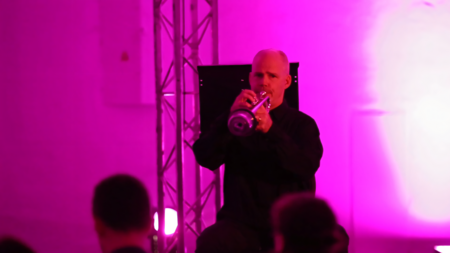
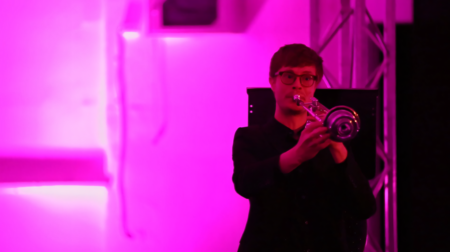
Screenshots from a performance at the 58th Warsaw Autumn contemporary music festival. 2015
This performance resembles a divinatory practice: gazing into a dense, viscous medium to discern patterns within it. Initially, a single note is extracted and sustained. Similar to the «Drift Study, ” sound waves reflect throughout the room, generating new overtones. Among these, the participants search for a specific pitch—for instance, the note G#. When someone perceives this new harmonic, they introduce it into the space, and the other players pick up the note. The performance concludes cyclically after four intervals have been played, with the fourth interval matching the first note.