Египет
(01) Concept
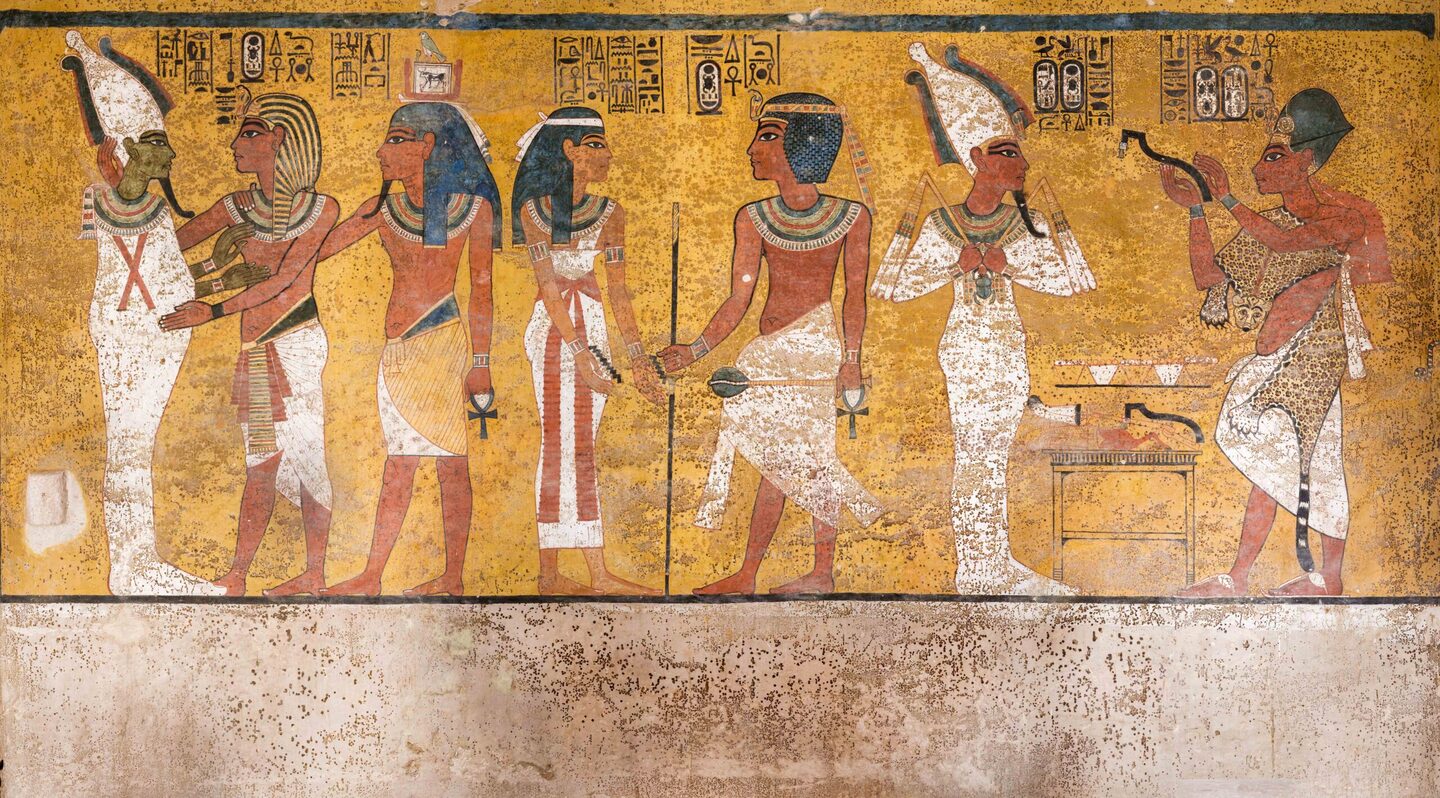
The ancient Egyptian civilization, which existed for millennia, left behind a colossal legacy that continues to astonish the imagination. However, perhaps the brightest reflection of their worldview is not found in the pyramids or the statues of the pharaohs, but in the tomb frescoes. The images on the tomb walls served not merely as decorative adornments, but as a complex symbolic system—a bridge between the world of the living and the world of the dead.
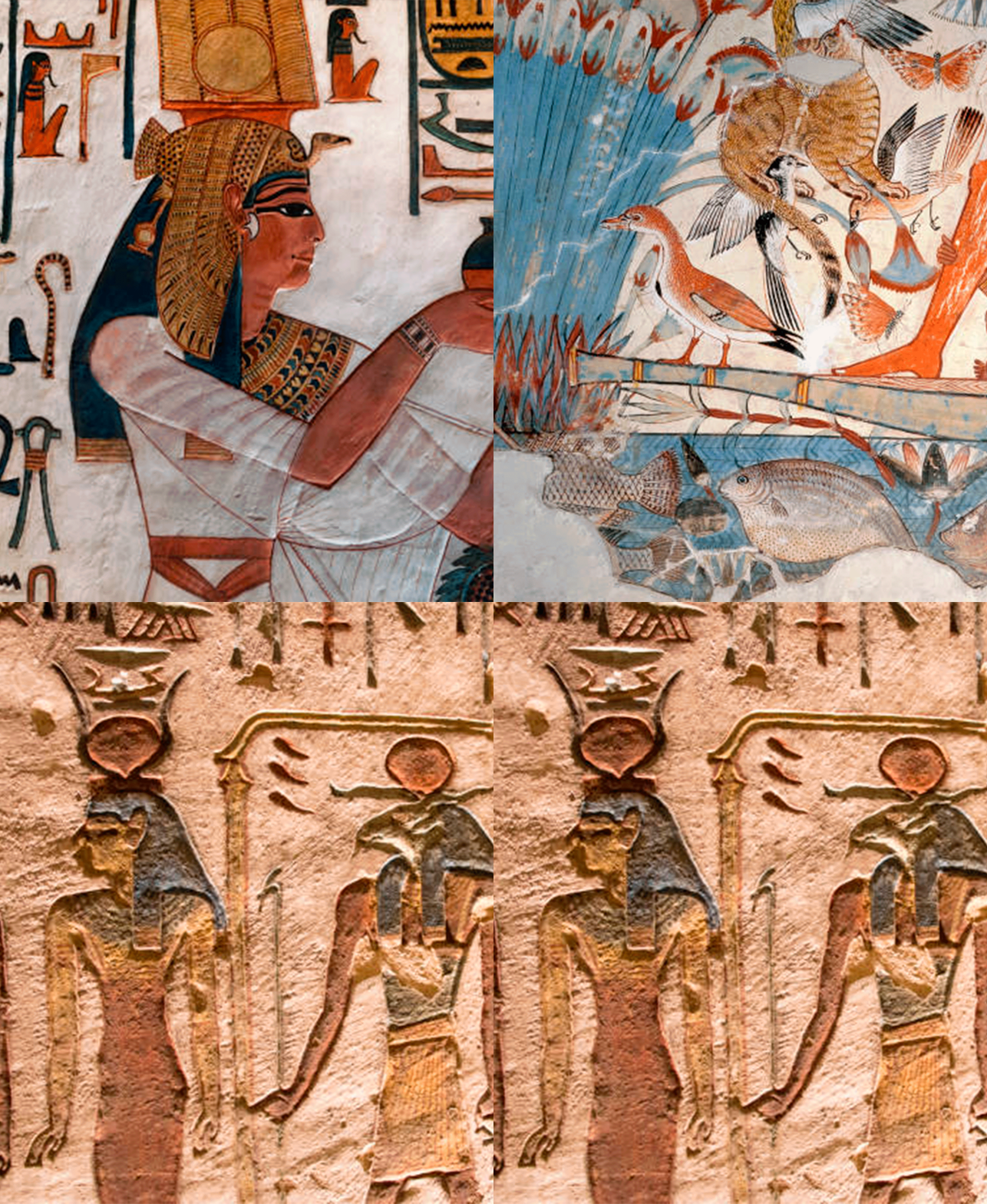
This topic fascinates me to an astonishing degree. It seems unbelievable how deeply real people can be concerned with their posthumous existence. In the modern world, we are accustomed to deferring thoughts about the finitude of life or perceiving death as something distant and frightening. The ancient Egyptians, conversely, built their daily lives and art around preparing for the transition to another world. Studying their murals is an attempt to understand how an entire civilization perceived the meaning of its existence and why art became their primary guarantor of immortality.
This visual study is dedicated to analyzing the profound and inseparable connection between Ancient Egyptian culture and its art—specifically, how the Egyptians expressed their spiritual values through tomb paintings, why the afterlife occupied a central place in their culture, and how art served as a tool for achieving eternity.
(02) Fivan Necropolis
One can discuss Egyptian art using the example of many tombs, but in my opinion, the Theban Necropolis is the most striking example. After all, it is not merely a complex of tombs, but a vast «city of the dead» that differs sharply from other ancient Egyptian necropolises.
The Faiyum necropolis is interesting primarily because it is not merely a burial ground for kings, but a vast «city of the dead» with a distinct social structure. On a relatively small territory, the tombs of pharaohs, nobles, and common artisans who created these monuments coexist. This very coexistence makes it unique: unlike necropolises that represent only the elite, here one can view Ancient Egyptian society in cross-section—from rulers to artists and stonemasons.
Unlike compact necropolises such as Amarna or Saqqara, the Theban necropolis (covering an area of about 14 sq. km) constitutes a complex system comprising several distinct zones.
— For the elite: The Valley of the Kings (pharaohs) and the Valley of the Queens (nobility and family members).
— For the «middle class»: Tombs of dignitaries and high-ranking officials.
— For the laborers: The unique settlement of Deir el-Medina. This was the place where the builders and artists who created the royal tombs lived and were buried. The existence of a separate necropolis for common workers is a rare occurrence in Ancient Egypt.
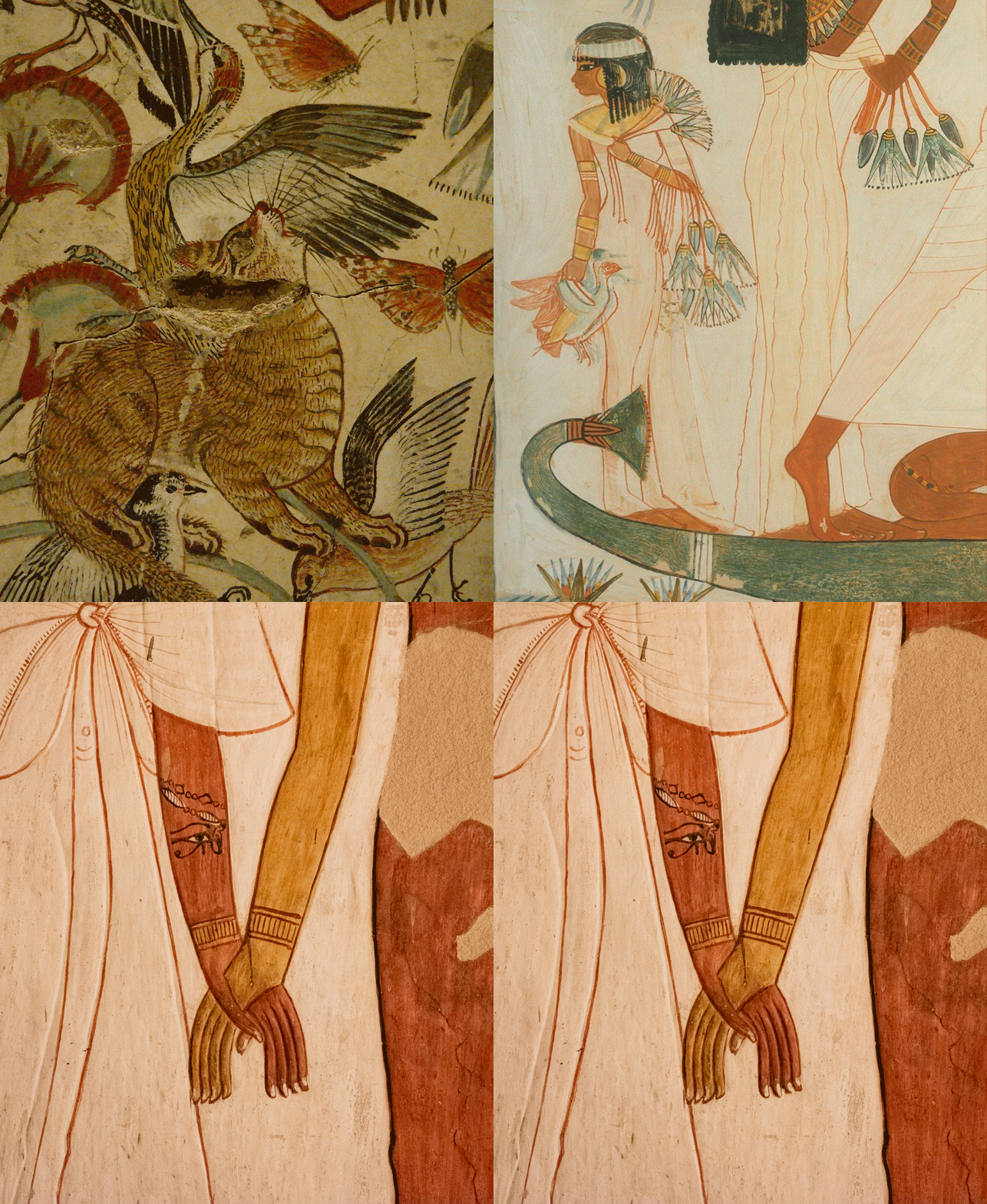
The tombs in Thebes are not merely burial chambers; they are genuine artistic galleries. Their frescoes are considered among the finest examples of ancient Egyptian painting. The paintings in the Theban tombs generally represent not just decoration, but a meticulously designed program intended to capture the idealized lifestyle of the deceased and ensure their prosperous existence in the afterlife. Unlike the strictly official art found in temples, these frescoes strike a balance between ritual necessity and the astonishing vivacity of domestic details for ancient Egypt.
The pictorial narratives of Pharaonic tombs revolve around the figure of the owner, who is depicted as the central character in all scenes. Negative aspects of life were not recorded there; hieroglyphs capable of carrying negative meaning were omitted unless they served a religious purpose related to resurrection. Instead, the walls were filled with scenes of agriculture, hunting, fishing, workshop activities, family banquets, and preparations for the afterlife.
(03) Valley of Kings
Tomb of Set I
Tomb KV17 in the Valley of the Kings is one of the most remarkable tombs of Ancient Egypt. Set I, the second pharaoh of the 19th Dynasty (circa 1294–1279 BCE), reigned during the New Kingdom, and his tomb is considered the longest, deepest, and most splendidly decorated in the Valley of the Kings. The primary artistic feature of KV17 is that it is the first tomb completely covered with paintings and reliefs—prior to this, tomb decorations were fragmented. The walls and ceilings are covered with approximately 2,000 square meters of imagery executed with exceptional precision and elegance.
«The Celestial Cow Supported by Shu»
, painting from the tomb of Set I, circa 1290–1279 BCE (13th Dynasty).The scene illustrates the myth of the «Book of the Celestial Cow, ” which recounts how the sun god Ra, disillusioned with humanity, ascends to the heavens upon the back of the cow goddess Nut, who is supported by the god of air, Shu. The image symbolizes cosmic order and the pharaoh’s transition to the heavenly realm, following Ra. For Set I, this scene served as a guarantee that he would not remain in the subterranean darkness but would ascend to the stars.
The composition is striking in its monumentality and silhouette clarity: the figure of the cow adorned with golden stars on its body forms a distinctive «vault, ” while Shu’s tense posture conveys the weight of the celestial body. The plasticity of the lines and the harmony of the color relationships—warm ochre tones complemented by turquoise accents—make this painting one of the most recognizable images of New Kingdom Egyptian art.
«Seti I Before Ptah»
, fresco from the columned hall of the tomb of Seti I, c. 1298 BCE (13th century BCE, 19th Dynasty).The pharaoh stands before Ptah, the Memphite demiurge and patron of craftsmen. The scene expresses the king’s personal piety and his desire to gain the patronage of Ptah’s creative force in the afterlife. For Seti I, a builder of vast temples and tombs, appeal to Ptah was particularly significant.
This fresco demonstrates the virtuosity of Phivan masters in conveying royal dignity and divine majesty. The figure of Set I is rendered in strict canonical style, yet the vitality that distinguishes the best works of the era is palpable in the details—in the facial modeling and the gesture of the hand. Ptah is depicted in his characteristic shroud, holding a staff, and his figure balances the composition.
Overall, the tomb paintings of Seti I represent the pinnacle of New Kingdom Pharaonic art: they synthesize a rigorous ritualistic program with unparalleled technical mastery and a rare monumental clarity in Egypt. KV17 was the first burial chamber where the paintings covered every available surface, and it was here that the vaulted ceiling first transformed the burial chamber into something akin to a celestial dome.
(04) Queen’s Valley
(05) Valley of the Elite
The Role of Painting in the Religious and Afterlife Culture of Ancient Egypt https://art-longa.ru/живопись/направления-и-стили-живописи/искусство-египта/роль-живописи-в-религиозной-и-загробн/ (Accessed 11/09/26)
Tomb Paintings https://www.metmuseum.org/art/collection/search/545140#1
Cat in the hunting scene of Nebamun https://ru.wikipedia.org/wiki/Небамон#/media/Файл: Cat, _Tomb_of_Nebamun.jpg
«Isis leading Queen Nefertari» https://richedwardsimagery.wordpress.com/wp-content/uploads/2023/05/tomb-of-queen-nefertari-valley-of-the-queens-thebes-luxor-egypt-photograph-10.jpg
Painting from the Tomb of Menna https://kr.pinterest.com/pin/77898268552265669/