Concept
Due to mass culture, the perception of the ancient Celtic peoples by most people is largely distorted. Most often, the Celts are portrayed as unruly barbarians and savages, or at best, as keepers of ancient wisdom and secret knowledge. However, ancient Celtic society was by no means crude or backward; their culture is far more interesting and profound than it first appears. The ornaments serve as a striking confirmation of this statement.
Celtic ornaments are unique and noticeably different from the motifs of other cultures of that time. Curved shapes and spirals, intricate scrolls, and unusual depictions of animals became characteristic features of Celtic ornamental art—features recognizable even today. These elements are actively employed in mass culture and design in the modern world. Therefore, I am interested in learning about the meaning and influence of these ornaments on Celtic culture and art.
The state of Celtic ornamental art presents an interesting subject for study—it was always dynamic and evolving. Over the centuries, Celtic culture merged with Roman and later Germanic cultures, adopting some of their traditions. Eventually, Celtic art encountered Christianization. Despite these significant historical processes, ornamental traditions did not disappear; rather, they transformed under the influence of other cultures and made a serious contribution to the early medieval Insular art of the British Isles.
In my research, I aim to trace how Celtic ornamental traditions changed under the influence of external factors, from the La Tène period through to early medieval Insular art of the British Isles, and what new motifs and objectives emerged in ornamentation as it merged with the artistic principles of other cultures.
The key question of visual research
What role did ornament play in the art of the ancient Celts, and how were its artistic principles preserved and evolved amid the constant changes of Late Antiquity and the early Middle Ages?
Hypothesis
My assumption is that despite the massive cultural changes of the early Middle Ages, many principles of Celtic ornamentation did not disappear but instead evolved further in insular art. Spiral motifs, curvilinearity, stylization of natural forms, and the complex organization of patterns were reinterpreted and combined with new motifs from other cultures.
Material Selection Principle
In this study, I will focus on works of art that feature ornaments in any form and in any role. I aim to select the most striking examples of artwork utilizing ornamental elements from Celtic culture.
Structuring Principle
The visual research is divided into three chapters based on the global periods of Antiquity and the Early Middle Ages, presented in chronological sequence. These chapters are further broken down into smaller sections that elaborate on specific themes.
Ornamental Traditions of the Late Antique Period.
Latene art derived its name from the archaeological excavation site in Switzerland. The approximate time period spans the 5th to 1st century BCE. Although this culture was influenced by Etruscan, Greek, and later Roman peoples, it reinterpreted borrowed ideas in its own unique style.For instance, unlike classical ancient art, which often strived for realistic depictions of the surrounding world and humanity, Latene masters moved away from a strict representation of reality. They actively transformed natural forms and stylized them to suit their needs.
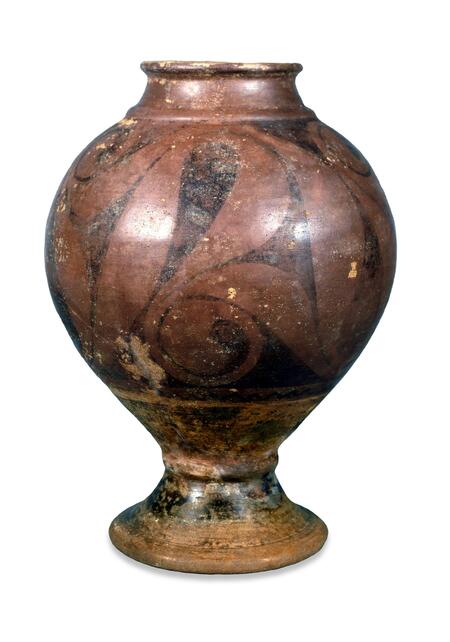
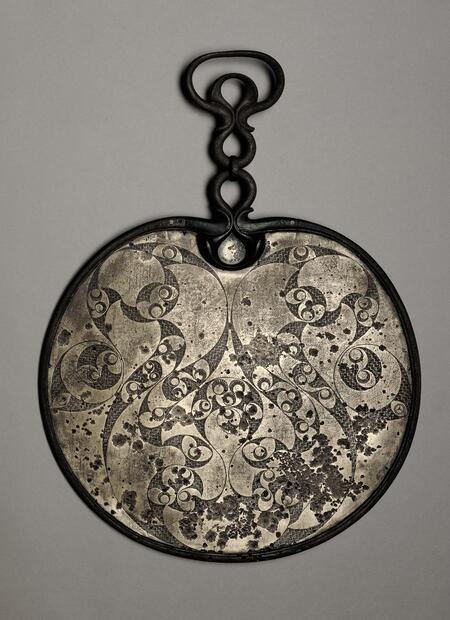
Unknown master. Pryene vase, circa 400–350 BCE (Early La Tène). British Museum, London. Unknown master. Desborough mirror, circa 50 BCE–50 CE (Late La Tène). British Museum, London.
The patterns of that period were not merely decoration or image borders; rather, they often played a significant role. Motifs could intertwine with the central composition, emphasizing its details, or they could become the primary feature of the work.
The ornamental traditions of Latin culture developed and were primarily applied in decorative and applied arts: patterns are found on bronze and gold items, ceramics, jewelry, and so forth.
Fundamental Principles of Ornamentation
The most characteristic elements of Late Antique decorative art are spirals, volutes, and natural forms. Masters could simplify, stylize, and geometrize these elements, significantly altering their appearance. The zoomorphic elements deserve special mention—animals often featured fantastic and unusual outlines and merged with other forms. Thus, the fundamental principles of Late Antique art were based on combining and reinterpreting existing forms and motifs.
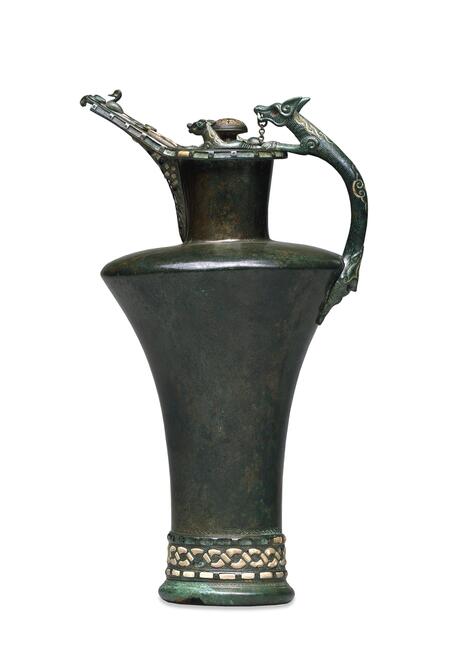
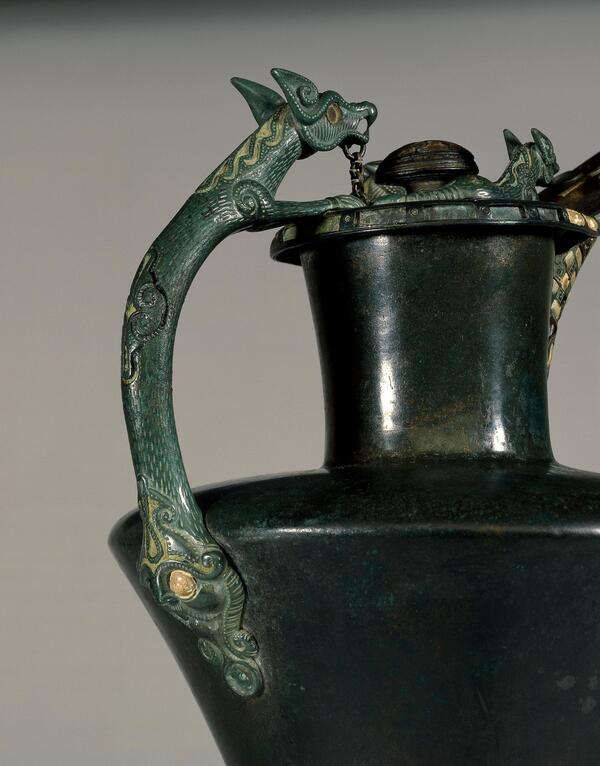
Unknown master. Jugs from Bas-Yuca. c. 450–400 BCE (Early La Tène). British Museum, London.
Not only the form of the ornaments but also their compositional arrangement played a significant role in late antique art. The ornament could conform to the contours of the object or transform and subordinate it to its own form.
Symmetry and the rhythmic alternation and repetition of elements were used to build compositions. However, this was not a strict rule, and masters could deviate from it while maintaining balance. The ornament’s composition was often divided into several zones and parts, each serving a distinct function and carrying its own motif.
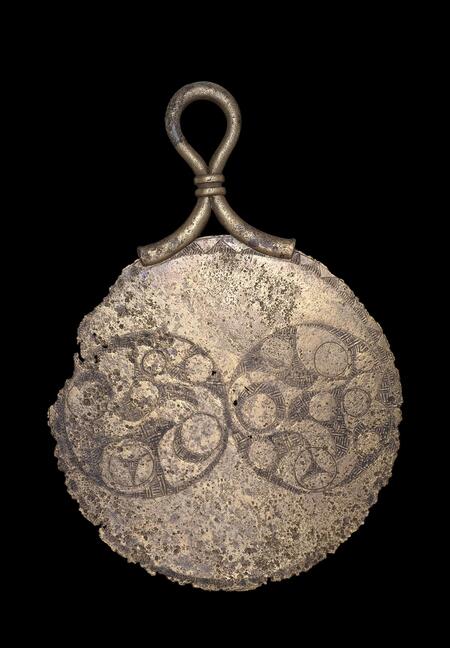
In the St. Kevern mirror, two symmetrical oval fields are present, yet each possesses its own unique composition. Although the elements in the different fields are similar and share many repetitions, they exhibit varying arrangements and applications.
Unknown artist. St. Kevern mirror, c. 120–80 BCE (Late La Tène). British Museum, London.
The Evolution and Transformations of Ornamental Art in the Transitional Period
As the Roman Empire expanded and spread, local artistic traditions of the Latin culture mingled and transformed under the influence of new technologies and object types. New resources emerged through trade routes, and Roman culture introduced different kinds of pottery, jewelry, and other decorative and applied art pieces.
Familiar compositional motifs—spirals, scrolls, and stylized depictions of natural forms and animals—continued to be actively used by artisans, but now they combined with new artistic principles.
Unknown artist. Staffordshire Bowl, mid-2nd century AD (Roman-Celtic art). British Museum, London.
A striking example is the Stafford Bowl—decorated with colorful inlays, it blends local Celtic forms and stylization with a Latin inscription that functions as a kind of boundary ornament.
German Influence: Origins and Diffusion of the Animal Style
As the Western Roman Empire neared its decline, the influence of its culture waned, and Germanic peoples gradually began to assume greater importance in Western and Central Europe.
Alongside the growing influence of German culture, this impacted Celtic ornamental traditions. Stylized animal imagery held a particularly prominent place. Among the most influential and significant trends was the animal style.
This style combined elongated animal forms, the intertwining of their bodies, and the transformation from one shape to another. This rendered the animal depictions into complex ornamental compositions, where the familiar contours of the animals were sometimes difficult to discern.
Unknown artist. Sutton Hoo shoulder clasps, circa 560–610 AD (Early Middle Ages, Early Anglo-Saxons). British Museum, London.
A prime example is the gold shoulder clasps from the Sutton Hoo burial. Intertwining serpentine creatures and two boars form a complex ornamental composition, where the outlines of individual animals are difficult to discern.
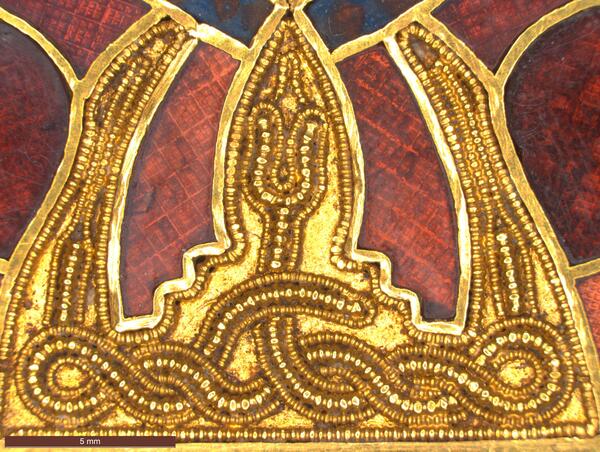
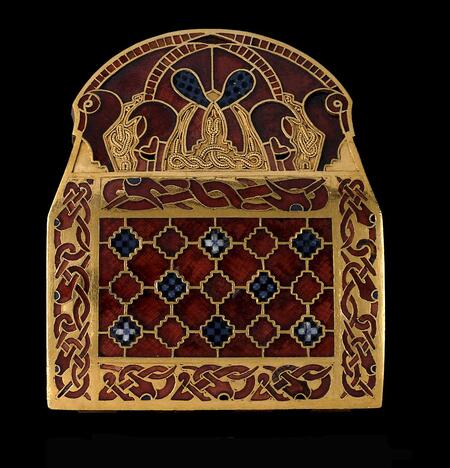
Unknown artist. Sutton Hoo shoulder clasps, circa 560–610 CE (Early Middle Ages, Early Anglo-Saxons). British Museum, London.