Concept
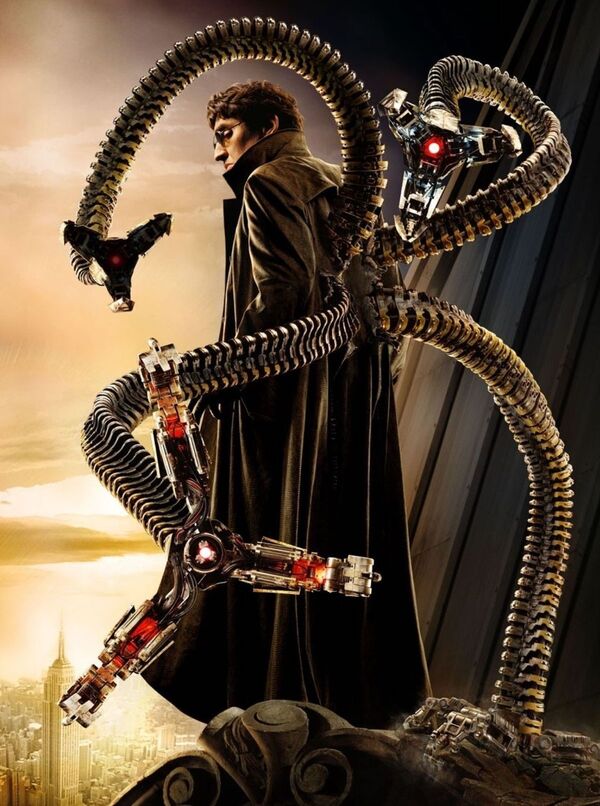
Doctor Octopus’s tentacles are not merely a dramatic element of the villain’s design or a showcase for computer graphics capabilities; they represent a fundamental technological construct of the film. This construction dictates how the character is produced, determines the physical believability of his on-screen actions, and shapes his interaction with the actor. The choice of technology for creating the mechanical limbs was one of the film creators' key decisions—a decision comparable in significance to choosing a genre in literature or a composition in painting. The technology used to materialize the tentacles sets the rules for the interaction between physical and digital material, generates unique production challenges, and draws the line between two eras of filmmaking: the practical and the digital. It is for this very reason that Spider-Man 2 and Spider-Man: No Way Home were chosen for comparison; in these films, the tentacles solve the same set of on-screen problems, and against this backdrop, the evolution of the production logic for creating the same object over seventeen years becomes strikingly clear.
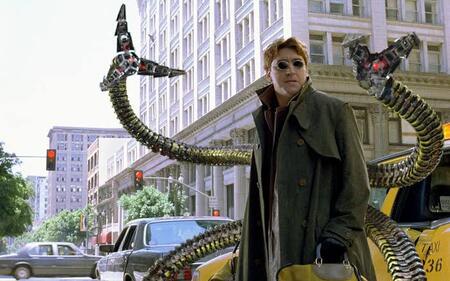
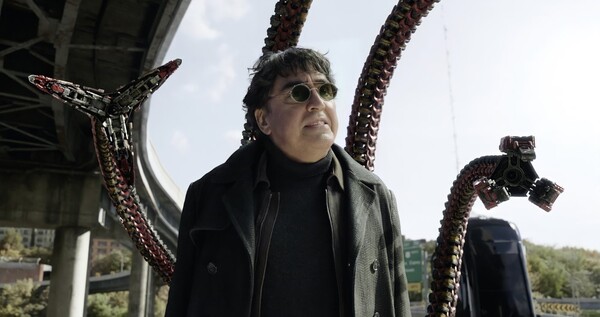
Doctor Octopus from the films Spider-Man 2 (2004) and Spider-Man: No Way Home (2021)
Introduction
The external look of Doctor Octopus in Sam Raimi’s «Spider-Man 2» and Jon Watts' «Spider-Man: No Way Home» is based on the same principle: four mechanical limbs attached to Otto Octavius’s back function as independent manipulators. They support the character’s weight, move him through space, grip objects, attack opponents, and interact with the environment. However, behind this outwardly similar construction lie two vastly different production approaches. Seventeen years passed between the films—a period during which capabilities in computer modeling, animation, rendering, and digital compositing advanced significantly. For this research, the more important aspect is not the emergence of more sophisticated software itself, but how the tasks were redistributed between the physical object and its digital counterpart.
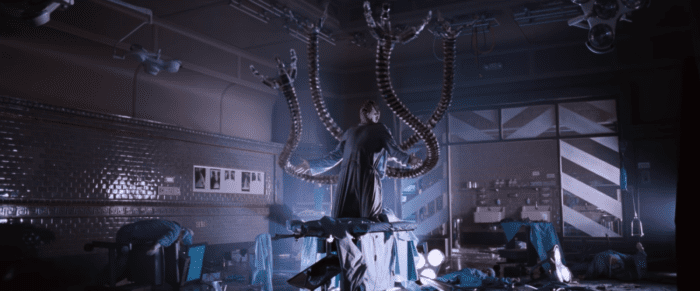
Autonomous manipulators in action. Source: Horror Obsessive.
«Spider-Man 2»: Physical Tentacles and Their Digital Equivalents
One of the primary production challenges for «Spider-Man 2» was creating four massive, mechanical appendages that needed to look not like costume elements, but like independent pieces of technology. The tentacles required complex mobility: they had to bend, extend, hold objects, brace against surfaces, and propel Otto Octavius, all while maintaining the visual integrity of the structure even during fast movement.
The problem was solved using physical puppet constructs created by Edge FX. Unlike standard, static props, these constructs are designed for real-time control during filming: they were placed next to Alfred Molina, used for genuine interaction with the actor, and integrated into the frame’s composition. The key advantage of this approach is that the mechanical limbs exist in the physical space of the set—they cast real shadows, overlap the actor and other objects, possess genuine volume, and interact with surrounding items.
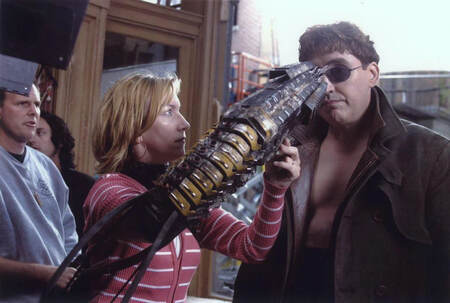
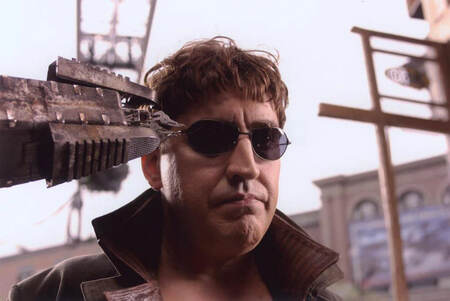
Practical mechanical construction on a film set (2004).
The practical system also had a severe limitation—control complexity. According to the article «Another Big Leap» in Computer Graphics World, controlling four tentacles required sixteen operators—four people per construct: each tentacle was a complex, articulated object whose movement had to be coordinated simultaneously with the actor’s actions and camera operation. Furthermore, the physical tentacles could not arbitrarily change their length; if a significant lengthening was required during a shot, other sections of the construct had to be used, and sometimes the tentacle parts had to be changed right in the middle of the shooting day.
Operators in blue suits control tentacles against a chroma key background. Source: Puppet Wiki — Fandom.
The construction is especially convincing on screen where the tentacles are near the actor or directly interacting with objects: the physical presence of the object provides natural overlaps, contact shadows, and correct spatial relationships between the appendage and the human body. However, a mechanical system has a limit dictated by its own dimensions and design: movement depends on the ability to perform overly complex or large-scale actions, causing the practical design to cease being a universal solution.
Digital Model: Structure and Geometry
The range of motion required by the script could not be achieved with practical constructions, so parts of the scenes were rendered using computer graphics. Sony Pictures Imageworks was responsible for the digital tentacles, and the structure of the computer model itself became a crucial part of the development. According to Peter Noffz, who oversaw the creation of the digital assets in the studio, the tentacle was built as a sequence of individual vertebrae strung on an internal cable, similar to beads on a string—this is the structure that conveys the characteristic segmentation of a mechanical limb. Inside the digital construction were cables capable of contracting and extending; these changed the position of individual segments and created additional oscillations during movement. Thus, the tentacle was not simply a flexible tube bending along an arbitrary trajectory—its geometry imitated a complex mechanical object assembled from numerous connected elements.
Official VFX breakdown from Sony Pictures Imageworks: from wireframe to final render. Source: before & afters.
For modeling, a subdivision surface method was employed: this approach allows for the creation of a smooth final form based on relatively simple initial geometry while still accommodating complex segmented construction. Computer Graphics World specifically noted that NURBS proved inconvenient for this model precisely because of the geometric complexity, leading the team to select the subdivision approach from the outset. The termini of the tentacles also played a significant role—the lower limbs bore grips, and the upper limbs featured characteristic mechanical components with surveillance cameras. This design necessitated not only geometry but also an animation system capable of independently controlling the position of each segment.
The difference from the physical version is fundamental here. If the movement of a physical mechanism is dictated by the real constraints of the machinery, the digital model allows control over every segment of the limb: the animator sets complex trajectories, changes the degree of bend, controls the oscillation and speed of individual parts. Furthermore, the digital model retains the structural principle of the physical original, and this is critical for authenticity—the viewer sees not arbitrary computer animation, but the operation of a mechanism assembled from individual metal components.
Separation of practical and digital tasks
Robertson B. Another Big Leap // Computer Graphics World. 2004. Vol. 27, No. 7.
Spider-Man 2 // Cinefex. 2004. No. 99.
Winchester H. Behind the Scenes of Spider-Man: No Way Home // Chaos. 2021.
Hogg T. Digital Domain Helps 'Bridge' the Multiverse in 'Spider-Man: No Way Home' // Animation World Network
Failes I. Behind the scenes of the biggest effects in 'Spider-Man: No Way Home' // befores & afters.