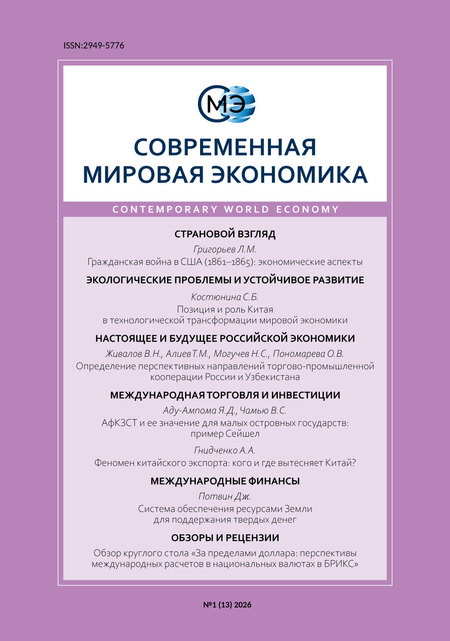
CONTEMPORARY WORLD ECONOMY, VOLUME 4, ISSUE 1 (2026)Andrey Gnidchenko, CMACP; INP RAS; HSE https://orcid.org/0000-0002-0678-8324DOI: https://doi.org/10.17323/2949-5776-2026-4-1-91-107Keywords: exports, goods, China, decomposition, concentration
The article examines structural changes in China’s exports from 2019 to 2024.
In addition to relatively straightforward tasks—such as identifying leading goods in China’s share growth in global exports, determining countries being displaced from the global market by China, and identifying countries with a marked increase in reliance on Chinese imports—the analysis also addresses several more complex analytical challenges: assessing changes in the geographic concentration of Chinese exports for the fastest-growing commodities, decomposing China’s export growth by changes in physical volume, pricing, and structural shifts, and regression-evaluating the factors driving the world’s increasing reliance on imports from China. All calculations are based on the CEPII BACI database, which consists of adjusted UN Comtrade data on foreign trade, harmonized to eliminate reporting discrepancies across partner countries.Several key findings were obtained. First, structural changes in China’s exports are linked to a narrow range of fast-growing export goods, including materials, electronics, vehicles, and machinery. Second, the analysis shows that in these product categories, China has partially displaced exports from countries such as Japan, South Korea, Taiwan, EU nations, and Russia. Third, a phenomenon of accelerating growth in China’s physical export volumes compared to their value volumes during 2023–2024 was discovered and explained: the contributions of structural shifts and price decreases to this process were nearly equal. Fourth, for the fastest-growing items in Chinese exports, there was an observed increase in geographic concentration, which runs contrary to the overall trend toward diversification. Fifth, the deepest increase in dependency on imports from China is characteristic of countries in the «Eastern Bloc» (Russia, Vietnam, Mexico).Finally, besides the importing countries' geopolitical bloc affiliation, their sanctions status and the share of fast-growing goods (based on the criterion of increased contribution to China’s global exports) in imports from China also influence the growth of dependency.