Navigation
- Concept
- The Person and Their Objects
- Private Life in Shared Space
- Traces of Presence
- Conclusion
- Sources
Concept
In my research, I aim to examine how the human figure is constructed in Soviet art through its everyday surroundings. The foundation of this study will be Ilya Kabakov’s installations, contrasted with official painting from the 1970s and 1980s in the genres of portrait and genre scenes. I am interested in the role that a person’s room, belongings, and relationships with others play in narrating their story. How does this narrative shift when the protagonist cannot be visually present?
I pay particular attention to Kabakov’s «Ten Persons, ” presented in 1988. In the rooms of these fictional residents, objects, notes, and external accounts allow us to imagine their habits, desires, and fears. A prime example is „The Man Who Flew into Space From His Room“ (1985). Here, the arrangement of the space and the traces of what happened compel the viewer to reconstruct the story of the absent inhabitant.For comparison, I refer to portraits and everyday scenes featured in official Soviet exhibitions. In these works, I will analyze the figure’s posture, facial expression, gestures, the hero’s activity, and the objects surrounding them. I am interested in how artists depict professions, family relationships, fatigue, or solitude, and the role the interior plays in all of these. This selection will allow for a comparison of different representations of private life within a single era.
A crucial element of the study will be the boundary between the personal and the public. In «Ten Characters, ” a specific room connects to the corridor and kitchen of a communal apartment, and the resident’s story is formed partly through the neighbors’ accounts. I want to explore how space dictates the possibility of privacy and to what extent an individual controls their own image when they are judged by the belongings and words of others. In painting, I will seek solutions to these same questions through the placement of figures and the composition of the scene.
My hypothesis is that in Kabakov’s work, the viewer is granted greater freedom in constructing the character’s image. The viewer synthesizes disparate pieces of information, notices contradictions, and decides which details to believe. To test this assumption, I will correlate the common types of rooms, their details, and accompanying texts with the paintings' compositions. I will also examine how lighting and the possibility of entering a room affect our perception of its occupant. Crucially, I must consider that the narrative of the absent inhabitant is pre-constructed by the artist.
My goal is to investigate how a room can function as a portrait and what it allows us to learn about a person. By comparing it with formal painting, I aim to understand how the depiction of private life and the viewer’s role in interpreting it have evolved.
Human and Their Possessions
Objects help tell a story about a person through their activities, habits, and attachments. A piano, a family photograph, or a saved letter all reveal different things about their owner. Equally significant is how these items are arranged, how much space they take up, and how visible the traces of daily life are among them.
For comparison with Kabakov, works by Tair Salakhov and Tatiana Nazarenko have been selected—both participated in the official art life of the USSR. Their pieces allow us to trace how surrounding objects complete the human figure in portraiture and daily life scenes.
Objects and the Human Condition
Tair Salakhov. «Portrait of Shostakovich.» 1974–1976. Canvas, oil.
In the portrait of Shostakovich, a dark piano dominates almost the entire background. Papers and a red pencil rest on it. These details are enough to denote the composer’s occupation. His hands are resting on the seat, and his gaze is directed to the side. His light-colored shirt sets his figure apart from the instrument and compels the viewer to examine the posture of his shoulders, face, and hands more closely.
The subjects connect Shostakovich to his work, while his posture and facial expression allow one to gauge his emotional state.
Salakhov depicts a person in a moment of intense focus. The piano helps to interpret this pause amidst routine activity. The room’s space is presented fragmentarily, and the viewer’s attention is drawn to the seated figure.
Ilya Kabakov. «Composer.» 1988. View of the installation at Ronald Feldman Fine Arts Gallery, New York. Photograph by D. James D.
In Kabakov’s «Composer, ” the conception of the hero centers around a series of easels. Across the history of the character, every Sunday, he arranges them in the hallway of a communal apartment, laying out grey sheets bearing drawings and texts. This repetitive action becomes his defining characteristic.
In the photograph, the tilted surfaces of the easels form a chain receding into the darkness. We can imagine the movements of the person who placed them and spread out the papers. His activity assumes a visible form through the objects left behind.
Ilya Kabakov. Drawing for the installation «Composer.» 1996.
In his work for the installation «Composer,» Kabakov depicts neighbors gathered in a hallway. They stand in a tight group, raising their arms, and turning toward one another. Music stands occupy the space used by all residents. The neighbors' animated gestures can be read as an expression of discontent. Under this reading, the composer appears as a person who persistently continues their practice despite the reaction of those around them.
Things and a circle of loved ones
Tatyana Nazarenko. «Moscow Evening.» 1978. Canvas, oil.
In «Moscow Evening,» Nazarenko depicts a gathering of friends. Musical instruments, photographs, and old publications help to reveal what unites the assembled group. The meeting acquires its own history through the objects the people observe, cherish, and bring with them.Superimposed over the figures is the image of an 18th-century lady—Elizabeth Cherevina, taken from a portrait by Grigory Ostrovsky. This image connects the contemporary gathering with a past that interests the characters. The objects in the foreground continue this connection.
These objects characterize the relationships between people. Friends share an interest in music, old photographs, and memories of the past. However, each maintains a separate pose and gaze direction. A connection is formed through shared interests and time spent together.
Objects as Personal Narratives
Ilya Kabakov. Drawing for the installation «The Man Who Never Threw Anything Away.» Date unknown.
In this room, fragments of paper, packaging, and small objects are given individual spaces and labels. The act of collecting becomes a way to hold onto lived experience. In his author’s commentary, Kabakov links the saved scraps to memories of events in his own life.
Ilya Kabakov. «The Man Who Never Threw Anything Away.» 1988. View from the Modern Art Museum, Oslo, 1995.
The recurring cells, stands, and labels reveal a sequence of the owner’s actions. They collects, organizes, and describes the findings. By observing the room’s arrangement, one can envision the time this work requires and the attention dedicated to every minute detail.
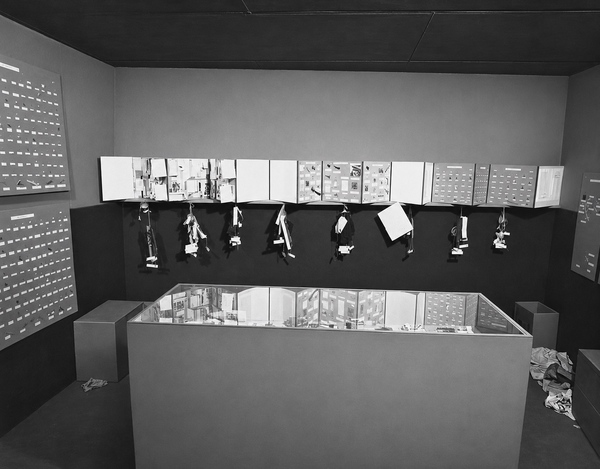
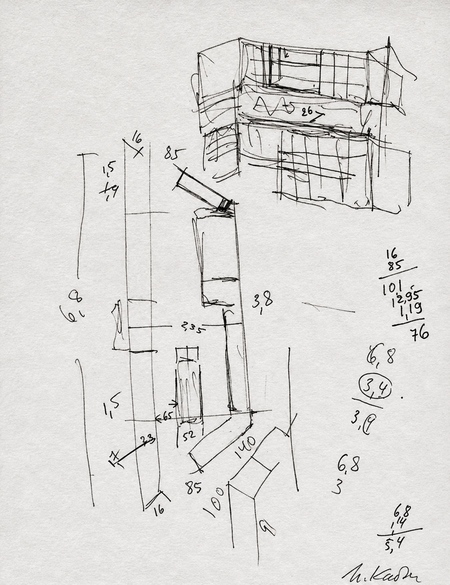
1. Ilya Kabakov. «The Man Who Never Threw Anything Away.» 1988. Exhibit view at the Hirshhorn Museum, Washington. Ilya Kabakov. 2. Plan with dimensions for the installation «The Man Who Never Threw Anything Away.» No date.