Контент для медиа
«Ключ к тайне»
Media Concept
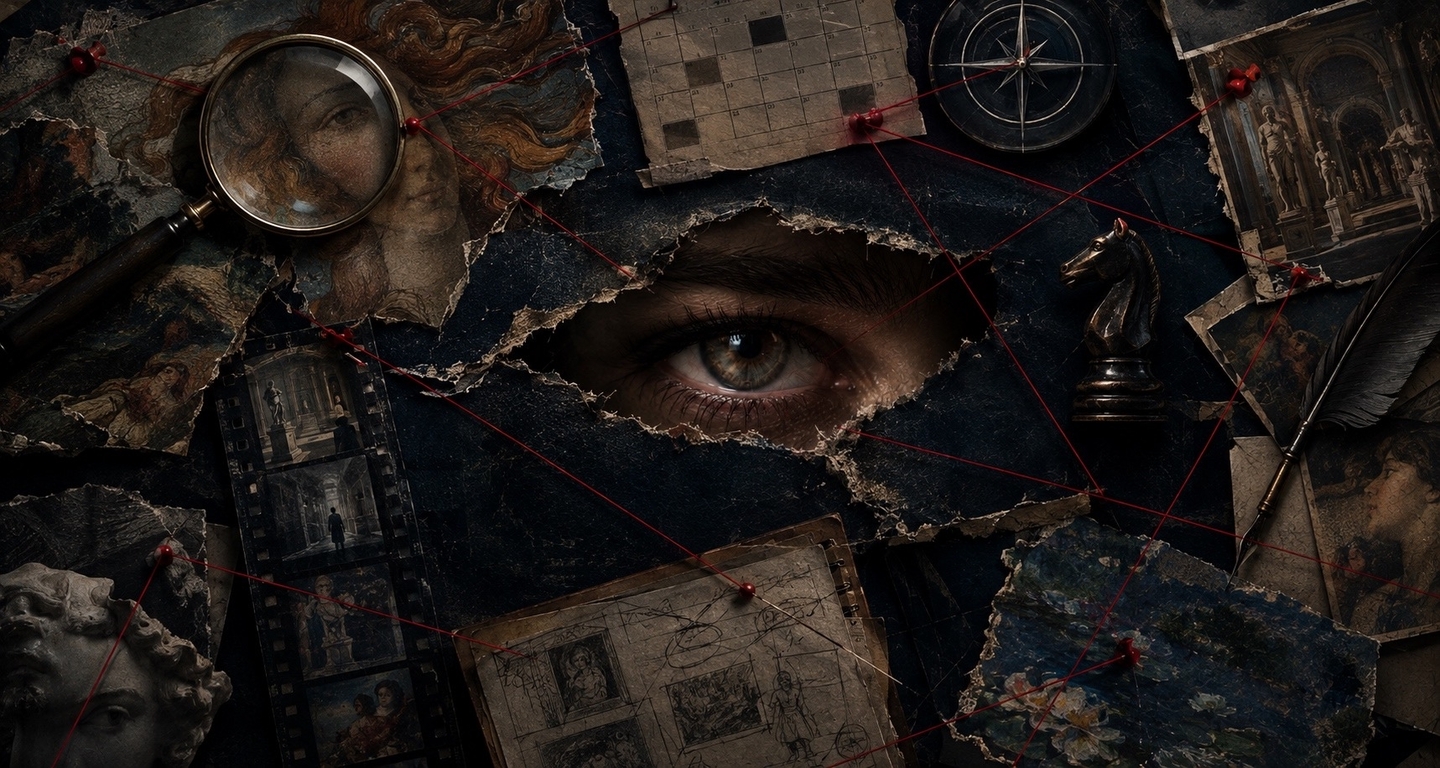
The media series «Key to the Mystery» consists of short, vertical videos in which a familiar classic painting transforms into a detective story: the viewer is presented with three or four «clues, ” hidden symbols, and an unexpected resolution that allows them to see what they have overlooked for years. The project’s core goal is to deliver a sense of intellectual discovery in just 40 seconds—and provide a reason to share it with friends. It exists because the niche of „art as mystery“ is currently served only by text-based channels and long lectures, whereas short, structured detective videos like ours are missing. We are filling that gap using museum archives and an automated production pipeline.
Half-Yearmatic Plan
Primary Goal for the Semester: To capture the «art detective in short video» niche, acclimate the audience to a detective tone of voice (clues, suspects, resolution), and achieve a consistent completion rate of 70–80%.
Pacing: One video per day (30 per month). Cross-posting: TikTok, Reels, Shorts, VK Clips. Telegram—for archiving and retention.
Month 1: «The Case of the Familiar Canvas» (Launch and Legitimation)
Goal: To test the format using the most recognizable paintings so that algorithms quickly understand who to show the content to. We are lowering the barrier to entry.Focus: The most famous masterpieces that the viewer has seen hundreds of times but overlooked the details. Episode Examples (Script Topics): · «Mona Lisa»: Why does she have no eyebrows? (Clue 1: era fashion. Clue 2: sfumato technique. Clue 3: eyebrow loss during restoration. The revelation). · Van Gogh’s «Starry Night»: What is hidden behind the swirls? (Astronomical data, religious context). · Bryullov’s «The Last Day of Pompeii»: Hidden faces in the background. · Serov’s «Girl with Peaches»: The symbolism of color and time of day.Tone of Voice: «You’ve looked at this for years. It’s time to see the truth.» Special Task: In the first three seconds of every video, provide a «hook» (the strangest detail in the painting).
Month 2: «Symbols You Missed» (Classroom Training)
Goal: To introduce the audience to the vocabulary items «clue, ” „decryption, ” and „suspect.“ To show that we are not just presenting facts, but a system.
Focus: The language of symbols—animals, flowers, gestures, and objects. Episode Examples: — „The Suspect: The Dog.“ How dogs in paintings indicate infidelity or loyalty. — „The Clue: The Mirror.“ Reflections that lie (Van Eyck, Velázquez). — „The Hidden Language of Flowers.“ What lilies and roses truly signify in paintings. — „The Anatomy of the Gesture.“ Why characters’ hands are positioned so strangely.
Tone of Voice: „Turning on the lie detector. The artist left us a message.“ Special Task: To create a series of videos with a recurring segment title, „Clue #1, Clue #2…“ to achieve recognition through editing.
Month 3: «Double-Edged Portraits» (Status and Aesthetics)
Goal: To attract the target audience segments «Margarita» (32, who values aesthetics and status) and «Elena» (45, who wants to get to the truth).
Focus: Grand portraits where a political or personal subtext lies beneath the beautiful exterior. Examples of episodes: · «The Arnolfini Portrait»: Is she pregnant? Or is it just fashion? · Goya’s «Portrait of Charles IV»: Who are the real monsters here? · «The Secret of the Blue Ribbon»: The symbolism of orders and secret societies. · «Eyes That Watch You»: Optical illusions in portraits.
Tone of Voice: «A beautiful picture is just a facade. Let the interrogation begin.» Special task: Add more detail and close-up shots (macro) to the visuals. Link in Telegram to the «full case» with sources.
Month 4: «Myths and Debunking» (Virality and Sharing)
Goal: Maximum reach and direct message (DM) forwarding. Debunking popular myths.
Focus: Paintings steeped in legend. We either confirm them with facts or expose them. Episode examples: — «The Painting’s Curse»: Why did the Mona Lisa only become famous after the theft? — «The Bloody Countess»: What does the portrait of Elizabeth Báthory hide? — «The Smile Mystery»: Neural Networks vs. Leonardo. What does AI see? — «The Upside-Down Painting»: Secrets visible only from a different angle.
Tone of Voice: «The official story lies. We found the proof.» Special Task: Provocative headlines that are impossible to ignore. An active call to discussion in the comments («Do you see it too?»).
Month 5: «Interactivity and Conspiracy» (Engagement)
Goal: To transform the viewer from an observer into a participant in an investigation. Increase comments and retention.
Focus: Paintings with ambiguous interpretations. We provide the clues, but we invite the viewer to draw their own conclusion (or choose one of two possibilities). Examples of segments: · Bosch’s «Garden of Earthly Delights»: Heaven, hell, or code? (Analysis of the three strangest details). · Munch’s «The Scream»: What is written in the painting? (The inscription riddle). · Malevich’s «Black Square»: What lies beneath the top layer? (X-rays). · «Secret Symbols»: How to distinguish a forgery from an original based on details.
Tone of Voice: «You have all the evidence. What is your verdict?» Special Task: Launch the segment «The Subscriber Investigates”—we select a painting based on requests from the comments.
Month 6: «Art Detective: Special Issue» (Scaling and B2B)
Goal: To establish expert status and prepare the groundwork for partnerships with museums and brands.
Focus: Museum archives, rare artifacts, and closed collections. We reveal the «inner workings» of art.
Episode Examples: · «What are the halls of the Hermitage hiding?» An analysis of a painting from the storage collection. · «Restoration as Detective Work.» What is discovered beneath layers of paint. · «Secrets of the Louvre»: Beyond the Mona Lisa. · «Banned Symbols.» Paintings altered due to censorship.
Tone of Voice: «Welcome to the inner sanctum. Only verified facts.»
Special Task: Announce a collaboration with a museum or brand (if an agreement can be reached). The «Full Story» episode will be released in Telegram as a long-form article.
Plan:
Content Sources: Museum archives (open data), Wikipedia, art historical articles.
Script Template: · 0–3 sec: Hook (strange detail/question). · 3–15 sec: Clue 1 + Clue 2 (dynamic montage, zoom on details). · 15–30 sec: Clue 3 (red herring or unexpected twist). · 30–40 sec: Reveal + Share Call to Action (DM).
Distribution: · VK Clips: Focus on the 15–30 sec version (the algorithm favors short content). · TikTok/Reels: Full 40-sec version. · Telegram: Post with video + accompanying text «Case File» (with source links).
Analytics (KPIs): · Primary Metric: % completion rate (target 70–80%). · Secondary Metric: Number of shares (Shares/DM). · Tertiary Metric: Clicks to Telegram (retention conversion).
Never let the detective tone drop. Even if the solution is simple, the presentation must be as compelling as the best detective series.
10 content samples
Issue 1: «Mona Lisa"—A Smile That Doesn’t Exist
Visual sequence (editing script):
0–3 sec: Close-up of the Mona Lisa’s smile. A sharp zoom in on the lips. Anxious music. A red target reticle on the corner of the mouth. 3–12 sec: Diagram of facial muscles. An anatomical diagram is overlaid onto the face. An arrow points to the left corner of the mouth. 12–22 sec: A divided face. The left half of the face separates from the right. The left side is smiling. The right side is neutral. 22–32 sec: Close-up of the eyes. Zoom in on the eyes. Slow movement as the smile «fades away.» 32–45 sec: Full portrait + final text. On-screen text: «You have never seen her real.»
Example frame (in horizontal format — for presentation)
Voiceover Text:«Before you is the most famous smile in history. But what if it doesn’t exist?Clue one: Leonardo da Vinci used the sfumato technique—a deliberate blurring. The corners of the mouth and the eyes are rendered in such a way that the human eye cannot focus on them simultaneously.Clue two: Scientists conducted an experiment. They divided the face into left and right halves. The left side expresses happiness; the right side is neutral.Clue three: In 2015, French researcher Pascal Cott, using layer amplification methods, discovered another portrait beneath the top layer of paint—a woman without a smile, with a larger head and thinner lips.The revelation: Leonardo did not paint a smile. He painted movement. The Mona Lisa’s smile is an optical illusion created by your own brain as it tries to 'assemble' conflicting signals into a single image. You look at it and don’t see it. Because it isn’t there.Now, look again. Do you still see the smile?»
Issue 2: «Starry Night» — Astronomical Cipher
Visuals:
0–3 sec: Wide shot of «Starry Night.» Overlaid with a coordinate grid. Red dots on the stars. 3–12 sec: Zoom into the swirling sky. Slow motion. Glowing lines «outline» the constellations. 12–22 sec: Cypress tree in the foreground. Zoom onto the dark tree. Outline of the flames is overlaid. 22–35 sec: Comparison with an astronomical map. Painting on the left. Map of the Aries constellation on the right. 35–45 sec: Final shot. Text: «He saw what no one else saw.»
Example frame
Narration Text:«Did Van Gogh paint this in an asylum? Or not?Clue one: look at the sky. Eleven stars. This isn’t chaos; it’s a reference to the eleven stars of the Old Testament. Joseph’s dream, where the sun, moon, and eleven stars worship him.Clue two: researchers compared the arrangement of the stars in the painting with astronomical data. They found a match with the actual position of Venus and the constellation Aries on the night Van Gogh looked out the window of the Saint-Rémy sanitarium.Clue three: the cypress. A massive tree that cuts across the sky. Van Gogh himself wrote to his brother: „These cypresses resemble black notes leaping across a sunny landscape. These black notes are simultaneously divine.“ The cypress in Mediterranean tradition is a symbol of eternal life and death.The revelation: Van Gogh wasn’t painting a landscape. He was painting his position between heaven and earth. The cypress—that was himself: rooted in the dark earth, and his crown, in the starry sky. The sky isn’t a landscape. It’s a message: „I am still here. I am still looking up.“He was in the sanatorium. But he was looking at the stars that Joseph saw.»
Issue 3: «The Last Day of Pompeii”—A Coded Shift of Eras
Visual sequence:0–3 sec: Wide shot of the painting. A sharp zoom in on the central group. 3–12 sec: Pagan priest. A red border surrounds the priest’s figure. Text: «Suspect #1» 12–22 sec: Christian cleric. A blue border surrounds the cleric. Text: «Suspect #2» 22–32 sec: Identical female faces. A slow panorama highlighting three recurring faces. 32–45 sec: Final shot. Text: «The painting they would ban.»