Navigation
- Concept
- History of the Creation of the Cross of Euphrosyne of Polotsk
- Structure of the Cross: Form, Proportion, and Materials
- Jewelry Detailing of the Cross
- Iconography of the Cross
- Loss of the Original and Cultural Memory
- Bibliography
- Image Sources
Chapter 1. Concept
Rationale for Topic Selection
The Cross of Euphrosyne of Polotsk, created in 1161 by the master Lazar Bogshey, is a complex work of art that combines jewelry craftsmanship, depictions of saints, inscriptions, and relics. For design research, it is interesting as an example of an integrated system where structure, materials, and visual design are linked to the object’s function. The original cross disappeared in 1941, so its initial appearance is studied through historical photographs, descriptions, and reconstructions. This allows us to examine how the image of the lost object is preserved and continues to exist within the cultural memory of Belarus.
Material Selection Principle
The primary visual material for this study is a 3D reconstruction of the cross. This allows for the examination of its form, proportions, structure, and the placement of decorative elements from various perspectives. Photographs of the original and historical descriptions are used to verify the accuracy of the reconstruction. During the analysis, documented details, elements restored based on indirect evidence, and hypothetical solutions are noted separately. Custom diagrams that reveal the object’s composition and structure are also utilized. Contemporary images of the cross are considered within the context of its reconstruction and the preservation of its cultural significance.
The Principle of Rubrication
The research moves from the material structure of the cross to its artistic and symbolic content. It sequentially examines the history of its creation, form and proportions, construction, materials and jewelry techniques, the depictions of saints on the obverse and reverse sides, inscriptions, and relics. The concluding section is dedicated to the loss of the original, its reconstruction, and its role in modern Belarusian cultural memory. This structure allows for a progression from studying individual elements to understanding their interconnectedness.
Principle of Selecting and Analyzing Textual Sources
The sources are divided into four groups: historical publications and descriptions of the cross, studies on inscriptions and Old Russian language, works on jewelry art and enamel techniques, and materials on cultural memory and monument reconstruction. Priority is given to sources that contain direct information about the cross. Factual claims regarding the images, materials, and inscriptions are cross-referenced with independent publications. Special attention is paid to distinguishing historically verified information from authorial interpretations. The data for the reconstruction is verified using photographs and descriptions of the original artifact.
Key Question
How do the structure, jewelry technique, depictions of saints, and inscriptions form a unified artistic and semantic system in the Cross of Euphrosyne of Polotsk, and how is its visual image preserved in the cultural memory of Belarus after the loss of the original?
Hypothesis
The Cross of Euphrosyne of Polotsk can be viewed as a single visual text where the structure, imagery, inscriptions, and relics complement one another. The obverse forms a prayer composition centered on the image of Christ, while the reverse unites the images of saints, apostles, and holy figures whose relics were kept within the cross. The inscriptions elucidate the meaning of the images, provide information about the creation of the object and its holy relics, and the jewelry technique gives the entire system its material and visual form. It is presumed that the interrelation of these elements defines the artistic integrity of the cross. Despite the loss of the original, its image continues to exist through photographs, historical accounts, and reconstructions, preserving the significance of an important symbol of Belarusian cultural memory.
Chapter 2. The History of the Creation of the Cross of Euphrosyne of Polotsk
The Cross of Euphrosyne of Polotsk was created in 1161 on the commission of Euphrosyne herself—the abbess and founder of the monastery in Polotsk. She entrusted the work to the local craftsman Lazar Bogshe for the Church of the Savior in the monastery. The date of creation and the craftsman’s name are known thanks to the inscription on the cross, which also links the holy relic to its patron.
Saint Euphrosyne of Polotsk. Icon.
The creation of the cross was a significant event for the monastery: it was intended for religious veneration and was meant to remain in the convent. Thus, Euphrosyne’s commission became not only a religious offering but also a monument to the history of Polotsk and a testament to the high level of local art in the 12th century.
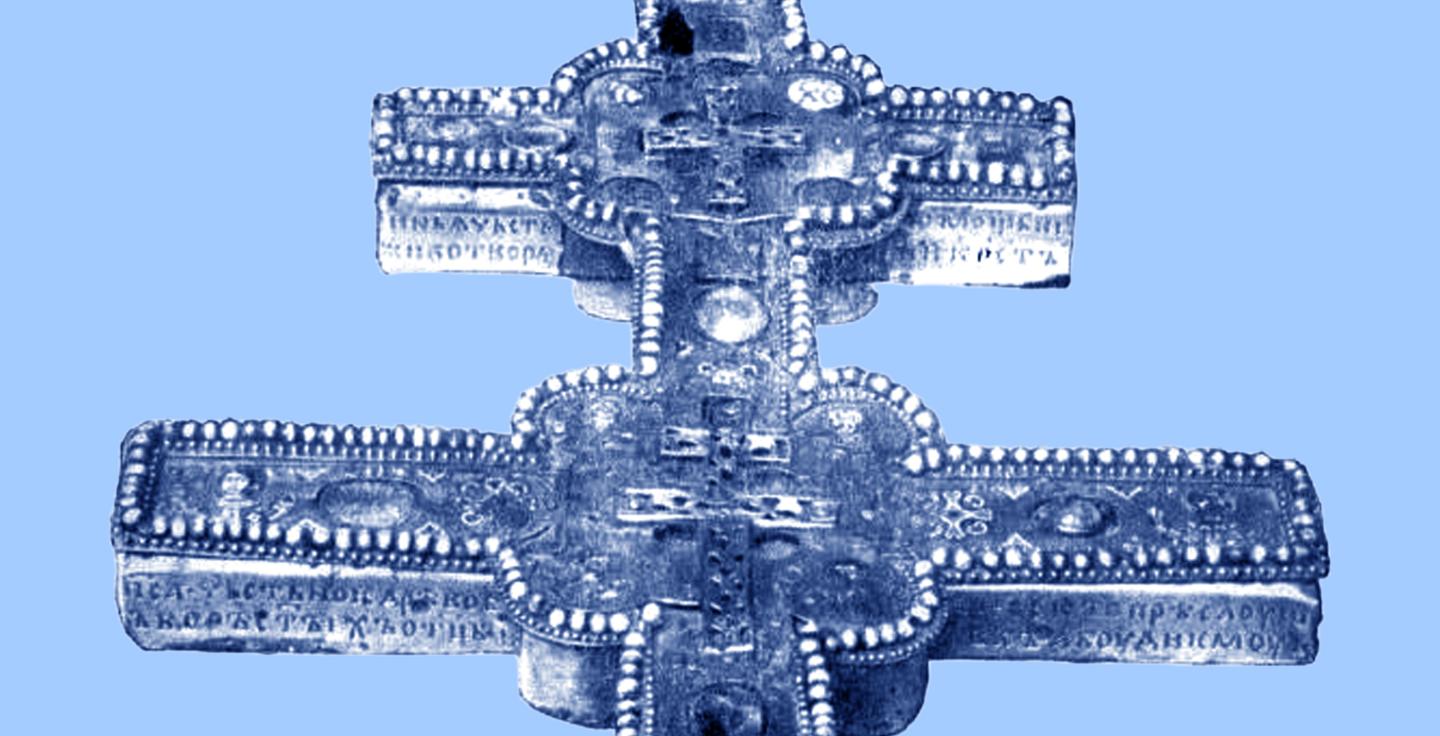
The examination of the jewelry design will begin with photographs from 1896, which capture the cross from both the front and back. These images were taken by I. V. Chistyakov. They are currently held in the archive of the Institute of the History of Material Culture of the Russian Academy of Sciences. These photographs are particularly important because the original cross is lost, and its appearance can be studied through the archival images and later reconstruction.
Cross of Euphrosyne of Polotsk. Front and reverse sides. Photographs by I. V. Chistyakov, 1896. Archive of the Institute of Material Culture History of the Russian Academy of Sciences.
Chapter 3. The Cruciform Structure: Form, Proportion, and Materials
Form and Proportion
The 1896 photographs show a hexagonal altar cross: its vertical shaft is intersected by two horizontal bars. The upper bar is shorter and narrower than the lower one, so the cross’s silhouette is stepped and maintains a pronounced vertical orientation. The total length of the cross was approximately 51.8 cm; the width of the upper bar was 14 cm, and the lower bar was 21 cm. These dimensions demonstrate that the lower section of the composition is noticeably wider than the upper section.
The Cross of Lazarus of Bogush represents the six-bar type: its vertical shaft is intersected by two horizontal crossbars. This form was known in the 12th–13th centuries; L. V. Alekseev noted that it corresponded to the artistic practice of its time [1]. Therefore, the Cross of Euphrosyne of Polotsk was not unique in silhouette, but it masterfully employed a common type for a specific liturgical and memorial object.The form helps organize its surface. The vertical shaft establishes the primary direction of the composition, while the crossbars create additional zones for images and ornamentation. The central intersections—the crossbeams—are accentuated with small applied crosses. As a result, the viewer’s gaze moves sequentially from the upper section to the center and then down the shaft. This compositional structure is particularly important for an object that simultaneously functioned as a prie-dieu cross-reliquary and was covered with numerous enamel images and inscriptions [2].The relationship between the form and the object’s function is also evident in the reliquary’s design: sacred relics were placed in different parts of the cross, and the reverse side featured four indentations for relics [2].The vertical shaft defines the main axis of the Cross of Euphrosyne of Polotsk, connecting its upper, central, and lower sections. Two horizontal crossbars intersect it, classifying the cross as six-bar type. The upper crossbar is shorter than the lower one: its width was approximately 13.3 cm, and the lower one was about 20.6 cm. The total length of the cross was approximately 51 cm [1].The difference in the crossbars' widths is noticeable in archival photographs and in the reconstruction. The upper crossbar occupies a smaller part of the composition, while the wider lower crossbar becomes a prominent horizontal accent. The intersections of the shaft and the crossbars form the crossbeams, where small applied crosses were placed. Thus, the shaft and crossbars form the framework of the composition and divide the surface into areas where images, ornaments, and other decorative elements are situated.
Base and metal cladding
Types of the 3D model of the Cross of Euphrosyne of Polotsk. Model author: Dmitry Tamkovich; model source: Sketchfab, usaria account