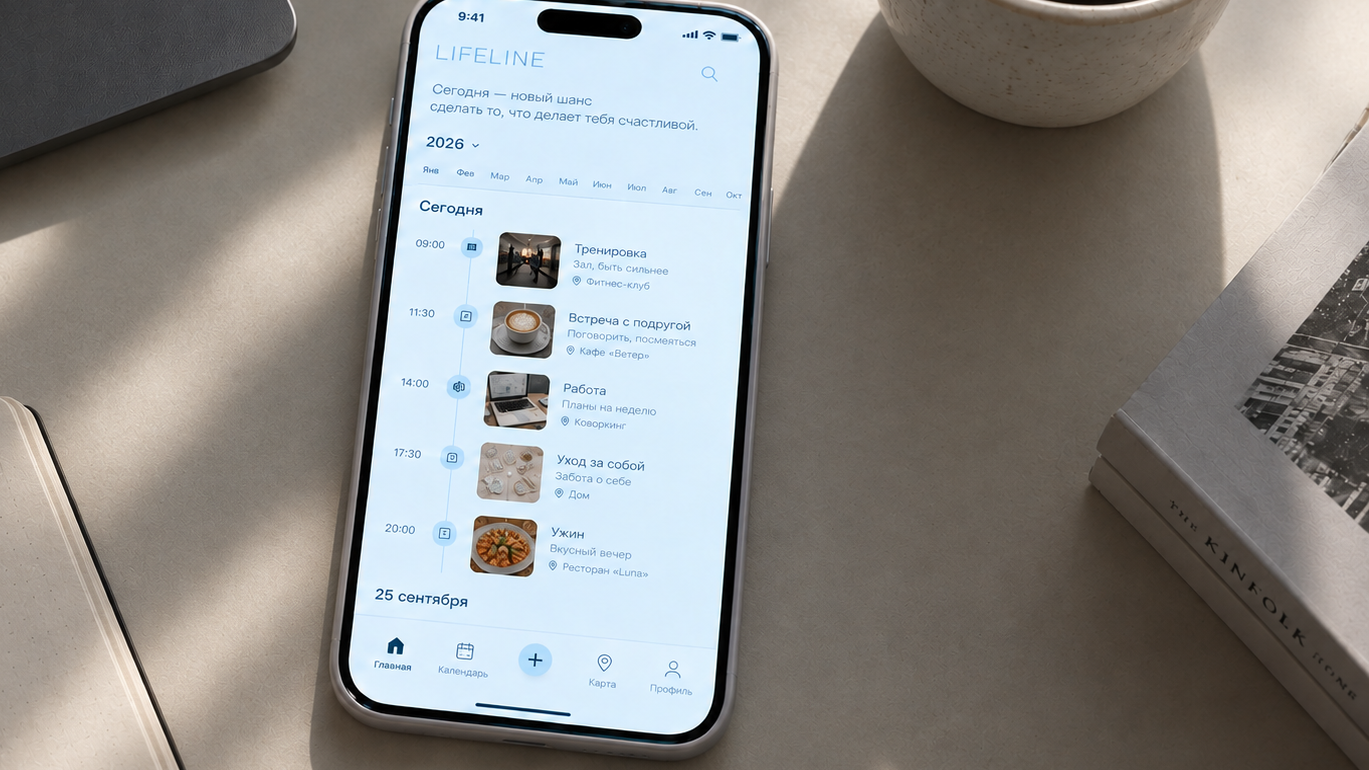
LIFELINE — a social platform and public multimedia diary.
Media Concept
The core idea behind LIFELINE is to reimagine the familiar format of social media. Users do not create individual posts that exist independently; rather, they gradually form a single, continuous chronicle of their life. Every photograph, note, voice recording, or video becomes part of a shared story that evolves with the individual.
If, in traditional social networks, a person usually thinks about what exactly they should post, here the moment of life itself becomes the foundation. The user does not have to invent a separate post or create «perfect content» every time. It is enough simply to save what has happened.
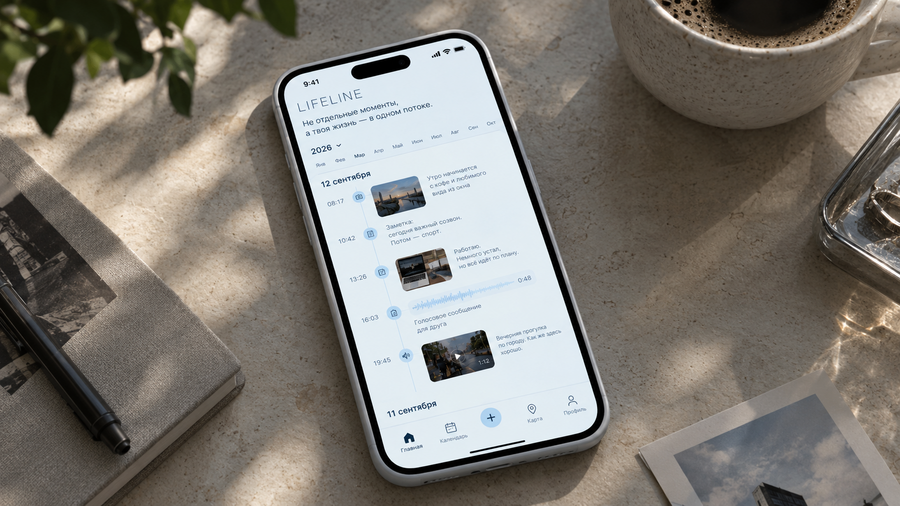
The goal of the LIFELINE media project is to create a digital space where a person’s everyday life can be presented naturally, continuously, and without the pressure of constructing an idealized self. The platform is built around simple and familiar moments: ordinary days, small events, random thoughts, walks, encounters, studies, work, and other details that collectively form a personal narrative.
Users don’t need to turn every moment into separate content or only showcase the highlights of their lives. LIFELINE is a digital diary augmented with photos, videos, audio recordings, and text notes, where ease of publishing, authenticity, and preserving the everyday as it is hold the greatest value.
Six-Month Thematic Plan
The LIFELINE thematic plan is designed for six months and aims to progressively reveal different aspects of daily life through personal entries, photographs, video, and audio materials.
Each month is dedicated to a separate theme, but all publications are united by the project’s overarching idea: preserving a personal chronicle that reflects a person’s events, thoughts, emotions, and impressions.
The first month is dedicated to getting acquainted with LIFELINE and forming the habit of keeping a journal. During this period, the project’s concept is revealed, the value of everyday moments is explained, and participants are encouraged to begin documenting their own lives. The main themes of the posts will be the reasons for journaling, initial entries, and events worth preserving in memory.
The second month shifts focus to daily life. Posts will reflect the familiar rhythm of the day—studies, work, household chores, and morning and evening rituals. The primary goal is to demonstrate that even the most ordinary events can become part of a personal narrative. The material for this period will include notes on the typical day, photographs of morning moments, and entries about days where, at first glance, nothing special seemed to happen.
The third month will focus on people and connection. The spotlight will shine on friends, acquaintances, social gatherings, conversations, shared leisure time, and the small traditions that build personal memories. Publications will help preserve not only the events themselves but also the atmosphere of connection, significant conversations, and moments spent with loved ones.
In the fourth month, the main themes will be thoughts, emotions, and personal interests. This stage involves publishing reflections, observations, impressions from music and books, as well as materials related to creative pursuits and hobbies. Through brief notes, audio recordings, and other formats, participants will be able to convey their inner state, share new discoveries, and document shifts in their personal interests.
The fifth month will be dedicated to places and experiences. Publications will feature walks, trips, discoveries of new spaces, the urban environment, and surrounding changes. Photos of favorite routes, videos from unfamiliar places, and observations of familiar surroundings will allow participants to preserve not only the geography of daily life but also the associated feelings and memories.The sixth month will be a time for review and reflection on the past. The primary focus will be on the archive of publications, photographs, old notes, and events from the past six months. Participants will be able to compare their experiences, note personal changes, and highlight the most significant moments. The thematic cycle will conclude with curated selections of the best entries, reflecting on the past six months and what one wishes to hold onto in memory for a long time.
Throughout the six months, the content will be enriched with regular segments that support the project’s cohesive concept.
The «Today Was Like This» section will allow users to log daily events using photographs and short notes, while «Thoughts on the Go» will serve as a space for spontaneous reflections and personal observations. The «No Special Occasion» section will feature simple, everyday moments that do not require a specific event or reason. «Sounds of My Life» will combine environmental audio recordings and voice diaries, «People of My Day» will share stories about encounters and conversations, and «Where I Am Now» will feature photos and videos of the surrounding environment. The «Looking Back» section will allow users to revisit old entries and relive saved moments.
To maintain publication consistency, a weekly schedule is proposed, featuring various content formats.
On Mondays, we will publish textual notes with reflections on the start of the week. Tuesdays will feature photographs with brief descriptions of daily life. Wednesdays will include audio recordings or voice diaries. Thursdays will be dedicated to short videos, walks, commutes, and the sounds of the city. Fridays are planned for publishing photo series that reflect on the past week. Saturdays will remain open for free-form content, including social gatherings, hobbies, and personal events, while Sundays will be devoted to curated collections and weekly summaries.
However, the schedule is not a strict requirement, nor does it imply creating publications solely to meet a timeline.
The core principle of LIFELINE is the natural preservation of real events, thoughts, and impressions. The project is not intended to create an artificial portrait of life, but rather to carefully document it as it is, helping to build a personal archive of memories over time.
Ten Content Samples for LIFELINE
The examples presented below demonstrate how the concept of the LIFELINE platform can be realized in real-world user publications. This collection encompasses various formats of personal content: text notes, captioned photographs, photo diaries, audio recordings, short videos, and series of posts united by the daily timeline.
Sample No. 1. «Start Today»
Format: Text publication. Section: «This is How It Was Today»
LIFELINE / Diary Day 001 / 8:42 AM
No need to wait for something extraordinary. Today I woke up a bit earlier than usual. It was overcast outside, and my phone was already filled with messages. Nothing unusual happened. It was just a morning where I wasn’t rushing anywhere. Before, I wouldn’t have even thought about documenting such moments. It seemed that something dramatic was necessary for a photo or a post. But if I don’t save these small details, what will my memory of life be made of? I am starting my diary here. Let’s see where this line leads. The first entry doesn’t have to be perfect. It just needs to be the first.
Publication Goal: To introduce the user to the core philosophy of LIFELINE and demonstrate that journaling can start with the most ordinary event, without waiting for something significant to happen.
Sample No. 2. «The Road I Walk Every Day»
Format: photograph with a text commentary.
Section: «Where I Am Right Now»
LIFELINE
Tuesday / 10:16
The same route. Completely different days.
Today, I noticed that I almost never look around when I’m going to class. Usually, my mind is filled with a to-do list, music is playing in my headphones, and my thoughts are already occupied with what will happen in the evening.
But today, I walked a bit slower. I saw someone feeding pigeons, saw them arranging cups in the window of a small coffee shop, and saw the sun appear between the buildings for a second. It feels like I haven’t truly been here in a long time, even though I walk down this street almost every day.