
SELECTION
— Movies tailored just for you
— Film and series selections based on mood and personality type
What is our project about?
We create media that solves the problem of choice. In an era of content overload, viewers spend more time searching for a film than watching it. Someone opens an online cinema, scrolls for 30–40 minutes, gets tired, and falls asleep during the credits—never even starting to watch. The solution: «Podbor» takes on this task. We recommend movies for specific situations: an evening after work, a weekend with family, background ambiance while working, or an in-depth analysis for a cinema enthusiast.
Our mission: To make choosing a film as enjoyable as watching it. Saving the viewer time and restoring the pleasure of cinema.
Data Sources for Media
We use several source categories: APIs for structured data, open sources for context, and manual expertise for evaluations.
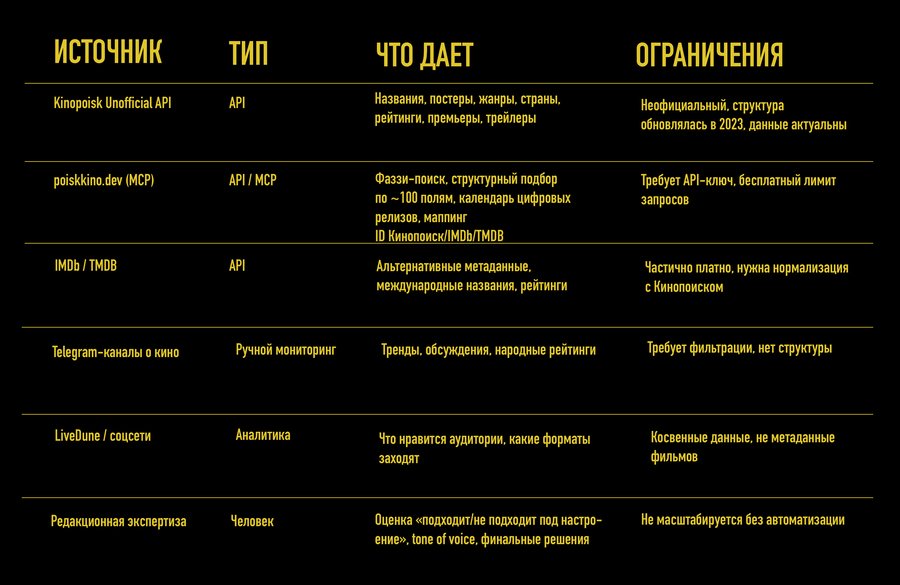
Conclusion: APIs provide us with the «skeleton» (what the film is, where to watch it, when it will be released), while humans provide the «flesh» (whether it is worth watching, who it suits).
Data Schema: General Logic
We divided the processing into two circuits: automated (collection, normalization, drafts) and human (selection, evaluation, publication). The machine never publishes content directly.
Machine Processing
Automation handles the routine tasks: collection, updating, and initial filtering. This saves the editor hours and reduces the risk of metadata errors.
MACHINE PROCESSING TASKS:
Synchronizing the film database
Daily queries to the Kinopoisk API / poiskkino.dev: new releases, rating changes Updating the digital release calendar Automatic generation of «candidates»
Based on specified filters: «dramas from 2015–2020 with a rating >7.5,» «comedies under 90 minutes,» «films tagged 'for an evening after work'» (tags are defined by a user) Draft of a selection comprising 10–15 titles ID normalization and mapping
Standardizing titles (RU/EN) Matching Kinopoisk ID ↔ IMDb ↔ TMDB Trend monitoring
Tracking film mentions in Telegram channels and social media Alert for the editor: «This film is being heavily discussed—check it out» Drafting supporting texts
Automatic insertion of metadata into the post template: title, year, director, poster, link No rating generation—only factual data
What the machine DOES NOT do:
It does not write final reviews
It does not assign a «worth watching/not worth watching» rating
It does not publish without review
Human Processing
In «Curation,» the human isn’t a «button operator,» but a filter of meaning. The machine provides 50 candidates; the human selects 5 and explains why those specific ones.
HUMAN EDITING TASKS:
Curatorial Selection
From the machine’s draft, the editor selects films that are truly relevant to the topic.
Filters out «junk» (low quality, category mismatch).
Subjective Evaluation
Who will enjoy this film: someone tired, a cinephile, or background viewing?
What does the viewer feel after watching?
Spoiler Check
The machine does not understand what a spoiler is. The human does.
Tone of Voice
Adjusting the text to the «Selection» voice: friendly, non-preachy, with self-irony.
Final Approval
No post goes live without explicit approval from an editor.
Feedback for the Machine
The editor notes which filters performed poorly $\rightarrow$ the machine learns (at the level of rules, not model training).
Guidelines for Automated Services
Automation without rules is a risk. We document six principles that apply to any automated process in «Podbore.»

For AI Assistants (if used):Do not upload personal user data to third-party services. Do not use AI to generate cover images without attribution. All AI tools undergo editor review before being used in production.
Technical Stack
We are not building our infrastructure from scratch. We use existing APIs and a minimal stack for automation.
Example: How the «Movies After Work» collection is born
Illustrating the data flow in a specific scenario