Navigator
- Concept
- Linear Metamorphoses
- Object-Subject Metamorphoses
- Corporeal Metamorphoses
- Spatial Metamorphoses
- Conclusion
Concept
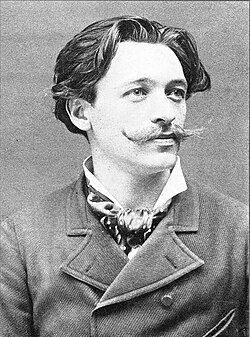
Emil Kohl—the artistic pseudonym of Emil Eugène Jean Louis Kurtz (1857–1938)—entered cinema as a mature draftsman, caricaturist, and participant in the Parisian art scene. By the time he worked with Gaumont, he possessed years of experience in magazine illustration, visual punning, sequential graphic series, and satirical exaggeration.This background is fundamental to understanding his approach to animation. Kohl did not merely make a static image move; he brought to cinema a mode of thought where one form could logically, associatively, or absurdly derive from another.
For the history of animation, it is particularly important that Kol started working with film relatively late: the artist first entered a film studio around the age of fifty, already possessing a fully formed aesthetic program. Object-based frame-by-frame animation existed before Kol, but it was with him that metamorphoses ceased being merely an effect within a trick film and became an independent method for organizing screen time.
In the study, metamorphosis is defined as a type of visual change where the stability of form, function, material, or spatial status is disrupted.
In one case, the drawn contour directly flows into the next—this is a linear metamorphosis. In another, the change occurs through a real object, a cutout, a hinged paper figure, a matchstick, or furniture—in this case, it is an object-based metamorphosis. The third type involves the body: limbs separate, a head swells, a human face transforms into an animal or an object, and the physiological form ceases to be constant. Finally, spatial metamorphosis arises when not only the object changes, but the logic of space itself does.
This kind of optics allows us to pose a different question about the meaning of «transformations» in Kolya. Metamorphosis is not merely a spectacular trick between two animation frames. On the contrary, the transition itself is often more significant than the initial or final form. In typical narrative cinema, the object primarily maintains its identity to participate in a consistent chain of action. For Kolya, identity exists only temporarily.
The image demonstrates not so much «what happened» as «how one became another.»
The visual research will analyze Emil Kolya’s preserved films through the prism of transition from frame to frame, the relationship between contour and body, the interaction of plane and depth, and object and drawing. The foundation for this study is (list films here)
Linear Metamorphoses
The most radical form of transformation in Kolya appears where objects are reduced to contour. In Phantasmagoria (1908), the drawn object is virtually devoid of materiality. The line does not outline the subject as something pre-existing; rather, it reaffirms it anew each time. This is why the transitions appear not as montage between two completed images, but as continuous transformations of a single graphic element—the line. The hand at the beginning of the film draws a Phantasm, but within seconds, the viewer discovers that the drawn figure does not adhere to a stable scale, anatomy, or object classification. The contours literally «flow» into entirely new outlines.
It is particularly noticeable that Kol often retains parts of the old figure within the new one. The subject does not entirely disappear before the next appears; the turn of the line, the circle, the elongated contour, or the arc continues and assumes a different function. In this respect, the transformation is structured like a graphic narrative of change: the new thing seems to emerge from within the previous one. The scene with the movie theater is especially telling. After the bourgeois in the top hat and with the umbrella appears, the elements of the image are redistributed so that the situation becomes the interior of the auditorium; subsequently, the woman’s head swells, and Phantosh reappears inside it.
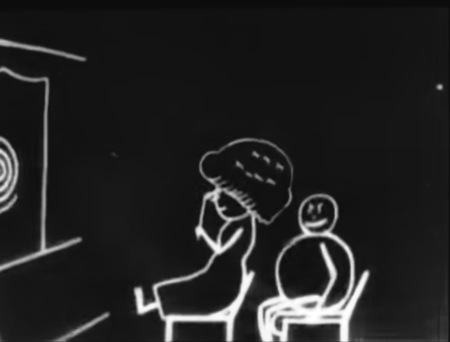
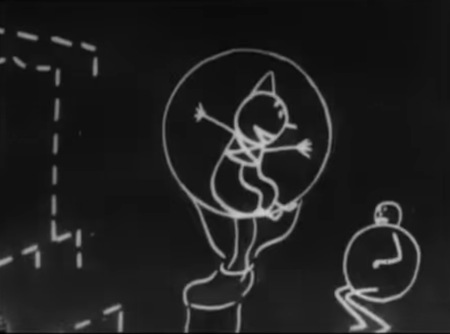
In academic drawing, the contour is usually secondary to the intended subject—it denotes the boundary of a body, space, or object. In Phantasmagoria, the opposite is true: the line itself is primary, and the subject emerges from it.
«Phantom Nightmare» (1908) develops the same principle, but organizes it as a nightmare. The deformation of figures here is not intended for comedic effect. The space is populated by hybrid creatures, and the main character’s form regularly loses stability.
Comparing «Phantasmagoria» and «Puppet Nightmare» reveals two variations of a single linear metamorphosis. In the first film, the transformation possesses an almost demonstrative transparency: the viewer can often observe the intermediate state itself. In the second film, the deformation is more strongly linked to the nightmare—the hybridity of form becomes a sign of the world’s instability. Therefore, the linear metamorphosis in Koly is simultaneously technical and semantic.
What initially saves time—a white outline, minimal detail, and the absence of complex modeling—becomes an aesthetic system where form can change almost without resistance.
Subject-Object Metamorphoses
The second group of transformations appears where Kolya gives up the fully drawn environment and makes a physically existing object change. Here, it is crucial to distinguish between techniques. Filming real objects frame-by-frame is not the same as drawn animation; a hinged paper figure is not the same as a newly drawn character; a composite film featuring an actor and an object is yet another distinct case. Noypert describes Kolya’s artistic heritage precisely for this reason as something «craft-based.» His animation method is not standardized by a single technology but is assembled from the manual combination of object, drawing, and photography.
Les Allumettes animées (1908) is particularly significant as an early example of «animating» the inanimate. The matchstick is interesting here precisely because it retains its real characteristics: it does not need to be depicted by a line; it already possesses length, thickness, and color. Frame-by-frame movement allows a multitude of identical elements to transform into new shapes. Unlike in Fantasmagorie, where one object changes into another through the redrawing of a common outline, here the identity of the material is preserved—the viewer always understands that they are seeing matchsticks, but the ensemble begins to signify something else.Therefore, the material metamorphosis functions differently than linear transformation. The matchstick does not cease to be a matchstick, but several matchsticks become the silhouette of a horse, a windmill, a flag, or a pipe.
In Les Douze Travaux d’Hercule (1910), a different form of objecthood is created using paper cutouts and hinged figures. Here, we cannot speak of a «flowing line» in the sense of Fantasmagorie; the character of Hercules exists as a constructed two-dimensional body, whose parts move physically relative to one another. The technique possesses an inherent artificiality: the limbs of the hinged Hercules can detach from the torso and «drift» beyond the edge of the frame. What would appear to be a technical flaw in a more naturalistic animation, Col transforms into an expressive principle. In the episode featuring the celestial vault, Hercules' figure is incorporated into a composition of flat decorative elements, where the human body, architecture, ship, and conventional cosmos share the same materiality. In the scenes with the Amazons, the multiplicity of warriors creates the effect of an almost unified printed ornament. The cutout thus allows Col not only to save on redrawing but also to create a special visual transformation of forms. The mythological event unfolds like a moving paper theater.
The Neo-Impressionist Printmaker (1910) no longer uses the cutout for a mythological spectacle, but rather for the collision of word, painting, and a literally understandable image. The real-life scene features a bohemian artist and a visitor; subsequently, it showcases «paintings» whose titles are based on puns, and whose content is visualized using animated cutouts. Crafton details this mechanism on pp. 74–76: for instance, a verbally absurd title receives an absurdly literal visual realization. He directly links the film to the practice of Incohérents, where a work could be built upon the mismatch between title, image, and audience expectation. The metamorphosis here occurs not only within the picture, but between the word and the image—the phrase materializes into a visual riddle.
Kolyas’s paper cutting is significant not just as a technique. It aligned with the aesthetics of collage even before collage became a canonized avant-garde method. The image is composed of heterogeneous signs, and their inherent dissonance generates meaning.
A special case is Mobilier fidèle (1910), in which pieces of furniture move independently in real space. Attributional caution must be observed here. The Cinémathèque française catalogs Le Mobilier fidèle as a 1910 film by Émile Cohl; a corresponding stop-motion version also exists on Wikimedia Commons. Furthermore, Crafton mentions Le Garde-meuble automatique by Romeo Bosetti, 1912, in his anthology Before Mickey, meaning the two titles cannot be mechanically equated. The film analyzed here is precisely Mobilier fidèle, attributed to Cohl by the French Cinémathèque. [Courtet-Cohl, Génin, Émile Cohl: l’inventeur du dessin animé, filmographic context; Crafton, Before Mickey, reference materials.]In Mobilier fidèle, the metamorphosis does not occur through the deformation of a table or a cabinet, but through a change in their behavioral status. The furniture remains furniture, yet it begins to act as a character: it leaves the space autonomously, moves, and organizes action around the human owner. This is a fundamentally different type of transformation than the elephant becoming a house in Fantasmagorie. In a graphic film, the material form changes; in a physical stop-motion piece, the agency changes. The object transforms from a passive object into an agent of action. This transition confirms Asenin’s idea that the specific freedom of animation lies in the ability to endow movement and character upon things that lack independent will in live-action cinema.
Thus, the subject-object metamorphosis in Kolya generates at least three distinct techniques: recombining material in matches-based films; reassembling a two-dimensional form in paper animation; and animating the function of real objects in stop-motion. Labeling all three simply as «object animation» is insufficient because their artistic logic differs. In the matchstick work, the unit is preserved, but the ensemble changes; in Hercules' work, the body’s structure reveals its own compositionality; and in the furniture, the form remains entirely intact, yet the object gains volition.
Bodily Metamorphoses