- Introduction
- Dubstep
- Dubstep Breaking Its Own Boundaries
- Developmental Trajectories within Post-Dubstep
- The Influence of Other Genres on Post-Dubstep Sound
- Is Post-Dubstep a Standalone Genre?
- Conclusion
Introduction
In the late 2000s, burgeoning directions related to dubstep began to actively develop within British electronic music, gradually extending beyond its established sound. Producers were combining elements of dubstep with UK garage, house, R&B, ambient, and experimental electronica. The term «postdubstep» became established in music criticism to label some of these experiments. However, as early as the 2010s, discussions emerged regarding how accurately this title described the new music [3, 4].
In the article «Grime / Dubstep» (2011), music critic Martin Clark noted that post-dubstep is easier to characterize through what it is not rather than through a unified sonic formula [3]. Nevertheless, this does not imply a lack of shared musical characteristics. Works categorized as post-dubstep often retained the characteristic British approach to low-frequency bass work, syncopated rhythms, and soundscaping. Simultaneously, some artists gravitated toward house and garage, others toward R&B and song-based music, and still others toward ambient and experimental electronic music.
Thus, a contradiction arises: post-dubstep acquired its own name and recognizable characteristics, yet simultaneously brought together works that differed markedly in rhythm, structure, and methods of sound manipulation.
Primary Research Question: Why did the development of dubstep lead to the blurring of its genre boundaries, and what unified the music that came to be called post-dubstep?
Research Objective: To trace the transformation of dubstep’s musical language under the influence of other genres, identify the main lines of post-dubstep development, and determine the validity of considering it a distinct genre.
The preliminary hypothesis is that post-dubstep arose not from the blending of musical styles, but through the development of experimental practices within the British bass scene. Producers maintained distinct approaches to working with bass, rhythm, and space, yet integrated them into novel musical forms. Consequently, the shared identity of post-dubstep might be defined simultaneously by its sonic characteristics, historical origins, and the connections between its artists. The conclusion will determine whether these lines constitute parts of a single musical phenomenon or if they diverged into separate directions over time.
Dubstep
Dubstep emerged in London in the early 2000s at the intersection of several electronic music genres. UK garage, particularly its 2-step variant with its distinctive syncopated rhythm, formed its foundation. Jamaican dub and jungle also influenced the new sound, prompting musicians to adopt a focus on bass, effects, and spatial sound design. As a result, a more minimalistic and darker form of British club music began to take shape [2]. The Croydon area in south London played a crucial role in the rise of dubstep, particularly due to the Big Apple Records record store there. It became a gathering spot for young producers, including Skream, Benga, Mala, Coki, and other future figures in the genre. They were connected not only by musical interests but also by club nights at FWD≫, where experimental tracks that didn’t fit the mold of mainstream UK garage raves could be heard.
Big Apple Records record store, Croydon area, London.
One of the early examples of transitional sound—El-B (Ghost) by Buck N Bury (2002)—is noteworthy. While the composition retained the broken rhythm characteristic of garage, it placed an emphasis on the bass and featured a sparser arrangement. Skream recalled that this specific track, which he heard at FWD≫, had a significant influence on him. In his early works, he attempted to replicate the musical techniques of El-B and Zed Bias, utilizing available music production software [2].
Thus, dubstep emerged not as a complete antithesis to UK garage, but as the result of experiments within an already established musical tradition. Producers gradually altered the balance of familiar elements: reducing melodic and vocal parts, intensifying the bass, and leaving more sonic space between sounds.
Mala (DMZ) performs at Plastic People in London, April 2005
By the early 2000s, dubstep had developed recognizable musical characteristics. One of these became a tempo around 140 beats per minute. However, the rhythmic organization often created the sensation of movement occurring twice as slowly—around 70 beats per minute. This technique is called half-time. Combined with syncopation, pauses, and irregular drum placement, it allowed for the creation of diverse rhythmic patterns. Another crucial element was the sub-bass—very low frequencies that are particularly palpable when listening through powerful club sound systems. In dubstep, the bass often serves not an auxiliary but a leading function, defining the movement and character of the entire composition.
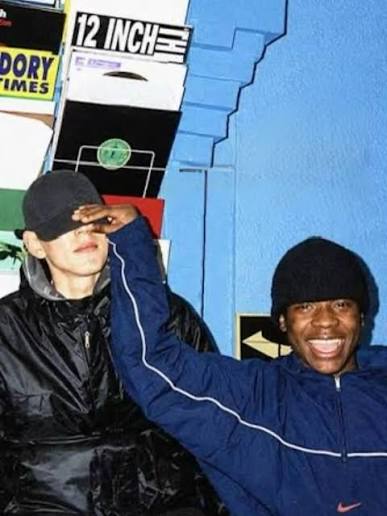
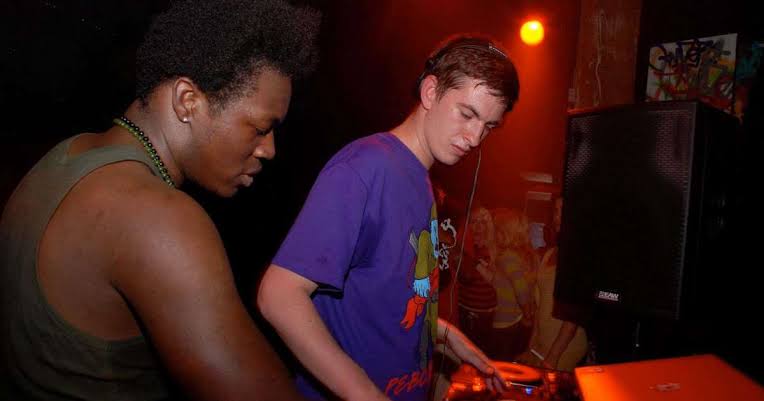
Benga and Skream, 2003.
These characteristics can be traced in the example of Benga & Skream — The Judgement (2003), released on Big Apple Records as part of the Judgement EP. The track also shows the influence of garage, especially in the rhythm, but the heavier bassline already brings it close to the recognizable sound of dubstep.
Benga explained the importance of the bass by noting that dubstep compositions often contain fewer musical elements than, for instance, drum and bass. Therefore, the bassline had to fill the remaining space and maintain tension [2]. Meanwhile, the minimalism of dubstep did not necessarily imply compositional simplicity. Musical development could occur through subtle changes in rhythm, timbre, bass intensity, and the placement of individual sounds. Pauses, echo, and reverb became as critical elements as the drums or the melody.
Despite a shared rhythmic and bass foundation, early dubstep did not possess a perfectly unified sound. This is particularly evident when comparing musicians associated with the DMZ label and its club nights.In 2004, Mala, Coki, and Loefah founded the DMZ label and subsequently organized parties under the same name. Their musical approach was heavily rooted in Jamaican sound system culture, which places significant emphasis on low frequencies and the physical experience of sound.However, each of these producers developed the potential of dubstep in their own unique way.
Loefah employed minimalist arrangements and sparse half-step intervals. Silence—the pauses between percussion and bass elements—held significant weight in his music. For instance, in Mud (2006), tension is generated through a small quantity of sounds, their repetition, and the space surrounding them.