«Unlike the Western portrayal of zombies and demonic entities, most Thai ghosts do not stalk people randomly. I think these films are trying to show us that people are far more frightening than the ghosts.» [1]
(Photo by Pilan Punyaprapha, researcher at Srinakharinwirot University)
Navigation
— Concept — Mythology — Comics — Film Industry — Conclusion — Bibliography — Image Sources
Concept
Thai culture frames the concept of «horror» quite differently from Western perception. Primarily, the concept we are accustomed to—"horror"—does not exist, nor does a single word specifically designating this genre. A large portion of Thai films does not leave the country; it is considered outside what global audiences expect to recognize as the horror genre. Films of this nature are divided into two categories: «nan phi» (literally «ghost films»; films about ghosts, animistic spirits, and magic—which includes virtually the entire local horror repertoire) and «nan sayong khwan» (literally «horror films»; movies designed to frighten the viewer with events unrelated to the supernatural). However, neither can be categorized as a standard horror film.
This pattern is not limited to the film industry but extends to all media platforms, as the root of it all lies in Thai mythology and mystical concepts. The core term characterizing this orientation is «Phi» (ผี), which refers to enigmatic entities—ranging from ghosts to divine spirits—that can either aid humans or cause them harm. These spirits have long played a vital role in Thai culture and beliefs, continuing to influence various aspects of Thai life to this day. It is believed that malevolent spirits can harm a person by possessing them, leading to illness or agonizing death. Beyond the traditional «Phi» from local folklore, there are also vengeful spirits that can haunt specific locations—such as homes, hotels, or hospitals—or become attached to objects cherished by the deceased during their lifetime. These ominous entities form the foundation of many Thai horror stories.
«Souls become ghosts due to dissatisfaction in life. They continue to dwell on unfinished business and the injustices that pursued them. Thus, Thai ghosts represent human needs.» [2]
© Pilan Punyaprapha, Researcher at Srinakharinwirot University
Thus, the genre is shaped by Thai spiritual worldviews, in which the boundary between the world of the living and the supernatural is constantly blurred. Unlike Western culture, Thai people believe that humans themselves generate the supernatural—particularly evil. Horror in Thai culture arises from societal realities, serving as a kind of warning, especially regarding populations that have traditionally been oppressed, such as women.
Another global difference that brings the dark and frightening closer to the Thai consumer—unlike Western horror, which cannot be categorized as «culture for everyone» due to internal censorship and different viewer preferences—is accessibility and ubiquity. Often, media of this type do not require expensive production, partly because the industry does not aim for it. For example, in the 1970s and 1980s, cult comics selling for one baht (translated as «a comic for one baht, ” การ์ตูนเล่มละบาท; equating to about 2.5 RUB in modern terms) were popular and sold in common places like hair salons or newsstands.
From this, one can draw the straightforward conclusion that for Thai people, darkness and horror are not about jump scares, realistic special effects, or a loud cast. In reality, fear for Thais is often mixed with comedy, presented through a social-karmic perception of fear—an ontology quite distinct from the Western view. This visual study aims to examine the phenomenon of horror within Thai culture through the lens of accessible and popular media, beginning with the mythological elements of the discourse as a foundation for understanding the topic.
Mythology
«Many people who become ghosts were oppressed during their lives, which is why they are torn apart by their own malice—because in the afterlife, there are neither social nor physical limitations. Thai women face oppression much more often, so it is often their ghosts who are so vengeful after death.» [3]
(photo) Pilan Punyarapha, researcher at Srinakharinwirot University
Comics
Film Industry
«From village to airplane cabin: how Thai ghosts evolve alongside the living» by Tappanai Boonbandit [Electronic resource] // KhaoSodEnglish. URL: https://www.khaosodenglish.com/featured/2019/10/31/from-village-to-airplane-cabin-how-thai-ghosts-evolve-alongside-the-living/ (Accessed: November 13, 2026). [1] [2] [3]
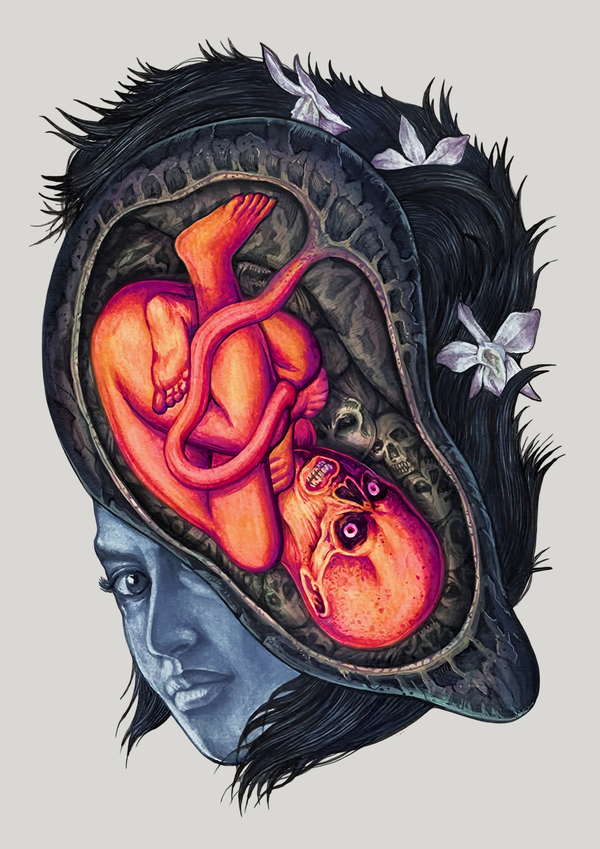
Cover: Namsing — Mae Nak Phra Khanong (2023) // URL: https://www.facebook.com/Namsingillustrat/posts/nang-nak-in-my-opinionแม่นาคพระโขนง-สีฝุ่นบนกระดาษ-ขนาด-a4วาดไว้นานมากๆเกือบสิบป/904460891201408/ (Date accessed: 13.11.2026).