Concept
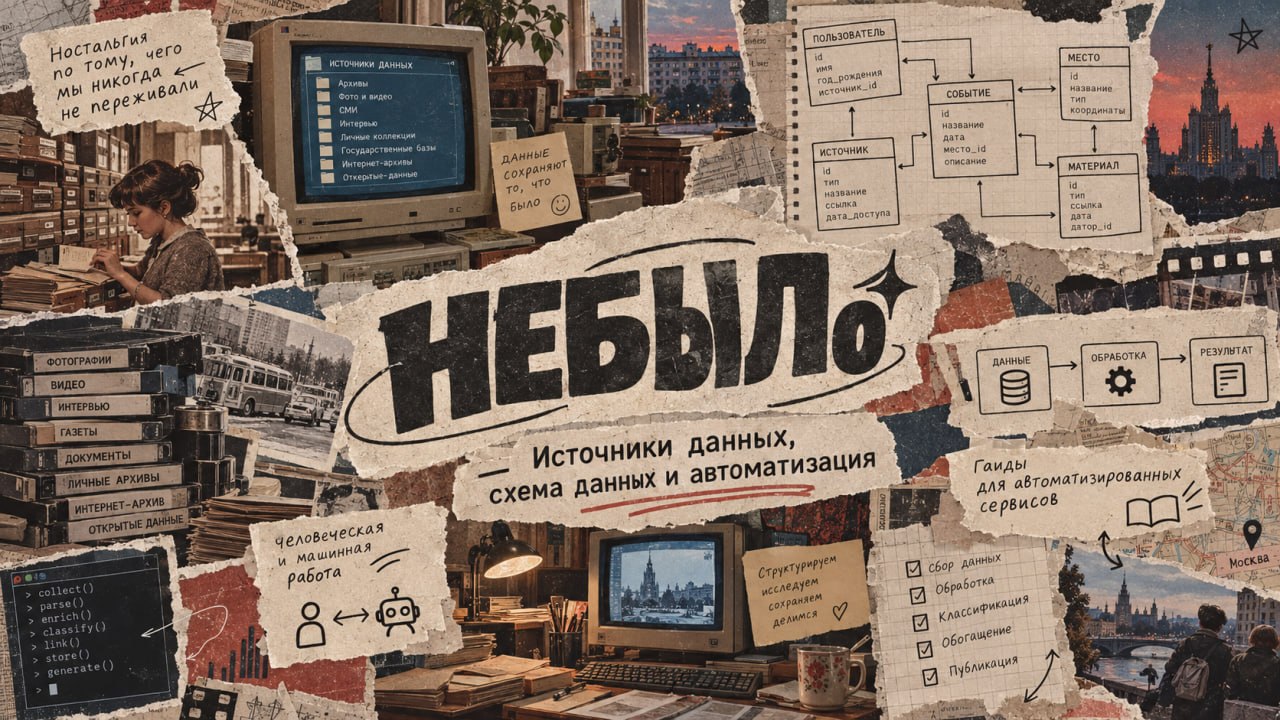
THE MEDIUM: explores the phenomenon of nostalgia for eras that contemporary individuals have never personally experienced or lived through.Main object of study: we gather visual and cultural artifacts from the past—photographs, objects, music, advertisements, interfaces, fashion, and film—to examine why they evoke a sense of a familiar past in people who do not personally remember it.Goal: to demonstrate how the image of the past is constructed and why we might miss not our own memories, but the cultural construct of an era.The concept for the 1st Project remains unchanged.

Data Sources for Media
For NEBYLO, data sources are materials upon which the editorial team reconstructs the visual and cultural context of the past. They can be divided into four groups.
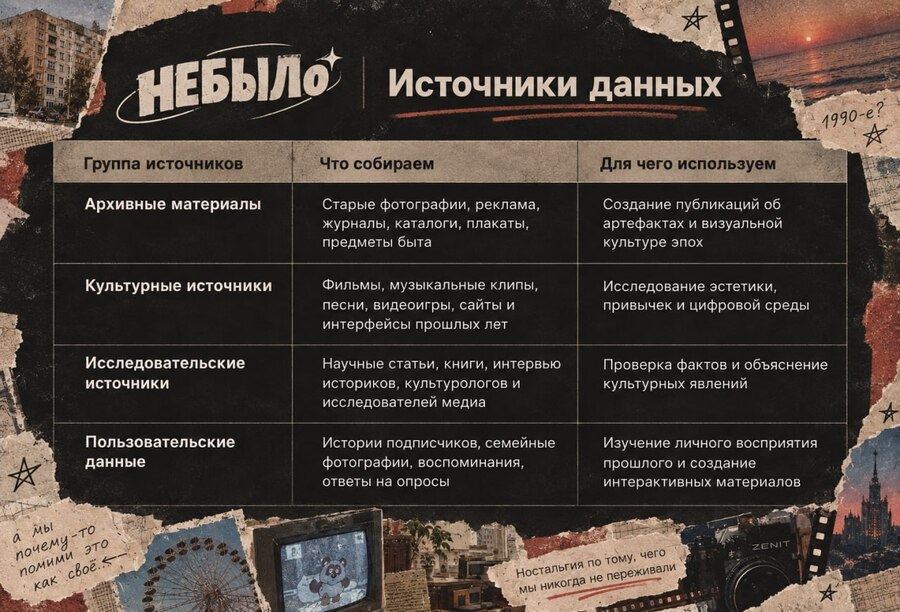
Where to Find Materials — Archives and Museums: digital collections from museums, libraries, and photographic chronicles. — Periodicals: digitized magazines, newspapers, and advertising catalogs. — Digital Culture: archival versions of websites, old computer games, interface screenshots, and video clips. — Research Resources: scholarly publications, electronic libraries, and books on the history of daily life, design, and culture. — Audience: surveys, comments, and materials voluntarily submitted by subscribers. — Channel Internal Data: publication views, reactions, comments, survey results, and shares.Principle of Working with Sources: every factual claim must have a verifiable source. For archival images, it is necessary to document the author or copyright holder, the date, origin, and terms of use, if known. Subscribers' personal stories should only be published with the authors' consent.
Data Schema
In NEBYLO, a hybrid model can be used: automated services assist in collecting, sorting, and preliminary analysis of information, while the human is responsible for interpretation, veracity, and the final output.
What the machine processes versus what a human processes:
The main distinction: the machine accelerates technical and repetitive tasks; the human makes editorial decisions. Automatically generated text or found dates are not considered verified facts until reviewed by an editor.
Guidelines for Automated Services in the Scheme
These guidelines define how artificial intelligence tools and other automated services must interact with NEBYLO materials.
1. Fact-Checking and Verification
Automated services can search for information, compile summaries, and propose timelines of events. They should not unilaterally determine controversial facts as true. All dates, names, quotes, and historical claims are verified against primary sources or reliable publications.
2. Working with Sources
For each material, the source title, link, publication or creation date (if known), and access date must be preserved. The service must not invent links, authors, quotes, or the origin of images.
3. Personal Style
The texts must maintain a tone that is not nostalgic: curious, contemplative, investigative, and accessible to a young reader. One cannot substitute genuine inquiry with clichés about how «the good old days were better.» While AI can provide drafts, the final articulation rests with the editor.
4. Working with Visual Materials
The priority is real archival imagery with established provenance. AI can assist with cropping, sorting, and creating illustrations, but generated images must not be presented as historical photographs. Restoration should not subtly alter the original content.
5. Copyright and Confidentiality
Services must operate exclusively with authorized data and take into account the terms of use for materials. Personal photos, stories, and messages from subscribers cannot be shared with third-party tools without necessary consent. Author permissions and the need for anonymization are checked before publication.
6. Pre-Publication Review
No material is published entirely automatically. The editor reviews the content, sources, image captions, tone, and alignment with the media concept. If a fact cannot be verified, it is either excluded or marked as uncertain.
Example of Using the Automated Service
Suppose the editorial team is preparing a publication about old internet interfaces.