
NEUROBIZ. PRACTICAL AI FOR SMALL BUSINESS
Media project on how to use neural networks in the everyday work of an entrepreneur

«NEUROBIZ» MEDIA CONCEPT
Neurobiz—practical media for entrepreneurs who want to use artificial intelligence in their work but aren’t ready to spend hours studying dozens of tools. We explain not just what neural networks can do, but how to use them to solve real business problems. Our formula: Business problem → AI tool → Step-by-step instructions → Result. The main principle: every piece of content must help the reader do something—simplify or improve something in their business.
What problem does media solve?
Neural networks can assist with text, visuals, information analysis, marketing, and customer communication. However, a business owner cannot simply know that another AI tool exists. They need to understand: — What problem it solves? — How to apply it without technical knowledge? — How much time it will take? — How to verify the results? — In which situations it is better to skip AI? The NeuroBiz problem: the gap between the capabilities of neural networks and their practical application in the daily operations of small businesses.
HALF-YEAR THEMATIC PLAN
November 2026 — AI without complex jargon. Introduction to neural network capabilities, selecting initial tools, and safe usage guidelines.December 2026 — Content and Promotion. Ideas for publication, copywriting, product descriptions, advertising messages, and visuals.January 2027 — Sales and Clients. Handling frequently asked questions, managing reviews, and preparing commercial proposals and communication scripts.February 2027 — Workflow Automation. Recurring tasks, templates, information processing, and process organization.March 2027 — AI for Various Niches. Dedicated case studies for cafes, beauty studios, online shops, and small teams.April 2027 — Systemization and Results. Quality assurance, assessing time savings, debugging, and building your own AI system.
10 NEUROBIZ CONTENT EXAMPLES
Content Sample #1
Category: «Challenge of the Day» Format: Text post with a visual card. Topic: How an entrepreneur can come up with content ideas for the week.
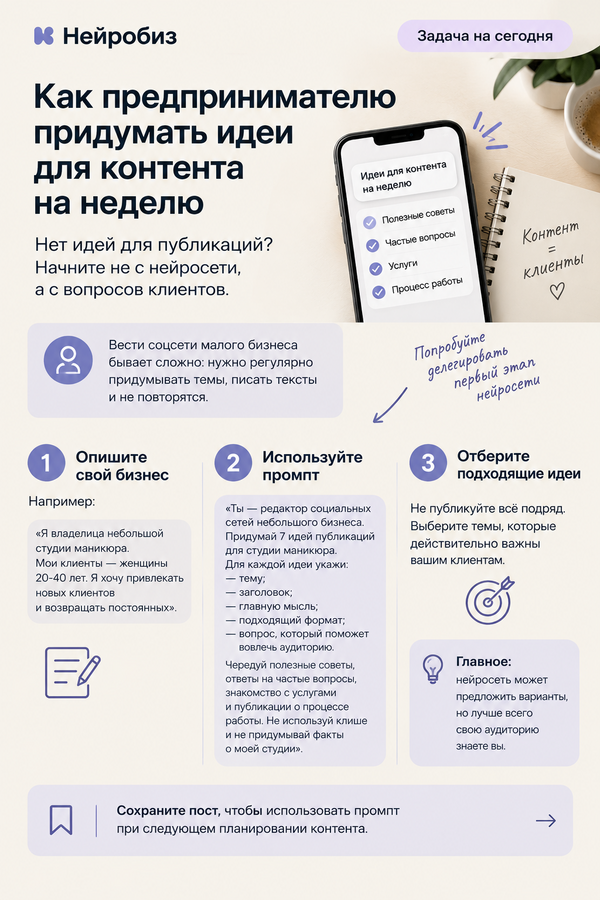

No ideas for content? Start by asking your clients questions, not the AI.
Managing social media for small businesses can be tough: you need to regularly generate topics, write copy, and avoid repetition. Try delegating the initial brainstorming phase to an AI.
Step 1. Describe your business. For example: «I own a small manicure studio. My clients are women aged 20–40. I want to attract new clients and bring back regulars.»
Step 2. Use the prompt. «You are a social media editor for a small business. Generate 7 content ideas for a manicure studio. For each idea, specify: — topic; — headline; — main idea; — suitable format; — a question to engage the audience. Alternate between helpful tips, answers to frequently asked questions, service spotlights, and posts about the working process. Do not use clichés or invent facts about my studio.»
Step 3. Select the relevant ideas. Don’t publish everything. Choose topics that truly matter to your clients. The main point is this: the AI can suggest options, but you know your audience best. Save this post so you can use the prompt for your next content planning session.
Content Sample No. 2
Category: «Prompt in Practice» Format: text + ready-made template. Topic: writing product descriptions for an online store.
A Product Page You Won’t Be Ashamed to Show Clients
Product descriptions are not merely a list of features. They must help the buyer understand if the item is right for them. Try this prompt: «You are an e-commerce editor. Prepare a product description based on the information below.Name: [product name]; Specifications: [material, size, color, other known data]; Target Audience: [who the product is for]; Brand Style: [calm, friendly, expert, or other]; Platform: [website or marketplace]
Structure:
- A short headline.
- Two sentences describing the product’s purpose.
- Three benefits based on the provided specifications.
- Practical information for the buyer.
- A short call to action.
Do not invent characteristics, certifications, guarantees, or properties that are not in the input data. If information is missing, ask questions.»
What to do after generation? — Review the specifications. — Remove vague phrases. — Add factual benefits. — Ensure the text aligns with the store’s style. AI will prepare the draft. The decision to publish remains yours.
Content Sample #3
Category: «AI in 15 Minutes» Format: step-by-step guide. Topic: preparation for a marketing campaign.
Need to brainstorm a business promotion? Use AI as an idea generator
Suppose you run a small coffee shop and want to boost sales on weekdays. Instead of settling for the first idea you come up with, ask the neural network to develop several options.
Prompt: «Propose 5 advertising campaign ideas for a small coffee shop.
Goal: Attract more customers on weekdays between 12:00 PM and 4:00 PM.
Constraints: — The budget is small. — The promotion must be easy for staff to implement. — The terms must be clear to visitors. — Do not suggest continuous, large discounts.
For each idea, specify:
- The campaign mechanism.
- Why it might appeal to the customer.
- What is required to launch it.
- Potential risks.
- How to measure the results.»
What to do next?
- Select 2–3 realistic options.
- Review the cost of goods sold and the economics of each proposal.
- Determine the duration of the promotion.
- Define a success metric—for example, the number of orders during the selected hours.
- Run a test and compare the results to the normal period.
Content Sample No. 4
Section: «Business Breakdown» Format: A five-card carousel. Topic: The application of AI in beauty studios. This slide can show the entire carousel as five thumbnails.
Card 1
Beauty Studio + AI
5 tasks to get you started.
Card 2
Content
Ask the neural network to suggest publication topics for the week: care routines, Q&A sessions, introductions to the stylists, and open appointment slots.
Card 3
Client Responses
Prepare draft replies to frequently asked questions: pricing, procedure duration, and preparation for the visit.
Card 4
Reviews
Ask it to group anonymized reviews by theme: service, atmosphere, booking speed, and communication quality.
This makes it easier to spot recurring client wishes.
Card 5
Planning
Create a list of themes and publication templates for the month.
Start with one repetitive task and check if the AI truly saves you time.
Caption for Publication
The neural network will never replace a stylist’s professionalism or the human touch with a client. But it can assist with organizational and textual routines.
Which task would you start with: content creation, client responses, or planning?
Content Example #5
Feature: «Before / After» Format: Comparative card. Topic: How to reduce the time needed to prepare a publication.
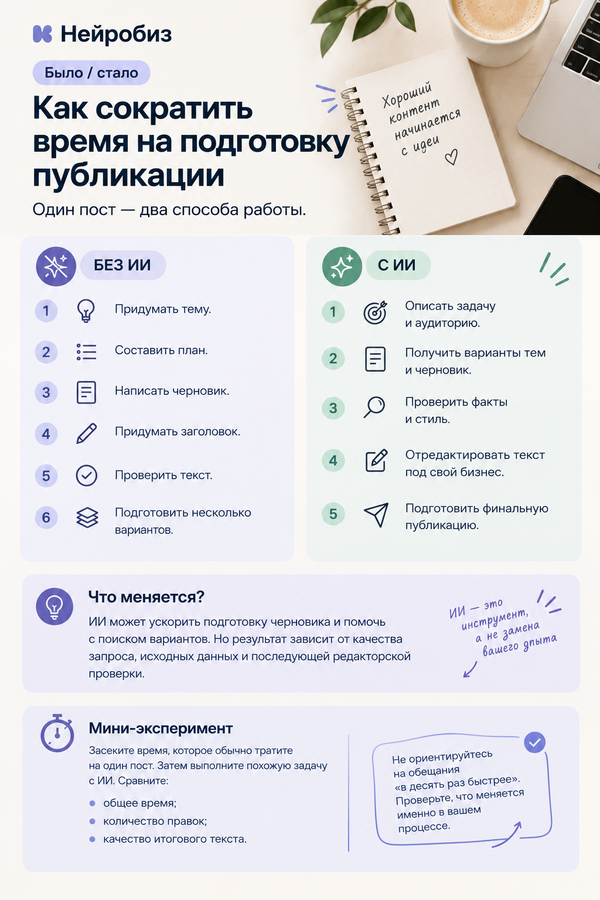

One Post—Two Approaches
WITHOUT AI
- Generate a topic.
- Create an outline.
- Write a draft.
- Develop a headline.
- Proofread the text.
- Prepare several variations.
WITH AI
- Describe the task and target audience.
- Receive topic options and a draft.
- Fact-check and refine the style.
- Edit the text to align with your brand.
- Prepare the final publication.
What Changes?
AI can accelerate draft preparation and assist in brainstorming options. However, the final outcome depends on the quality of the prompt, the initial data provided, and subsequent editorial review.
Mini-Experiment
Time yourself to see how long you typically spend on a single post. Then, complete a similar task using AI.
Compare: — Total time spent; — Number of revisions; — Quality of the final text.
Don’t get carried away by promises of «ten times faster.» Focus on what genuinely changes within your personal workflow.
Content Sample #6