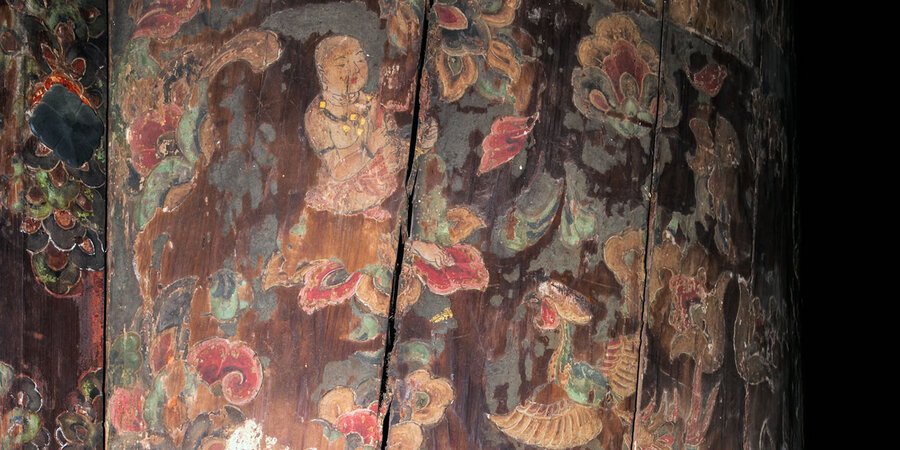
Concept
«People became more devoted to Buddhism and believed in the Buddhist Pure Land» [4]
In Japanese art from the 10th to 14th centuries, a special place is held by the visual embodiment of Buddhist paradise—the Pure Land of Amida Buddha (Pure Land school).According to Buddhist tenets, the Pure Land is a cosmic realm transformed into a sinless world. Concepts of the Pure Land gradually found expression across various art forms: temple architecture, sculptural depictions of Amida, wall paintings, and painted compositions illustrating paradise. Space, composition, plasticity, color, and light helped the viewer perceive an ideal, tranquil Buddhist world free from anxiety and problems, and to feel a connection with Amida.During the Heian period, symmetry, idealized form, compositional stability, and harmony held particular significance. Over time, the depiction and representation of the Pure Land evolved as the period shifted, yet the underlying principles remained. The shift to different techniques does not mean the core idea lost its original embodiment, nor does it mean that dynamism was entirely absent from the symmetry and stasis of the Heian era.The most striking and well-known visual representation of the Pure Land is the Byōdō-in temple. It is this complex that conveys to the viewer the idea of harmony in paradise and the connection between Amida Buddha and humanity.
The interest in this topic stems primarily from the fact that Japanese masters sought not merely to depict the Buddhist paradise, but also to evoke a sense of its presence in the viewer; engaging with this subject allows one to view art not just as a collection of individual pieces, but as a system of visual tools that shapes a particular religious conception. When selecting sources, particular attention was paid to authenticity and thematic relevance, so I utilized museum studies and articles focused on examining the techniques and period.
Pure Land in Japanese art is not merely a depiction of a Buddhist paradise; it is a visually constructed space designed to shape the viewer’s perception—that is the essence of this research.
The central research question
How did Japanese architecture, sculpture, and painting from the X–XIV centuries shape the visual image of the Pure Land of Amitābha Buddha, and through what techniques did Japanese masters evoke a sense of sacred space?
Hypothesis
I propose that the concept of Amitabha Buddha’s Pure Land in Japanese art was realized through specific techniques in architecture, sculpture, and painting. Together, these elements helped people visualize the Buddhist paradise. Therefore, I aim to demonstrate how harmony, symmetry, and subtle dynamism—woven into a sense of tranquility—translate into a visual representation of the Pure Land.
Topics
- Concept
- Architectural Embodiment of the Pure Land in the Heian Period
- Sculptural Depiction of Amitābha Buddha
- Pictorial Representation of the Pure Land
- Conclusion and Bibliography
Architectural Realization
Bodo-In Temple: Phoenix Hall
Phoenix Pavilion (Oodo), Bodo-in Temple, Uji, Japan. 1053. Overview
«Elegant Palace on the Pond in the Buddhist Pure Land» [3]
The Bedo-in Temple is a symbol of rebirth and immortality. Its crown jewel is the Phoenix Pavilion. The significance of this temple extends beyond mere aesthetics.The architecture of the Phoenix Hall features strict symmetry and an unconventional composition. It resembles a bird: the central hall forms the body, the side galleries are the wings, and the rear corridor is the tail. The repetition of columns, openings, and roofing creates a measured visual rhythm. Because of this, the extended composition is perceived not as a random assembly of several parts, but as a unified architectural whole. The center is the primary spatial and thematic element of the ensemble, as it is where the statue of Amitabha Buddha is housed.In addition to the unusual form of the structure, the building is surrounded by water and gardens, causing it to be perceived as a self-contained world, separate from the everyday world.The Phoenix Hall embodies the concept of a Buddhist paradise—the Pure Land. This was not done arbitrarily: the source of the symbolism is a Sutra describing a place for meditation free from suffering. The Phoenix Hall thus becomes a visualization of this place, where a person can find hope for salvation and imagine a realm free from cruelty and anxiety.
The building features a symmetrical P-shaped composition. It is important to note that the side galleries serve a decorative function—their structure is not designed for standard pedestrian traffic. Therefore, the architectural form here is determined not only by practical needs but also by the necessity of creating a specific visual image. The design of the roofs, columns, bases, and galleries indicates that the fantastic architecture of Pure Land is based on the actual architectural concepts of its time. To present an ideal world to the viewer, the architect employed familiar techniques and styles characteristic of his era.
The side galleries of the Phoenix Pavilion
The Sacred Pond
One of the most significant features of the Edo-in is the pond. The Phoenix Pavilion is situated on an island, and the water surface separates it from the main garden area. Consequently, water functions as a means of visual distance.
This creates an effect of separation: the person is on one bank, while the temple is located on the island. Such an arrangement can be interpreted as a symbolic contrast between the everyday world and a secluded space free from worldly concerns. [1]
However, the water does not represent an insurmountable barrier; its surface visually connects the viewer to the temple through the building’s reflection. This placement enhances the impression of the space’s ideal nature. Symmetry exists not only within the architectural structure but also between the pavilion and its reflection.
Reflection of the Phoenix Pavilion in the Water
Sculptural Representations of Amitabha Buddha
Statue of Amitābha Buddha
A key feature of the Phoenix Pavilion is the connection between its external architectural appearance and the internal space.
Interior of the central hall of the Phoenix Pavilion, featuring a statue of Amitābha Buddha by Jōcho, 1053.
If the symmetry and reflection in the water draw the primary attention when viewing the building from the outside, then the central compositional element inside is the seated statue of Amitābha Buddha.
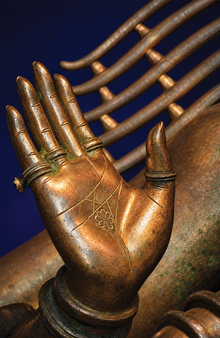
Amitābha’s seated posture emphasizes his focus and spiritual stability. The viewer’s attention is drawn to the Buddha’s pose, which reflects serenity. This impression is achieved through the symmetrical posture and the folded hands of the sculpture.
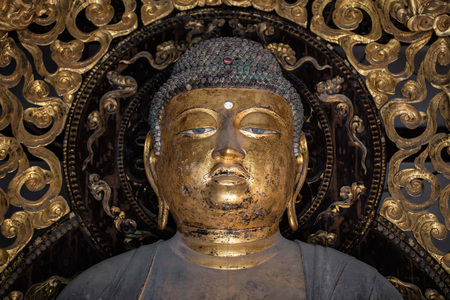
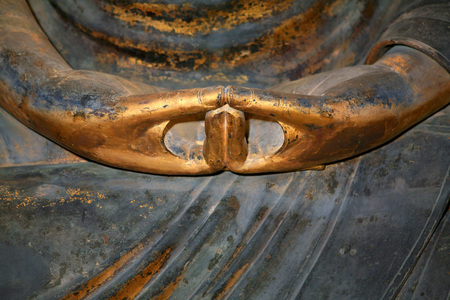
Statue of Amida Buddha by Jōchō, 1053.
The symmetry of the exterior facade continues within the internal organization of the space. The figure of Buddha creates a sense of solemnity. The gilded surface of the statue contrasts with the painted wooden structures and the decorative interior finishes. The gold highlights the image of Amida against the surrounding space. All of this underscores the sacred nature of the space, making the figure the central motif of the temple’s interior architecture.
Flower-shaped canopy