
План и контент
Медиа коммерческой фотографии
01. Media Concept
Project Concept:
«Visual Code» — an original media outlet focused on commercial photography that explores how images are created, what meanings they convey, and how they shape the visual identity of brands.The Problem: Visual content surrounds us everywhere, yet behind a finished advertisement, the concepts, the art director’s work, the lighting choices, the composition, the styling, and the communication strategy often remain unnoticed.Mission: To develop the audience’s visual literacy and present commercial photography not merely as an aesthetic outcome, but as a deliberate process of image creation. Media Goal: To teach the audience how to analyze advertising images, understand the relationship between form and content, and apply this knowledge to their own projects.Target Audience: aspiring photographers and students in creative fields; working photographers and visual creators; art directors, designers, and branding specialists; marketers and brand representatives.02. Thematic Directions
- Advertising Campaign Analysis Analyzing visual solutions, underlying meanings, and methods of engaging the viewer.02. From Idea to Frame Concept development, references, mood boards, art direction, filming, and post-production.03. Visual Language Color, light, composition, textures, symbols, and emotional perception.04. People and Industry Interviews with photographers, art directors, stylists, and producers. Format and Platforms. The primary platform is Telegram: analytical publications, author commentary, interviews, and reference selections. Visual materials are adapted for VK and Pinterest, and short videos and carousels are used to attract a new audience. Tone of Voice: intellectual, observant, and visually literate. Sophisticated without being overly academic, yet using professional terminology with clear explanations.
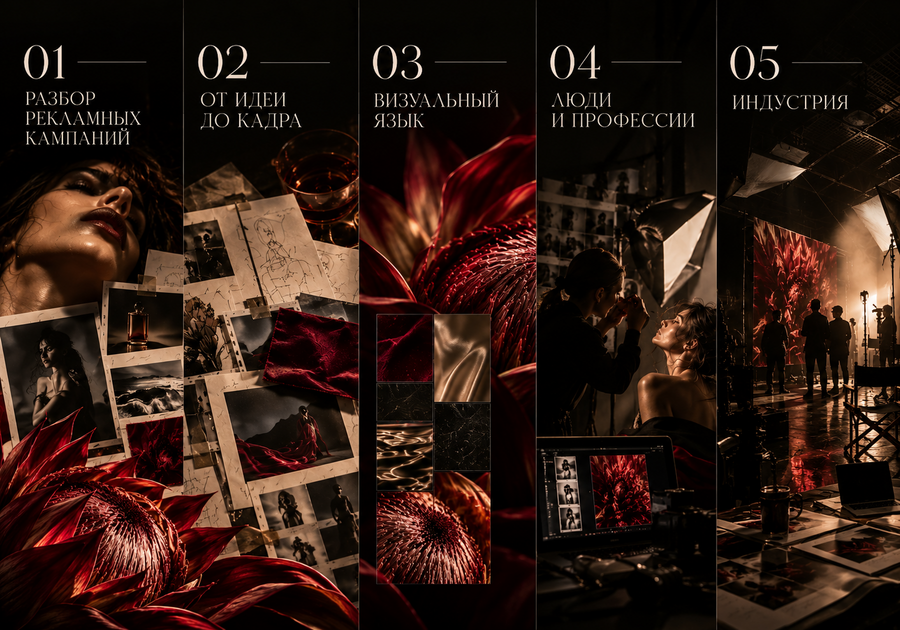
The key difference: media doesn’t just display beautiful photographs; it reveals the logic behind their creation—from the initial concept to the final commercial image.
03. Thematic Plan for Six Months
I propose a six-month editorial plan—roughly one major topic per week. From each topic, we can release the core material along with adapted publications for other platforms.
Month 1. Learning to See
Foundations of Visual Literacy1. What is a brand’s visual code? 2. How photography shapes the first impression of a product. 3. The psychology of color in commercial photography. 4. Light as a tool for creating mood.
Month 2. Image Grammar
Composition, Texture, and Visual Techniques1. Composition and directing the viewer’s attention. 2. Texture, materials, and product photography. 3. Working with the color palette in commercial photography. 4. Props and symbolism in the frame.
Month 3. Analysis of Advertising Campaigns
From Aesthetics to Communication Objectives1. How to analyze an advertisement image. 2. Beauty Advertising: how photography conveys sensation. 3. Fashion Campaigns: clothing, character, and history. 4. Product Advertising: how to make the product the main character. 5. Comparing two campaigns within the same segment.
Month 4. From Concept to Execution
Visual Production Practice1. How the idea for a commercial shoot is born. 2. Creating a mood board: from references to concept. 3. Art Direction: how to unify all elements of the frame. 4. Lighting scheme and set preparation.
Month 5. People and Professions
Team, Process, and Industry1. Photographer and Art Director: role differentiation. 2. Interview with a commercial photographer. 3. How a stylist works with image and props. 4. What constitutes the production of a commercial shoot.
Month 6. The Future of Visual Communication
Trends, Technologies, and the Authorial Viewpoint1. How to analyze visual trends without mindless copying. 2. Artificial Intelligence in Commercial Photography. 3. How to develop your unique visual signature. 4. Final Case Study: Creating a concept for a commercial photoshoot from idea to execution.
Recommended Publishing Rhythm:
1. One major analytical piece per week.
2. One to two short posts: a visual technique, a reference, or an observation.
3. One interactive format every two weeks: a poll, image comparison, or mini-critique.
This way, over six months, the project will develop not just a collection of posts, but a coherent educational curriculum.
04. Ten Content Samples
Sample 1. Analytical Article
Why Do Some Advertising Photos Stick in Your Mind While Others Don’t?Column: Deconstructing Visual Language Most advertising imagery is created not just to display a product. Its function is to evoke a specific impression before the viewer even starts examining the details. Imagine two pictures of the same perfume. In the first, the bottle is shot against a white background with even lighting. In the second, it is enveloped by deep shadows, reflections, and rich burgundy fabric. The product remains the same, but its perception shifts. The first shot might suggest purity and functionality, while the second conveys sensuality, drama, and luxury.What creates this difference?
- Light. Directed lighting emphasizes form and builds drama. Soft, diffused light creates a calmer image.
- Color. The color palette sets the emotional tone and links the photograph to the brand’s visual identity.
- Composition. The placement of the product, scale, and negative space determine where the viewer’s eye goes first.
- Context. Props, background, and textures form associations that go beyond the product itself.A powerful advertising photograph doesn’t have to be complicated. It must be precise: every visual decision must work toward the overall concept.
Visual code—behind every strong image is an idea.
Sample 2. Social Media Carousel
Format: 6 slides Topic: «The 5 elements that shape a brand’s visual code.»Slide 1. Cover «Brand Visual Code: 5 elements you need to learn to notice.»Slide 2. Light Defines volume, drama, and mood. Soft light and deep shadows create different emotional scenarios.Slide 3. Color Helps build associations and unify images into a single system.Slide 4. Composition Directs attention: it defines the main subject, visual rhythm, and element balance.Slide 5. Texture and Props Create tactile associations and help convey product properties through the image.Slide 6. Cohesion The visual code arises not from a single technique, but from a sequential combination of decisions. A strong system is recognizable even across different scenarios.