Concept
In the modern human perspective, an image is created to be looked at. However, in the early Middle Ages, its purpose was somewhat deeper: the images on the church walls seemed to look back at the viewer themselves. In such a dynamic, the role of the eyes shifts noticeably—they are no longer simply a facial feature, but rather a tool that helps establish a specific connection between the image and the person viewing it. The gaze in mosaics and frescoes always becomes one of the most memorable details; this study will focus its analysis precisely on that element.
Where exactly does the figure’s gaze lead in Byzantine and Romanesque monumental painting? Through what artistic means did the author achieve a specific effect in each of the works?
For the analysis, frescoes and mosaics from the 11th to 14th centuries were selected; in these works, the images are viewed by the audience from a low vantage point and from a distance. The eyes on these monuments must be clearly visible. It is also important to note that high-quality reproductions are available for them: the mosaics of Chephalo, Montreal, Daphne, Sophia of Kyiv, San Vitale, and Sant’Apollinare Nuovo in Ravenna, the mosaics in the Monastery of Chora, as well as the paintings in San Clemente de Taul, the Monastery of Mirozhskoye, and Saint-Savin-sur-Gartain. Two works from the early Renaissance period—those by Giotto and Duccio—are presented separately to visually demonstrate, through contrast, how the gaze itself changes when its role evolves from being a mere sign to becoming an engine of action.
For this analysis, frescoes and mosaics from the 6th to the 14th centuries were selected. In these works, the images are viewed by the spectator from below and from a distance. The eyes on these monuments must be clearly visible. It is also important to note that high-quality reproductions are available: mosaics from Chefal, Montreal, Daphne, Sophia of Kyiv, San Vitale, and Sant’Apollinare Nuovo in Ravenna; mosaics from the Monastery of Chora; and paintings from San Clemente-de-Taul, the Mirozhsky Monastery, and Saint-Sauveur-sur-Gartain. Two works from the Early Renaissance period, those by Giotto and Duccio, are presented separately to contrast and show how the viewer’s perspective shifts when their role becomes more of a driver of action rather than a mere signifier.
The chapters of the study are divided according to the type of relationship that emerges between the viewer and the imagery of specific works, as well as by the direction of their gaze: directly at the viewer, past them, or into the narrative. Within each chapter, the works are arranged chronologically to clearly illustrate the development of the technique. The chapter titles are highlighted in yellow.
My hypothesis is that the eyes and their direction in Medieval art served as a crucial method to convey meaning, organize the hierarchy between depicted figures, define the viewer’s role in the action, and even guide the gaze across the space of the church.
I used literature to find the necessary monuments, determine and refine dates, verify the authenticity of images, and ascertain their place within the church interior hierarchy. My research was primarily based on studies of Byzantine and Romanesque painting and the relationship between the image and the viewer, as well as descriptions of works from temple and museum websites. When analyzing each individual monument within this study, I ask myself three questions: precisely where is the gaze directed, how is the eye itself structured, and how does this relate to the image’s placement within the church?
A Viewpoint from the Audience
The depiction of Christ or the Virgin Mary in the domes and apses of Byzantine and Romanesque churches is a direct address to the viewer. The figure is symmetrical, frontal, and gazes downward forward. This chapter explores the effect of this confronting gaze and its evolution from monument to monument.
Mosaic of Christ Pantocrator. Cathedral, Cefalù, Sicily. Mid-12th century. Fragment.
In the apse of the Cathedral of Cefalù on Sicily, Christ Pantocrator is depicted from the waist up. The figure completely fills the niche and is positioned above the other figures—the Virgin Mary, angels, and apostles. Like his face, his hand giving a blessing and the open book are directed toward the viewer.
Mosaic of «Christ Pantocrator.» Cathedral in Cefalù, Sicily. Mid-12th century. Fragment.
Large eyes are wide open, with dark pupils and a sharp contour; the eyebrow and eyelid follow a single arc. The face is not entirely symmetrical, and as the viewer moves around the mosaic, there is a sensation that the gaze follows them. The tesserae on the face are finer and denser than on other parts of the mosaic so that it reads clearly from a distance.
Mosaic of the Pantocrator Christ. Cathedral Basilica, Monreale, Sicily. Late 12th century. Fragment.
Christ Pantocrator in Montreal echoes the Sicilian piece, but on a larger scale, occupying almost the entire apse. Comparing these two monuments, I can note similarities in posture, gaze, and frontality, while the differences lie in the background density and facial proportions. In both cases, the gaze is perceived from a distance, yet the distance is significantly greater in the Montreal piece.
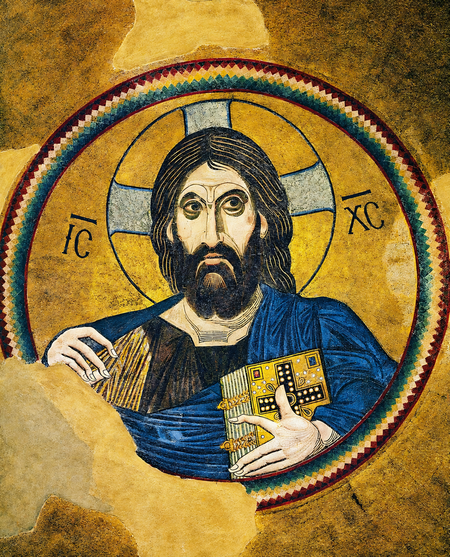
Mosaic «Christ Pantocrator.» Daphne Monastery, Attica, Greece. Circa 1100.
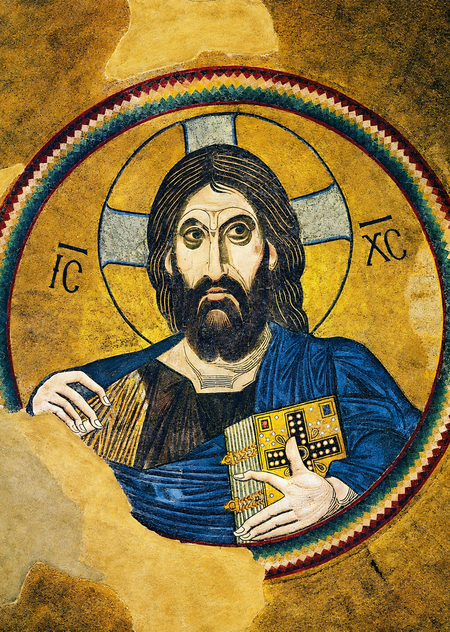
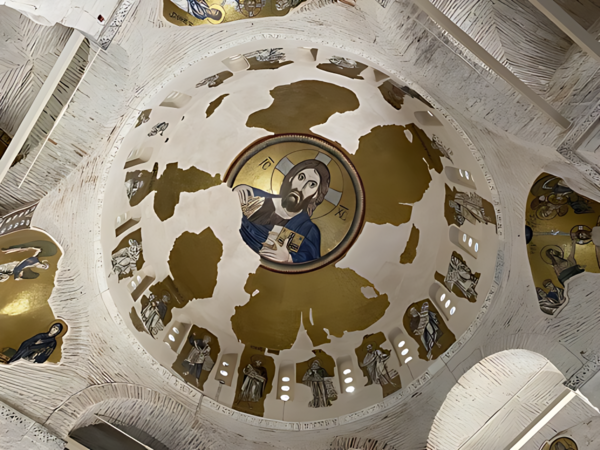
The Pantocrator in Daphne is located at the center of the dome, depicted surrounded by prophets. His eyes are cast downward, directing the viewer’s gaze toward him. Like the preceding figures, Christ seems to guide your attention toward the subsidiary images.
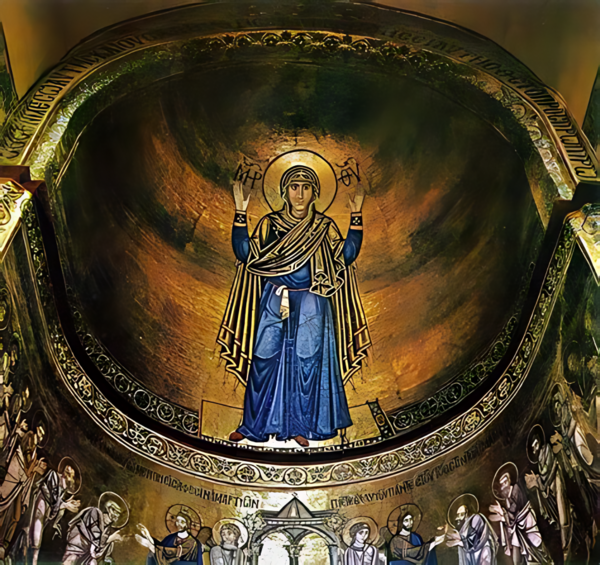
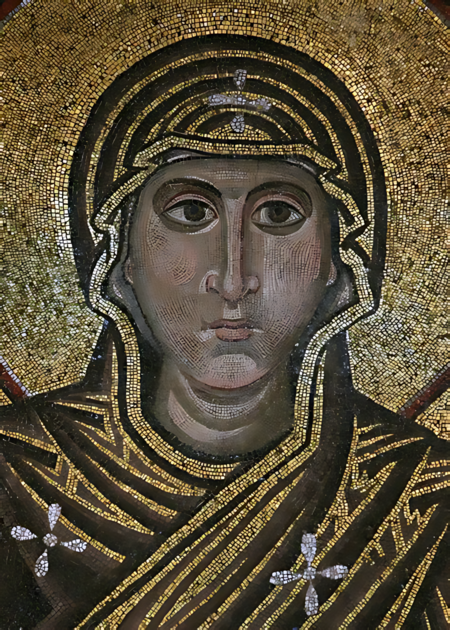
Mosaic of the «Orant Mother of God.» St. Sophia Cathedral, Kyiv. 11th century. Fragment.
The mosaic of the Orant Mother in the altar apse of St. Sophia’s Cathedral in Kyiv stands 5.45 meters high. In a posture of prayer, she raises her arms—her gaze and body oriented toward the viewer. Her stare is direct, yet its meaning is not immediately clear: the heroine stands not only before those who pray, but she herself is also praying to the image of the Almighty Christ on the dome.
Fresco, «Christ in Glory.» Apse of the Church of San Clemente de Taüll, Catalonia. 1123. Currently housed at the National Art Museum of Catalonia, Barcelona.
In the apse of the Church of San Clemente, Christ in Glory is depicted looking directly forward. There is no volume comparable to that found in Byzantine style works; the eyes are very large and outlined with a dark line. The gaze is created not through facial sculpting, but through contrast and outline. The engagement with the viewer is still present, but here it is shown through graphic rather than painterly means.
In all the figures considered, they hold a central position, are distinguished by symmetry and scale, and a direct gaze toward the viewer underscores their importance. The latest work sharply contrasts with the others, illustrating the difference between the Romanesque tradition and the Byzantine: graphic contour and simplified forms instead of detailed mosaic sculpting of the face. However, they unite in their gaze toward the viewer, even though it is constructed differently.
A Look Without Dialogue
This chapter will discuss figures whose gazes are directed past the viewer, yet remain focused forward. The figures are arrayed in a single line, looking into the space where the action takes place. Such a gaze establishes a certain hierarchy within the composition rather than engaging in dialogue with us.
Mosaic of «Emperor Justinian with his Entourage.» Basilica of San Vitale, Ravenna. 6th Century.
On the Justinian panel in the apse of San Vitale, the emperor is depicted in the center, surrounded by his subjects: warriors, priests, officials, bishops, and other courtiers. The figures are closely arranged in a line. One can discern role and status only by their clothing and halos. While the figures look forward, the dialogue is clearly not directed at the viewer, and the next work will prove this.
Mosaic of «Emperor Justinian with his Entourage.» Basilica of San Vitale, Ravenna. 6th Century. Fragment.
The faces of the entire procession share a common structure and set a unified rhythm: straight noses, oval face shapes, and large eyes with dark outlines. The gaze is no longer meant to express a specific emotion, but rather to convey the uniformity of intention and purpose of the figures—their participation in the ceremony. Individuality is irrelevant here.
Mosaic «Empress Theodora with her Entourage.» Basilica of San Vitale, Ravenna. 6th Century.