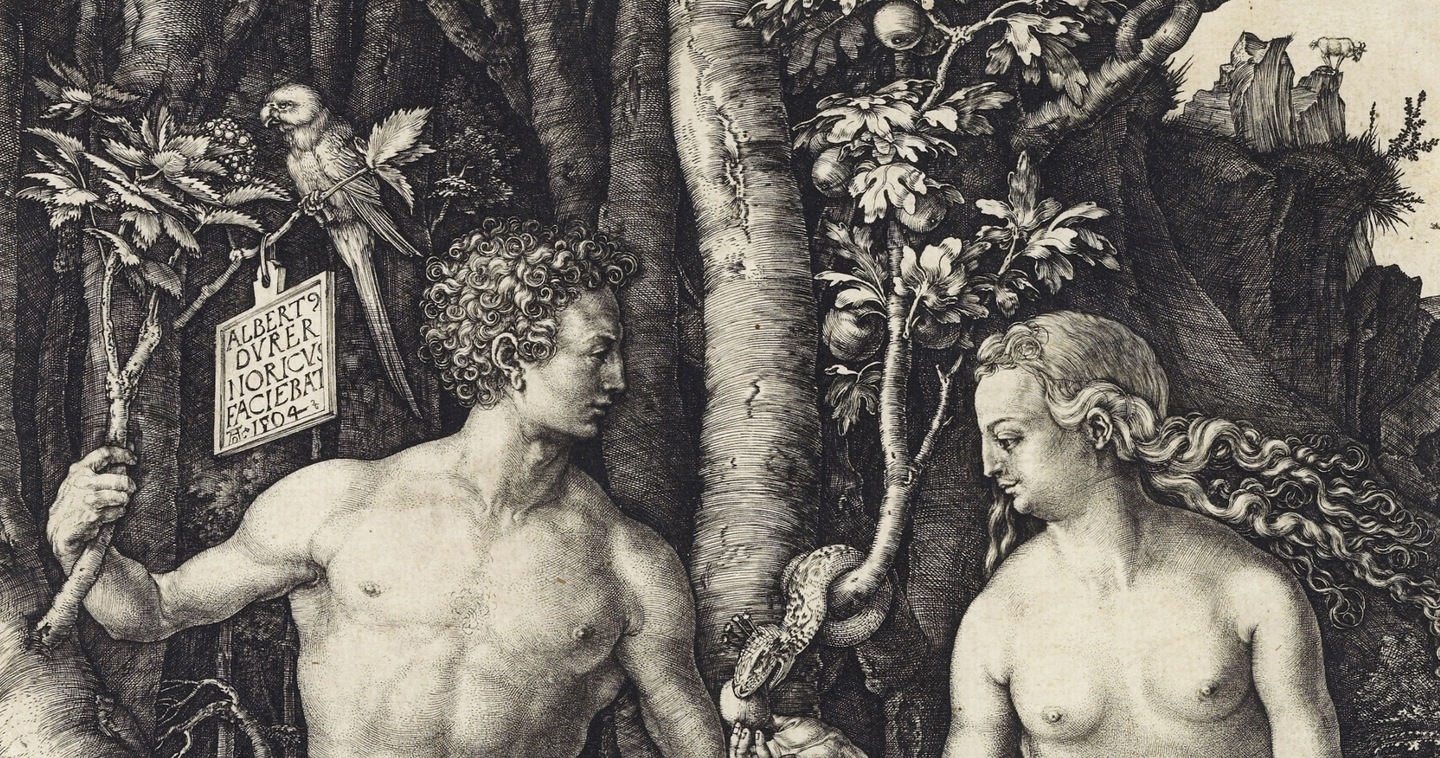
When viewing large engravings up close, we cease to see the subject matter. Only the lines remain—and through them, one can understand that what is before the viewer is not simply objects, but different ways of applying hatching to a surface. The stroke communicates the material before we have a chance to notice the object itself. This led me to wonder: what if hatching is not just a technique, but a language through which an object can tell its own story?
I. Hypothesis
Hatching in Western European engravings from the 15th to 17th centuries is not merely a technique for applying tone or a means to render light and shadow; it is an autonomous system where the direction, density, and rhythm of the line form a distinct voice for the material. The line does not depict a surface—it embodies it, communicating its physical properties before and independently of whatever is being represented.
II. Research Objective
Demonstrate how hatching in 15th–17th century engravings functions as an independent material language, and trace how this handwriting evolves from master to master and from era to era.
Navigation
I. Hypothesis II. Research Objective III. Object and Subject of Research IV. Visual Analysis and Selection Criteria V. Material as Language VI. Handwriting Changes VII. Line as Temperament VIII. Conclusion and BibliographyA topical guide was incorporated into the research paper to ensure comfortable navigation and a clear sequence in the development of hatching techniques in engravings.
III. Research Subject and Object
This work explores Western European woodcut and etching from the 15th to 17th centuries as the historical foundation for printmaking. The investigation focuses on hatching as an autonomous visual system that forms the «handwriting» of the material—a combination of techniques (line direction, density, rhythm) that convey the physical properties of a surface regardless of the subject matter.
IV. Visual Analysis and Selection Principles
The artists and works have been selected based on the principle of demonstrative contrast. Each master serves a specific function in testing the hypothesis.Albrecht Dürer’s «Adam and Eve» illustrates how line work differentiates materials within a single print.Lucas van Leyden and Rembrandt van Rijn demonstrate how the same material—fabric—is «signed» differently depending on its historical and individual context. Furthermore, Rembrandt captures the extreme points of the evolution of line grammar—from regularity to freedom.Albrecht Dürer’s «Melencolia I» becomes the culmination, where line work transcends the description of material and becomes an expression of temperament.Thus, the selection is governed not by chronology, but by the logic of proof: each subsequent master refines and strengthens the argument of the one before.
V. Material as Language
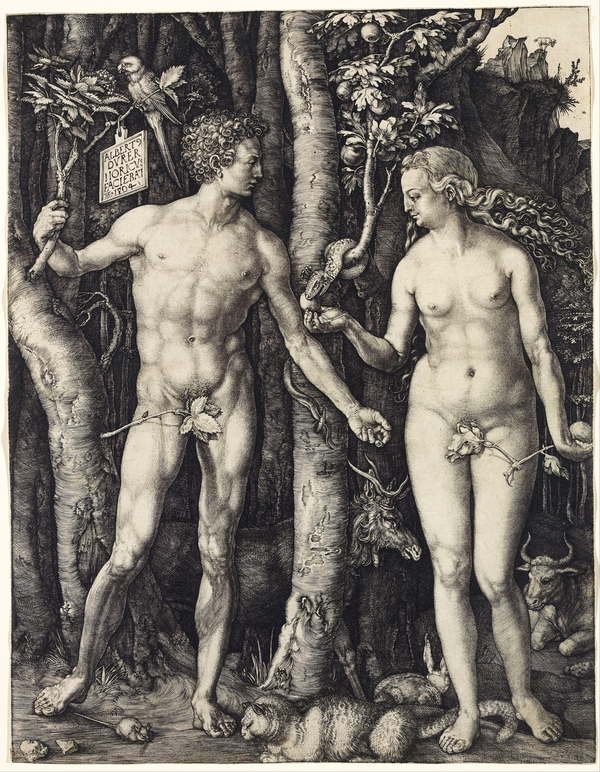
As an example to support this hypothesis, Albrecht Dürer’s engraving «Adam and Eve» was chosen. Not because it is a canonical work, but because five distinct materials—leather, foliage, stone, hair, and snake skin—are all present on a single sheet. Each of these materials «speaks» in its own language of line. Relying on the stated hypothesis, it should be discernible within this single sheet, executed by one hand and one burin, how the hatching describes the material rather than merely conveying tone.For a detailed study of the lines and hatching, I selected specific fragments of the work: the depiction of Adam’s skin, the stone, the foliage, and Eve’s hair.
The fragment depicting Adam’s body presents the viewer with rounded, soft lines that are sometimes slightly curved. They do not form a rigid grid but seem to «breathe, ” following the contours of the form. In areas of flexion, the hatching becomes denser yet retains its roundness.
In contrast, an image of rocky terrain is employed. Hard, parallel, almost architectural lines are used; they create a regular structure reminiscent of masonry or a facet.
Unlike the skin, these lines do not curve but run straight, intersecting at various angles.
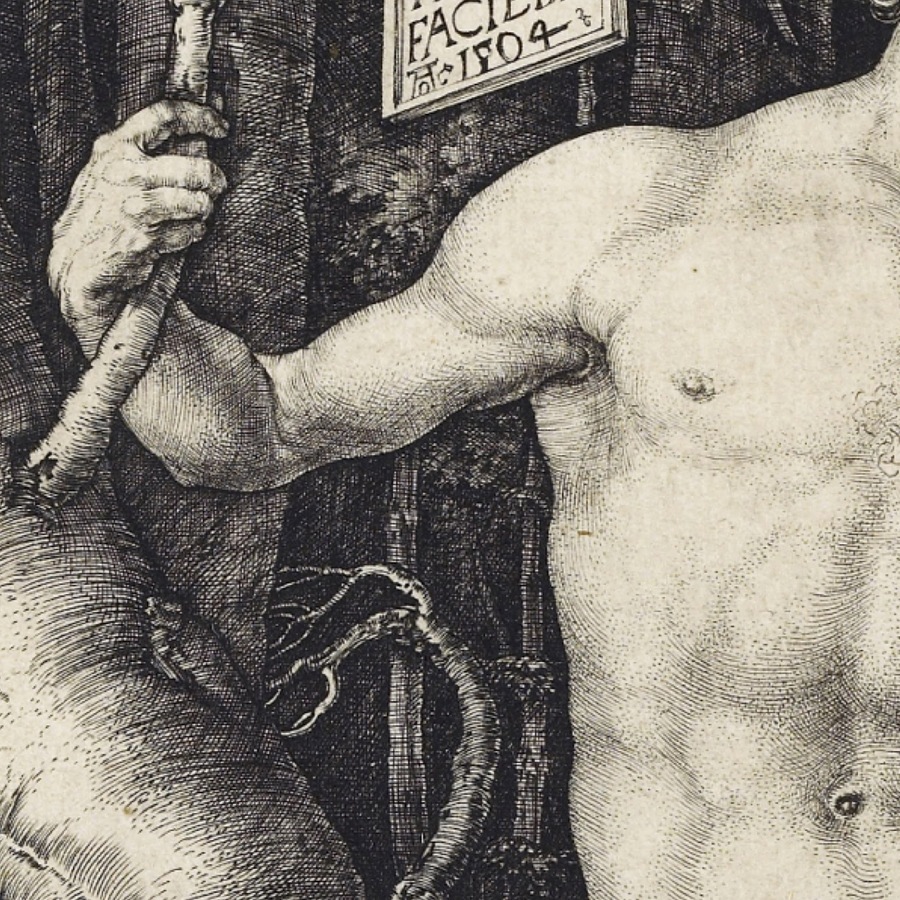
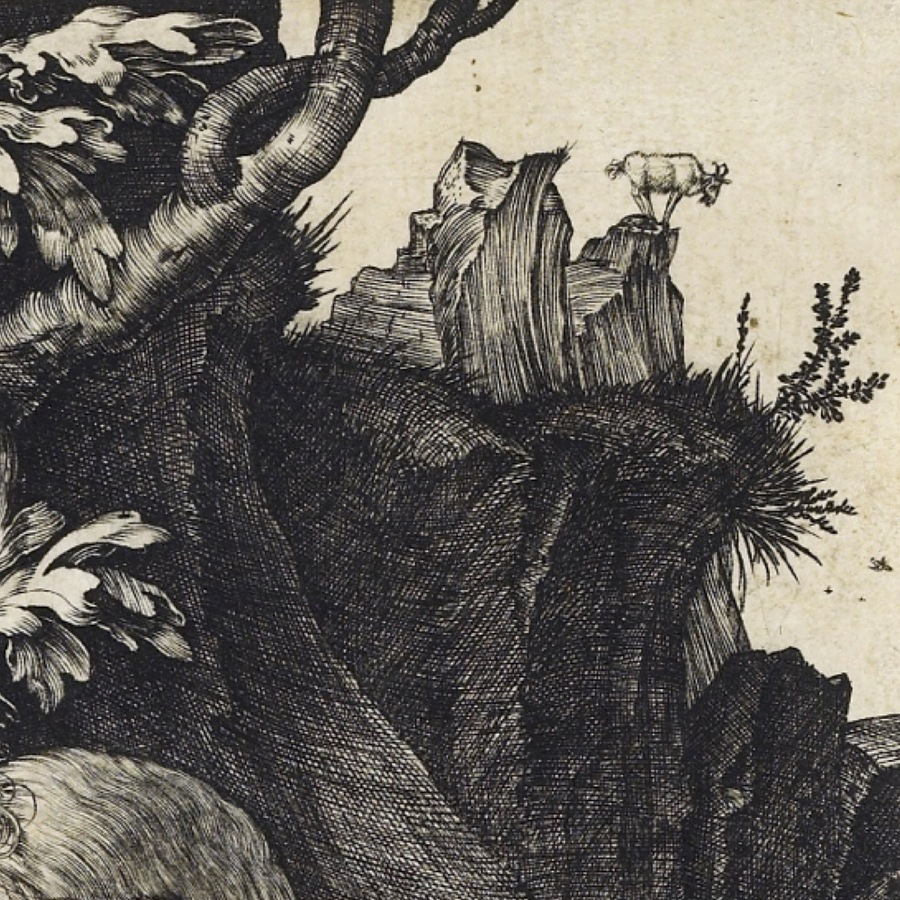
Fragments. Albrecht Dürer, «Adam and Eve.» 1504
In Albrecht’s fragment, the depiction of foliage features short, chaotic, and ragged lines. They do not adhere to a single direction but instead disperse. Unlike stone, there is no regularity; and unlike skin, there is no smoothness. In the depiction of Eve’s hair, conversely, the lines are thin, curly, and almost calligraphic. They form long, smooth loops, and like the foliage, they do not follow the volume but instead create their own rhythm.
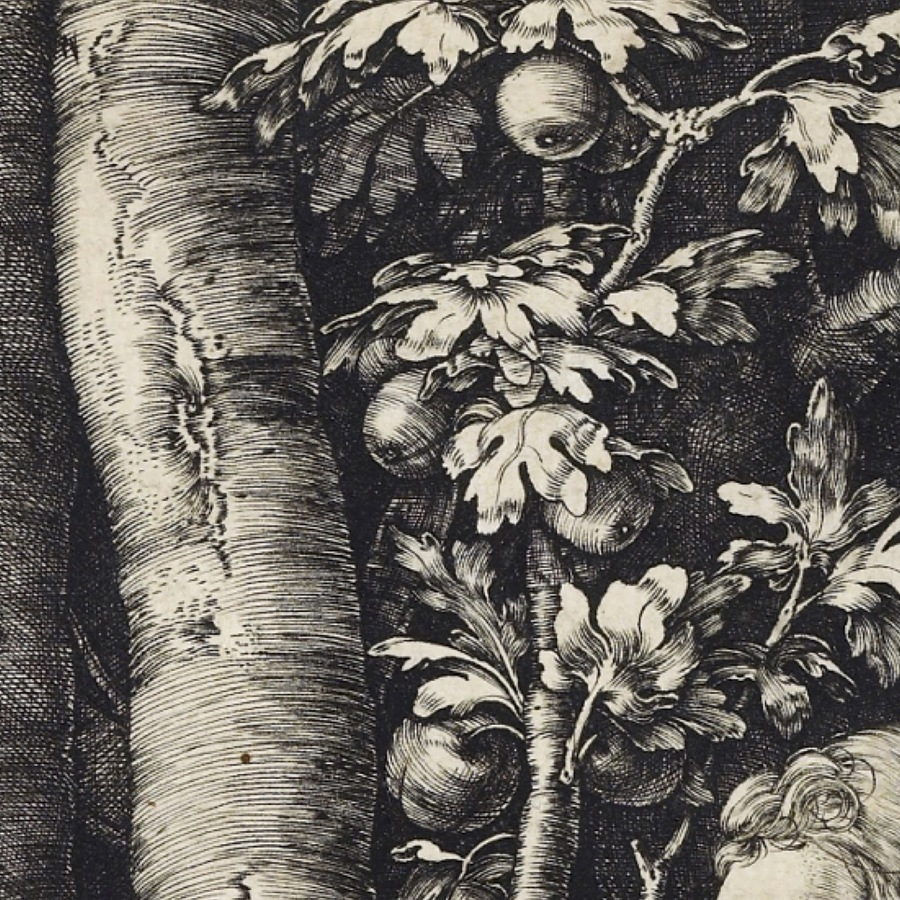
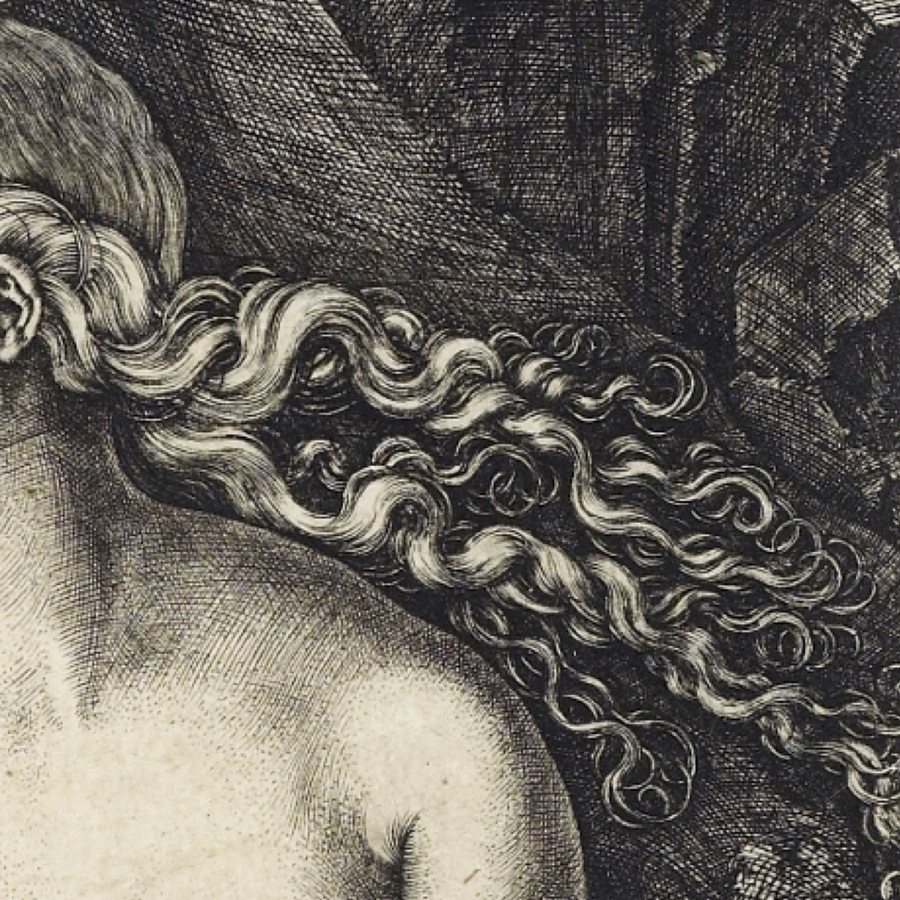
Fragments. Albrecht Dürer’s «Adam and Eve.» 1504
On a single sheet by Dürer, it is evident that hatching functions not as a secondary tool for rendering light and shadow, but as an autonomous language. Skin, stone, foliage, and hair are described using different line types, allowing the viewer to perceive the material’s physical properties: softness, hardness, looseness, fluidity. This happens long before the viewer can consciously register what they are looking at. This is the first argument supporting the hypothesis: hatching does not depict the material—it «signatures» it.
VI. The Hand Changes
Having refined the hypothesis from one perspective, we move on to the next. The manner of the brushstroke should be not only a differentiator between materials but also between masters. The individual character of the stroke should manifest not just in the difference between materials, but also in the difference between the artists.Therefore, here I use the same material—fabric—and examine how it is rendered by two painters from different traditions: the Dutchman Lucas van Leyden and the Dutchman Rembrandt van Rijn. If the fabric is read differently by each artist, it means that the stroke is not a universal code, but a language that changes historically.
For the analysis, the engraving «Resting Pilgrims» by Lucas van Leyden from 1508 was selected.
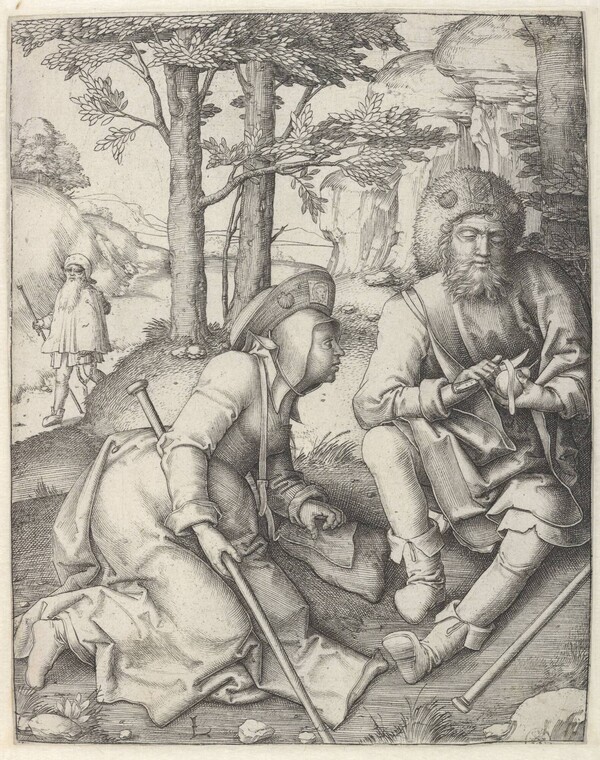
Full-scale work. Lucas van Leyden. «Resting Pilgrims.» 1508
Lucas’s drapery is constructed through the cross-hatching of lines: a fine mesh in the illuminated areas, and a deeper, looser pattern in the shadows. The line does not make the surface look metallic; rather, it softly creates the folds, leaving air between the strokes. But most importantly, the line is subservient to the geometry of the fold: it follows its curve, repeats its ridge, and concentrates at the bend. The fabric reads as dense, heavy, almost sculptural—it holds its shape through its own weight.
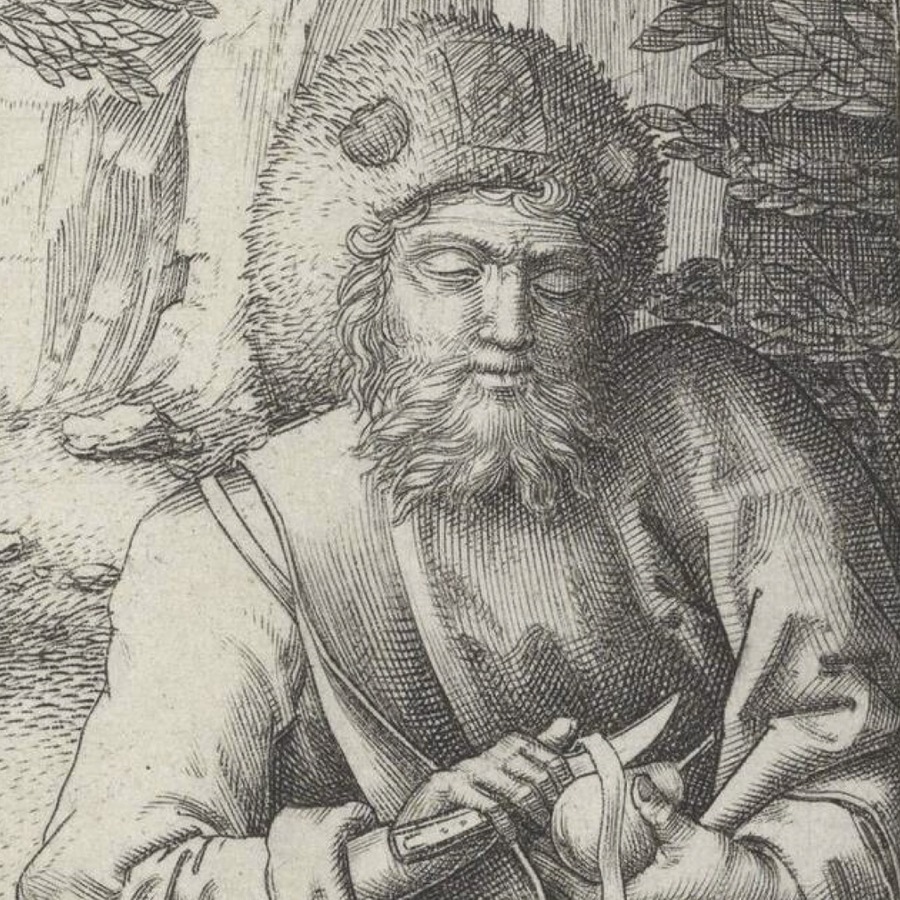
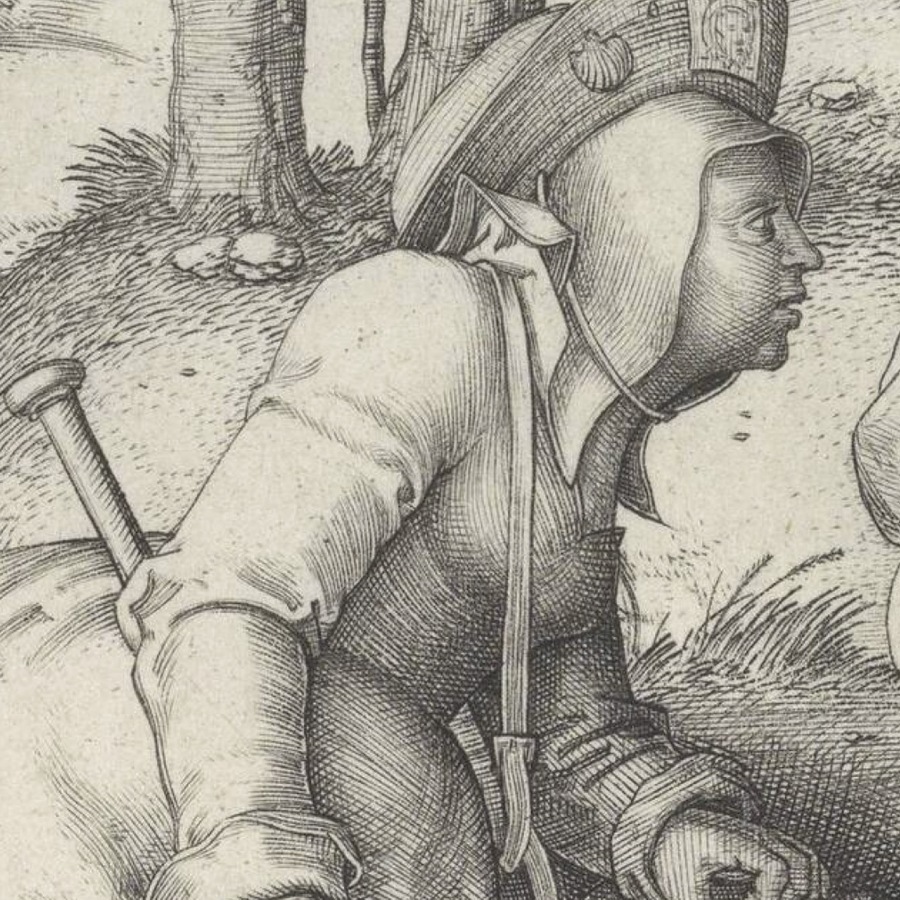
Work Samples. Lucas van Leyden. «Resting Pilgrims.» 1508
For contrast, Rembrandt van Rijn’s «Death of Mary» (1639) was chosen.
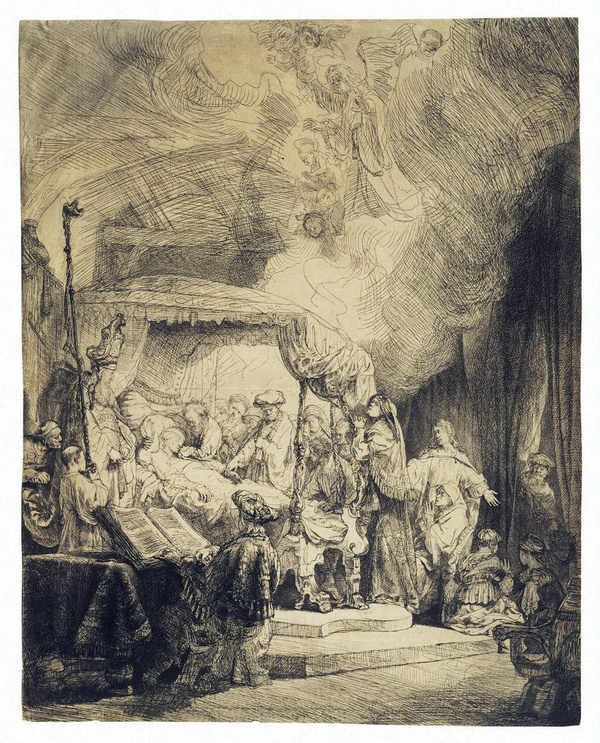
Full format work. Rembrandt van Rijn. «The Death of Mary.» 1639
Rembrandt operates differently. His brushwork is free, rarefied, sometimes almost vanishing. The lines do not form a rigid grid—they vibrate, governed not by the shape of a fold, but by light and atmosphere. The drapery of the sheets and Mary’s garments is read as a soft mass that does not hold a fixed shape but flows around the body and dissolves into shadow. In the shadows, the artist does not thicken the grid; he thins it, leaving a dark field.
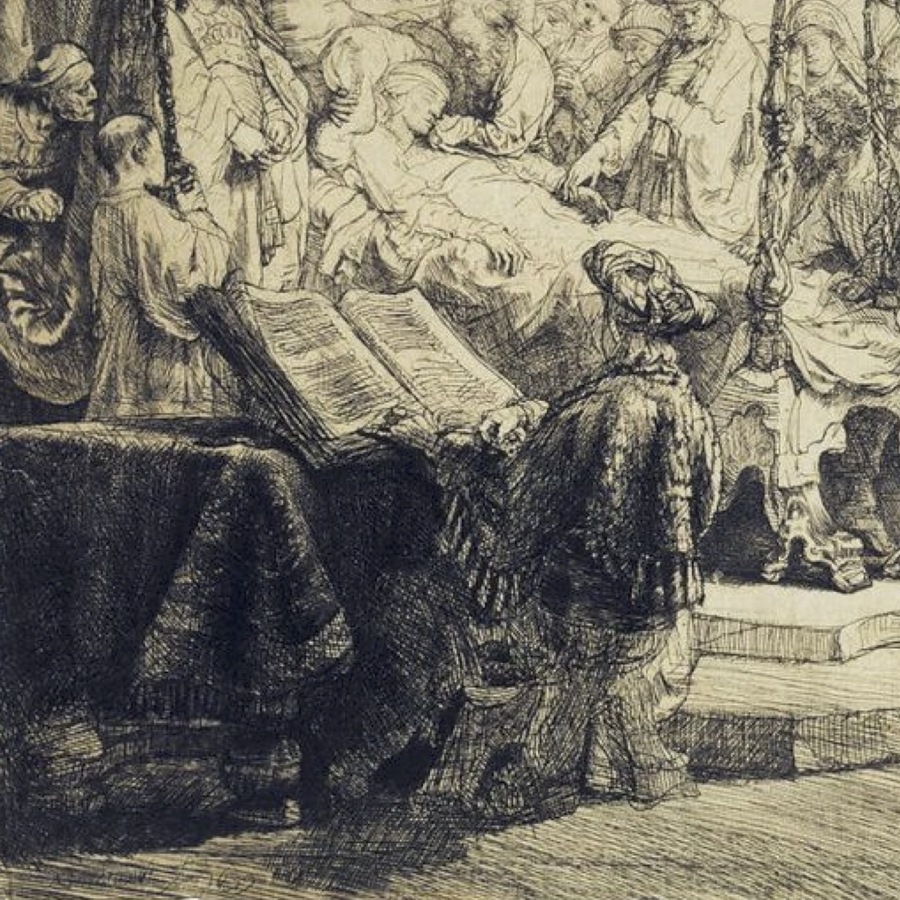
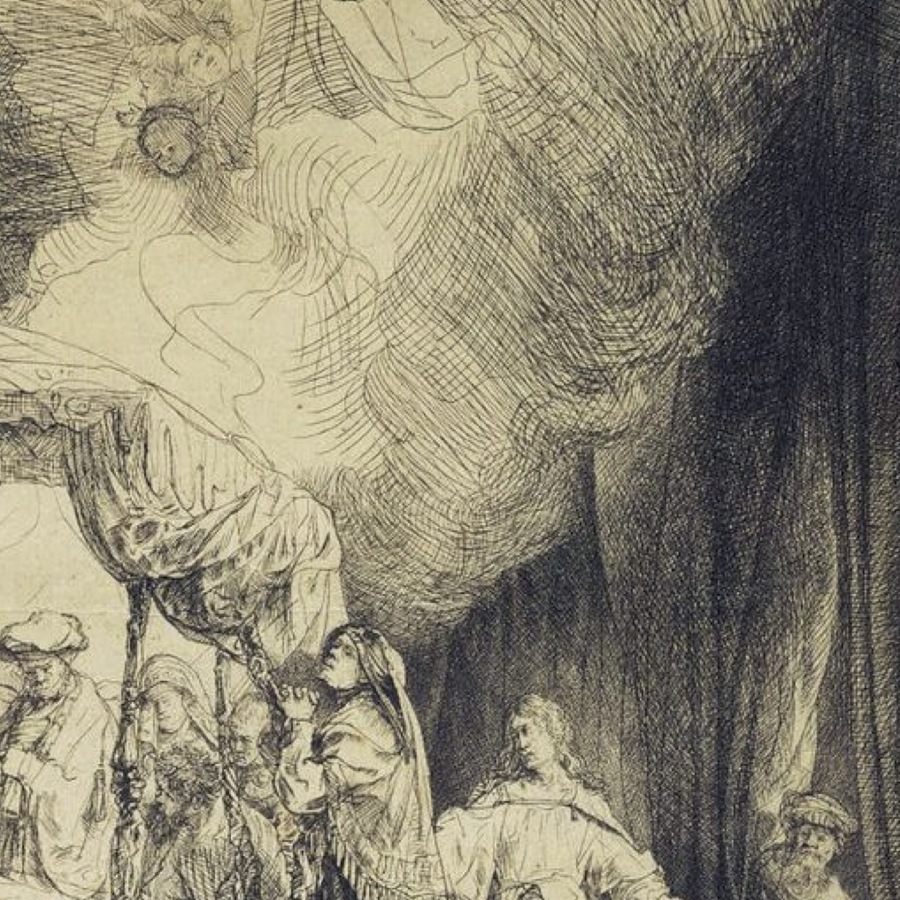
Fragments. Rembrandt van Rijn, «The Death of Mary.» 1639
Comparing the two engravings, one can conclude that fabric can be described in different ways: for Lucas van Leyden, the hatching gathers the surface into a dense, almost architectural fold, whereas for Rembrandt, it dissolves it in light. This means that line work is not a universal technical technique, but a historically mutable language. The «fabric’s texture» depends not only on what is depicted, but also on what the master subordinates the line to—form or light.