Effective advertising is a powerful tool capable of selling people anything—even things that aren’t always healthy or are sometimes even dangerous. This visual study examines exactly such a situation: how large marketing campaigns employed visual and rhetorical mechanisms to establish sugar as a «natural» part of children’s mornings, ultimately contributing to a generation of children struggling with overweight issues.
Navigation
1. Introduction
2. Section 1: Visual Environment: A Saturday Morning as a Sugar Display Window
1.1. Mascots as a Means to Distract from Sugar
Introduction
Why did the 80s and 90s become a «turning point» in sugar consumption culture?
To understand how deeply connected American children’s breakfasts have become with sugar consumption, one must look beyond the packaging on store shelves to what was shown on television screens and what scientific communities were broadcasting. The reason the 1980s and 1990s became a «point of no return» lies in the intersection of three key factors during that decade: the lack of regulation of children’s television advertising, the industry’s systematic use of «health-conscious» rhetoric, and the publication of studies by scientists who conducted fraudulent research and misled the public. Together, these three factors create a visual and cognitive imbalance: children and their parents see cheerful mascots on screens and on breakfast boxes with slogans promoting a wholesome, nutritious meal, while the contents of their bowls may be more than half sugar. First, the repeal of federal regulation in 1984 opened up vast opportunities for commercial companies to advertise high-sugar products. The Federal Communications Commission (FCC) eliminated limits on the length of commercial advertising in children’s television programs, leaving the amount of broadcasting up to market discretion. Before these measures, there were attempts to control the situation: in 1978, the Federal Trade Commission (FTC) initiated a rulemaking process that would have banned the advertising of high-sugar products in children’s TV programs aimed at children under 12. Otherwise, companies would have been required to include counter-advertising detailing the nutritional value of sugar-added products. However, these initiatives were halted under Congressional pressure. Ultimately, FTC staff acknowledged that the data gathered on the impact of sugar product advertising on children’s diets was insufficient to draw definitive conclusions, leading to the recommendation in 1981 to cease the development of these rules. In 1980, Congress further restricted the FTC’s authority to create regulations, after which the agency virtually ceased work on new rules in this area for a prolonged period. The withdrawal of regulatory authority meant that throughout the 1980s and 1990s, food advertising on children’s television faced virtually no oversight or restrictions.
Secondly, empirical data from 1991 revealed the consequences of that regulatory vacuum. The Center for Science in the Public Interest (CSPI) published a study that received widespread media coverage that year. Researchers analyzed four-hour blocks from five television stations in the Washington area (ABC, NBC, CBS, and affiliated Fox and Nickelodeon) on Saturday mornings, recording a total of 222 food product advertisements. Over 90% of these advertised low-nutrient items, such as sugary cereals, candy, chocolate syrup, cookies, potato chips, and fast food. Only eight were rated as «nutritious, ” including three low-sugar porridges, three frozen entrees, and two milk advertisements [1]. Even more striking is this comparison: in 1976, the ratio of high-sugar cereal advertising to low-sugar cereal advertising was 5 to 1, while by 1991, that ratio had increased to 17 to 1. CSPI Executive Director Michael Jacobson stated directly at a press conference that „they should be called candy for breakfast, not cereal“ [1]. Furthermore, data from the CDC-funded National Health and Nutrition Examination Survey in 1991 showed a significant rise in overweight prevalence among teens aged 6–17 during the period from 1976–1980 to 1988–1994, with overweight prevalence reaching 10,9% (based on the 95th percentile) [2]. The CSPI report links this trend to the impact of unhealthy food advertising, pointing out that over the past two decades, the rate of obesity among elementary school children has increased by 54%, and among teens, by 39%. Thirdly, sugar is systematically hidden in the product’s name and visual presentation. Take, for instance, Kellogg’s Honey Smacks. Its predecessor was called „Sugar Smacks.“ After the name change on the packaging, an image of honey-flavored flakes appeared, but according to the U.S. Department of Agriculture, the sugar content in this product remains 56.2 grams per 100g [3].
«Honey Smacks» Packaging, 1990s
This means that over half of the product’s weight is sugar. In the visual aspect of the advertisement, this fact is hidden behind the illusion of a complete breakfast: the text «Provides 8 essential vitamines and iron» and the cartoon frog in the image convey energy and happiness, rather than warnings about high sugar content. This strategy is effective precisely because the regulatory environment no longer requires this information to be indicated on the packaging. Based on the above, the main question that should be asked in this visual study is: what specific visual and rhetorical mechanisms were used in the breakfast cereal advertisement to make high-sugar products the «default choice» for American children? The study will examine three levels sequentially: the visual grammar of television advertising (how mascots, plots, and colors establish emotional connections and distract from ingredients), the «healthy» discourse on the packaging and in the advertisement (how honey, fruits, and vitamins «replace» sugar), and the absence of political and scientific evidence in the public eye (why the visual presentation of sugar and health risks did not appear on a single screen).
1. Visual Environment: A Saturday Morning as a Sugar Showcase
1.1. Mascots as a Way to Distract from Sugar
The core visual strategy of 1980s and 1990s breakfast cereal advertising was not to directly display the product’s ingredients, but rather to place a cartoon mascot at the center of the frame, positioning it as an emotional intermediary between the child and the product. The mascot acted as a «friend» on screen: it interacted with the child, shared a bowl of cereal with them—yet never mentioned that over half the weight in that bowl was sugar. This section analyzes, using specific examples, how this visual mechanism functioned.
Kellogg’s Honey Smacks: The visual substitution of «sugar» with «honey» and a mascot change
Let’s return to Honey Smacks—the most telling example of how branding and visuals mask the actual ingredients. The product was first released in 1953 under the name Sugar Smacks and was already the sweetest breakfast cereal on the American market, containing about 56% sugar by weight. In 1981, Kellogg’s renamed it Honey Smacks precisely to «soften the perception of its sweetness, ” even though the formula did not change. Furthermore, honey is present in only trace amounts in the composition; according to the ingredient list, sugar and dextrose make up at least two-thirds of the product’s sweet content.
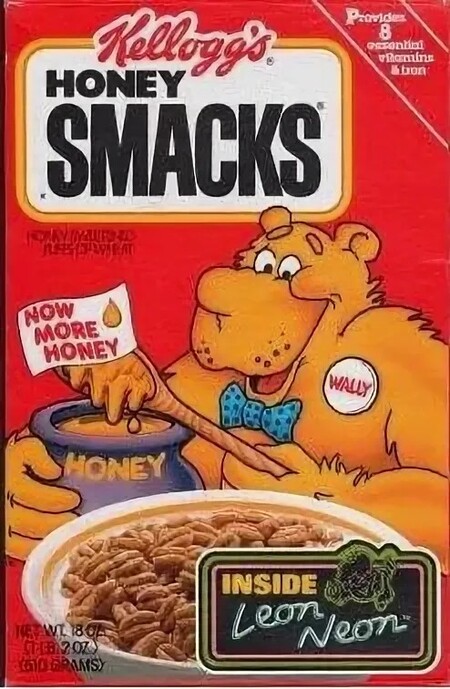
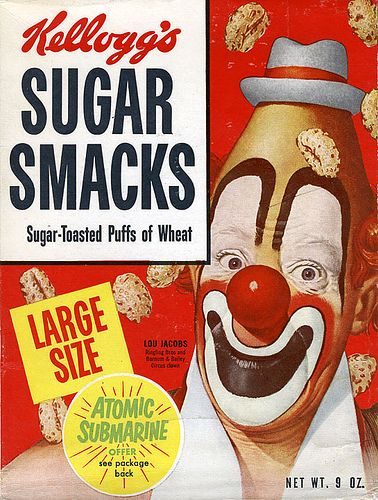
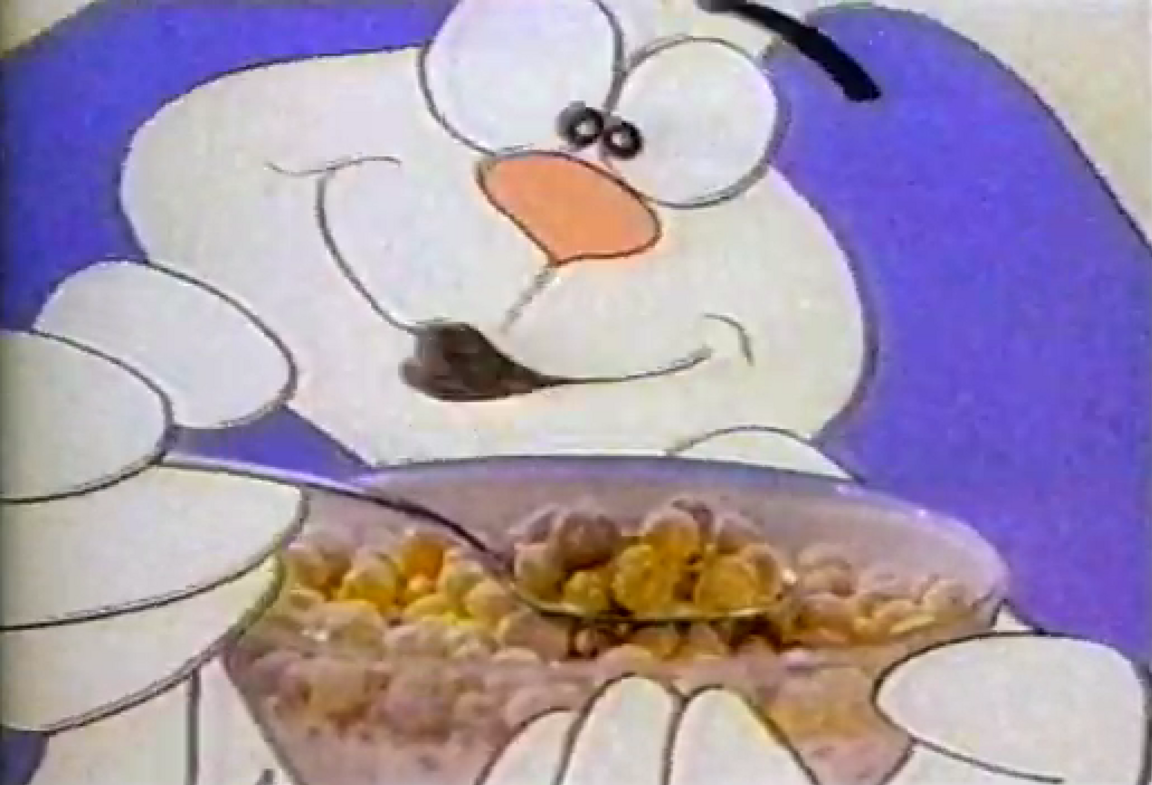
Wally the Bear, 1986, Cliffy the Clown, 1950s
The visual result of this renaming was immediately reflected in the packaging and advertising compositions. «Sugar» disappeared from the name, replaced by «Honey, ” which brought with it bees, jars of honey, and other „natural“ imagery to create a visual illusion of natural sweetness. Concurrently, the choice of mascot was changed to align with the product’s positioning. Since 1972, the face of the product had been Dig’em Frog (a frog wearing a baseball cap), who remained in the initial years following the renaming. In 1986, Kellogg’s briefly replaced him with Wally the Bear—specifically because the bear is more strongly associated with honey than the frog. Due to consumer dissatisfaction, Dig’em returned the following year.
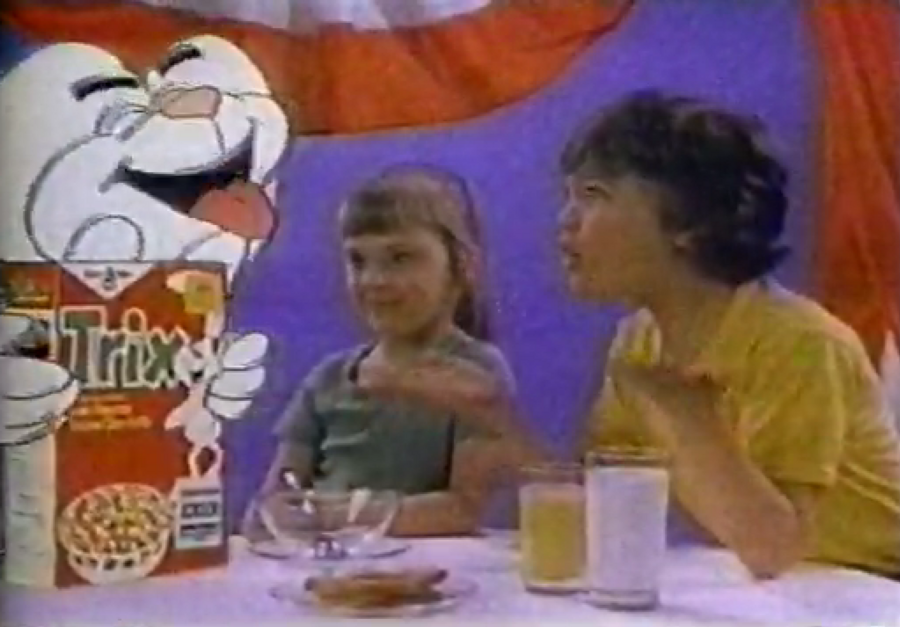
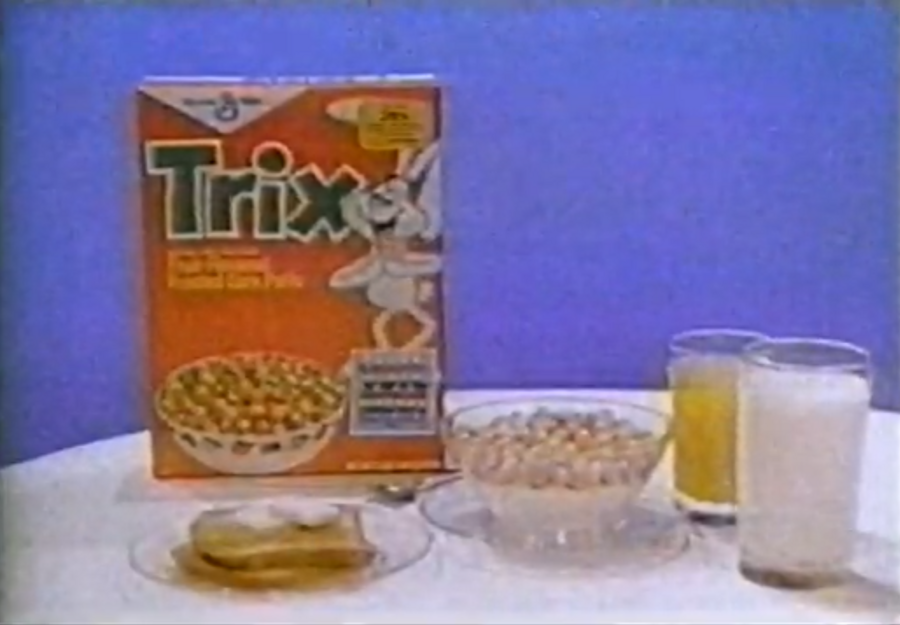
Trix Rabbit and Lucky the Leprechaun: The Visual Narrative of the Chase and Protection
Trix and Lucky Charms advertisements are constructed according to the same rigid schema: the mascot either strives to acquire the cereal (Trix Rabbit) or protects it from others (Lucky the Leprechaun), while the child is always positioned as the «owner.» This structure places the bowl of cereal at the center of the frame—all of the mascot’s actions are directed toward the bowl, but never toward its contents.
Trix Rabbit in 1980s advertisements repeatedly attempts to obtain the bowl of Trix, failing each time to the voiceover, «Silly rabbit, Trix are for kids.» The rabbit’s mere desire serves as visual confirmation of the product: he does not deliberate on nutrition; he simply demonstrates «want.» Lucky the Leprechaun guards Lucky Charms with colorful marshmallows—the «magic» in the advertisement originates from the shapes of the marshmallows (hearts, stars, clovers, shamrocks), not from any claims of health benefits.
Bibliography
- Los Angeles Times Report. 1991 / https://www.latimes.com/archives/la-xpm-1991-06-04-fi-295-story.html
- Official Statistical Document from the National Center for Health Statistics (NCHS) / https://pubmed.ncbi.nlm.nih.gov/9072680/
- USDA National Nutrient Database for Standard Reference, Basic Report 08071: Cereals ready-to-eat, KELLOGG, KELLOGG’S HONEY SMACKS
Image Sources
- https://forums.justcommodores.com.au/attachments/this-was-the-sugar-smacks-mascot-in-the-50s-maybe-weve-been-a-little-too-harsh-on-older-genera-jpg.241035/?__cf_chl_rt_tk=CzKAU0I9TVHFGnIztH4r5T0UPTcF9xFlPbPFJ6caVS0-1794414439-1.0.1.1-pHslN6GRqrem1PHsBetA1gqbmFv5Q8R.UXisV.NcAzU
- https://forums.justcommodores.com.au/threads/pic-of-the-day-thread-read-rules-in-first-post-before-posting.254811/page-1762?utm_medium=organic&utm_source=yandexsmartcamera
- https://ru.pinterest.com/pin/419538521510002057/