Concept
The star is a persistent motif in European art, appearing across various historical periods and artistic traditions. It can be found in mosaics, frescoes, icons, reliefs, and illuminated manuscripts, featured in diverse religious narratives, whether functioning as an independent symbolic element or as part of a more complex composition. Furthermore, the star motif is not uniform: its interpretation and artistic realization depend on the historical context, iconographic tradition, and the specific subject matter of the artwork.
My interest in this topic has both personal and academic roots. While the star is often perceived as a secondary element of the background, in medieval art, it frequently assumes the role of the primary semantic and compositional focal point. Moreover, the star has long resonated with me as an image of magic and destiny—a motif I frequently draw upon in my own work. I wish to explore how this profound symbolism developed over the centuries and how masters of the past employed this sign.
In some works, the star becomes part of the celestial space in the image; in others, it surrounds the cross in an apse composition, accompanies sacred figures, or guides the Magi.
The same motif can take on various meanings and artistic characteristics depending on the narrative, its placement within the composition, and the tradition in which the work was created.
My hypothesis is that in each of the periods examined, the star is primarily assigned a specific role: an image of celestial space, a sign of presence, or a sign of event. This role can be determined by its position, size, and surroundings.
These roles do not succeed each other linearly; instead, they coexist—only the dominant one shifts.
The core research question is: what specific characteristics of the star image can be identified in early Christian, Byzantine, Romanesque, and Gothic art of the 4th–14th centuries, and by what factors is its role in the composition determined?
The research is divided into three chapters because it was particularly important for me to demonstrate how the focus shifts in interpretations of this image from one period to the next. This justifies my choice of a chronological approach to the analysis. To provide a complete picture, my work covers a wide range of pieces—from early Christian mosaics and sarcophagi to Byzantine icons and Western European stained glass.
Material Selection Principle For me, the principle of material selection is based on visual diversity. In my visual study, I do not limit myself to single images; rather, I assemble material into thematic collages and comparative sequences. The body of work includes monuments where the star is read as an independent motif. To clearly show its form (rosette, disk, comet) and its placement within the composition, I compare general views of the works with detailed fragments. This approach allows one to see how the specificity of the image unfolds through different media in each era.
Principle of Choosing and Analyzing Textual Sources The principle of choosing and analyzing textual sources relies on authoritative art historical literature and scientific databases. To understand the iconography, I consult foundational works on medieval art and Christian symbolism. For each piece, I verify that the dating is confirmed by scholarly descriptions, and that the star in the image is discernible and not obscured by rays, a cross, or ornamentation. Some monuments are shown in multiple frames (overall view, fragment, detail) to dissect the structure of the composition.
Chapter I. Space and Pointer: The Star in Early Christian Art
During the early Christian period, the star had not yet acquired complex narrative traits, but it was already clearly divided into two functions. On one hand, it shaped the sacred space of the temple; on the other, it became a precise symbol pointing to a specific Gospel event. This division is particularly evident when comparing monumental mosaics and sculptural reliefs.
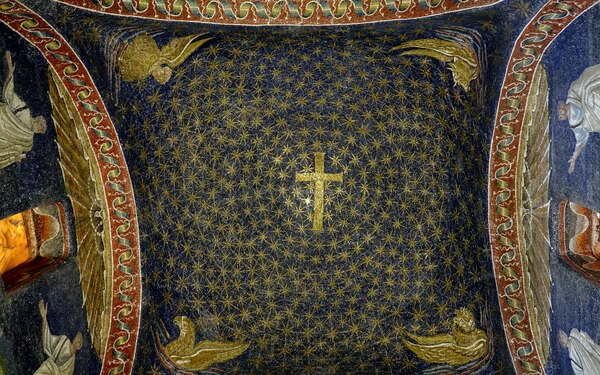
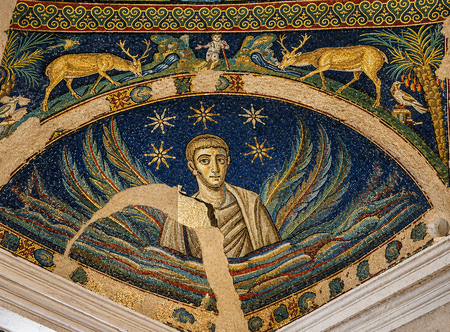
Mausoleum of Gallus Placidia, Ravenna. «Dome with Starry Sky, ” c. 425–450 — fragment // Baptistery of San Giovanni in Fonte, Naples. „Starry Sky, ” late 4th—early 5th century — fragment
Please note how the space is organized differently in these two domes.
In the mausoleum of Gallus Placidus, stars transform into a dense geometric pattern, creating a continuous, shimmering carpet around the golden cross. In the Neapolitan Baptistery, the rhythm shifts: here, the stars are larger and more sparse, accentuating the central figure.
In both mosaics, the artist forgoes realistic rays in favor of an abstract pattern. Thanks to the mosaic technique, the surface reflects light and shimmers, creating the image of an infinite, sacred cosmos.
Here, the star functions not as a specific object, but as an environment that immerses the viewer in cosmic space.
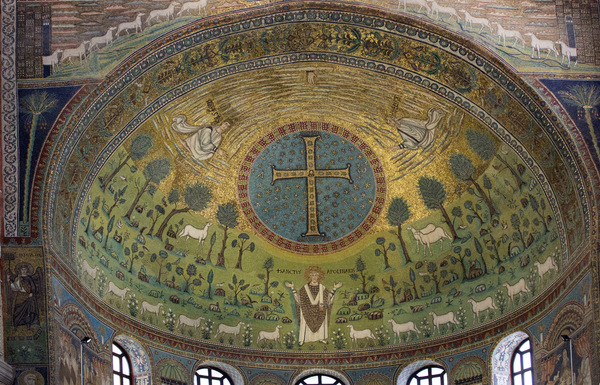
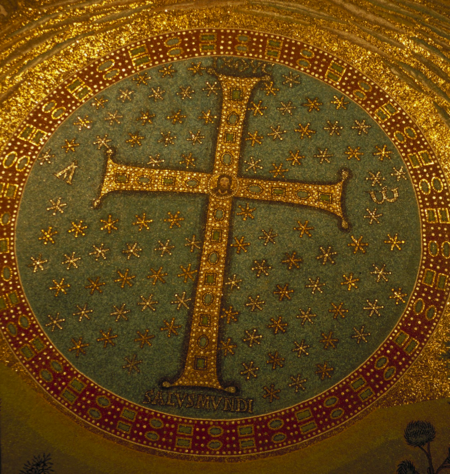
Sant’Apollinare in Classe, Ravenna, fragment, circa 549 AD
The same function—creating a sacred space—is fulfilled by the star in the apse of the Basilica of Sant’Apollinare in Classe in Ravenna, but here the composition takes on a theological meaning.
Stars surround a large golden cross, forming a radiant medallion.
In this mosaic, the star does not function as an independent background but as a sacred frame for the main symbol.According to the Gospels, Christ told his disciples about His Second Coming when «the sign of the Son of Man will appear in heaven» (Matt. 24:30). The Church Fathers understood this sign to be the Cross.
Thus, the starry sky in this work is not merely outer space, but the sky of the end times, awaiting the Second Coming.
The stars emphasize the solemnity of the moment, and the Cross becomes the center of this sacred space. [2]
The star unfolds in sculpture in a completely different way. Here, it ceases to be a backdrop and becomes a concrete symbol of an event. Consider the sarcophagus from the necropolis of Saint Agnes in Rome:
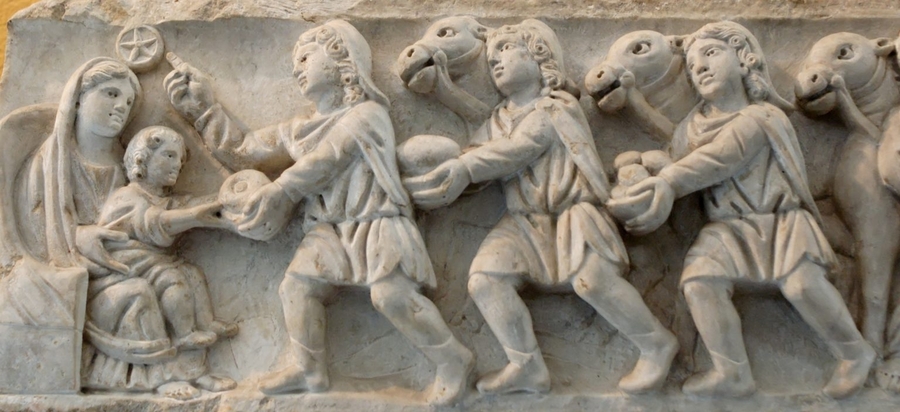
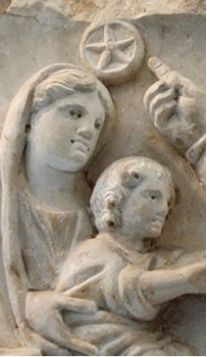
Sarcophagus from the Necropolis of Saint Agnes, Rome. «Worship of the Magi,» 4th century—fragment // Relief fragment depicting the Magi pointing to the star
The star becomes the compositional center of the scene.
Due to the properties of stone, the sculptor cannot convey a shimmering effect, so it transforms into a laconic convex rosette. Furthermore, the first wise man dramatically points to it with his hand, directing the viewer’s gaze.As researchers note, the poses of the wise men and their gestures of presenting gifts are derived from ancient iconography depicting the presentation of gifts to an emperor, which lends the scene a special solemnity [1].
The star here functions not merely as a celestial body, but as a signifier of an event toward which the characters’ gazes and movements are directed.
Where it created celestial space in the mosaic, it operates as a pinpoint indicator in the relief.
If a star functions as a large navigational sign in a marble relief, demanding a gesture, then in small-scale sculpture, it acquires an even more graphic and precise character. Let us consider the carved ivory plaque:
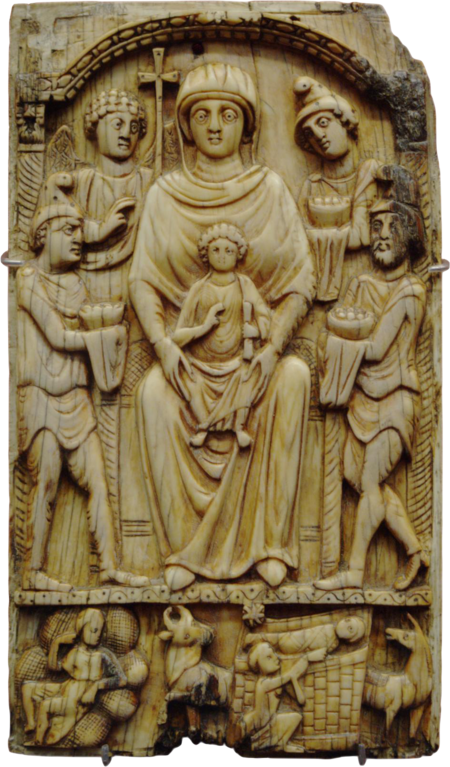
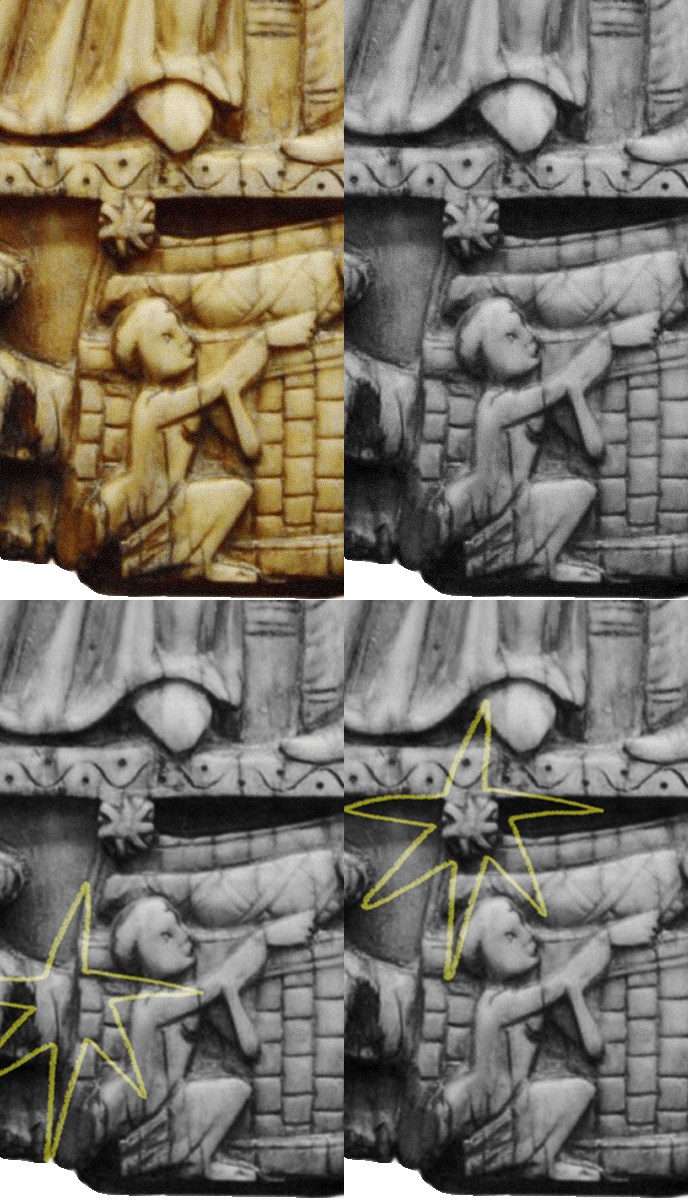
«Adoration of the Magi and Christmas» (plaque), c. 500–550 — fragment
The composition of the panel is intentionally divided into two registers. This division creates a semantic contrast.
At the top of the altarpiece, the Magi have already arrived with their gifts, and an angel holds a cross. The journey is complete, so there is no star here—it has already fulfilled its role. Now, let’s cast our gaze to the lower register. This depicts the Nativity itself: the Infant in a manger between an ox and a donkey, with Salomea reaching out her hand toward him. As researchers note, the Star of Bethlehem appears directly above the Infant [3].
This technique excellently demonstrates how material dictates form. Intricate bone carving prevents the creation of a shimmering background, yet it transforms the star into a concise, almost graphic symbol.