Introduction
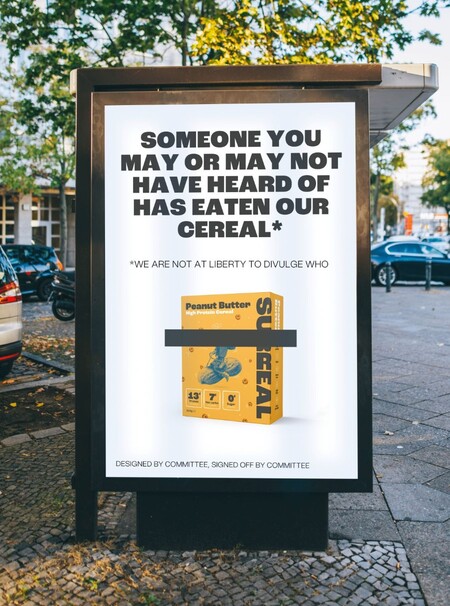
SURREAL is a British cereal brand launched in 2021. It takes a product from childhood, bright sugary cereal, and reimagines it for adults: high protein, low sugar inside, and a joke on the outside. Its positioning combines nostalgia and nutrition. The main audience is young urban adults who care about fitness but are bored of traditional clean-eating brands. They follow trends, enjoy memes, and pay a bit more for a product that feels modern and ironic.
SURREAL / Advertising / 2024
This project focuses only on one channel: SURREAL’s billboards and posters. This is where the brand’s strategy is clearest and where it goes viral. I look at two questions: how a billboard persuades a passer-by who has only a few seconds, and why it does not stay on the street but spreads across the internet.
Communication Channels
SURREAL has a very visible public presence built around a comedic voice. On social media its hub is Instagram, supported by LinkedIn and YouTube shorts, all of which are currently banned in the Russian Federation. The posts contain memes and bold minimalist visuals, and the account often reads like a comedy page rather than a cereal brand.
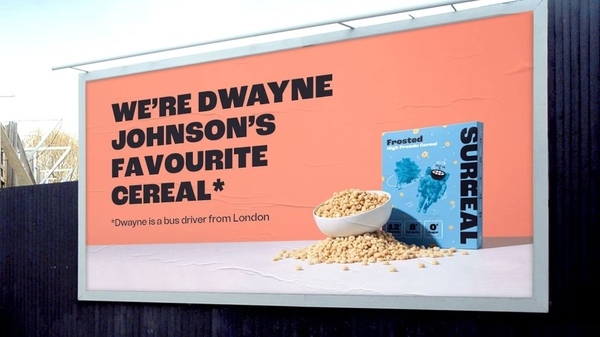
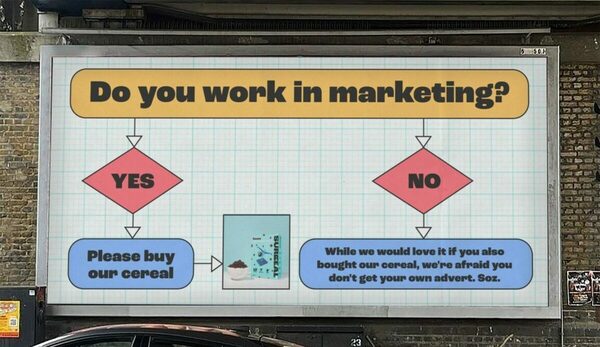
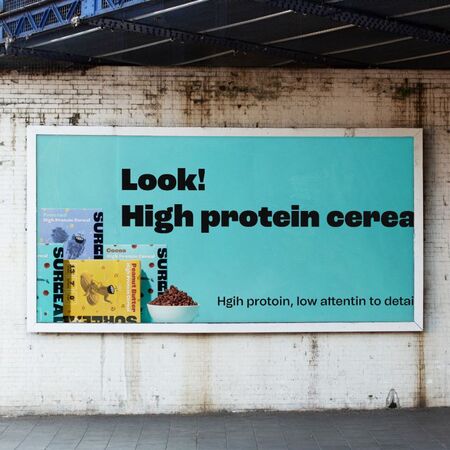
Beyond social media, SURREAL invests heavily in PR-driven out-of-home advertising. Its billboards are designed to be photographed and shared rather than to sell directly. Three campaigns stand out and form the evidence for this project: fake celebrities (ordinary people with famous names review the cereal under a tiny disclaimer), ads only for marketers (billboards that openly tell non-marketers to look away and mock advertising itself), and intentional typos (posters with deliberate spelling mistakes). In all of them the ad looks like a joke first and a promotion second, so people repost it and the press writes about it.
SURREAL / Advertising / 2025
Theoretical Framework
Let’s look at this brand using two theories from the course. The Elaboration Likelihood Model explains how a single billboard changes the attitude of the person who sees it. The Two-Step Flow Theory explains why that billboard reaches millions. Together they cover both halves of the question: how the message persuades, and why it travels.
Elaboration Likelihood Model
Petty and Cacioppo describe two routes of persuasion. The central route happens when a person is motivated and able to think; they process the real arguments and form a strong, stable attitude. The peripheral route is a shortcut: when people lack motivation or time, they rely on simple cues instead of the argument itself.
The model is often illustrated with several cues, including liking (an attractive or famous source), social proof, authority, scarcity, and novelty. Because we see thousands of ads a day, the peripheral route fires far more often than the central one. A billboard is a textbook low-elaboration case, since a passer-by did not choose to look and sees it for only seconds, so peripheral cues do the persuasive work.
Two-Step Flow
Lazarsfeld and Katz describe a message moving in two stages. First, opinion leaders receive it from the media; then they interpret it and pass it on to others. Opinion leaders are people who follow the media closely, have the competence to read it, and are well connected. For SURREAL these are marketers: they recognise the techniques, photograph the billboard, and spread it through their networks. The «only for marketers» campaign is literally a billboard aimed at opinion leaders.
Analysis
Fake celebrities
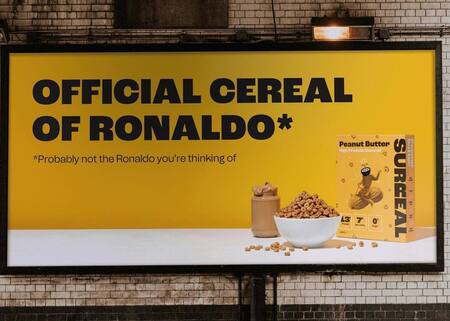
The campaign works through the peripheral route as described in the ELM, and specifically the liking cue: a famous name carries a positive attitude that the viewer transfers to the product before reading anything. The tiny disclaimer then reverses the name into a joke. No argument about protein is needed; the surprise alone creates a weak positive attitude. The «high protein, low sugar» line sits small and secondary, exactly as the model predicts for low attention.
SURREAL / Advertising / 2023
From a diffusion perspective, the campaign also strongly aligns with Two-Step Flow Theory. Marketers recognised a clever, cheap endorsement trick and shared it as a case study; the press covered how SURREAL got Dwayne Johnson and Serena Williams without paying fees. These opinion leaders carried the billboard far beyond the streets.
Only for marketers
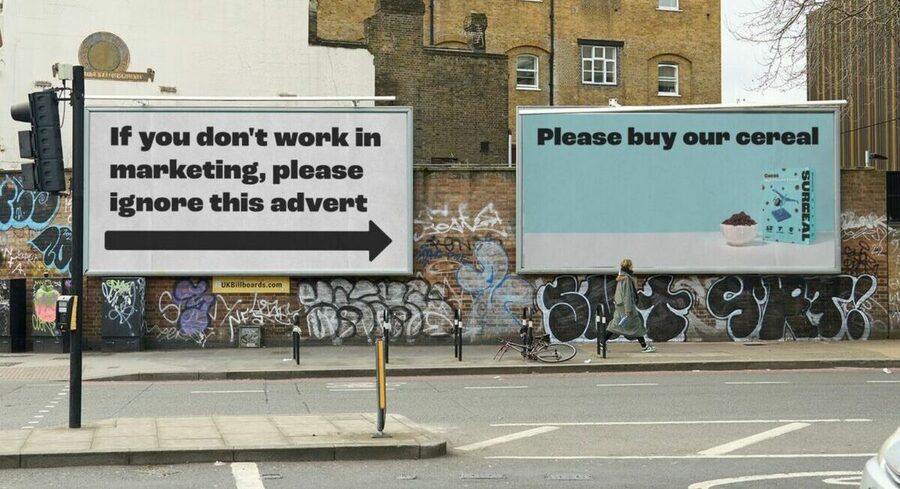
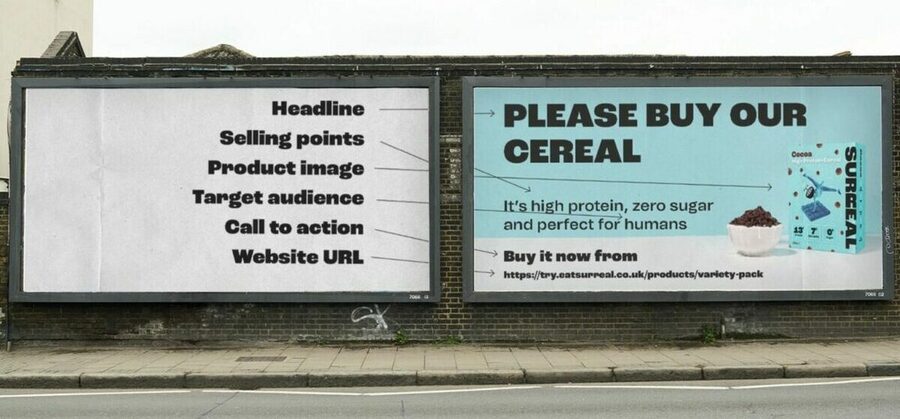
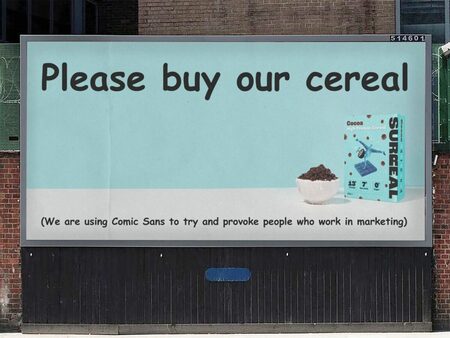
This campaign deliberately splits audiences into different processing routes within the ELM framework. Marketers are addressed directly, so their motivation and ability to process both rise; they move toward the central route, actively decoding the in-jokes, the Comic Sans font the brand says it chose to annoy them, and the mock internal email. For a marketer the joke is the argument, and the attitude it builds is stronger and more stable, exactly as the central route predicts.
SURREAL / Advertising / 2024
Everyone else stays on the peripheral route, reacting to a simple reactance trigger: being told «don’t read this» makes you want to read it. The unusual format, one ad split across two billboards or laid out as a mind-map, adds novelty that makes people stop.
SURREAL / Advertising / 2024
SURREAL also strongly reflects Two-Step Flow dynamics. This is the clearest example in the project: the billboard is addressed to opinion leaders. By speaking to marketers, SURREAL guarantees that the most media-attentive, connected part of the audience photographs it. It was posted on LinkedIn where these people gather, then picked up by the marketing press. SURREAL aimed at marketers and, through them, reached the wider public.
Intentional typos
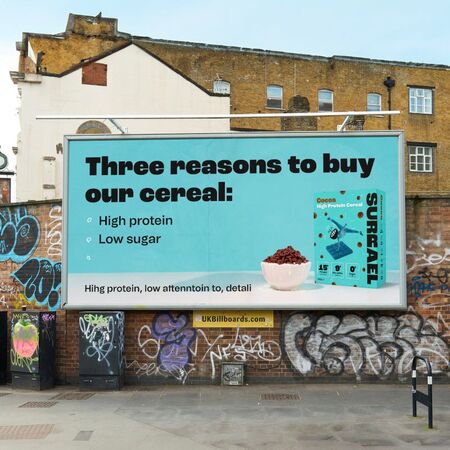
The deliberate typo functions as a peripheral cue through novelty within the ELM framework. You expect a polished ad and see an obvious error, which breaks the pattern and is mildly funny, shifting attitude without any reasoning about the product.
SURREAL / Advertising / 2025
In terms of Two-Step Flow, the design is explicitly optimised for shareability. As soon as a small mistake appears, people rush to point it out in the comments, and every correction is a re-share that pushes the post to new feeds. Here the «opinion leader» is anyone who feels competent enough to correct an error. The brand turns the urge to correct mistakes into free distribution.
SURREAL / Advertising / 2025
LinkedIn and the comments