
The first part of the lecture on black and its perception in European culture.
Black, for us, is perhaps the most contradictory, enigmatic, and multifaceted color. It encompasses a host of fears, potentials, and semantic paradoxes gifted to us by different cultures and civilizations. Books are dedicated to black; fashion houses build their philosophy around this single color. Let’s examine some intriguing facts and symbolic structures of black.
BLACK — IT IS THE ABSENCE OF EVERYTHING AND THE POTENTIAL OF EVERYTHING

To determine the first paradox, we can look to color theory and the physics of color. Physically, color is light of a specific wavelength that is reflected off an object and perceived by our eye. White is a mixture of all wavelengths. Red, however, is discernible when an object’s surface has absorbed all wavelengths except the one perceived by receptors as red. Green, blue, and other colors operate under the same principle. And what about black?
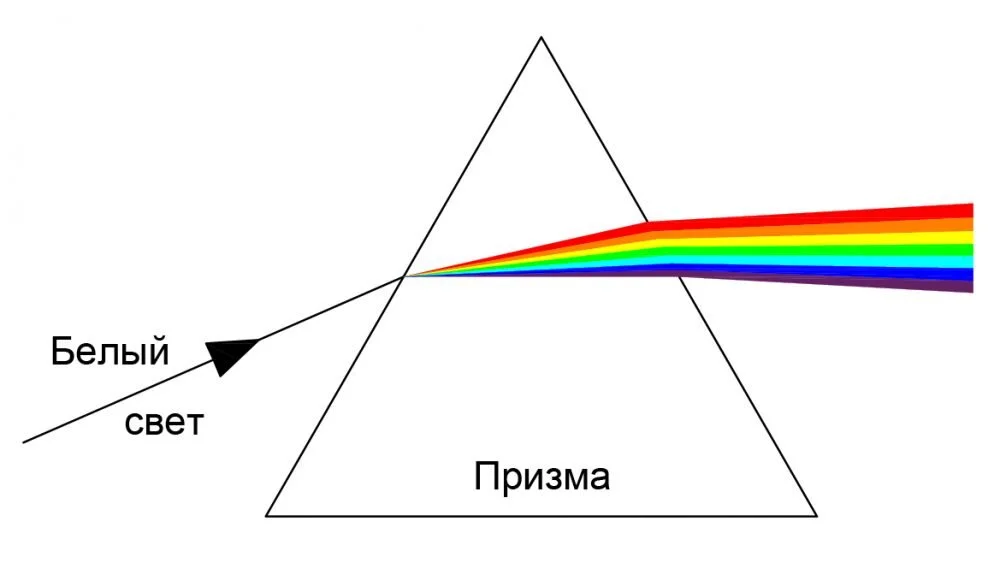
Black can be defined as radical absence. The complete absorption of visible light. When we see a black object, it means that the object absorbs almost all the light that hits it and reflects almost none back to our eyes. This results in an almost optical void—a hole in space. In fact, we are not seeing a black object; we are seeing the absence of reflected light from it.
Our retina has two types of photoreceptors: cones (which are responsible for color vision in bright light) and rods (which are responsible for black-and-white, low-light vision).
When we look at a black surface, the cones receive almost no stimulation. However, the rods activate, and they are far more sensitive. They signal to the brain that there is very, very little light present. The brain interprets this signal as blackness. But even in complete darkness, when even the rods are inactive, we do not see the color black; instead, we see what can be called «eigen-gray”—a faint, intrinsic visual noise generated by our brain in the absence of data.
So, even at a physiological level, black is not absolute silence, but rather a very quiet sound. It is not a total absence, but something striving toward it.
Concurrently, black is perceived as the ideal background—an infinite repository of information. Our brains have evolved to interpret light and shadow in terms of volume. Bright, light objects appear closer and larger to us, while dark ones appear farther away and smaller. Black, as the darkest tone, represents the ultimate state of recession. It creates an illusion of depth, of void behind the object.
BLACK — IT IS THE DEATH OF EVERYTHING AND THE LIFE OF EVERYTHING
Even before the advent of science and art, humanity encountered the void in nature. This experience has forever been etched into our culture in the form of archetypes—primary, fundamental images that reveal our primal nature.
The first and most powerful archetype is night. For ancient humans, night was a time of real danger. The main enemies and natural predators hunted during the night, so darkness became firmly associated with a sense of threat. Because of dietary characteristics, humans did not need nocturnal vision to survive; consequently, night deprived us of our primary sense—sight. Black became the color of fear of the unknown, the color of chaos that opposes daytime order. This is a deep, instinctual fear that we inherit genetically. Black is the color of what we cannot discern, meaning it may be potentially hostile. We are much calmer toward things we can identify and understand; therefore, we tend to assign negative and dangerous characteristics to what is incomprehensible.
Anubis in the guise of a jackal. A statuette from Tutankhamun’s tomb.
However, in the ancient world, the color black was not only associated with death and chaos. It contained a primal power; the ancient Egyptians called this «Kemet.» Black symbolized life, rebirth, fertility, and resurrection. They even named their country the Black Land. This name derived from the color of the rich, fertile soil, which remained on the banks after the annual flooding of the Nile and sustained the civilization.
Fragment from the Book of the Dead of Hunefru, depicting the judgment of Osiris. circa 1310 BCE. The British Museum
Black was the color of the afterlife, yet it was in the context of eternal life. Osiris, the god of the afterlife, was often depicted with black (or green) skin, signifying his power to resurrect and grant new life. Anubis, the protector of embalming and guide of souls, was represented as a black jackal. The black color of his fur symbolized the preservation of the body and the subsequent rebirth of the deceased. The color black was used as a protective amulet. Applying black eyeliner around the eyes (kohl) served both a practical purpose (protection from harsh sun and infection) and a magical one (protection against the evil eye and malevolence).
MORAL DARKNESS
Fragment of a Last Judgment fresco from the Novodevichy Convent. 17th century
Later, during the flourishing of Christianity and Christian painting, we see this duality in its fullest expression. For instance, in Old Russian icon painting, the color black was often used very sparingly and could signify paradoxically polar things.
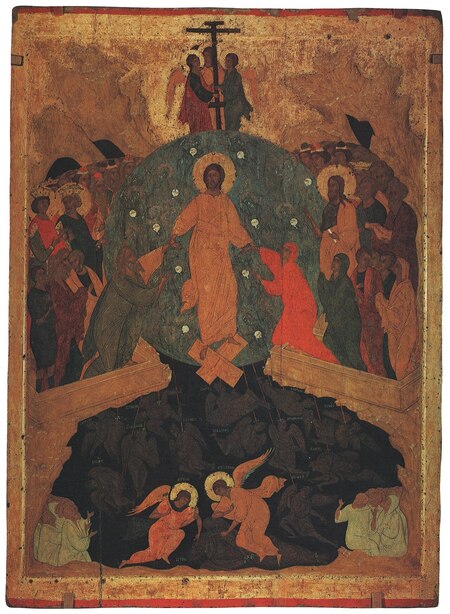
In frescoes of the «Last Judgment,» the mouth of an infernal monster, the caverns of hell, and the abyss itself are depicted in black. This symbolizes a place where divine light never penetrates. Black represents spiritual blindness, sin, and ultimate separation from God. Demons, devils, and fallen angels were almost always depicted in black, gray, or deep blue, as they had lost their original angelic radiance.
Christ leads the righteous from hell (fresco by Andrea di Bonaiuti da Firenze, 1365–1368)
Сошествие во ад, икона Дионисия, 1495–1504 год
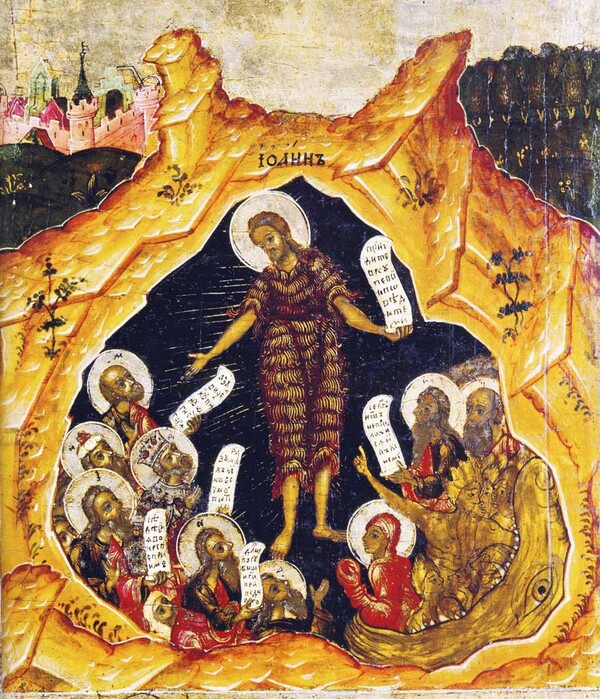
Проповедь Иоанна Предтечи в аду, клеймо иконы «Иоанн Предтеча Ангел Пустыни»
SACRED DUTY
The duality of black will once again be confirmed in Christian culture. In Orthodox theology, the color black sometimes paradoxically signifies «superlight"—the mystery of divine being that is utterly inaccessible to the human mind. But we are interested in its visual expression in iconography.
Saint Benedict receives Totila. Gaspar de Krajier (1584–1669)
Black was not only symbolic of hell, sin, and damnation in Christian culture. Naturally, unlike older religious systems, black was not a color of fertility and rebirth, and carried darker connotations.
For example, in Christian monasticism during the Early Middle Ages, the Benedictine order chose black for its vestments because it defined the spiritual philosophy of the order.
Saint Benedict and his Rule of Monastic Life, a book miniature
Black is a symbol of mourning, dust, and darkness. The habit reminds the monk that he has «died» to earthly life, worldly temptations, and ambitions in order to be resurrected for a spiritual life. Black symbolizes sincere repentance for sins and the renunciation of the self for the service of God. In the Middle Ages, bright, dyed fabrics (red, blue, green) were expensive and a sign of wealth and nobility. Black (or originally dark, undyed) emphasized poverty, simplicity, and the equality of all brethren before God, erasing social distinctions. Initially, St. Benedict’s Rule (6th century) did not specify a particular color. The text stated that the clothing should be cheap, simple, and appropriate to the regional climate. In the early centuries, Benedictines wore garments made of undyed wool, which was most often gray, brown, or dirty white. Later, with the development of weaving and the standardization of ecclesiastical vestments, the order officially adopted black. This became their main distinguishing mark, especially after the Cistercians, who split from the Benedictines in the 12th century («the white monks»), chose white as a symbol of returning to original purity and apostolic poverty.