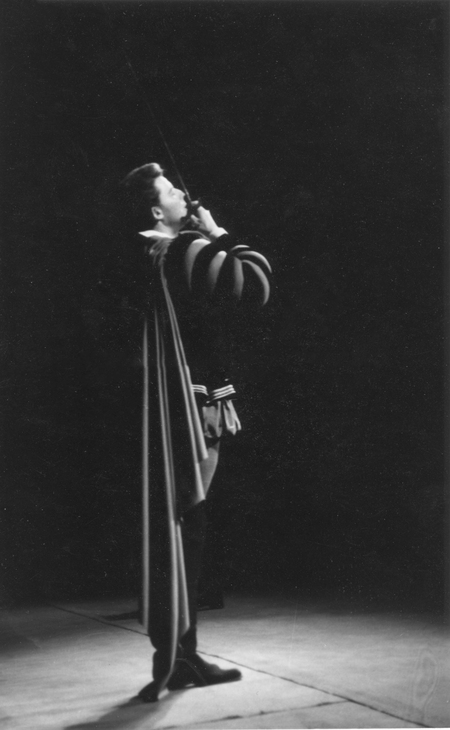
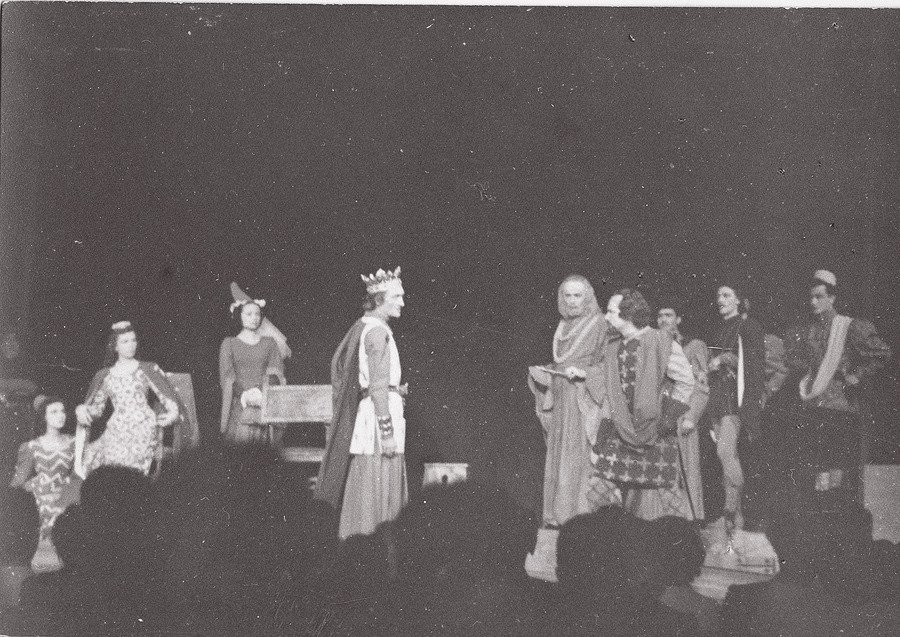
Richard II in the Cour d’honneur of the Palais des Papes, 1949
«A bare stage, a wall of stone and the sky: how Jean Vilar turned a papal courtyard into a theatre.»
State the aim, the research question and the working thesis from above. Add context in one sentence: the Festival d’Avignon, founded in 1947, is the oldest existing festival in France, and the Cour d’honneur is its symbolic stage.
Each chapter answers one question
1: Where did the idea of a popular open-air theatre come from?
2: What does a Vilar stage consist of?
3: How did the TNP years make the model national?
4: Why did 1966–1971 turn the stage into a political problem?
5: How did directors after Vilar use the court and the region?
6: What has changed since the 2003 crisis?
7: Which tensions explain the whole history? Then the conclusions.
Chapter 1. The idea: a theatre for everyone, outdoors
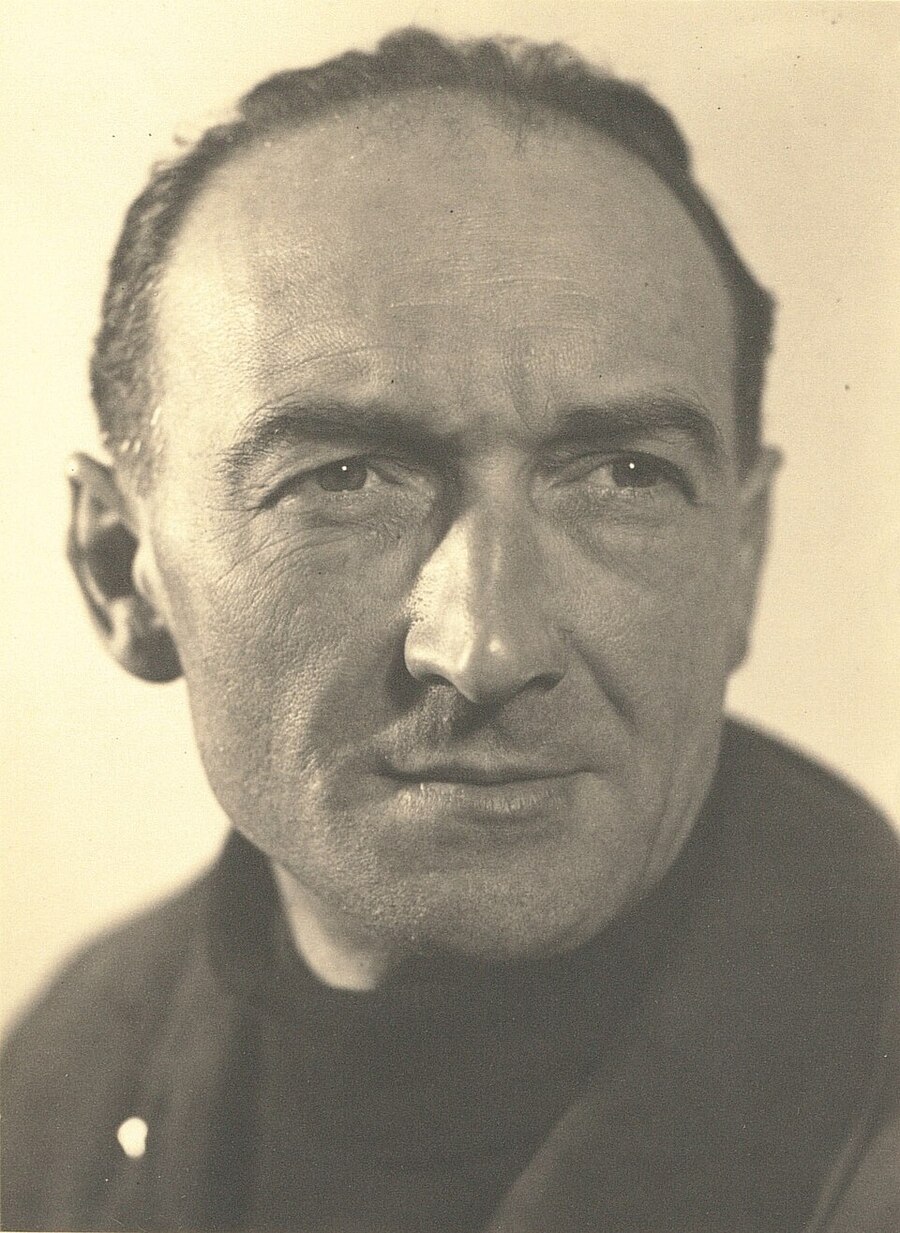
Portrait of Jean Vilar, 1950s
Vilar (born in Sète in 1912) founded the Compagnie des Sept in 1943 and had his first great success with Eliot’s Murder in the Cathedral. He came from small Paris stages, which explains a telling detail: when first invited to bring that play to the Palais des Papes, he refused because the Cour d’honneur seemed too vast and shapeless. The space that later defined him was first a problem he did not want.
Vieux-Colombier theatre, Paris, 1913–1924.
Vilar had predecessors: Romain Rolland’s call for a «théâtre du peuple» (1903), Firmin Gémier’s Théâtre National Populaire (1920) and Jacques Copeau’s bare stage at the Vieux-Colombier (from 1913). He combined Gémier’s social aim with Copeau’s stripped-down stage. What was new was the scale and the openness of the setting.
Portrait of Jeanne Laurent, c. 1950.
Popular theatre was also state policy. Jeanne Laurent, director of performing arts in the post-war ministry, encouraged Vilar before 1947, supported the 1947 week financially and later backed his move to Chaillot. A festival under the open sky therefore began with public money and a public mission, which is the context for Vilar’s phrase «theatre as a public service».
the Palais des Papes, Avignon and Cour d’honneur
The place: the Palais des Papes, a fourteenth-century fortressresidence of the popes ofAvignon. Its Cour d’honneur offers a tall, flat stone wall as a ready-made backdrop that no designer could build. Describe it as an architectural given that sets scale, acoustics and mood, and say that Vilar had to design for it, not against it.
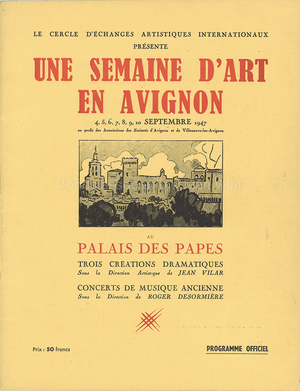
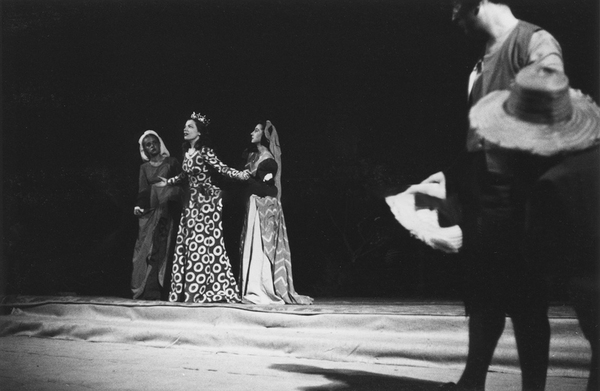
Programme leaflet of the «Semaine d’art en Avignon», 1947 (Maison Jean Vilar) and Richard II, 1947, photograph by Agnès Varda.
The first event, «Une semaine d’art en Avignon», ran from 4 to 10 September 1947. Christian Zervos and René Char had organised an exhibition of modern painting and sculpture in the Grand Chapel and invited Vilar to add theatre: Richard II (Cour d’honneur), La Terrasse de midi by Maurice Clavel (municipal theatre) and Claudel’s Tobie et Sara (Verger d’Urbain V). The festival was born at the meeting of modern art and theatre, which explains why painters became its designers.
Chapter 2. The Vilar stage
Le Prince de Hombourg, Cour d’honneur, 1951
Vilar used bare boards, black curtains and no set, and he spoke of the audience as «participants» and not as spectators. The scenery was supposed to arise from costume, light, music and a few props, in the spirit of Elizabethan and Greek theatre. This is a method, not poverty: it moves attention to text and actor and makes the architecture part of the show.
Cour d’honneur in 1947, Maison Jean Vilar.
The stage in the court was a temporary platform in front of a permanent wall. The contrast between an ephemeral performance and centuries-old stone is the visual drama of Avignon: two time scales share one picture.
Cour d’honneur at dusk during a performance
Light and time of day. Evening performances in the open air mean that the sky darkens during the play, so natural light gives way to stage light (the TNP’s lighting was by Pierre Saveron). One reading, to offer as interpretation: the audience and the actors share the same time, and the changing sky acts as a lighting design that no technician controls. This is the link to your course theme. Check start times in the archive.
Gérard Philipe as Rodrigue in Le Cid, Avignon 1951
Painters designed the costumes: Léon Gischia, Mario Prassinos, Edouard Pignon and Gustave Singier. When the space is bare, colour sits on the body, socostume becomes the scenography. The most remembered image of early Avignon, Gérard Philipe as Rodrigue in 1951, is above all a painted costume.
Léon Gischia, design for the King in Richard II, 1947 and Mario Prassinos, costume designs for the TNP
The design drawings are works of art in their own right. Gischia is reported to have said that the word «decoration» was never pronounced in the TNP workshop, because the task was something else. Link this attitude to Zervos’s art exhibition of 1947.
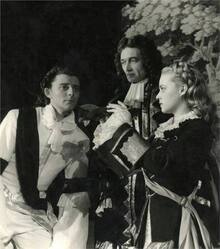
Music and text: Maurice Jarre wrote music for the TNP, and Vilar insisted on ample diction and a text-centred performance. The working method was as minimal as the stage: a director with an actor on bare boards
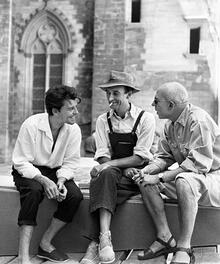
Photography as co-author. Agnès Varda photographed Vilar’s festival from its early years, and Bernand, Marc Enguerand and Maurice Costa also worked there. Our idea of Vilar’s theatre is partly their idea: black and white, frontal, humane, close to the popular ideal. Treat the photographs as constructed images and not as neutral evidence.
TNP poster by Marcel Jacno, 1950s and Festival d’Avignon poster, 1954.
Graphic identity. The TNP posters of 1951–1963 were designed by Marcel Jacno, who also created the TNP’s lettering (verify in the Maison Jean Vilar catalogue). They apply the bare-stage principle to paper: type, few shapes, maximum legibility.