Navigation
Concept
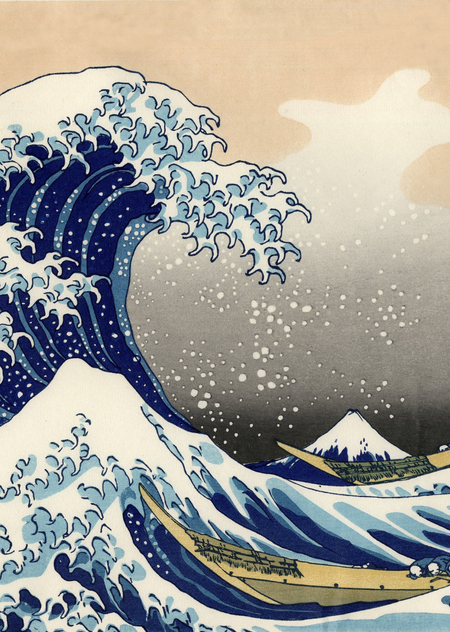
Katsushika Hokusai’s «The Great Wave off Kanagawa» is recognizable to almost everyone. It depicts a colossal wave looming over three boats, and the rowers inside appear minuscule. While the scene depicts a catastrophe, the image is not frightening—it is mesmerizing. I became curious as to what accounts for the pleasure derived from viewing such a formidable natural force.
Immanuel Kant, in his Critique of Judgment (1790), describes the sublime as a feeling evoked by something of immense size or power. In the landscape prints of Hokusai and Hiroshige, the vast and the small are constantly colliding; therefore, in this study, I examine ukiyo-e prints from the 1830s–1850s through Kant’s category of the sublime. Japanese masters worked outside the European philosophical tradition, and it is important for me to test how accurately Kant’s concept describes their work and at what point it ceases to function.
The relevance of this research lies in the fact that the theme of harmony between humanity and elemental forces is highly sought after in contemporary visual culture. Engaging with Japanese graphic art allows us to view the categories of the infinite as living artistic images.
The principle for selecting visual material encompasses Hokusai and Hiroshige’s landscape series («Thirty-six Views of Mount Fuji, ” „One Hundred Famous Views of Edo, ” etc.), where scale or elemental force plays a central role in comparison with the human figure. Three European Romantic-era paintings were selected for comparative analysis. All images were sourced in high resolution from museum collections.
The principles for choosing textual sources are centered on a single theoretical foundation—Kant’s „Analysis of the Sublime“ from the „Critique of Judgment“ (translated by M. I. Levina)—as well as established museum catalogs and descriptions for the dating and attribution of the engravings. The incorporation of later interpretations of the sublime has been deliberately excluded to maintain the purity of the experiment.
Key research question: How is the experience of the sublime created in the landscape prints of Hokusai and Hiroshige through scale and the power of elemental forces, and how does this differ from Kant’s understanding of the sublime?
The research hypothesis posits that engravings contain both types of the sublime described by Kant: the sublime in magnitude (through scale contrast) and the sublime in power (through nature). However, the fear and feeling of human insignificance are tempered because the person in the engraving continues to live and work alongside the elemental force. The sublime is experienced not by the character in the engraving, but by the viewer, who holds a small sheet of paper and is in complete safety.