«За что балл?» — дз 2
Concept
The media’s goal is to make figure skating judging more understandable for viewers.
Media will break down specific elements from the figure skaters' performances. The level of the paths and rotations will be determined (analyzing executed blocks of steps, complex turns, and features within these elements); the execution technique of jumps will be analyzed, along with the bonuses for specific elements and any potential errors. This will help the audience understand how the overall score for a particular element in a specific performance is calculated.
Special attention is paid to controversial elements or programs that are actively discussed on social media, where the evaluations raise questions among viewers.
Thematic Plan
The plan is tied to the 2026/27 competitive season calendar (The Grand Prix kicks off on October 23). The six-month period covers November 2026 through April 2027.
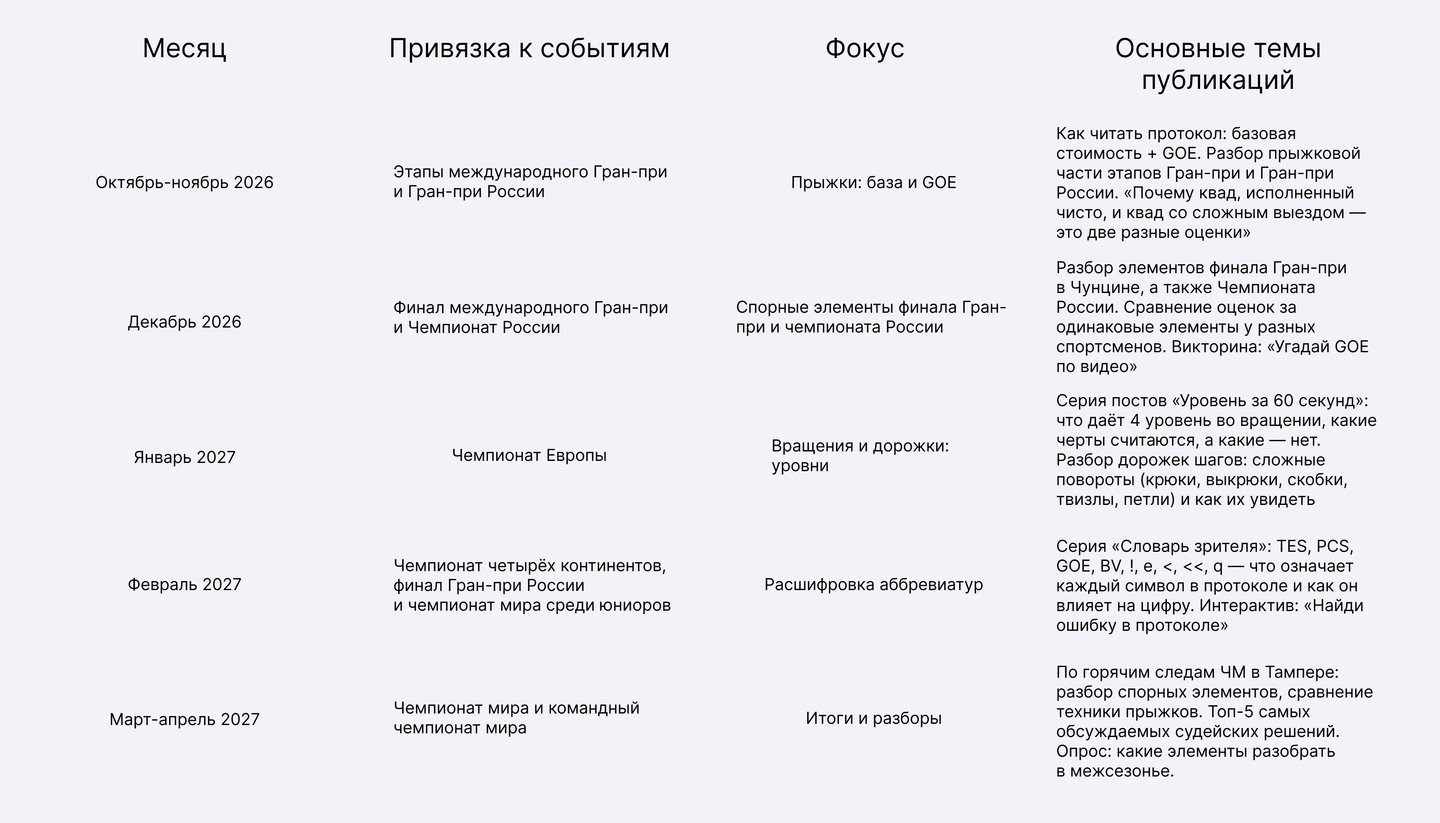
Frequency: Telegram — 3–4 posts per week (1 in-depth analysis + 2–3 short ones). TikTok — 2–3 videos per week during competition periods. Zen — 1–2 in-depth articles per month, tied to major startups.
Content Samples
Example 1 Telegram Post: «Spectator’s Glossary» Format: Text + card with symbols and meanings.Post Text: Cheat Sheet: What the Symbols in the Protocol Mean Save this so you don’t have to Google during the broadcast. Tomorrow, we will break down each symbol using a specific example from the past Grand Prix stage.
Sample 2 Telegram Post: An Announcement of a Breakdown Format: Text + Poll.Post Text: What should we break down first after the Grand Prix final?The final in Chongqing is behind us. The protocols have been published, and there are several moments that raised questions.We are preparing a comprehensive analysis. Choose what interests you most:The score for the free skate of [figure skater’s name]: why is the final score lower for [figure skater’s name] with two clean quads than for [rival’s name] with one quad and a takeoff error from a combination jump?A third level instead of a fourth in the step sequence of [name]: we will show exactly which criterion was not credited and why.A GOE of +4 for a jump that «looked ordinary»: we will explain what the judges saw.Vote in the poll below. The breakdown of the winning topic will be released within 48 hours with video annotations.Poll:• Score of [figure skater’s name] for the free skate• A third level instead of a fourth in the step sequence of [name]• GOE +4 for an «ordinary» jump
Sample 3 Telegram Post: A «Hot» Comment Following the Discussion Format: Plain TextPost Text: «Why did they score [figure skater’s name] higher than [figure skater’s name], even though the second skater performed more complex content?»After the [tournament] broadcast, a debate ignited: [first figure skater’s name] received a higher score for her free skate than [second figure skater’s name], despite having one more quad in her program.1. Base Value. [Second skater’s name] does indeed have a higher base value—thanks to the extra quad, there’s no question about that.2. GOE. This is where the difference lies: [first skater’s name] has an average GOE of +2.1 for jumps, while [second skater’s name] has +0.8. She has two jumps with a «q» and one with an «!», and each such symbol deducts from the bonus. [First skater’s name] jumped cleaner—and the judges noted that.3. Program Component Scores (PCS). [First skater’s name] scores higher due to «composition» and «interpretation.» This isn’t just about «beauty»; it’s about connection to the music, the program’s integrity, and the quality of the skating. While the second skater has a technically more complex program, her transitions between elements are simpler and involve fewer difficult crossovers.Want a detailed video breakdown with scoring for each element? Drop a 🔥—we’ll make it happen.
Sample 4 Zen Article: «Analyzing one fall: how one error affects the final score» Format: Text + PhotographsArticle Text: «A fall during a jump: how many points it actually costs—and why it’s not always as disastrous as it seems»A fall always looks dramatic: a skater painfully lands on the ice, the stands gasp, and the skater loses rhythm. But if you detach yourself from the emotion and look at the protocol, you’ll find that a fall is not a sentence—it is a very specific arithmetic value. Let’s analyze exactly how the cost of a fall is calculated and why, sometimes, it impacts the final score no more severely than a seemingly minor technical flaw.Let’s start with the mechanics. When a skater falls from a jump, the base value of the element is not nullified. That is, if an athlete declares, say, a triple Lutz and falls, the base value of that jump remains in the protocol. However, the GOE (Grade of Execution) automatically drops into the negative: judges are required to assign a negative value, usually minus five (in specific cases, depending on the element type and season rules—minus four). In addition to this, there is a mandatory deduction for the fall itself—minus one point. It is this combination of «negative GOE plus a fixed penalty» that forms the true cost of the mistake.Suppose a jump has a base value of 10 points. The skater falls. The judges assign a GOE of minus five, and the final element value is calculated as follows: 10 minus 5 equals 5, then minus 1 for the fall—a total of 4 points. Thus, out of a potential more than 10 points (if the element were performed cleanly with a positive GOE), 4 remain. The loss is about 6 points. This sounds significant, but note this: the element still scored points, rather than zero. A fall does not annul the jump; it severely depreciates it.
Photo Examples:
Now let’s compare this to another common error—under-rotation, which is denoted in the protocol by the markings «q, ” „<, ” and „≪.“ With an under-rotation, the base value of the jump is reduced, and the GOE also goes negative—for the execution error itself. Consequently, the total losses can be comparable to a fall, and in some cases, the under-rotation is „more expensive“: the skater does not fall, but the protocol records a serious reduction in base value and a negative GOE. Add to this lower GOE scores on other elements—and the picture changes radically.This is precisely why a fall isn’t „game over, ” but a specific amount of loss that can be calculated. And sometimes, a skater with one fall wins against a skater who hasn’t fallen at all but has accumulated several „q’s, ” „<'s, ” and consistently low GOE on jumps and spins. A seemingly „clean“ performance can lose to a „messy“ one numerically—and this is normal judging logic, based on the value of the elements and the quality of their execution.If you want to see how this works in practice, we have video clips of falls in Telegram with frame-by-frame annotations and precise loss calculations. Subscribe to understand figure skating based on protocols, not on the shouts of the crowd.
Sample 5 TikTok: Video Script «One Element—Different Levels» Format: Text (Voiceover) + VideoTopic: The Visual Difference Between the Third and Fourth Levels in a Step Path
Example video storyboard:
Sample 6 Telegram Post: «Score the GOE Yourself» Interactive Format: Video clip (10–12 seconds) + text.Text: «Score the GOE Yourself»: Round 2Here is a quad Salchow by [skater’s name] from the [tournament] event. Watch the video and try scoring the GOE based on three criteria:Height and distance — above/below average?Landing quality (rotation, mistake on the exit) — is there a «q,» an «!» or a hand touch?Ease and flow — does the jump look like a «struggle» or is it effortless?Write your version in the comments: for example, «+3 because the height was excellent, but the landing was slightly harsh, the exit glide was long, and the entry into the jump was difficult.»In 3 hours, I will post the official protocol and explain whether your scores matched the judges'.
Video storyboard example:
Example 7 Zen Article: «GOE Criteria for Spins — A Complete Breakdown» Format: text + videoArticle Text: «Level Four Spin and +5 GOE: What Must Align for Judges to Award the Maximum»The spin might seem like the simplest element in figure skating—what’s so complicated about spinning? In reality, every spin is backed by a sophisticated two-tiered scoring system: first, the level (Level 1–4) is determined based on a set of technical features, and then the GOE addition (from -5 to +5) is assigned, which describes the quality of execution. These two factors are connected but not identical: you can achieve Level 4 yet receive a modest GOE, or you can maximize both parameters. We will analyze exactly how they combine and what must coincide for the judges to grant the coveted +5.Let’s start with the level. To earn Level 4, the skater must accumulate a sufficient number of so-called features—technical complexities, each adding a «rung» to the level. The arsenal of such features includes complex positions (such as a Bilman or Zaklon), foot changes, position changes, spinning in both directions, complex entries, complex exits, jumps during the spin, rocking motions, noticeable acceleration in one of the positions, and position changes via a jump. The key point: the features must be executed cleanly and distinctly—if even one is «muddled» (a position not held correctly, a foot change that is sloppy, an entry not registered), it may not count, causing the level to drop. Thus, Level 4 isn’t just about «checking boxes»; it’s about achieving them in a manner that is unambiguously clear to the judges.However, the level is only the foundation. This is where GOE comes into play, and the criteria here are fundamentally different from those for jumps. Jumps are scored based on height, distance, and the cleanness of landing, whereas spins are scored based on an entire set of quality parameters: spinning speed, centering (how stably the body holds the axis), the clarity and fixation of the positions, the number of revolutions in each position, the smoothness of transition between positions, and the correspondence to the music and overall expressiveness. To achieve a high GOE, many things must align—and none of these parameters can falter.
Let’s look at an example. Consider a figure skater performing a Level 4 spin with a GOE of +3/+4. If the level is fully attained—all criteria are met, and positions are sharp—a high GOE is attributed to stable centering, good speed throughout most of the element, and smooth transitions between positions. However, she fell short of a +5 because of one specific issue: the speed noticeably dipped in the final position—the skater struggled to hold the position, and the judges saw it. One weak criterion means the maximum score is not given, even if the element is very strong overall. That is the logic of GOE: it doesn’t just sum up «pluses»; it requires all criteria to be maintained at a high level simultaneously.This leads to the most common viewer mistake: «She spun fast, so why not a +5?» Speed is just one criterion on the list. If the centering wavered, that’s a deduction. If the Biellmann position wasn’t held through to the end—if it was «under-held"—that’s a deduction. If the transition between positions was abrupt instead of fluid, that’s another deduction. High speed alone cannot compensate for flaws in other parameters; judges evaluate the totality of the performance. Such perfect matches happen rarely—and that is completely normal. More often, strong spins receive a +3 or +4, and that is a fair assessment: the element is good, but one or two criteria didn’t fully meet the standard. Understanding this logic resolves half of the audience’s confusion.If you want to see exactly how this works in detail, we have videos of this spin with frame-by-frame positional markings in our Telegram channel. Subscribe to see exactly where the point was lost and how one weak criterion separates a +4 from a +5.
Video Storyboard Example:
Example 8 Telegram Post: «Daily Protocol» Segment Format: Text + Photo
Text: «Daily Protocol: Reading Line by Line»
Here is an excerpt from the protocol of an arbitrary program by Yuna Aoki from the Grand Prix stage.
Line 1: 3Lz+3Lo — Base 10.80, GOE -1.10. The judges unanimously awarded negative scores (from -1 to -3) due to an error exiting the cascade jump—specifically, exiting into the triple loop—causing the average to drop into the negative. The final element value is 9.70. Line 2: 2A — Base 3.30, GOE +0.85. A clean double Axel. The judges assigned «+2» and «+3, ” resulting in a positive bonus. The total is 4.15. Line 3: 3F — Base 5.83, GOE +1.59 (marked with x). The symbol „x“ here indicates that the jump was performed in the second half of the program, so its base value is increased by 10% (5.30 × 1.1 = 5.83). The judges gave high bonuses (up to „+4“), totaling 7.42. Line 4: FCSp4 — Base 3.80, GOE +1.14. A twizzle with a change of foot. Judges awarded „+2“ and „+3.“ The total is 4.94. Line 5: LSp4 — Base 3.20, GOE +1.01. Step sequence/spin. Scores of „+3“ and „+4.“ The total is 4.21. Line 6: StSq4 — Base 4.10, GOE +1.82. Step sequence. Very high bonuses from the judges for excellent speed and artistry („+4“ and „+5“). The total is 5.92. Line 7: CCoSp4 — Base 4.20, GOE +1.14. Combined spin. Scores of „+2“ and „+3.“ The total is 5.34.
Conclusion: Total Element Score is 41.68. The base value of all elements is 35.23. Thanks to the strong bonuses (GOE), the skater scored almost 6.5 points more than the base value. The main deduction in this protocol was in the first element (3Lz+3Lo), where the GOE went negative (-1.10). Overall, this was a very strong performance without major technical errors (under-rotations or falls, which would incur penalties). The Program Component Scores are also high—34.63.