Concept
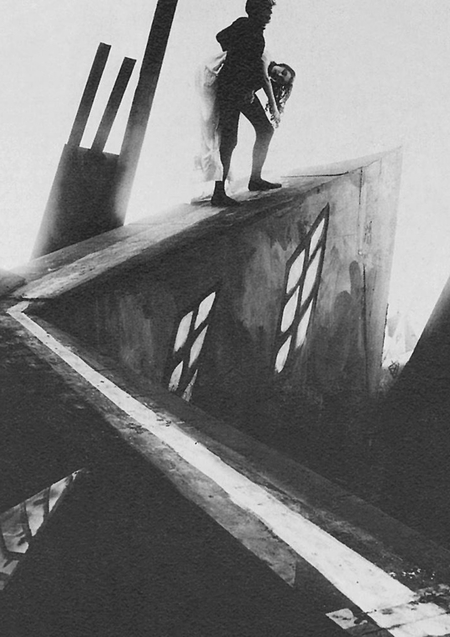
German film expressionism developed a unique system for visually expressing alienation, where architecture, the geometry of space, chiaroscuro, perspective, and composition ceased to be a neutral backdrop for action. Space itself became an independent expressive tool, capable of conveying anxiety, isolation, and humanity’s conflict with the surrounding world. These principles persist in contemporary cinema, but their functions and modes of realization have evolved. While space in expressionist film often adopted grotesque, artificially distorted forms, in modern cinema, alienation can be conveyed through sterile architecture, repetitive geometric structures, monumental interiors, emptiness, and disruptions to the conventional human scale.
Hypothesis
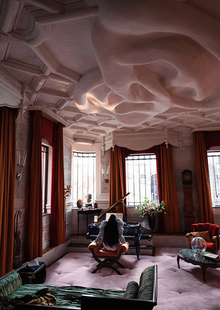
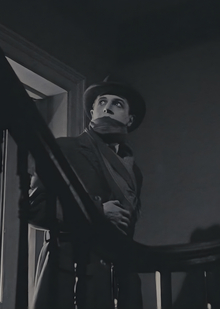
The hypothesis is that the visual legacy of German film expressionism persists in contemporary cinema primarily at the level of spatial organization principles and semantic load, rather than through the direct reproduction of characteristic sets and stylistic devices. I propose that the deformation of architecture, the disruption of perspective, the contrast of light and shadow, and the disproportion of the human figure to its environment have formed a stable model for expressing alienation. In contemporary cinema, this model takes on new forms. Various architectural solutions, seemingly different at first glance, can fulfill a similar expressive function. Both the deformed space of German expressionism and the ordered architecture of modern cinema can demonstrate the rupture between humanity and the surrounding world.
The materials for this study are films from German Expressionism and works from subsequent and contemporary cinema, in which the architecture and spatial organization play a significant role in shaping the artistic image of alienation.
As primary examples of German Expressionism, films such as The Cabinet of Dr. Caligari, Metropolis, Nosferatu: Symphony of Horror, and other works are examined. To analyze the subsequent transformation of these principles, I consider films like Gattaca, Blade Runner, The Lighthouse, and Blade Runner 2049. These films demonstrate various methods of organizing alienated space—from artificially deformed urban environments to sterile architecture, confined interiors, and monumental structures that underscore human isolation. This study does not aim to prove a direct influence of every examined Expressionist technique on specific modern films. Instead, the focus is on identifying functional and visual correspondences and differences that allow us to trace the transformation of the principles of spatial psychologization. At the beginning of each chapter, I examine older works of German Expressionism before gradually moving toward contemporary cinema.
Navigation
- Space as an Expressive System
- Geometry of Anxiety
- Light and Shadow
- The Human Within Architecture
- Conclusion
- Sources and Literature
1. Space as an Expressive System
«Dr. Caligari’s Office, ” directed by Robert Wiene, 1920
The interior of the film The Cabinet of Dr. Caligari is not perceived as a mere domestic space. Its function is not limited to marking the characters’ whereabouts or ensuring the plausibility of the action. Instead, it is integrated into the film’s overall cinematic world, reinforcing its subjective nature. It is particularly important that the interior space is not separated from the film’s artistic concept; it continues the same visual logic as the exterior environment. Because of this, individual rooms are perceived as parts of a singular world rather than as isolated set pieces.
«Nosferatu: A Symphony of Horror,» directed by Friedrich Wilhelm Murnau, 1922
In «Nosferatu, ” space is not limited to merely denoting a setting. The city, its streets, and its buildings participate in constructing a world image where the presence of threat gradually becomes part of everyday life. The environment unites discrete events, giving them a shared semantic context. The principle of narrative organization is equally important: the surrounding world is not indifferent to what is happening. Instead, it becomes an expressive element through which the nature of the screen reality is revealed. Therefore, the space here can be considered an active component of the film, rather than just incidental scenic dressing.
«Metropolis, ” dir. Fritz Lang, 1927
In «Metropolis,» the city assumes the significance of an autonomous structure around which the entire screen narrative is organized. It does not merely serve as a setting but shapes the viewer’s perception of the film’s world order. The architectural environment becomes a visual expression of its social and spatial order. Unlike individual set pieces, which may serve a localized function, the city in «Metropolis» is perceived as a single, integrated system. The human figure’s position within this world cannot be examined independently of the environment surrounding them.
«Dark City, ” directed by Alex Proyas, 1998
In this shot, the city is perceived as a closed system that exists by its own rules. Its architecture forms a unique reality where the individual cannot fully comprehend the surrounding world or determine their place within it. This example can be compared to «The Cabinet of Dr. Caligari.» In both films, the space is artificially organized and does not aim to depict everyday reality. However, in the works of Proyas, this constructed nature is expressed not through theatrical sets, but through the image of a large, outwardly convincing city.
Gattaca, directed by Andrew Niccol, 1997
Architecture in «Gattake» forms an image of a society built on strict organization and control. The space appears orderly, clean, and rational, yet individuality is barely perceptible. The interiors become a visual expression of a system where the individual is primarily assessed as an element of the overall order. While the urban architecture in «Metropolis» demonstrates the scale of the social structure, in «Gattake,» this idea is brought inside modern buildings. The space does not merely surround the character; it dictates their position and possibilities.
Blade Runner 2049, directed by Denis Villeneuve, 2017
In this frame, the scale of the architecture noticeably surpasses that of the human figure. The person becomes part of a vast spatial structure that does not evoke a sense of security or intimacy. On the contrary, the emptiness and monumentality of the environment underscore their isolation. This technique continues the trajectory established in «Metropolis, ” where the city also dictates the human’s position within a monumental system. However, in the contemporary film, architecture becomes not only a symbol of technological power but also an image of emotional desolation. Space expresses alienation through the relationship between the individual and their surroundings.
The scenes examined show that in German Expressionist cinema, space acquires an independent artistic function. It unifies individual scenes, forms a cohesive image of the screen world, and participates in the creation of meaning. The street, the interior, the architecture, and the city become part of the author’s statement. Space in these works does not exist separately from the content. Its organization is subordinate to the overall concept of the film, and the surrounding environment becomes one of the ways to reveal the depicted reality.
2. Geometry of Anxiety
«The Cabinet of Dr. Caligari, ” directed by Robert Wiene, 1920
In this interior, the space is composed of sharp angles, irregular planes, and abrupt transitions between architectural elements. Instead of the familiar unity of the room, there is a sense that it is assembled from discrete geometric fragments. This kind of composition disrupts the notion of a room as a stable and coherent environment. The boundaries between the walls and other surfaces do not create a tranquil structure; rather, they amplify the feeling of visual fragmentation.
«The Cabinet of Dr. Caligari, ” directed by Robert Wiene, 1920
In this frame, the familiar organization of the street is replaced by a system of slanted and broken lines. The architectural elements do not form a stable composition. Walls, roofs, and spatial boundaries seem to lose their vertical and horizontal equilibrium. The depicted environment appears unstable. This effect arises from the very geometry of the image. The slant becomes an expressive device that disrupts the accustomed sense of order. The space is perceived as unreliable; it is difficult to determine a point of support within it.
«The Cabinet of Dr. Caligari, ” directed by Robert Wiene, 1920
In «Dr. Caligari’s Studio, ” the perspective drawing does not so much create a convincing illusion of depth as it emphasizes the artificiality of the image. Some lines converge at unconventional angles, and the proportions of elements may not align with expectations. As a result, the depth is perceived as unstable and artificially constructed. The viewer sees a subjectively transformed image of space. Perspective becomes a means of communicating a disruption of spatial certainty.
«Metropolis,» directed by Fritz Lang, 1927