What lies behind a powerful visual concept?
For me, every project begins with curiosity—a desire to look beyond the obvious and discover what makes an idea meaningful.I am a fourth-year Communication Design student, specializing in branding. I am fascinated by the stories embedded in cultural traditions, the symbolism of everyday objects, and the unexpected connections between seemingly unrelated things. I believe these details can serve as the genesis for original ideas, lending a project a deeper sense of identity.
I decode cultural meanings to unlock original visual concepts, transforming research and insights into distinctive visual languages that reveal the essence of each project.
My approach to design is driven by the search for these underlying meanings. Rather than relying solely on visual trends, I explore the context behind a project, question familiar associations, and look for perspectives that have yet to be revealed. This process allows me to create design solutions that are not only visually distinctive but also meaningful, relevant, and connected to the story they communicate.I approach each project in stages—from exploring its context and experimenting with visual language to discovering the core concept and bringing it to life.
1. EXPLORATION
I begin every project by exploring its context, seeking out meaningful details, hidden connections, and cultural references. By understanding the narratives behind a place or an object, I discover ideas that can form the foundation of a distinctive visual concept.
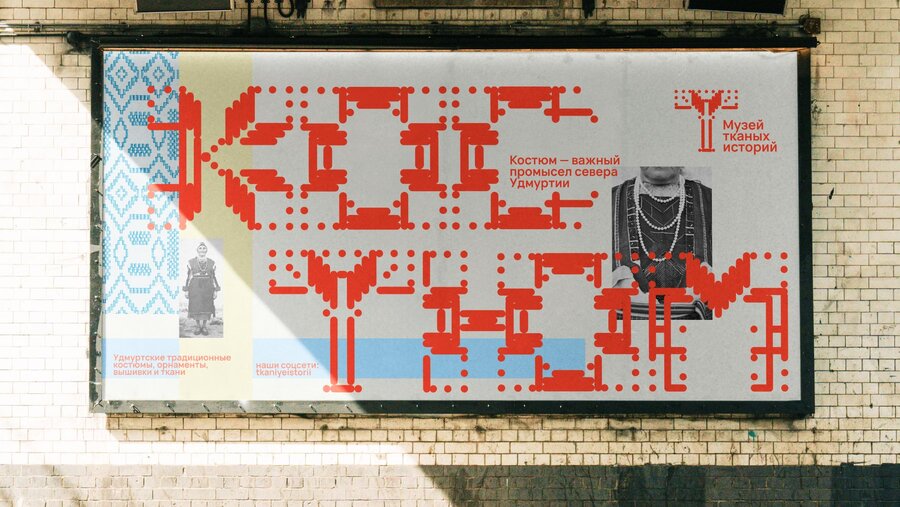
The Kargopol Costume Museum features a permanent exhibition of traditional folk costumes from the Kargopol district, dating from the late 19th to the early 20th century.
To develop the visual identity, I studied traditional textiles, embroidery techniques, and the symbolism behind their patterns and motifs.
This research helped me identify three key visual elements: the traditional costume, the rooster, and the fir tree. These motifs became the foundation of the identity, translating the region’s cultural heritage into a distinctive visual language inspired by embroidery—where individual stitches coalesce to form a broader world of images and narratives.
Another project, «Direct Contact», is an urban cultural initiative that invites residents to rediscover Moscow’s Basmanny District through art, history, and local efforts. The objective was to create a visual identity that unifies various project formats and provides clear navigation through events and urban spaces.
I explored the district’s urban environment, identifying significant locations and the connections between them. This research led me to the concept of a route as a symbol of movement, discovery, and encounters. The visual identity integrates map points, directional cues, and architectural elements into a cohesive system. Particular focus was placed on developing pictograms and maps, making navigation an integral part of the visual language.
The logo combines three key elements: a building representing history, an arrow symbolizing the journey, and a map pin marking a location.I also designed a map of Bauman Garden, where the exhibition took place, enabling visitors to pick up a brochure and begin their own exploration of this section of the Basmanny District.
2. EXPERIMENTATION
I explore how visual elements can be transformed through composition, geometry, and structure. By experimenting with grids, shapes, and modular systems, I investigate how formal principles can become more than tools for organizing information — they can shape the character of a visual identity and give it a distinctive voice.
The Swiss Design Grid Calendar is a project dedicated to the posters of Swiss Style designers and their use of modular grids. The goal was to introduce the principles of Swiss graphic design through a functional calendar while showcasing the work of its key representatives.Each month is designed as a poster inspired by a renowned designer, with the underlying grid made visible to reveal how it shapes the composition. The calendar comes in a folder accompanied by a booklet featuring the original posters and quotes from their creators, offering a closer look at the ideas and principles behind their work.