Ornithomorphic Image
The image of a bird holds significant importance in many cultures worldwide, and this is true for Russian art as well. Ornithomorphic imagery often conveys themes of freedom, the human soul, and rebirth. In M. Chagall’s «Above the City, ” characters soar above the everyday world. The pair acquires the superpower of the soul’s flight—those who are „winged“ are free. Alkonost and the Siren Bird, derived from ancient Greece, are frequent mythical figures in medieval book illustration, in painting (V. Васнецов’s „Siren and Alkonost. Song of Joy and Sorrow“), and in Abramtsevo mosaic (the same image of the Siren bird on Vrubel’s bench). In Orthodox iconography, images of the white dove appear as the „Holy Spirit.“ Thus, the ornithomorphic motif carries meanings of transition between worlds (the spiritual and the worldly), and it is frequently connected to the human soul, which is crucial for an individual to understand their own nature.
Kulaisky and Itul Cultures
Examining earlier depictions of birds can help us understand how this motif developed subsequently. Therefore, the following topic was chosen: the ornithomorphic image in the Kulay and Itkul archaeological cultures of the Early Iron Age. The name of the first archaeological culture is linked to Mount «Kulayka, ” which is located near the modern village of Podgornoye in the Tomsk region. A hoard of bronze objects was discovered there in the early 1920s. Its territory encompasses Western Siberia (in the Ob basin, from the Narym and Surgut Tributaries to the southern taiga regions). The second culture is associated with Lake „Itkul, ” where archaeologists investigated a fortified settlement containing metallurgical finds. The discoveries of the last century led to the formation of the terms „Kulay“ and „Itkul, ” which were subsequently adopted. Geographically, this area covers the Middle and Southern Urals (trans-Urals and pre-Urals: Sverdlovsk and Chelyabinsk regions, Bashkortostan). Thus, the visual research analyzes material from the Kulay culture spanning approximately the 5th century BCE to the 5th century CE, and from the Itkul culture spanning the 8th–3rd centuries BCE.
Basis for Comparison
The comparison of these archaeological cultures is possible for several reasons. Some researchers discuss the possibility of their succession, linked to the migration of peoples at the geographical crossroads of cultures. Yu. P. Chemyakin, in his work «Kulay Culture—Community—Continuity?», examines three hypotheses regarding the movement of the Kulay population toward the Urals (1), and also cites L. A. Chidina, who notes the possible dominance of Kulay culture in migration areas.
Regarding other, more southern territories of the spread of Kulai antiquities, migration theories dominate the understanding, though presented in various forms.
Another basis for comparing the Itkul and Kulai ornithomorphic images is the significance of the bird motif in the mythological beliefs of the peoples of Western Siberia, the Middle and Southern Urals. For instance, in the myth of the earth’s creation, Gagara retrieves a lump of clay from the bottom of a body of water, from which the land subsequently forms (2). Novikov A. V. and Terekhina V. Yu. mention a similar plot in the mythological beliefs of the Itkul people (3). In the same article, the authors refer to the image of the Raven—a powerful bird dwelling in the celestial realm and observing human actions. This motif also allows us to see the place birds occupied in the mythological worldview of the Itkul people (3).
Research Question
This visual study addresses the following research question: what similarities and differences in decorative and plastic techniques are discernible in the ornithomorphic imagery of the Itkul and Kulay cultures in metalware? The hypothesis is that these cultures exhibit a desire to emphasize and preserve the most recognizable features of the bird image through conventional decorative elements. However, similar elements—such as the geometrization of wings and tail, the simplification of the head, and the use of dot and line patterns—may form distinct systems of stylization within each culture.
CHAPTER I (minor details on the body)
During the analysis of the visual material, the most striking stylizations for me appeared to be the convex «dots» and «rods, ” along with other elements on the birds’ bodies. This is precisely the part of the figurine images that primarily lends decorative quality. For example, the general study of the silhouette—its simplification or complication—affects the initial perception, and recognizability of the image largely depends on it. The logic of the fine details, however, is what best imparts uniqueness to a specific image. I find it interesting to study in greater detail how this manifests in the metal-plastic art of the Kulatskaya and Itkulskaya cultures.
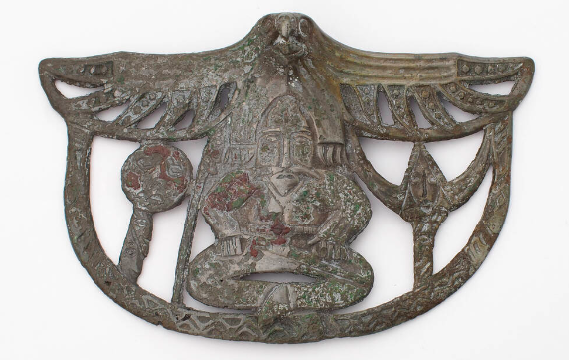
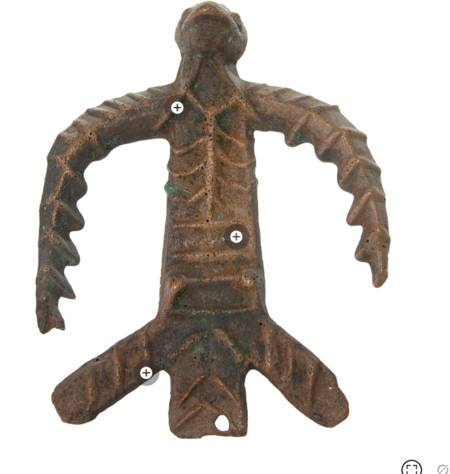
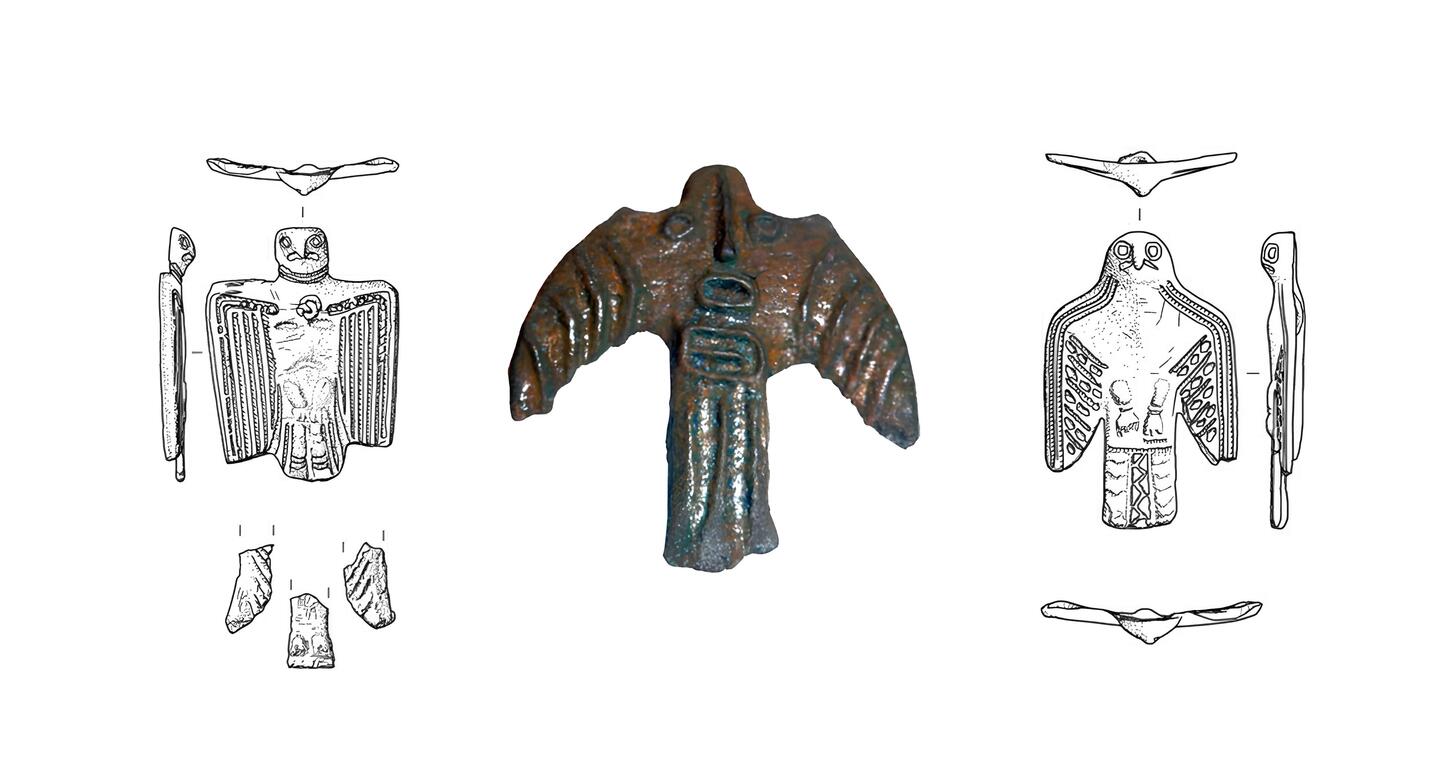
Figure 1 (Title: Pectoral Ornament with Narrative Composition; Period: 6th–7th century CE; Size: 10×16 cm; Technique: Bronze, Casting) Figure 2 (Title: Bird Idol; Period: 7th–3rd century BCE; Location: Polyovsky District; Size: 11×8.5×2 cm; Technique: Metal, Casting; Collection: Sverdlovsk Regional Museum of Local Lore)
This technique is more pronounced in the Itkul culture, but it is also found in the Kulai culture. Despite the significant time difference between images 1 and 2, a common tendency toward the use of decorative elements is evident. In the first image, dots and elongated oval lines are visible on the eagle’s wings. Here, the decorative nature is clearer: although the stripes could be interpreted as an attempt to depict the growth of the feather, the «dot» element still suggests the decorative quality of these features. In the second image, however, the lines seem to merely outline the bird’s skeleton (this is particularly noticeable in the chest area, resembling the sternum) or the growth of the feathers (as seen on the wings, where the lines follow a pine-like pattern). Yet, the three stripes on the belly disrupt this logic, causing this «drawing» to be perceived simply as a general texture.
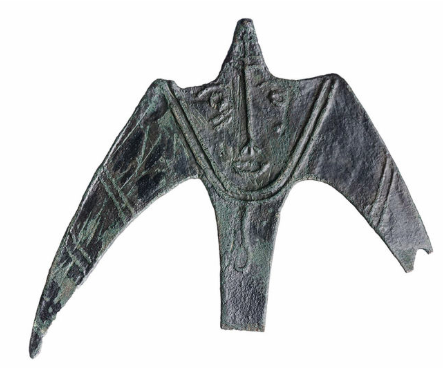
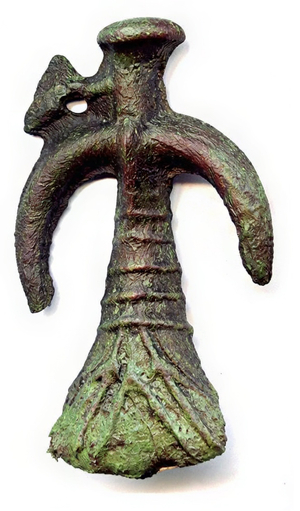
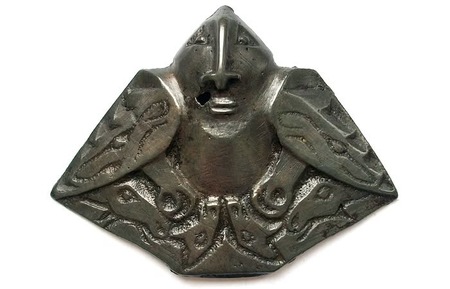
Fig. 3 Image of a bird with an anthropomorphic face on its chest. Parabel culture artifact. Early Iron Age. 6th century BCE — 5th century CE. Parabel culture artifact. 6th century BCE — 5th century CE. Uraev R.A. Bronze, casting. 13,8×15.5 cm TOKM 297/27 Fig. 4 ITKULSKA CULTURE
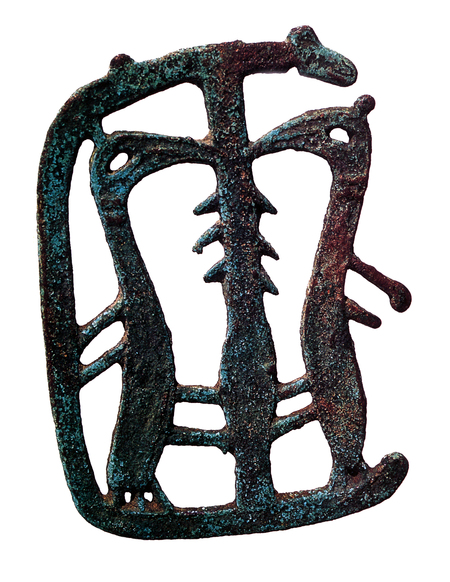
Now, let’s examine images 3 and 4, in which the bird is depicted in a more schematic manner. Using works where there is slightly more untouched space on the overall body of the bird, one can notice the same logic of the «line» decorative elements.
In both cases, the figurines lack a standard avian head. A «head» protrusion is present. Despite this, the image remains recognizable. (But it is important to note that in Figure 2, the face is anthropomorphic.) These images were used as a counterexample because the artists left untouched space here. This suggests that the saturation of details—such as «sticks» and «dots"—is not a mandatory part of the Kulai or Itkul styles. However, the logic of decorative patterning is maintained, as seen in Examples 1 and 2. The element of «rhythm» or «repetition» in the overall pattern either mirrors the structure of a bird or serves a purely decorative function. For instance, in Image 3, there are two horizontal sticks on each wing that are repeated several times. Image 4, however, shows striping on the bird’s belly, which appears to serve a decorative purpose.
Conclusion:
Thus, it can be argued that a common logic in the use of decorative patterns is noticeable in both cultures. These elements create a certain rhythm in the figure, embellish it without color, yet do not attempt to realistically replicate the structure of a skeleton or a bird’s feathers.
CHAPTER II (General Limb Forms)
Although in the Itkul culture, imagery seems to lean more toward simplifying the forms of wings and making the tails more stick-like (which may be due to the culture having existed for a shorter period and having ceased to exist earlier), the geometry is still not highly stylized. It is interesting to analyze how this operates in the wings of birds. For example, this is noticeable in figures 6 and 7, where it is evident that the protrusions (most likely representing wings) have branching at the ends. The shape itself resists remaining simple; it tends toward expansion, similar to how it is structured in a real bird. However, it must be understood that this is still a significant distance from realism. A similar tendency toward splitting into several bars at the wing tip can also be observed in the Kulaisk birds.
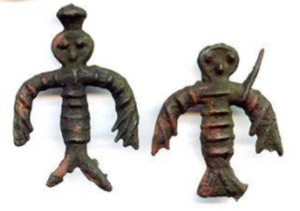
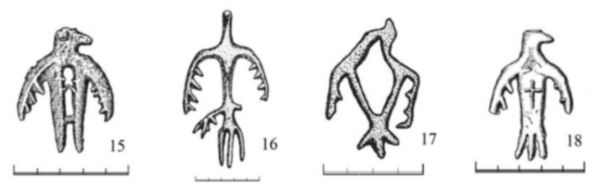
Figure 6: ITKULSKA CULTURE and Figure 7
It is interesting to note that the tail frequently behaves in a similar manner. Less often, it can be depicted as a single line (though images exist where it may be absent or reduced entirely to a mere convention of a «line»).
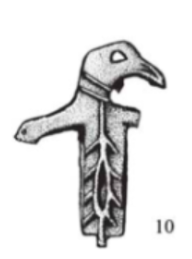
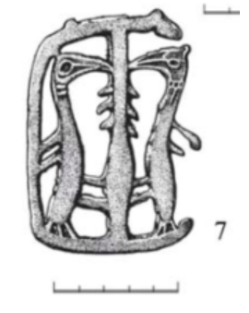
Fig. 8 Fig. 9
In addition to wings and tails, birds also possess feet; however, their depiction is less common in Kulai and Itkul metal-plastic art. This fact may support the decorative nature of metal-plastic art—its general logic and inclination toward simplification. Since feet are not crucial for the overall recognition of the bird image, they are often omitted from figurines. The use of a highly schematic representation of feet—for instance, as dots—can also be considered evidence of its decorative quality. (One can likely observe this technique in Figure 2. However, one cannot assert this with absolute certainty.)
Conclusion:
To summarize, it can be said that in the ornithomorphous figure across both cultures, the extreme stylization of the limbs is not frequently visible. In most cases, there is an attempt to slightly complicate the form, even with simple, decorative «fluffing» at the ends. It is also important to note that the main appendages of birds (tail and wings) behave similarly: there is a slight complication in their shape, an attempt to slightly increase recognizability. However, this remains within the bounds of decorative conventions and arbitrary choices.
CHAPTER III (Features of the Head and Image Identification)
If one perceives the bird’s head as a separate appendage, it can be observed that it behaves differently. It cannot simply be omitted here (as is done with the legs). Although there is a similar tendency toward decorative simplification, the overall form is maintained.