(01)Concept
In ancient Greek sculpture, the depiction of clothing significantly shapes the perception of the human figure. Folds can emphasize body shape, create a sense of volume, or convey movement. Their placement, direction, and character influence the overall interpretation of the work; therefore, drapery should be viewed not merely as an illustration of garments, but as a vital component of the artistic image.
While studying ancient Greek sculpture, I became interested in the varied ways masters depicted fabric: in some instances, folds form distinct, repeating lines, while in others, they follow the contours of the body, accentuate its volume, or generate a sense of motion. I wanted to understand the differences between these methods of representation, how they evolved over time, and what role they play in interpreting sculpture.
Research Question:
How do different methods of rendering drapery contribute to the creation of the artistic image in ancient Greek sculpture?Hypothesis:
I hypothesize that the manner in which drapery is depicted influences the perception of the sculptural image. The direction and rhythm of the folds form the texture of the fabric, the volumetric modeling emphasizes the form of the body, and the variation in the direction and curve of the folds helps convey the figure’s movement. Thus, the specific depiction of clothing can affect the overall impression of the sculpture and reveal its artistic intention.For my research, I selected works from the Archaic, Classical, and Hellenistic periods of Ancient Greece. This distribution allows me to trace the differences in drapery representation and compare the artistic techniques characteristic of each period. When selecting pieces, I focused on sculptures where the handling of fabric is clearly visible, allowing for an examination of various ways folds were organized.
The material is divided into three sections, each dedicated to a specific characteristic of fabric rendering:
1. Linear organization of folds. Examination of the direction, rhythm, and placement of the folds, as well as their role in creating the draping pattern.
2. Volumetric modeling of drapery. Analysis of how to convey the density and weight of the fabric, its interaction with the body, and its influence on the perception of figure volume.
3. Conveying movement through drapery. Study of how the position and curvature of the folds emphasize posture, body turns, and create a sense of motion.
For this project, I utilized images of sculptures, museum catalogs, and art historical literature. Correlating my own observations with the research of other scholars helped me examine the characteristics of drapery representation and test the hypothesis I proposed.
(02) Linear Organization of Folds
For this section, we have selected three works where the folds of clothing are organized differently. In «The Lion’s Skin,» the fine lines of the chiton emphasize the contours of the legs; in «The Delphic Charioteer,» the clothing is rendered more abstractly; and in the bas-relief of Nike, vertical folds of one layer of clothing intersect with the curved folds of another.
In the lower section of the «Lyon Cloak,» the folds of the chiton become finer, creating the illusion of sheer fabric through which the legs are visible. L. I. Akimova emphasizes that the folds effectively outline the legs and convey the delicacy of the material covering the living body [1].
The lines stretch along the legs, forming a vertical rhythm.
They are closely spaced, but their direction shifts according to the contours of the figure. In the upper section of the cloak, the garment is interpreted differently: the folds are expressed more subtly, and the fabric itself adheres more closely to the overall shape of the body.
The «Lyon Cloak» survives only in fragments. Its upper and lower parts are housed in different museums—one in Lyon and the other in Athens. Therefore, the draping characteristics of these sections must be considered separately.
In the «Delphic Charioteer, ” the clothing is rendered with restraint. The chiton drapes freely down the body, and its folds are worked out less meticulously than the individual details of the figure. M. V. Alpatov contrasts the generalized depiction of the costume with the careful rendering of other parts of the statue [2].
The folds form elongated lines that emphasize the figure’s vertical direction. Unlike the „Lion Mask, ” where fine lines are particularly noticeable in the lower part of the garment, here the focus is on the overall form of the chiton. According to Alpatov’s observations, the statue’s clothing maintains its character when viewed from different angles [2].
In the relief, the folds of two layers of clothing create a complex pattern. B. R. Whipper describes the intersection of the vertical folds of the himation with the curving folds of the cloak [3].
Vertical lines combine with smooth curves that change direction and create their own rhythm. The folds vary in length and the nature of their curve, making the surface of the garment look diverse. In this relief, it is particularly noticeable how the different directions of the folds combine within a single figure to form the overall pattern of the drapery.
(03) Volumetric Drapery Modeling
When sculpting clothing, the artist considers the material’s properties: its density, weight, and how the fabric drapes on the figure. This is clearly evident in works like «Eirene with Pluto» and the «Aphrodite of Milos,» where the treatment of the fabric significantly impacts the perception of the pieces.
The group «Eirene with Pluto» was created by the sculptor Kephisodot.
The bronze original is lost; the work is known through Roman marble copies. One of these is housed in the Glyptothek in Munich [3].
Eirene’s chiton appears heavy and dense. It clings to the body, mirroring its forms. B. R. Wipper emphasizes the folds in the area of the left leg: they change direction and interweave [3].
In the lower part of the figure, it is clearly visible how the fabric drapes over the legs. The material clings tightly to the body in places, while flowing freely further down,
creating a sense of the material’s weight. Simultaneously, the surface of the garment retains softness: the folds transition smoothly into one another, echoing the contours of the figure.
The statue, known as the «Aphrodite of Milos, ” was discovered on the island of Milos in 1820. It belongs to the Hellenistic period and is dated to the third quarter of the 2nd century BCE [7].
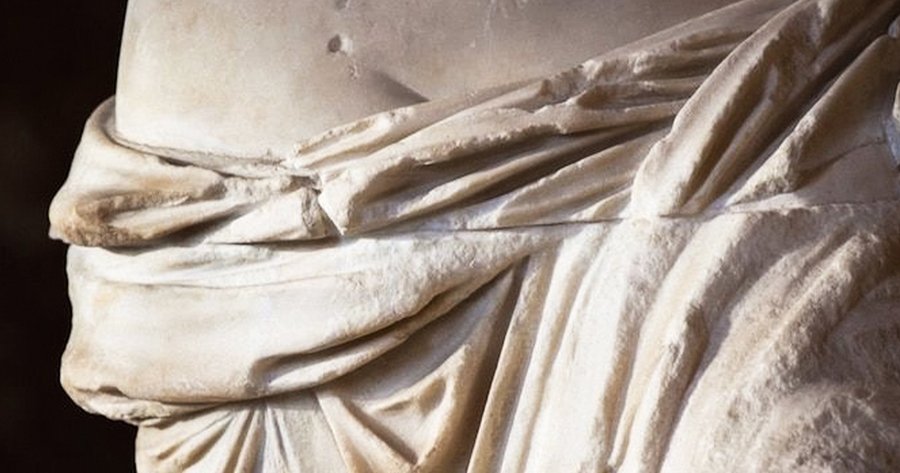
Aphrodite is depicted semi-nude: the goddess’s legs are covered by drapery with deeply sculpted folds. According to the authors of „General History of Art, ” this decision lends greater mass to the lower part of the figure. The contrast between the nude body and the drapery allows for particularly rich plastic expressiveness [4].
The fabric is perceived almost as a separate sculptural mass.
The deep folds between the creases create noticeable shifts in light and shadow. Against the smooth torso, the texture of the clothing appears particularly voluminous.
The draping weights the lower part of the composition, while the exposed upper body maintains a sense of lightness. The authors of «A General History of Art» also draw attention to the spiraling turn and slight tilt of the figure. Because of this, its perception changes depending on the viewpoint [4].
(04) Conveying Motion Through Drapery
The movement of the figure finds continuation in the drapery of the clothing. Their direction and placement emphasize the pose, the body’s turns, and create a sense of dynamism. The conveyance of movement differs in «Nike of Peony, ” „Dresden Maenad, ” and „Nike of Samothrace.“
The statue was created by the sculptor Peonia from Mentyra. The Messenians and Naupactians dedicated it to Zeus Olympios, as evidenced by the inscription on the base. It states that the statue was installed from a tenth part of the military spoils. The sculptor’s name is also preserved in the inscription. Nike stood near the Temple of Zeus in Olympia on a high triangular pedestal [5].
The exact dating of the work is linked to various interpretations of the dedication circumstances. B. R. Wipper examines several versions and favors a later one, connecting the statue’s creation to the capture of Sphacteria in 424 BCE [3].
Nike is depicted as if hovering in mid-air. Her figure is leaned forward, and the chiton clings closely to her body. Wipper describes the cloak billowing behind the goddess’s shoulders, lifted by the wind like a sail. Since the statue’s hands are missing, the description of Nike holding the cloak is based on the author’s reconstruction [3].
Wipper points out a particular aspect of the movement in this statue: the dynamism is especially noticeable in the drapery, while the figure’s core structure retains features of an earlier plastic style. He writes that the «pictorial dynamism» primarily pertains to the surface of the object—that is, the clothing—and does not penetrate its internal form [3].
The combination of the closely fitted chiton and the flowing cloak creates a sense of movement in the air. The fabric continues the figure’s silhouette and connects it to the surrounding space.
The «Dresden Menad» is traditionally associated with Scapas. However, the surviving statue is a Roman copy, and its connection to Scapas’s original is not definitively proven. The Greek original is dated to approximately 360 BCE [6].
The figure is depicted dancing: the torso is strongly turned, and the head is thrown back. The chiton drapes over the body, and the lower part of the garment is cast backward. The fabric mirrors the complex pose of the figure, emphasizing its turn.
Draping is perceived as a part of dance: the figure’s movement continues within the fabric itself.
The famous statue, «Nike of Samothrace,» dates to approximately 190 BCE and is associated with the School of Rhodes [2]. The goddess is depicted on the prow of a ship. Her figure surges forward, overcoming the resistance of the headwind. In M. V. Alpatov’s description, Nike’s drapery is subservient to the movement of the body: the folds are swept backward yet maintain a connection to the figure without disrupting its outer contour [2].
When viewed from the front, the fabric clings to the torso, emphasizing its forms. The pleats of the short peplos accentuate her chest, and the right leg visible beneath it enhances the impression of swift motion. From the right side, the goddess’s wide stride and spread wing become more apparent. Alpatov notes that the wings harmonize with the hull and ease the resistance from the oncoming air [2].
The entire drapery adheres to a general forward momentum. The folds thrown back convey the force of the wind while remaining tethered to the form. Alpatov compares the rhythm of the folds to a musical composition, in which motion is revealed through repetitions and crescendos [2].
The folds immediately convey two directions: the goddess’s forward movement and the resistance of the headwind. Their combination creates the impression of swift flight.
(05)Conclusion
Comparing sculptures from different periods revealed how distinctly the ancient Greek masters rendered drapery. While the folds of clothing may seem purely decorative, the nature of these folds heavily influences the perception of the entire figure. The depiction of fabric helps convey the plasticity of the human body, emphasizes its forms, and illustrates movement.
Thus, drapery plays a vital role in shaping the artistic image, and the specific way it is rendered reflects the evolution in the ancient Greek masters' approach to representing the human figure.