Visual Research Concept
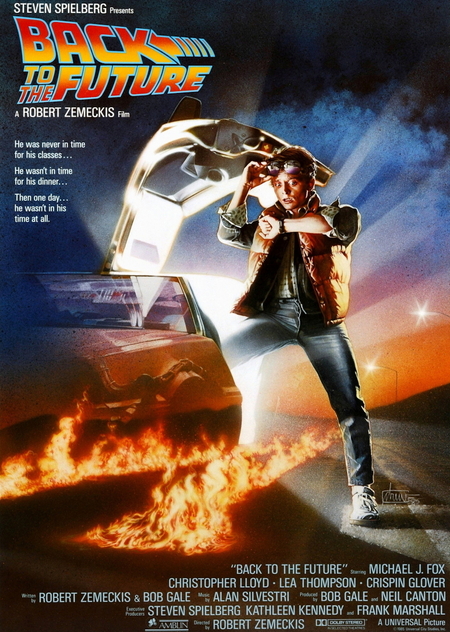
It is always interesting to learn how things work, and movies are no exception. The Back to the Future films were shot on film, and during that time (1984–1990), computer technology was not widely accessible. The limited computing power and the imperfect graphics of that era forced creators to devise unconventional solutions for their tasks, which adds intrigue to exploring this trilogy.
The first film featured very few special effects shots—only about 28–32—but despite this, it won the Saturn Award (1986) for Best Special Effects [1].
The second film had more shots (approximately 180) and received two awards: 1) Saturn Award (1991) for Best Special Effects. 2) BAFTA Award (1990) for Best Special Effects [2].
The third film had fewer shots (around 90), but the film did not receive any awards.
*The number of shots was not officially disclosed; these are enthusiast estimates.
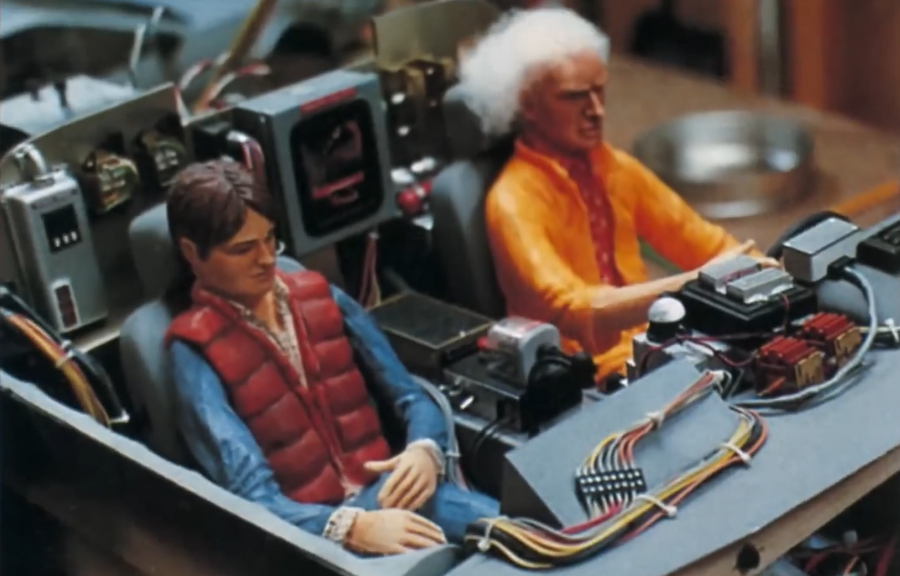
Diorian mockup with small Marty and Doc, ¼ scale // Back to the Future 3, 1990 // Supervisors: Michael Lantieri (SFX), Ken Ralston (VFX)
The special effects (SFX) supervisor for the first film was Kevin Pike [3], and Michael Lantieri [4] for subsequent films.
The visual effects (VFX) in all three films were created by Industrial Light & Magic, where Ken Ralston [5] served as the visual effects supervisor.
In the study, we will compare the special effects of all three films.
We will also examine: 1) The evolution of Hill-Valley across different years (1885, 1955, 1985, 2015) 2) The evolution of makeup usage 3) The evolution of effects for the DeLorean
Hill-Valley
Hill Valley is a fictional California town. In the first film, the city is shown in two versions: 1985 and 1955.
It was not a fully built city. Only its main square was constructed at the Universal Studios in Los Angeles [6], using existing city set pieces from another film and adding a clock to the courthouse building. The other parts of Hill Valley (the school, Marty’s house, Doc’s house, the supermarket parking lot) were filmed in other California towns [6].
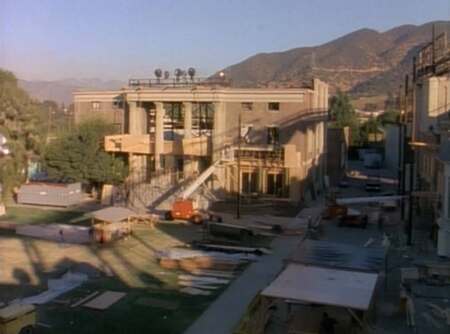
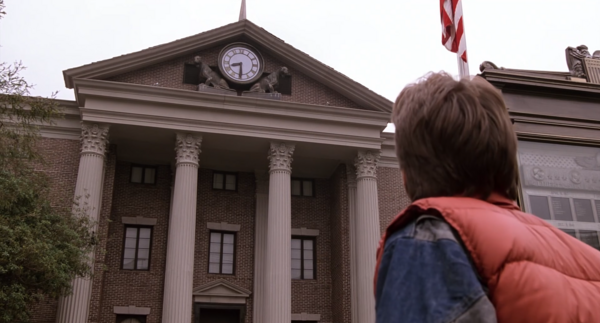
The courthouse building before the clock tower was built and in the footage from the film // «Back to the Future, ” 1985 // Supervisors: Kevin Pike (SFX), Ken Ralston (VFX)
The city was styled for different eras: first, it was given a clean 1955 aesthetic, and then it was «aged» to 1985.The footage below shows how the building is intact and beautiful in the 1955 footage, while in the 1985 footage, its windows are covered in graffiti and the green awning is torn.
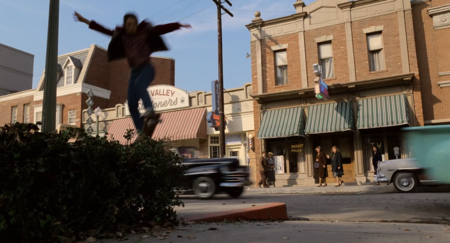
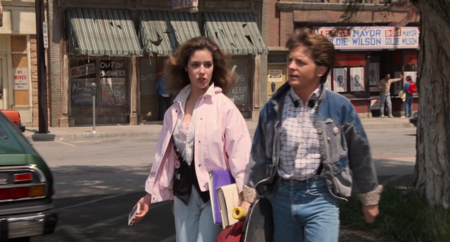
Hill Valley comparison in 1955 (left) and 1985 (right) // «Back to the Future,» 1985 // Supervisors: Kevin Pike (SFX), Ken Ralston (VFX)
The only effects indirectly related to the city in the first part are the thunderstorm from 1955. The clouds were made of cotton batting and shot separately from the building, and the lightning was added by ILM specialists after filming [7].
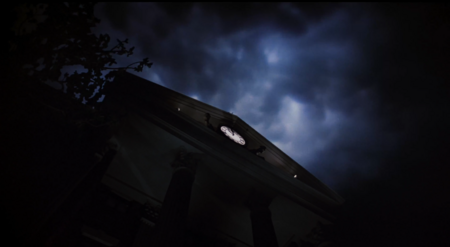
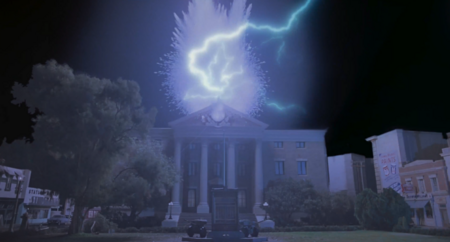
Cotton Clouds and a Finished Lightning Bolt // «Back to the Future,» 1985 // Supervisors: Kevin Pike (SFX), Ken Ralston (VFX)
In the second part, four timelines are involved: the original 1985, an alternate 1985, 1955, and 2015. We have already seen the original 1985 and 1955. We are far more interested in the alternate 1985 and 2015, as that’s where the special effects appear.
To build the alternate 1985, a 2.7-meter model of «Biff Tannen’s Paradise of Pleasure» [8] was created, which was combined with real footage of an empty, dark sky. Later, in post-production, smoke pipes and blinking lights were added to the building.
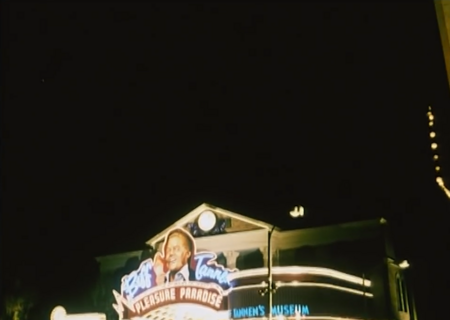
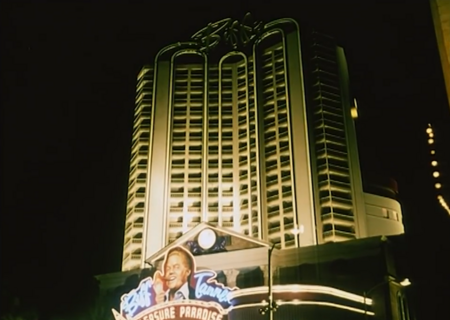
Combining live-action filming and models // «Back to the Future Part II,» 1989 // Supervisors: Michael Lantieri (SFX), Ken Ralston (VFX)
Final frame from the film // «Back to the Future Part II,» 1989 // Supervisors: Michael Lantieri (SFX), Ken Ralston (VFX)
The 2015 piece is more complex, featuring flying cars and holograms in addition to the futuristic set design. The flying cars were constructed similarly to the Eiffel Tower—a combination of a model and live-action footage—but the added complexity here is the continuous camera movement. While the Eiffel Tower sequence involved the camera rotating on one axis, the futuristic Hill-Valley sequence requires the camera to move and rotate almost continuously. This was achieved using ILM VistaCruiser technology [9], which simultaneously moved both the camera and the model during filming, ensuring that the pre-planned camera movement in reality matched the movement captured in the model sequence.
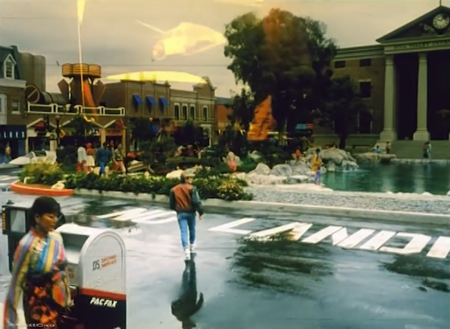
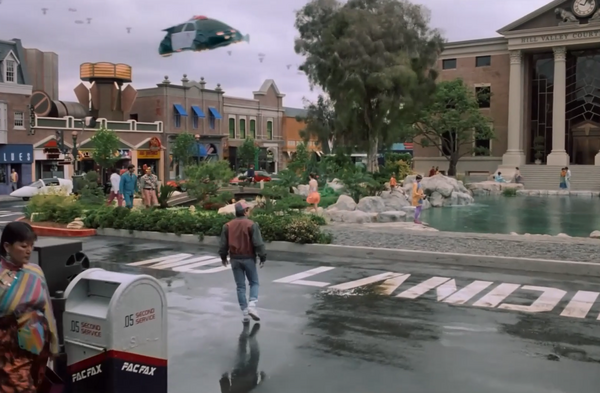
Concept design for the flying vehicle // «Back to the Future Part II,» 1989 // Supervisors: Michael Lantieri (SFX), Ken Ralston (VFX)
The next point, which is interesting, is created using ILM VistaCruiser, where the mockup is combined with live footage. Here, Marty sees the approaching «mockup»; the camera does not stop filming and simply tracks past Marty’s back, and that same «mockup» is replaced by the actual car.
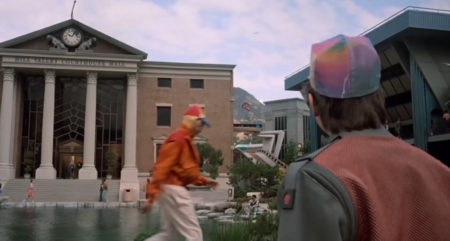
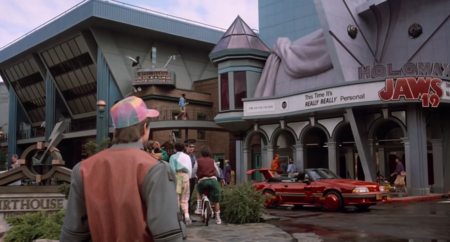
Flying model replaced with a real car without splicing // «Back to the Future Part II, ” 1989 // Supervisors: Michael Lantieri (SFX), Ken Ralston (VFX)
A little further on, Marty sees an advertisement for the film «Jaws '19,» where a holographic shark attacks Marty.This shark was entirely created using CGI [10], as the graphics of that era looked very cartoonish, which suited futuristic advertising perfectly. The shark’s animation was simply superimposed onto the footage shot with the actor.
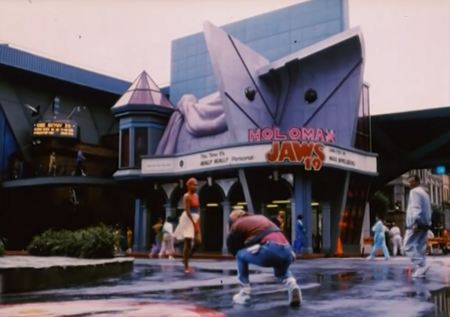
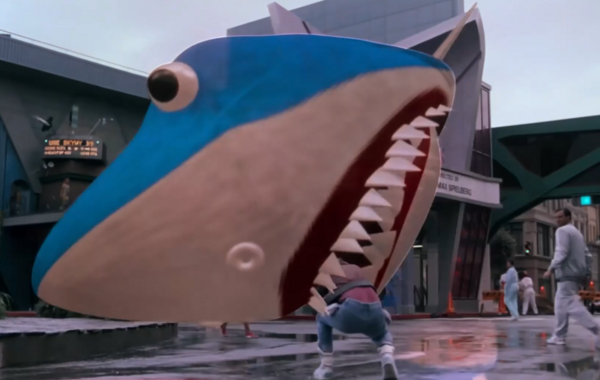
CGI Shark Bites Marty // «Back to the Future Part II,» 1989 // Supervisors: Michael Lantieri (SFX), Ken Ralston (VFX)
In the final installment of the trilogy, the main action takes place in 1885. The authors recount how they found vacant land and built an entire Wild West town from the ground up. While there are no special effects, the scope is impressive.
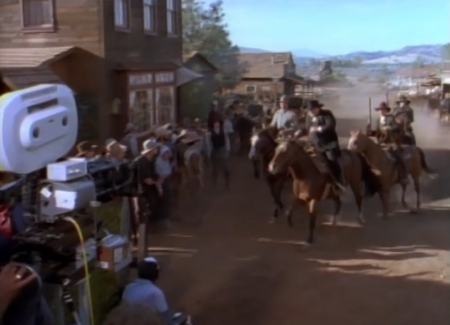
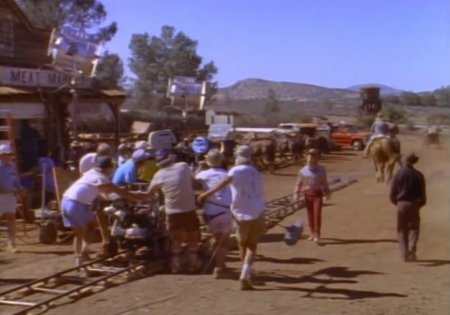
Stills from the filming of «Back to the Future III,» 1990 // Supervisors: Michael Lantieri (SFX), Ken Ralston (VFX)
Hill-Valley View // «Back to the Future Part III», 1990 // Supervisors: Michael Lantieri (SFX), Ken Ralston (VFX)
Throughout the trilogy, the authors meticulously developed different versions of Hill-Valley, but only the second part incorporated special effects to augment the city.
Makeup
The characters travel through different time periods and constantly encounter the same individuals—their younger and older versions. To achieve this, the creators used makeup [11] to age the characters. The results look quite believable. In the first film, the aging effect was applied five times: Marty’s parents, Doc, Biff, and the school principal.
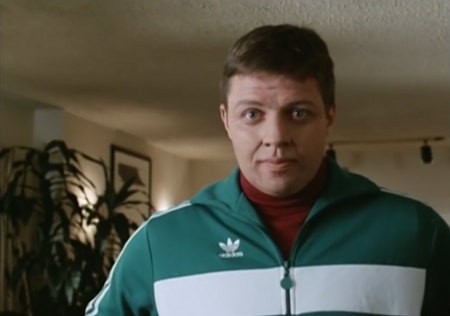
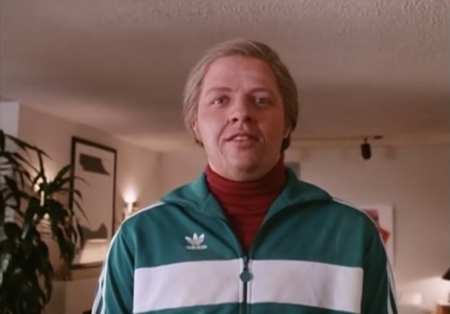
Young and aged Bill Tannen (played by Thomas Wilson) // «Back to the Future,» 1985 // Supervisors: Kevin Pike (SFX), Ken Ralston (VFX)