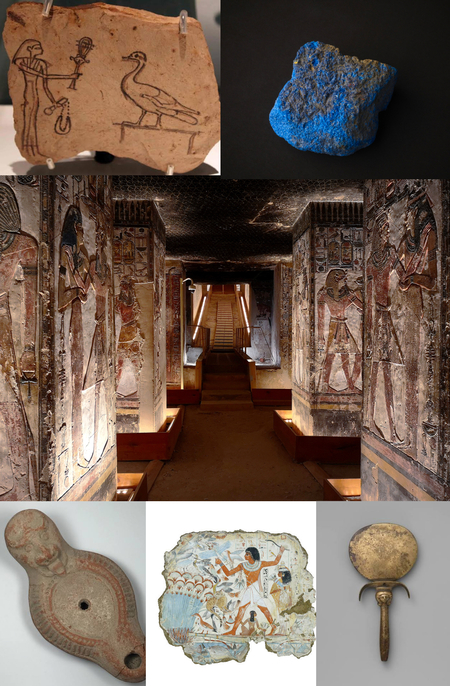
Visual Study
Eva Pylaeva, B26UKI02
Where do questions or topic selection specifics originate?
In the museum, Egyptian murals hang under even lighting, making it seem as if they were always meant to be viewed that way. But in the Valley of the Kings, the corridor of Seti I’s tomb extends into the rock for over a hundred meters. There are no windows. This means that someone traced every line on those walls almost in complete darkness, and that person must have had some light source. I have been fascinated by Ancient Egypt since childhood; encyclopedias still sit in my home, where I spent hours examining cross-sections of pyramids and sarcophagi. I have always been more interested in «how was this achieved?» than in «how beautiful it is.» Therefore, in this study, I examine Egyptian murals through the lens of light: how the work was illuminated, who controlled that illumination, and what this reveals about the people who decorated the tombs.
Back in 1892, readers of the British journal The Spectator were seriously discussing this very issue. One writer remarked: «It is perfectly accurate that the artist worked in complete absence of even a single ray of daylight. It is equally accurate that he did not use any artificial light that would cast a smoke.» — A letter to the editor of The Spectator, September 24, 1892. Over two months of correspondence, the participants managed to suggest electricity, mirrors, and painting «under light» before the tomb was sealed. 130 years later, we have a better answer, and it is provided by the artifacts themselves.
Hypothesis and Framework
Hypothesis. The murals in the depths of the rock tombs were the result not only of talent but also of logistics. Light had to be acquired, accounted for, and distributed, and this left its mark both on the painting technique and on how the masters' workshop was organized.
Objective. To test this hypothesis on six artifacts and separate what is supported by findings and texts from beautiful but unproven versions.
Objectives
1. To determine the sequence in which the sarcophagus was excavated and decorated, and at which stage the artists were involved.
2. To gather evidence regarding sources of light: lamps, wicks, and mirrors.
3. To examine how light relates to technique: sketching, preliminary designs, and pigment selection.
4. To integrate all findings into a single model: tracing the path light took from storage to the wall and what this reveals about society.
Chronology. The New Kingdom, primarily the 19th–20th Dynasties (c. 1292–1069 BCE). This was a time of flourishing artisan workshops from Deir el-Medina and the most elaborate royal tombs. Two artifacts are older (18th Dynasty), and one is much later: I have set these aside for comparison and will note this honestly in the captions.
Geography. West Thebes (today opposite Luxor): the Valley of the Kings, the necropolis of officials, and the village of Deir el-Medina, where the builders and artists of the royal tombs lived.
Selection Principle. I selected items of various types to capture the entire process: the workplace, the finished painting, a sketch, two items related to light, and pigment. Each piece must have a clear image and a verifiable source.
Six Artifacts:
1. Corridor of Tomb Set I (KV17): workplace
Valley of the Kings, 19th Dynasty, reign of Seti I (c. 1294–1279 BCE). Photo source: Wikipedia, Tomb of Seti I.
Tomb of Seti I — one of the longest, deepest, and most fully painted tombs in the Valley of the Kings. It was discovered by Giovanni Belzoni on October 16, 1817 (Wikipedia). The photo clearly shows the main point: the light here is entirely artificial. Modern lamps are hidden near the floor, and even with them, the ceiling fades into darkness, and daylight is only visible as a distant opening at the staircase.
This was not the work of solitary geniuses, but of a collective. Workers were divided into a «right» and «left» side, and each managed its own wall of graves. Along these same two sides, attendants distributed wicks and oil for the lamps, sometimes separately in the morning and evening (Morfini 2019). It appears that light in the crypt was as much a managed resource as grain or bronze chisels.
2. «Nebamon Hunting in the Marshes»: What Was Achieved in the End
Faiyum, 18th Dynasty, c. 1350 BCE. Painting on dry plaster, 83 × 98 cm. The British Museum, EA 37977. Photo source: World History Encyclopedia, © Trustees of the British Museum.
Nebamon was a scribe and grain accountant at the temple in Thebes—a mid-level civil servant. Almost everything we know about him comes from the frescoes in his funerary chapel. Giovanni d’Atanasi found it in 1820; fragments were cut from the walls, and the site was subsequently lost.
Important caveat: this is not the depth of a royal tomb. The chapel was small and open to relatives who came with prayers and offerings; the sealed burial chamber was located beneath it. I took this fragment as a standard of quality. Bird feathers, cat fur, and fish scales are delicately rendered with a fine brush, and such work requires good light, wherever it may be executed. There is also a great deal of Egyptian blue in the details. I will return to it in the sixth artifact.
3. Ostracon with Sketch: Artist’s Draft
Limestone, black paint. Ramesside Period (c. 1295–1070 BCE). Photo source: HistoricalEve.
Ostraka—these are fragments of limestone or pottery shards that the Egyptians used as an alternative to expensive papyrus. On these shards, a female figure holding an object resembling a sistrum and a bird on a pedestal are depicted with swift, confident lines. Thousands of these fragments have been found in Deir el-Medina. They have preserved drawings, absence records, bills, and those very records of wicks.
In the unfinished tombs, it is evident that the wall painting also progressed through a preliminary sketch. First, a grid of proportions was applied using thread dipped in red paint. Then, the painter added a red draft, and the master craftsman refined it with black (Theban Mapping Project). In the tomb of Khaoremheb (KV57), all these stages are still visible on one wall (ARCE). In the darkness, this system guards against errors: the composition is determined beforehand, allowing it to be neatly transferred onto the wall.
4. Bronze Mirror: The Petri Hypothesis
Mirror from the Hatnefer Tomb. Copper alloy, Early XVIII Dynasty, circa 1491–1473 BCE. Metropolitan Museum of Art, 36.3.13. Photo source: The Met.
The mirror is cast in two pieces and was found at the bottom of a coffin alongside porcelain dishes, a cosmetic box, and amulets (The Met). This means it was a personal item belonging to a woman, not a working tool. It gained its place in the study because of a single letter.
In November 1892, Flinders Petrie intervened in an article in The Spectator. He wrote that in Giza, he took photographs in complete darkness under sunlight, reflected four times off sheets of tin, like the lids from cookie tins. The light traveled around corners for more than nine meters (The Spectator, November 19, 1892). Petrie himself admitted, however, that he did not intend to decide whether ancient craftsmen used mirrors or lamps. His goal was to show that an explanation did not require inventing electricity.
Conclusion: Reflected light is physically possible and likely served to illuminate the entrance. However, I found no direct archaeological evidence that royal tombs were systematically lit with mirrors. The tinder, on the other hand, is recorded clearly in the artisans' journals.
5. The Oil Lamp: What Was It Really Used For?
Terracotta lamp with a handle shaped like a Gorgon’s head, Egypt, 2nd century CE (Roman period). Photo source: World History Encyclopedia, photo by Tom Pierce, CC BY-NC-SA 4.0.