Concept
This visual study analyzes how physical models and computer graphics contribute to the verisimilitude of the Tyrannosaurus Rex in cinematic gaming. The empirical basis consists of three films: Jurassic Park (1993), The Lost World: Jurassic Park (1997), and Jurassic World (2015). The selection of these specific films is due to their status as representative milestones in the evolution of visual technologies, allowing us to trace the transformation of approaches to creating the same on-screen creature across different historical periods. The study verifies the hypothesis that the final effect is determined by the correspondence between the chosen technology and the specificity of the individual frame. Close-ups of skin texture, full-body shots, and scenes of object interaction may imply different technical solutions. Accordingly, the evolution of the toolkit is examined through the lens of changes in visual outcomes, without presupposing that later films possess greater credibility a priori. Instead, the research assumes that each technological stage has its own expressive capabilities and limitations, and comparing these capabilities requires careful analysis of specific scenes rather than generalized assessments.
Choosing three films allows for a comparison of the same type of creature over twenty-two years. Jurassic Park serves as the starting point—the 1997 film—while Jurassic World expands the temporal scope of comparison. This longitudinal perspective makes it possible to observe how not only the tools but also the problem statement for visual effects evolved, as well as how audience expectations regarding on-screen realism have changed. The object’s identity makes the analysis concrete: it allows for a detailed study of the head, eyes, jaws, skin texture, and the nature of the feet’s contact with the surface. Furthermore, differences in the design of individual specimens must be separated from technological variations. Different coloration or a modified head shape alone does not constitute evidence of technical progress. This approach prevents the conflation of artistic choices with actual technological achievements, which is particularly crucial when comparing films separated by a significant time gap. In this context, the convincing quality of the Tyrannosaurus Rex is understood as the consistency of its rendering with the surrounding environment. Steven Prince interprets perceptual realism as the correspondence of the image with the viewer’s familiar experience of perceiving volume, surface, light, and motion. Thanks to this, a fictional creature that cannot be directly filmed can be perceived as physically present in the frame. [6, pp. 32–33] This understanding of realism allows us to analyze not so much the accuracy of reproducing the dinosaur’s biological appearance as the plausibility of its integration into the film’s visual environment. Four groups of characteristics were identified for analysis: surface readability, volume retention, environmental contact, and the consistency between practical and digital imagery. These criteria are applied to comparable shots, not to the film as a whole. This hierarchical approach ensures the ability to correctly compare individual scenes and reveal precisely in which aspects of the image the differences between technologies manifest, and in which similarities are dictated by universal principles of screen expressiveness.
Navigation
- Concept
- Creating the Tyrannosaurus Rex in Jurassic Park, 1993
- Tyrannosaurus Rex in The Lost World. Jurassic Park, 1997
- The Return of the Tyrannosaurus. Jurassic World, 2015
- Technology Comparison and Findings. The Tyrannosaurus across three films.
- Conclusion
- References
Creating the Tyrannosaurus in «Jurassic Park, ” 1993
The creation of the Tyrannosaurus screen image was not handled by a single performer—it was distributed among several specialized groups. Stan Winston oversaw the construction of the physical (practical) models. Michael Lantieri was responsible for the mechanical effects and control devices that allowed for real-time interaction with these models on set. Dennis Miren served as the VFX Supervisor at ILM. [4] Phil Tippett’s team developed the dinosaur choreography. The shift to computer-generated imagery did not represent a break from prior stop-motion animation practices; rather, it evolved as a continuation of them. Together with Tippett Studio, the Dinosaur Input Device was created—a mechanism that connected the operator’s input to the physical manipulator and digital animation, ensuring a direct transfer of movement from the analog to the digital environment.
Tyrannosaurus Rex sculptural sections. Stan Winston Studio. Jurassic Park, 1993.
The massive silhouette of the Tyrannosaurus Rex was being formed even before its full-scale model was created. An article in American Cinematographer mentions small sculptures that were used to fine-tune the creature’s proportions and dimensions. To enlarge the form, a cross-section method was employed: these sections were transferred onto wooden templates, and the large sculpture was then constructed based on that framework. [4] In the production still, you can discern the head and fragments of the torso. Dividing it into separate sections allowed for handling an object that significantly exceeded human height. [1, p. 60] From a visual analysis perspective, this frame displays the form before paint application and before studio lighting. This suggests that while the silhouette and overall relief can be studied from it, it is impossible to judge the final color of the screen T-Rex based on this image.
Tyrannosaurus mechanical structure on a mobile platform. Stan Winston Studio. Jurassic Park, 1993
The practical Tyrannosaurus model comprised a supporting frame, drive mechanisms, and a movable platform. A hydraulic system, modeled after an aviation simulator, was employed for significant movements. As Winston noted, the speed regulation and compensating movements reduced the jerk force during the heavy structure’s stop. [4] The snapshot captures elements of the support chassis, the actuators, and the supports. These elements illustrate that the creature’s external appearance is inseparable from the logic of its movement—the moving volume required the coordinated operation of several mechanical assemblies. Nonetheless, this photograph does not allow us to conclude that the dinosaur was capable of walking autonomously across the set. The mobility of the structure and free locomotion are fundamentally different objectives. The capabilities of a specific model must be evaluated in consideration of the plan utilized in the film.
Attaching the outer skin to the Tyrannosaurus construction. Stan Winston Studio. «Jurassic Park, ” 1993.
The next step is applying the outer casing to the structure. The caption for the photo published in Cinefex mentions a phonoltex leather. John Rosengrant and Bill Bass developed the color scheme for the T-Rex while working with a scaled model, and subsequently transferred the discovered pattern onto the life-size figure. [1, p. 61] In this image, the shell is already covering the mechanics, but some of the supports and technical platforms are still visible. This transitional state helps distinguish two production tasks: forming the creature’s recognizable surface and enabling it to function on a movable base. The relief and the color should be considered separately. It is the folds that create the surface topography, while the coloring redistributes the ratio of light and dark areas. How these elements manifest in the final shot is additionally determined by the lighting, the shooting position, and the distance to the camera.
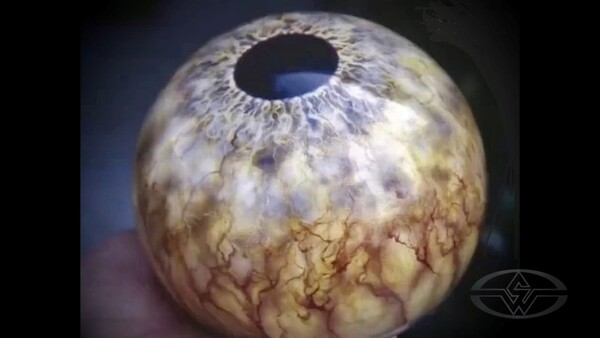
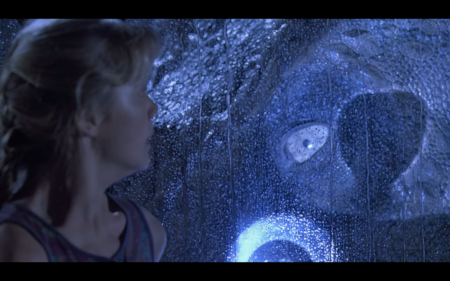
Left: A Tyrannosaurus eye, as depicted in the work of Rob Hinderstein. Stan Winston School of Character Arts, The History of the Dinosaur Eyes of Jurassic Park, 2022. Frame from a published educational video; watermark retained. Right: A frame from the film Jurassic Park, 1993
The eye was crafted as a separate element, and its appearance was tested by placing it in the eye socket. According to Rob Hinderstein, the studio prepared several variations and then presented them to Stan Winston and Steven Spielberg. The eye of an eagle served as the basis for one of the early designs. [7] In the publication, the chosen tyrannosaur eye is characterized by a dark pupil whose iris boundary is less sharply defined and transitions into a spotted texture. An airbrush was used for coloring in combination with hand-painting. [7] The presented frame shows an uneven pattern, a darkened center, and a surface highlight.
Practical Tyrannosaurus head captured from inside a vehicle. Stan Winston Studio; hydraulic support by Michael Lantieri’s division. «Jurassic Park,» 1993. Publication framing
In the shot, taken from the car cabin, the Tyrannosaurus’s snout appears very close to the viewer. As Cinefex explains, similar shots were captured using a separate prosthetic head manufactured by Stan Winston Studio and mounted on a hydraulic rig managed by the Lantieri team. [1, p. 62] The lower part of the image allows one to clearly see the jaw: the bright enamel of the teeth contrasts with the darker interior cavity. The gaps between the teeth and the depth of the space behind them create a sense of volume. The upper part of the head and the eyes are perceived through reflections on the glass. This simultaneously integrates the creature into the car’s interior and narrows the view of its surface. The photograph indicates that a fabricated head was positioned in front of the camera, but it does not reveal the entire structure. Therefore, no conclusions should be drawn about the construction of the full-scale body. In this case, we are discussing a specific prosthetic model.
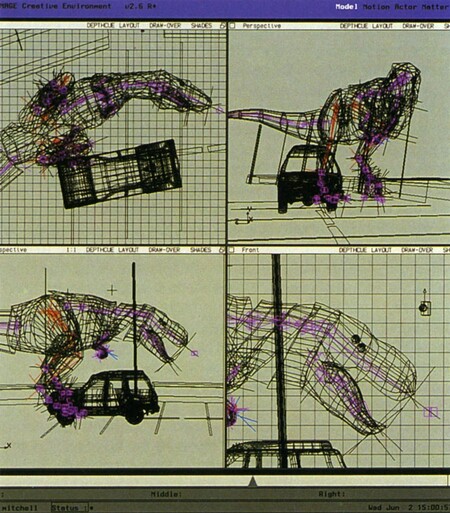
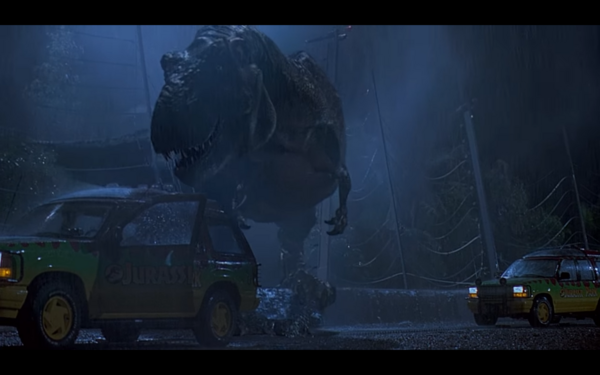
Left: A digital Tyrannosaurus in Softimage. ILM. «Jurassic Park,» 1993. Right: A frame from the film «Jurassic Park,» 1993.
In the archived screenshot from Softimage, the digital Tyrannosaurus Rex is presented as a volumetric model. Through multiple projections, one can assess the posture of the body and how it relates to other scene objects. The wireframe display mode here serves as a working representation of the form; it should not be mistaken for the creature’s final surface. Among the tools used in the film, ILM names Viewpaint—a system that allowed for painting directly onto the 3D model. This implies that the shaping of the form and the work on the colored surface were interrelated tasks, yet not identical ones.
Digital effects by ILM, VFX Supervisor Dennis Miren. Illustration framing retained as published. Jurassic Park, 1993
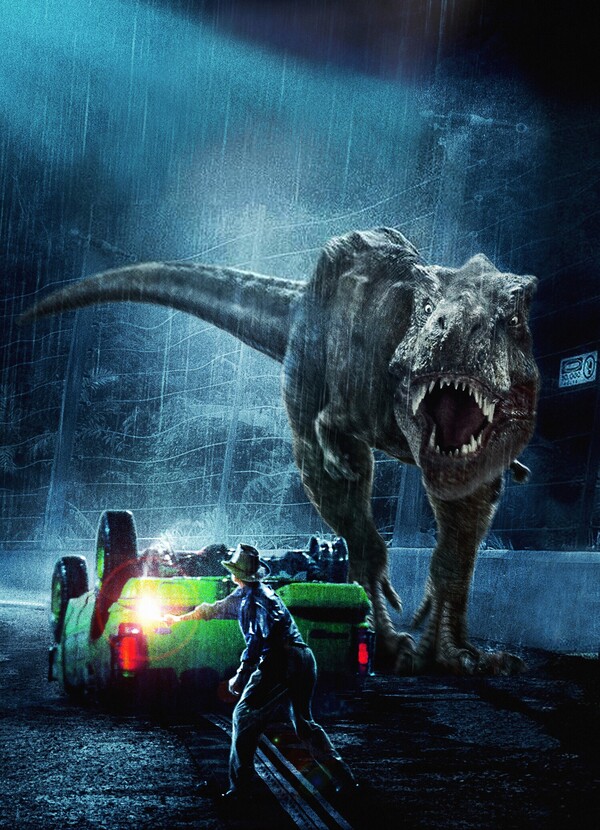
In the fourth frame, the computer model is integrated into the final image. Cool highlights appear on the back and head, while the lower body remains darker. The light emphasizes volume without breaking the connection to the nighttime setting. Malcolm stands in front of the Tyrannosaurus, partially obscuring its figure. The relative placement of the human, the machine, and the creature establishes a sequence of spatial planes. Due to the overlapping elements, the dinosaur reads as being positioned behind the protagonist rather than as a layer overlaid on the entire picture. Since Cinefex presents the fourth frame alongside the original footage and intermediate stages of digital processing, the presence of CG in this image is confirmed by the production source. [1, pp. 70–71]
The digital tyrannosaur passes through the fence. ILM and Tippett Studio. «Jurassic Park,» 1993
In this shot, where the creature is positioned behind a fence, a magnificent section of the Tyrannosaurus’s body is revealed. The vehicles on either side of the frame provide a familiar sense of scale, against which the dinosaur appears colossal. Light accentuates the head and chest, while the legs and rear half of the figure partially recede into darkness. Cinefex directly characterizes this shot as computer-generated imagery. [1, p. 66] Here, the digital solution allows the creature to inhabit the space between the cars and the fence while maintaining the figure’s integrity without a noticeable mechanical support. Visual fidelity in this instance is achieved not through the equal level of detail across all parts of the body. Primarily, the viewer perceives the silhouette, scale, and direction of movement. The poor visibility of the legs makes it impossible to judge contact with the ground—this frame cannot be used as sufficient evidence of the precise placement of the feet.
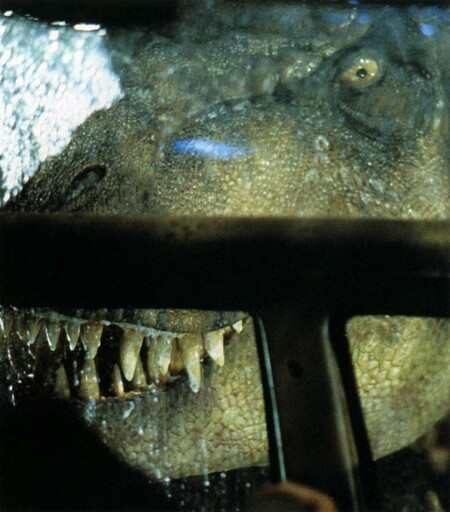
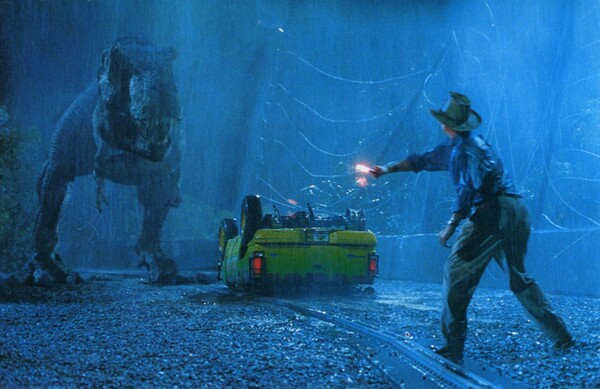
Left: Practical animatronic head. Stan Winston Studio; hydraulic support by Michael Lantieri’s team. «Jurassic Park, ” 1993. Right: Digital Tyrannosaurus in a scene with Grant and the overturned car. ILM and Tippett Studio. „Jurassic Park, ” 1993.
Both photographs depict the same creature, realized through different technical means. In the first case, the camera is positioned close to the practical head; in the second, the Tyrannosaurus is shown in full height. In both images, the elongated snout, large jaws, and uneven surface are recognizable; the other proportions can only be discerned in the second frame. The shooting conditions, however, differ quite significantly. The first image reveals fine skin details and teeth; the second emphasizes the relationship between the head, torso, and limbs. This does not mean that one technology yielded a more detailed result: the difference may be explained by the shot size, lighting, lens, and reproduction quality. American Cinematographer describes the reduced sculptures created by Winston’s team as the foundation that was also used for the computer versions. [4] The unified handling of the form contributed to the consistency between the variations.
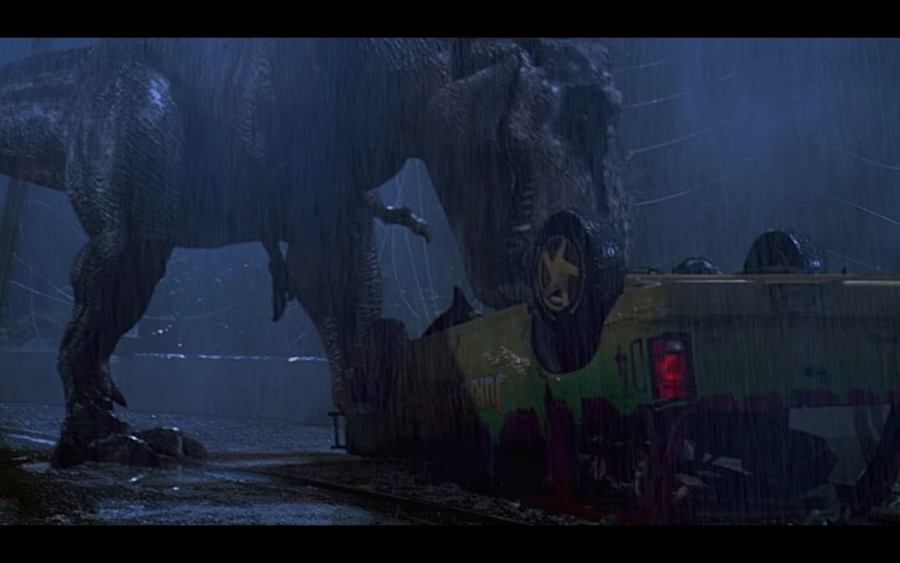
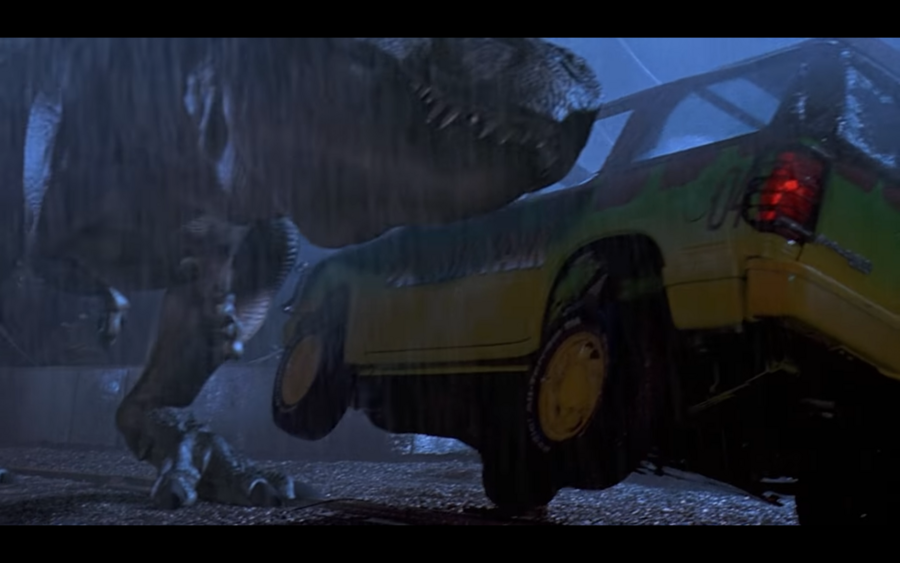
Stills from the movie «Jurassic Park,» 1993
References
Duncan, Jody. The Beauty in the Beasts // Cinefex. 1993. No. 55. August. [Electronic resource] URL: https://ia600500.us.archive.org/view_archive.php?archive=/20/items/CineFex_1993/CineFex%201993%20No%20055.zip&file=6.ReadingView.html (accessed: 11/06/2026)
Duncan, Jody. On the Shoulders of Giants // Cinefex. 1997. No. 70. June [Electronic resource] URL: https://ia801904.us.archive.org/view_archive.php?archive=/12/items/CineFex_1997/CineFex%201997%20No%20070.zip&file=4.ReadingView.html (accessed: 11/06/2026)
Duncan, Jody. Indominus // Cinefex. 2015. No. 142. July [Electronic resource] URL: https://ia801605.us.archive.org/view_archive.php?archive=/11/items/cinefex_2015/CineFex%202015%20No%20140-144/CineFex%202015%20No%20142.zip&file=readingView3.html (accessed: 11/06/2026)
Magid, Ron. Jurassic Park: Effects Team Brings Dinosaurs Back from Extinction // American Cinematographer. June 1993 [Electronic resource] URL: https://theasc.com/article/jurassic-park-effects-team-brings-dinosaurs-back/ (accessed: 11/06/2026)
Pizzello, Stephen. Chase, Crush and Devour in The Lost World: Jurassic Park // American Cinematographer. June 1997 [Electronic resource] URL: https://theasc.com/article/the-lost-world-jurassic-park/ (accessed: 11/06/2026)
Prince, Stephen. True Lies: Perceptual Realism, Digital Images, and Film Theory // Film Quarterly. 1996. Vol. 49. No. 3. P. 27–37 [Electronic resource] URL: https://vtechworks.lib.vt.edu/server/api/core/bitstreams/805f11d2-2e51-418a-8c5f-7147a6c94b38/content (accessed: 11/08/2026)
Stan Winston School of Character Arts. The History of the Dinosaur Eyes of Jurassic Park. August 12, 2022 [Electronic resource] URL: https://www.stanwinstonschool.com/blog/the-history-of-the-dinosaur-eyes-of-jurassic-park (accessed: 11/08/2026)
Stan Winston School of Character Arts. Double the Teeth, Double the Terror: Behind the Male T-Rex of The Lost World: Jurassic Park. June 26, 2026 [Electronic resource] URL: https://www.stanwinstonschool.com/blog/double-the-teeth-double-the-terror-behind-the-male-t-rex-of-the-lost-world-jurassic-park-1997 (accessed: 11/08/2026)
Interview: ILM on Jurassic World // ZBrushCentral. February 2, 2016 [Electronic resource] URL: https://www.zbrushcentral.com/t/interview-ilm-on-jurassic-world/334212 (accessed: 11/08/2026)
Failes, Ian. Crafting the Hero Moment // fxguide. November 19, 2015 [Electronic resource] URL: https://www.fxguide.com/quicktakes/crafting-the-hero-moment/ (accessed: 11/08/2026)