Navigation1. Concept 2. Aloïsa Korbas: Creativity Beyond Norms. 3. Imagined Love and Female Identity. 4. Aloïsa Korbas’s Visual Language. 5. Between Pathology and Art. 6. Conclusion. 7. Bibliography. 8. Image Sources.
Concept
Research Relevance: Aloïse Korbas occupies a unique place in the history of Art Brut. Her drawings were created in psychiatric institutions, where patients' artistic pursuits were long under the scrutiny of physicians. Later, these images entered art collections and became subjects of art historical analysis. Korbas’s story provides a foundation for exploring the boundary between a medical and an artistic perspective on creativity. Her drawings feature scenes of love, elaborate female figures, historical characters, and a dense decorative space organized according to her own rules.
Research Concept: The focus is on the imaginary world of Aloïse Korbas and its visual structure. The artist spent a significant part of her life in psychiatric facilities. There, she drew upon romantic narratives, theatrical imagery, and characters from European culture, weaving them into unconventional compositions. This study examines the persistent techniques in her graphics: vibrant color combinations, large character eyes, emphasized outlines, floral patterns, and the repetition of intimate scenes. Her biographical circumstances establish the historical context, while the peculiarities of her artistic form are revealed through the analysis of the images themselves.
The core idea of this research is the distinction between the historical conditions under which the works were created and their artistic qualities. Korbas’s drawings initially existed within a medical setting, then they were featured in Art Brut collections and exhibited publicly. This trajectory raises the question of how society’s criteria for recognizing a work as art evolve. The institutional history, as well as the inherent qualities of the graphic work—its consistency, decorative richness, and the nature of the depicted relationships—are vital for this analysis.
Research Goal: To identify how Korbas’s romantic subjects, female figures, and expressive devices form a cohesive artistic world, and to trace how the perception of her work has changed within the context of Art Brut.
Research Objectives:
- To examine the biographical and historical context of Aloise Korbaz’s work and its place in the history of Art Brut.
- To trace the development of romantic plots, female archetypes, historical figures, and theatrical motifs.
- To analyze the characteristics of color, line, composition, ornamentation, and materials utilized.
- To compare the initial reception of the drawings within the medical community with their subsequent recognition by artistic institutions.
Material and Selection Principles. This study is based on reproductions of Korbaz’s drawings from museum collections and her scholarly catalogue raisonné. Images from various years and formats have been selected for comparison, focusing on the expressive eyes of the characters, the theatrical portrayal of figures, romantic scenes, and floral ornamentation. Examining these motifs in different combinations reveals the consistent characteristics of Korbaz’s artistic language.
Research Structure. The study begins with an examination of the artist’s biography and the emergence of the concept of Art Brut. Attention then shifts to romantic subjects and the depiction of female figures. The following section is dedicated to color, line, composition, ornament, and materials. The research concludes with the history of Korbaz’s recognition—from the initial perception of her drawings in a medical institution to their inclusion in museum collections.
Source Work. The biographical section is primarily supported by materials from the Collection de l’Art Brut, museum publications, and Korbaz’s scholarly catalogue raisonné. The visual analysis relies on Charles Russell’s research, publications by Art Brut specialists, and a comparative study of available reproductions. Past medical assessments are considered part of the history of how her work was perceived. The composition, expressive devices, and recurring motifs in the drawings are analyzed directly from the images.
Research Question: How did Aloise Korbaz develop a recognizable artistic language in isolation, and how did the perception of her drawings change after they entered the sphere of art? The hypothesis posits that the unity of her work stems from consistent imagery and representational techniques: romantic scenes, the theatricality of poses, her unique depiction of eyes, and the decorative filling of the surface are recurring elements across works from different years. Artistic recognition altered the modes of interpreting her pieces, shifting focus toward their expressive qualities.
Aloïsa Korbaz: Creativity Beyond the Norm
Figure 1 — Aloïsa Korbas. Photograph by Henriette Grin, 1963
Aloïse Korbas (1886–1964) was a Swiss artist associated with the history of Art Brut. Born in Lausanne, she once dreamed of the opera stage and briefly worked as a governess in Germany. In Potsdam, she served in the household of the court chaplain for Wilhelm II. After returning to Switzerland, her behavior concerned her relatives. In 1918, Korbas was placed in the psychiatric hospital in Serrières, and in 1920, she was transferred to La Rosière, where she lived until the end of her life. [2, p. 3; 5]
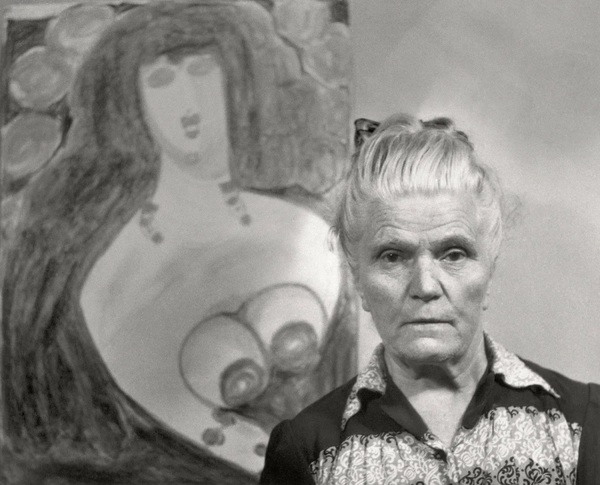
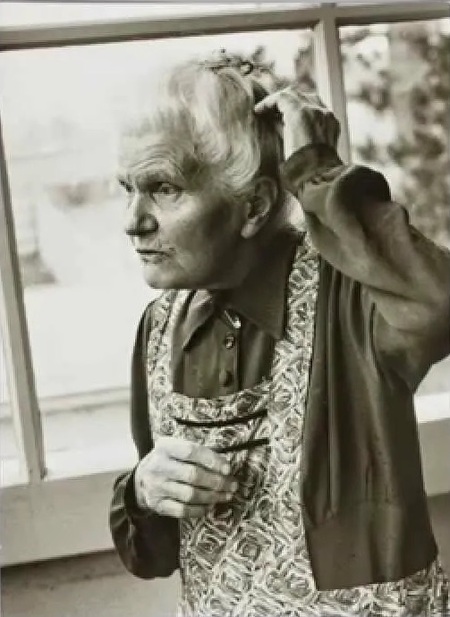
Figure 2 — Aloysa Korbaz in front of her drawing. Photograph by Alfred Bader Figure 3 — Aloysa Korbaz by the window. Archival photograph
Figure 4 — Aloïsa Korbaz next to the drawings. Archival photograph
Korbas began to draw after being hospitalized. Initially, she worked in secret, concealing the found paper; many early drawings have been lost. Psychiatrist Hans Steck preserved her works, and starting in 1941, the artist was in correspondence with Dr. Jacqueline Porret-Forel, who later dedicated many years of research to her creative output. [2, pp. 4; 5]
Figure 5 — Aloïsa Korbas. Aristoloches, c. 1925–1933
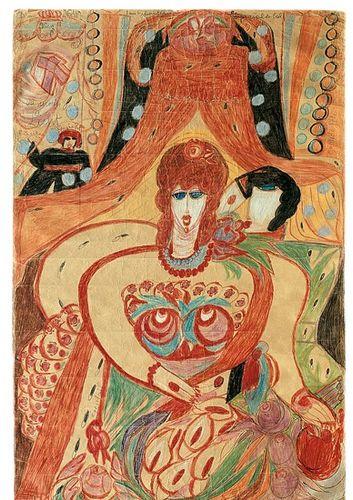
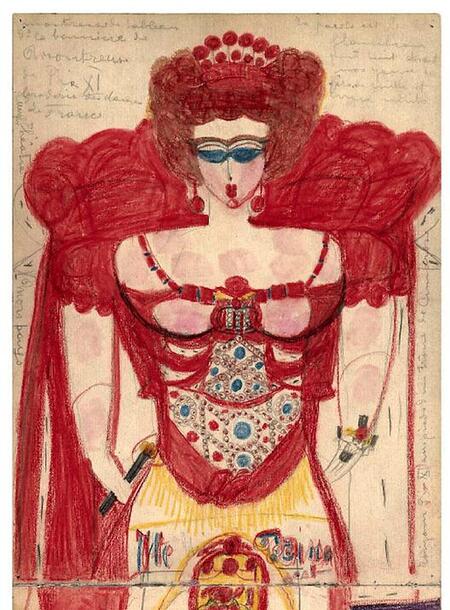
Figure 6 — Eloise Korbaz. Female figure in red-orange design Figure 7 — Eloise Korbaz. Montreuse de tableau in the Montreux banner, 1941
The term art brut («raw art») was introduced by Jean Dubuffet in the mid-1940s, referring to works created by individuals operating outside of formal academic training and the established art market. For Dubuffet, the liberation of the author’s language from recognized cultural templates was paramount. He included in the sphere of art brut both the works of psychiatric patients and the creativity of artists working under different circumstances. [2, p. 4; 6]
Figure 8 — Aloïsa Korbaz. Tsarine («Empress»), circa 1941
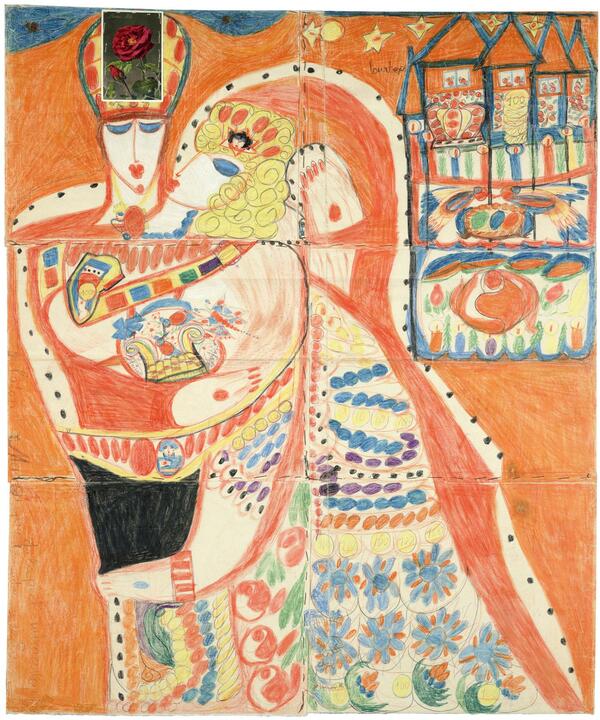
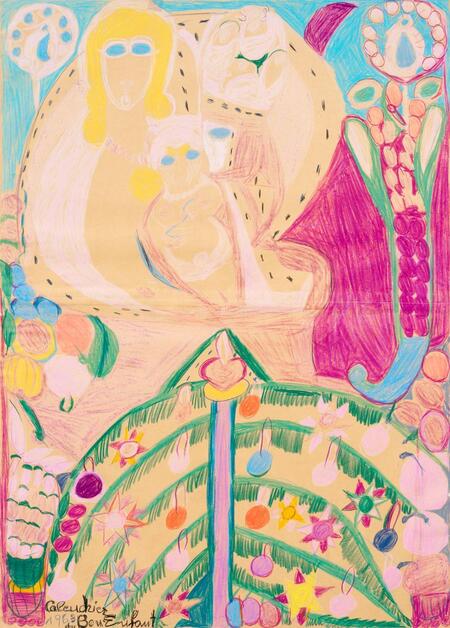
Figure 9 — Aloysa Korbaz. Figure in formal attire against an orange background Figure 10 — Aloysa Korbaz. Figures in a light composition with floral ornamentation
Korbaz’s works became one of the most recognized examples of art brut. Her artistic practice developed without formal professional training, exhibition commissions, or a focus on the market. Her later recognition drew attention to the composition, the character of her imagery, and the individual language of her drawings. [2, pp. 3–4; 6]
Figure 11 — Aloïsa Korbas. Montreuse de tableau in the Montreux banner, 1941. Fragment
Korbas’s drawings consistently feature loving couples, elegantly dressed women, emperors, and biblical and historical figures. Napoleon and other famous personalities appear amidst fictional events and theatrical scenes. In one composition, the artist freely blended characters from different eras. [1, pp. 85–93; 5]
Figure 12 — Aloïse Korbaz. Portrait of a woman with a voluminous hairstyle
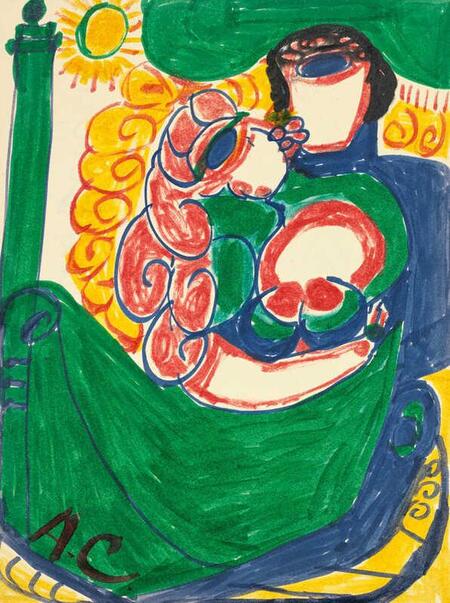
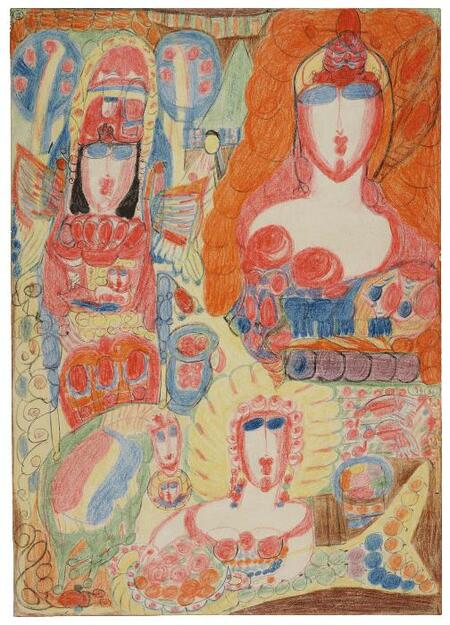
Figure 13 — Aloise Korbaz. Figures in a blue-green composition Figure 14 — Aloise Korbaz. Several female figures in a decorative setting
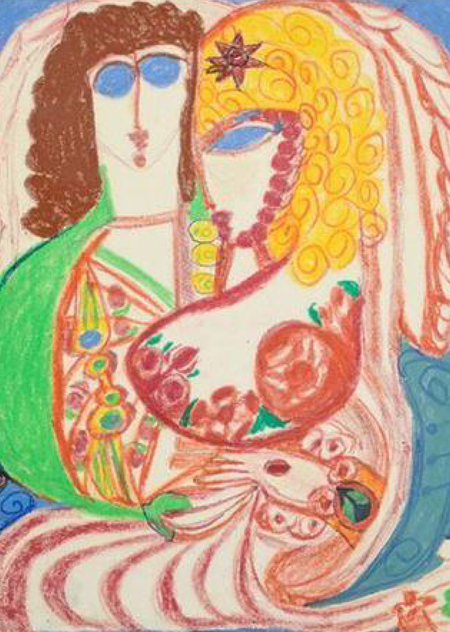
People on these sheets are often positioned close to one another. Flowers, ornaments, birds, and festive decorations crowd around them. Familiar poses and characters reappear, but their settings change. Thus, individual drawings are perceived as parts of an ongoing narrative, where personal fantasies are interwoven with historical, operatic, and religious motifs. [1, pp. 85–91; 3]
Imagined Love and Female Identity
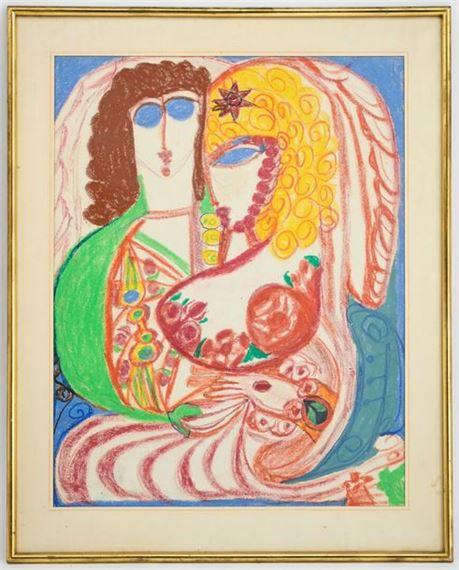
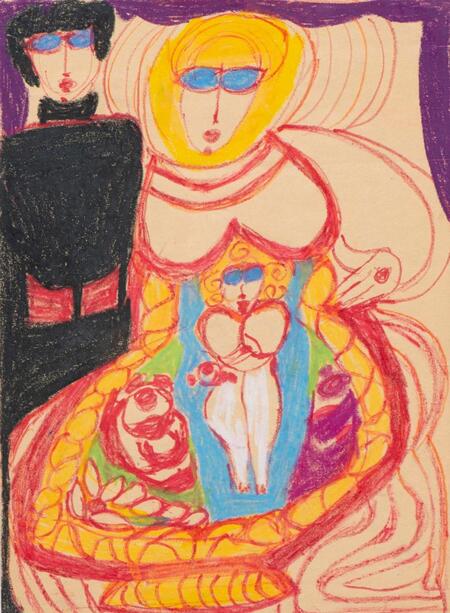
Figure 15 — Aloïsa Korbaz. Les deux amies («The Two Friends»), circa 1960–1963 Figure 16 — Aloïsa Korbaz. Couple et figurine sous un rideau violet, circa 1959
Love scenes occupy a significant place in Korbaz’s work. While living in Germany, she became fascinated by the figure of Emperor Wilhelm II and imagined a connection with him. Later, embraces, kisses, and romantic encounters frequently appeared in her drawings. These motifs coexist with narratives of famous rulers, heroines, and literary characters. [2, p. 3; 5]
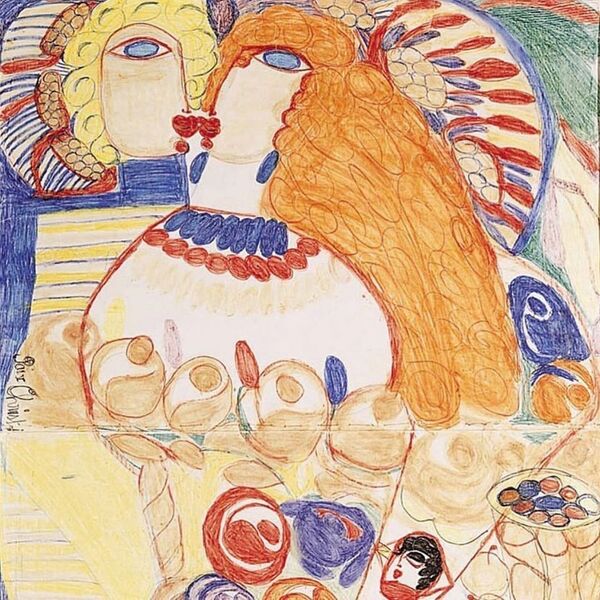
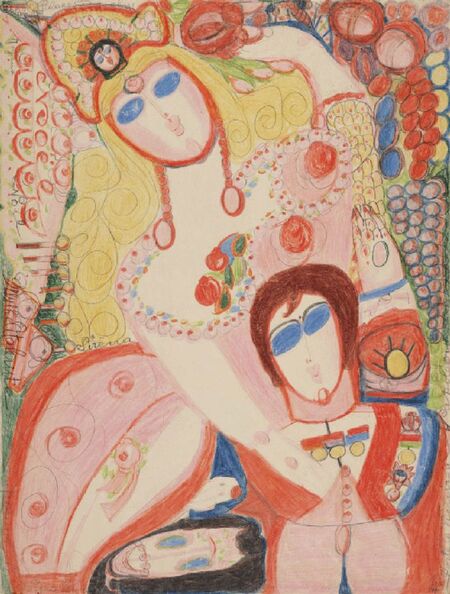
Figure 17 — Aloïsa Korbach. Two figures in a scene of intimacy Figure 18 — Aloïsa Korbach. Feminine forms among ornaments
Individual relationships transform into a recurring narrative at Korbas. A woman and a man might stand almost motionless, touching faces, or merging in an embrace. Similar gestures transition from one composition to the next; the outfits and the figures in the scene change. The imagined story continues beyond a single page. [1, pp. 85–91]
Figure 19 — Aloïse Korbas. Horizontal composition with several figures
Female figures are easily recognizable by their wide-open blue eyes—often nearly pupil-less—elaborate hairstyles, ornaments, and voluminous costumes. Lips are emphasized in red; the neck, arms, and torso are often elongated or curved. The attire occupies a significant portion of the image: the fabric transforms into a pattern of flowers, lines, and colored spots. These details create an image reminiscent of an opera stage. [1, pp. 85–90; 3]
Figure 20 — Aloïse Korbas. Collier en serpent and Malibran Marie Stuart, circa 1956. Obverse and reverse sides