Navigation Menu
I. Project Description
1. Topic 2. Object 3. Subject 4. Goal 5. Objectives 6. Chronology 7. Geography 8. Artifacts for AnalysisII. Visual Research Concept
1. Rationale for Topic Selection 2. Material Selection Principle 3. Categorization Principle 4. Principle for Selecting and Analyzing Textual Sources 5. Key Question and HypothesisIII. Visual Narrative
Introduction 1. Historical and Cultural Context 2. The Architecture of the Fibula (Mechanism and «Escutcheon») 3. How the Fibula Functioned on the Body (Reconstructions) 4. Analysis of Objects: 4.1. «The Sign» (Arbalest Fibula, Bird Fibula, Cicada Fibula) 4.2. «The Escutcheon» (Two-Plate Fibula, Finger Fibula from Suuk-Su, Merovingian Fibulae) 4.3. «The Showcase» (Hilderic I’s «Bees» and Eagle Fibulae) 4.4. ComparisonIV. Conclusion
V. Bibliography VI. Image SourcesI. Project Description.
1. Topic
Form and status in the design of fibulae from the 5th–6th centuries (based on materials from the State Historical Museum collection and comparative holdings in France and the United States).2. Subject
Fibulae from the 5th–6th centuries as costume elements and visual markers of social status, sourced from the collections of the Caillebotte Institute Museum, the Walters Art Museum, the National Museum of Archaeology in Saint-Germain-en-Laye, and the National Library of France, as well as scientific reconstructions of the costumes from that era.3. Subject Matter
The relationship between the form of the fibula and its social function—that is, how the architecture of the face, size, material, decoration, and method of wearing communicated the owner’s status during the era of the Great Migration of Peoples.4. Objective
To identify and analyze how the form of fibulae from the 5th–6th centuries expressed the owner’s social status, and to demonstrate that the increasing complexity of the form was related not only to fashion but also to the necessity of visually representing status.5. Objectives
- To define the visual forms of V–VI century fibulae and their structural characteristics (plate, mechanism, mode of wear).
- To trace how the shape of the fibula functioned within the costume, demonstrating through reconstructions that the clasp was an optical dominant and a «representative screen.»
- To compare items from the GIM collection with Western European fibulae (Merovingian, Visigothic, Frankish) to identify a common visual code of status.
- To analyze how size, material, decoration, and pairing correlate with status level, distinguishing cases where the form expresses status from cases where it expresses fashion or local tradition.
- To compile a table of objects and form dynamics, illustrating the transition from simple cast clasps to composite polychrome structures.
6. Chronology
The lower bound—the Chernyakhov iron dart-shaped fibula of the 2nd–5th centuries CE and the turn of the 4th–5th centuries CE (early cast bird fibula from Pantikapeia)—is utilized as a starting point for comparison, illustrating the utilitarian base of the clasp. The main period is the 5th–6th centuries CE—the Age of Migration, a time of the formation of warrior elites and the development of plate and zoomorphic forms in Eastern Europe and the Black Sea region (the cicada from Pantikapeia, as well as finds with broad museum dating—a two-plate fibula from the 1st millennium CE from Altyn-Asar and a clawed fibula from the second half of the 6th–10th centuries CE from Suuk-Su). The upper bound (in the context of costume) is the 6th–7th centuries CE—reconstructions of early Byzantine military attire on the Syrian and Danube frontiers, which demonstrate the common use of large clasps on cloaks. Comparative material: late 5th–6th centuries CE—Western European status regalia and clasps from the Merovingian and Visigothic kingdoms («bees» from Hilderic I’s tomb before 482 CE, mid-6th-century Merovingian fibulae, and 6th-century Visigothic eagle fibulae).7. Geography
The main area of operation was Eastern Europe, Crimea, and the Aral region (Ponticus, Suuk-Su, Chernyakhovo, Altyn-Asar). The comparative areas included Western Europe (Gaul, Spain) and Byzantium (the Syrian and Danube frontiers).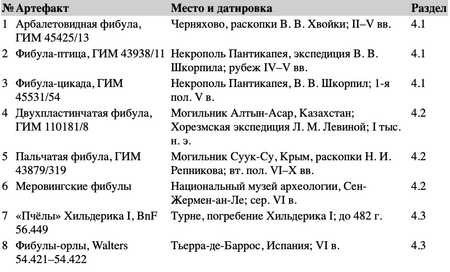
8. List of artifacts for analysis.
Costume Reconstructions
- Historical reconstruction of military attire: «The Army in Syria and Palestine, 6th–7th Centuries» (Artist G. Samner, based on D’Amato R. Roman Military Clothing (3): AD 400–640, 2005).
- Historical reconstruction of military attire: «The Army on the Danube, Late 6th Century» (Artist G. Samner, based on D’Amato R. Roman Military Clothing (3): AD 400–640, 2005).
II. Visual Research Concept.
Justification for topic selection.
Today, a garment clasp is perceived purely as discreet, utilitarian hardware—something designers either try to conceal or, at least, display very obviously. But it wasn’t always like that. During the Late Antiquity and Early Middle Ages, the fibula held a central place in costume, functioning as a primary visual marker of social hierarchy. I became interested in this design paradox: how a purely functional mechanism (essentially, a simple pin for fastening a cloak) began rapidly growing in complexity during the 5th and 6th centuries, increasing the surface area of its face and transforming into a monumental «representational screen.» The form ceased to serve only the practical task of securing fabric and began to transmit the wearer’s rank, wealth, and status.
The era of the Migration Period, as a chronological framework, was a time of unprecedented migratory activity, where established tribal boundaries disintegrated, traditions merged, and new military and royal elites were formed. In a world where people from diverse cultures constantly encountered one another, there was a need for a universal visual language understood without translation. An expensive, intricately decorated fibula worn on the shoulder or chest served as an instant social navigator, allowing one to gauge a person’s status from a distance.
Comparing finds from the Northern Black Sea region, Crimea, and Eurasia (the GIM collection) with Western European monuments (France, Spain) shifts the work from mere object description to analytical research. By comparing different typological groups of fasteners, one can observe how a unified visual code of power adapted to local materials and needs—transitioning from a lavish, polychrome style featuring gold and garnets to the austere «elite asceticism» of warrior fastenings.
Material Selection Principle.
The selection of visual sources was based on five primary criteria. This enabled the formation of an objective sample and allowed for the correct substantiation of the research hypothesis:
Chronological Principle. The main period of the study is the 5th–6th centuries CE—the era of the Great Migrations of Peoples and the establishment of early medieval elites. The selection also includes individual monuments from the turn of the 4th–5th centuries and the 7th century. These demonstrate the origins of the form and its subsequent development in military attire.
Geographical Principle. The material covers key contact zones of Eurasia: the Northern Black Sea Coast and Crimea (Panticapaeum, Suuk-Su), Eastern Europe (Chernyakhovo), Central Asia (Altyn-Asar), as well as Western Europe (France, Spain) and the frontiers of Byzantium. This wide coverage demonstrates the existence of a unified visual code of power during a period of active migrations.
Form and Construction Principle. The study includes various typological groups of fasteners: zoomorphic (birds, cicadas), double-plate, finger, and crossbow fibulae. This helps trace how the architecture of the facial shield evolved from a modest cast detail to a monumental representative screen.
Preservation and Readability Principle. Items were selected based on a high degree of preservation, where the silhouette, construction, decorative techniques, and material are clearly discernible. Scientific costume reconstructions were additionally utilized for analyzing how the fibulae fit onto the human body.
Source Reliability Principle. The core of the selection comprises authentic archaeological finds from major museum collections (State Historical Museum, Walters Art Museum, Bibliothèque nationale de France, National Museum of Archaeology in Saint-Germain-en-Laye).
The principle of rubrics.
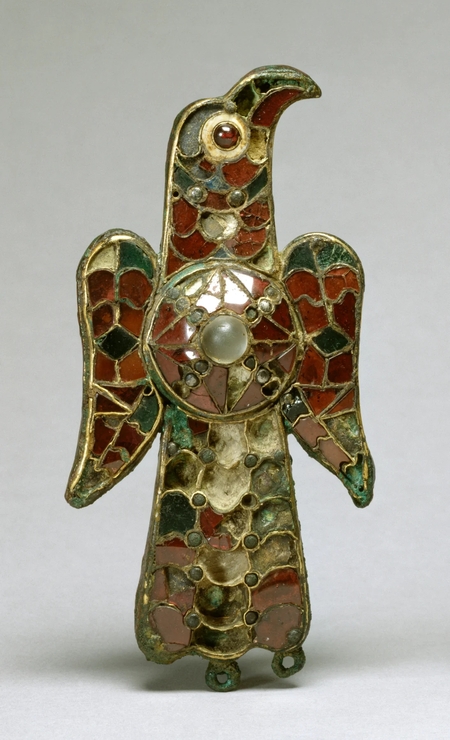
The research structure is based on a dual principle. The material is organized, moving from the context of the object’s use in costume to an analysis of specific forms and the progressive complexity of their visual code. The work is divided into five thematic sections: Section 1. Function and Costume: the fibula as a «representational screen.» This section reviews scholarly reconstructions of military attire from the 6th–7th centuries along the Syrian and Danube frontiers, referencing Osprey Publishing. This section addresses how the fibula’s architecture (the frontal decorative plate and the concealed pin) interacted with the human body—governing the folds of the cloak and serving as a mark of distinction. Section 2. Zoomorphic Codes of Power: from cast insignia to polychrome symbol. This is the central analytical block for plastic imagery. It includes bronze fibulae from the Panticapeia necropolis (a bird and a cicada from the GIM collection) compared with Western European regalia, such as Visigothic eagles from the Walters Museum and gold plaques from the tomb of King Hilderic I. This section tests the hypothesis of how the same sacred and heraldic motif scaled and became more complex from the Black Sea region to Gaul.
Section 3. Cross-cultural Parallels: Adaptation and Scaling of the Plate. This section is dedicated to the evolution of the cloak clasp’s geometry. The two-plate fibula from the Altyn-Asar burial site in Kazakhstan is examined as an example of adapting a prestigious European silhouette into local bronze, as is the case with the large Crimean digit fibula from Suuk-Su when compared to the Merovingian fibula from France. This comparison allows for the demonstration of a unified, pan-European visual code of status, based on the typology of A. G. Furasiev. Section 4. The Antithesis of Ornament: Elite Asceticism in Warrior Fasteners. Here, the iron crossbow-shaped fibula of the Chernyakhov culture (GIM) is analyzed as a contrast to the gold and gilded ornaments of Western Europe. This section demonstrates that status during the Migration Period could be conveyed not only through material luxury but also through the strict graphic quality of the form within the military hierarchy. Section 5. Conclusion. General findings of the research are formulated regarding how the formal evolution of fibulae responded to the social challenges of the migration era and why the fastener transformed into a universal tool for social navigation. Within the sections, artifacts are compared using unified criteria (material, construction, scale, decorative technique, and social context). This approach allows for the accurate comparison of findings from different regions of Europe and Eurasia and tracks the evolution of status in design.
Principle of selecting and analyzing textual sources.
Principles for Selecting and Analyzing Textual Sources To test the hypothesis and correctly interpret the visual material in this work, four groups of sources are utilized: — Foundational archaeological and typological literature. The key support is the classic work by A. K. Ambros, «Fibulae of the Southern Part of the USSR» (1966), which establishes the methodology for morphological analysis of fasteners, their chronology, and cultural affiliation in the Northern Black Sea region. To study the evolution of later forms, the research by A. G. Furasiev, «Genesis of Bivalve Fibulae of Crimea» (2010), is consulted, allowing tracking of the construction’s increasing complexity and the enlargement of fibulae from the 6th–7th centuries based on materials from the Suuk-Su burial mound. — Studies on the history of military costume and reconstruction. R. D’Amato and G. Samner’s Roman Military Clothing (3): AD 400–640 (2005) is used to analyze the fastening’s function within a real material environment. Illustrations and textual commentary from this publication reveal how the fibula secured the pallium–chlamys and served as a military rank insignia on the borders of the Late Roman Empire. — Museum catalogs and scientific databases. Descriptions from the digital collections of the State Historical Museum (GHM), the Walters Art Museum (Baltimore), the Bibliothèque nationale de France (Paris), the National Museum of Archaeology in Saint-Germain-en-Laye, as well as the art history educational project Smarthistory, are drawn upon for precise artifact attribution, verification of size, materials, execution technique, and archaeological context. — Synthesis of visual and textual analysis. The analysis is built upon comparing data from scholarly publications with original design observations. Textual sources provide historical accuracy and dating, while the visual breakdown focuses on the object’s architecture, proportions, plasticity, and the optical qualities of the surface within the costume.
Key Question and Hypothesis.
• Key Question: How did the architecture and formal design of V–VI century fibulae transform a utilitarian clasp into a «representational screen» of power? What visual forms—from zoomorphic symbols to strict geometric minimalism—did this code take, and what does this reveal about the social hierarchy of the era of the Migration Period? • Research Hypothesis: The increasing complexity of the design and construction of fibulae in the V–VI centuries was not merely due to a shift in decorative fashion, but rather to the acute need for rapid visual display of social status, military rank, and clan affiliation amid the high migratory activity of that period. The transformation of the faceplate into a dominant «representational screen» in costume—through the scaling of form, polychrome style, sacred zoomorphic motifs, or «elite asceticism”—reflects the formation of a unified, pan-European visual language of the nobility, wherein an everyday clasp became a precise tool for social navigation.
III. Visual Narrative Text.
Introduction.
Introduction Jewelry design from the era of the Great Migrations is often judged solely by its decoration—the presence of precious metals or the quantity of colorful stones. However, behind this ornamentation lies a conceptual design. In an age of constant migration and military conflict, an adornment needed to function as a reliable structural component, capable of securing a heavy cloak in field conditions, while simultaneously remaining a recognizable symbol. The polychromatic style, which combined the luster of gold with red stones, was not merely a decorative technique but also a social indicator that distinguished the nobility (Ryabtseva, 2015). Fibulae represent a mass category of artifacts that are traditionally used to date complexes and define cultural boundaries (Ambrose, 1966). It is this sheer abundance that allows us to compare simple and opulent fasteners and observe how craftsmen integrated utilitarian function with visual coding. This study is based on items from the digitized collections of the State Institute of Museology; fibulae from French and U.S. museums were included for comparative purposes.
1. Historical and Cultural Context.
The transition from late antiquity to the early Middle Ages in the 5th and 6th centuries was accompanied by the migration of large populations—Huns, Goths, Vandals, Alans, and early Slavs. These migrations reshaped the political map of Europe and the social structure of society, elevating the military aristocracy and tribal alliances, whose status had to be constantly confirmed and displayed. Fibulae were part of attire in antiquity as well: a chiton was secured at the shoulders with small clasps, and a cloak was fastened with a fibula at the shoulder or chest (togas, conversely, were usually not pinned). The artisan’s role was to hold the light fabric in place and emphasize the wearer’s status. There was no sudden shift in costume in the 5th century; the cloak fastened by a fibula was already known to the Roman army. However, according to researchers, the influence of clothing worn by peoples accustomed to equestrian travel, campaigns, and outdoor life made large cloaks made of thick wool, broadcloth, or sometimes leather more prominent (Zilmanovich, 2005). Such garments required more durable fasteners capable of withstanding weight and tension. Simultaneously, the fibula remained a signifier. Its shape, size, ornament, and material could indicate the wearer’s wealth and position in the hierarchy, and in some cases—their affiliation with a particular group. Caution is required regarding the latter: the link between fibula types and ethnic identity is a subject of debate, as the same forms were used by different groups, and fashion spread rapidly. Therefore, the discussion below focuses primarily on social status and the methods of its representation, rather than on «tribal markers.» Thus, the form of 5th–6th-century fibulae developed at the intersection of two demands: mechanical reliability in harsh campaign life and maximum legibility of the visual code. Specific artifacts demonstrate how this was achieved in practice.
2. The Architectonics of the Fibula: Mechanism and «Screen.»