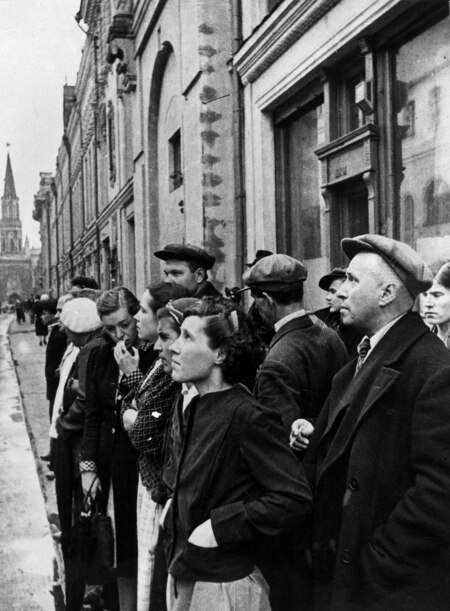
War, much like photography, is a replacement for life—albeit of a different kind. It intensely heightens life experiences, threatening human existence with annihilation. In war, a person gains the ability to manipulate every moment of their life’s «scope,» constantly feeling its weight, its boundaries, and its price—as if seeing it in its entirety. It could even be said that here, life condenses into a photograph.
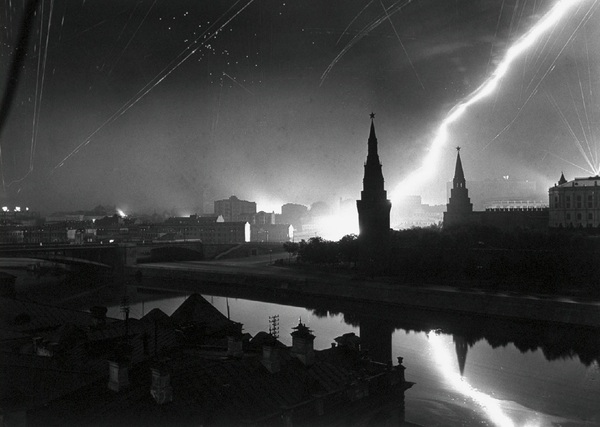
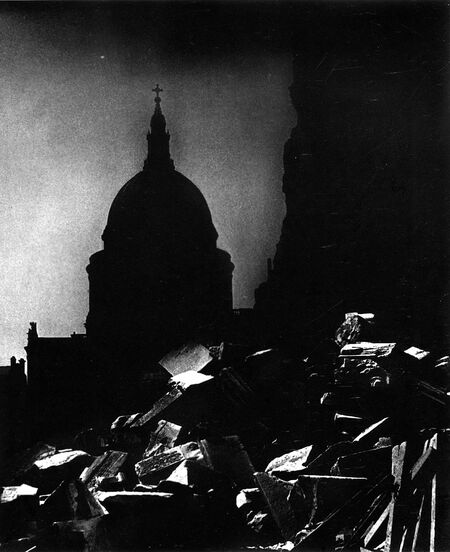
Margaret Bourke-White. German air raids on Moscow. July 26, 1941 Bill Brandt. St Paul’s Cathedral in London under moonlight. 1942
World War II is underway. The second in a century, and the first in which photography takes a direct role. Thanks to the first war, photography had become embedded within the social mechanism, evolving into an organic part of it by the second. The previous war still felt like a natural disaster, and photography could only passively record its deafening consequences. The new one became a clash of total ideological projects—grand social machines. It might even seem as if everything created between the wars was intended primarily for deployment in a universal conflict.
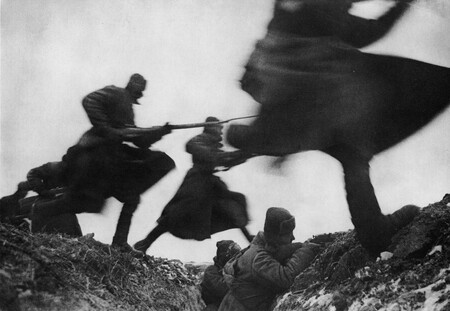
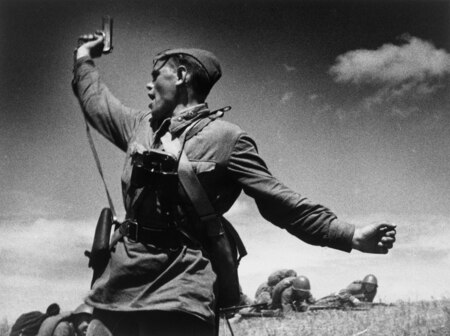
Dmitry Baltermanz. Attack. November 1941 Max Alpert. Commbat. 1942
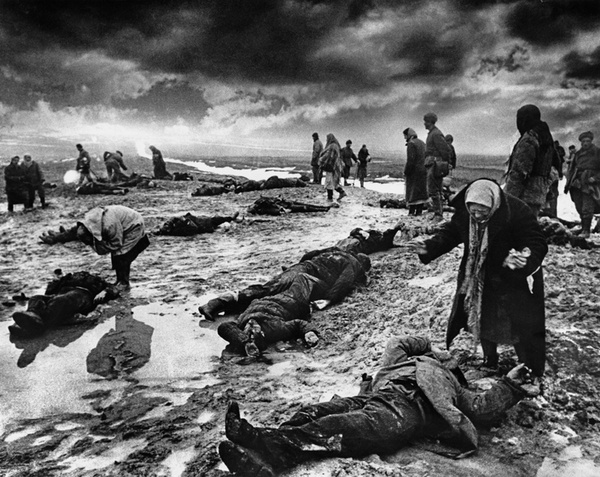
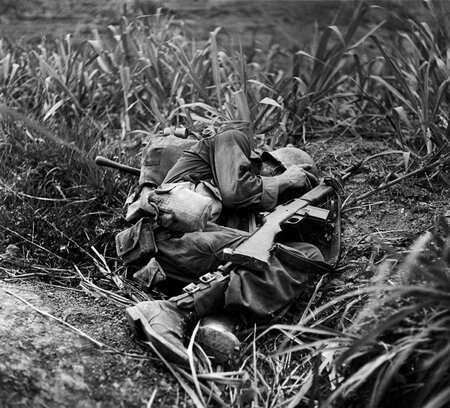
Dmitry Baltermants. Grief. Kerch. January 1942 Eugene Smith. Terry Moore from the 7th Infantry Division of the U.S. during the Battle of Okinawa, Japan. May 1945
Following the occupation of German territory, photographers from Allied nations presented the world with numerous accounts of the atrocities committed by the Nazis in the concentration camps. The impact these photographs had on global public opinion was profound because they appeared to be sensational revelations of sinister, carefully concealed secrets. However, purely informational testimonies like these were redundant: the Nazis deliberately and with extreme meticulousness documented the process of destroying the old world, something the Allies confirmed by examining their archives. Visual documentation accompanies all processes of war—both in totalitarian and democratic states—and photography serves intelligence functions, documents the intense work of the social mechanism, and creates informational and propaganda products for the masses.
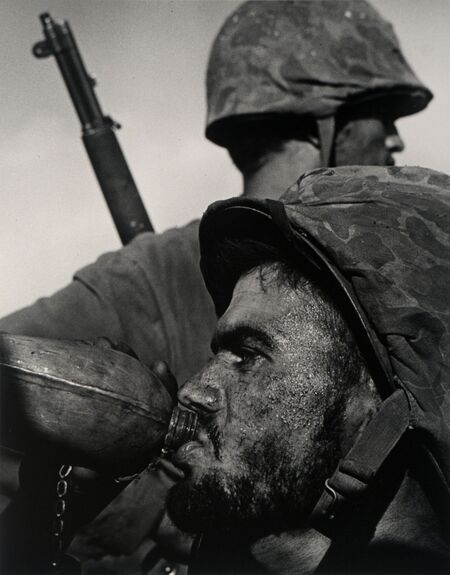
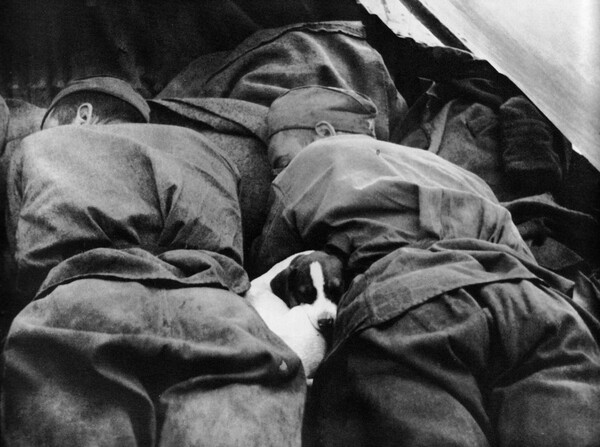
Eugene Smith. Soldier on the front line with a canteen. Saipan Island, Japan. 1944 Georgy Lipskerov. Let the soldiers sleep a little. Czechoslovakia. 1945
Whether people are fighting on the front lines, working in the rear, or simply far removed from the conflict, they already use visual reproduction techniques as a commonplace way to create personal archives of memories. Civilian clerks in New York, for example, do this in nearly the same way as American soldiers in Normandy or Germans near Moscow. Even Soviet officers in combat, despite the danger of being accused of espionage and the far less common availability of photographic and cinematic equipment, succumb to the very same passion.
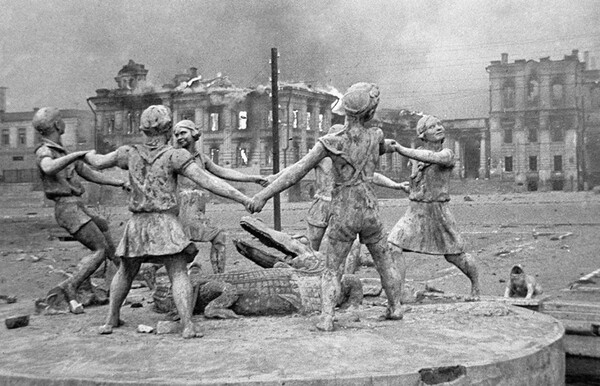
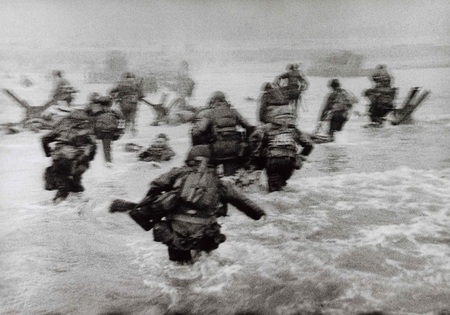
Emmanuel Yevzerikhin. Fountain «Children’s Round Dance» in Stalingrad after a German air attack. 1943 Robert Kap. Landing of American troops on Omaha Beach in Normandy, France, on D-Day, June 6, 1944
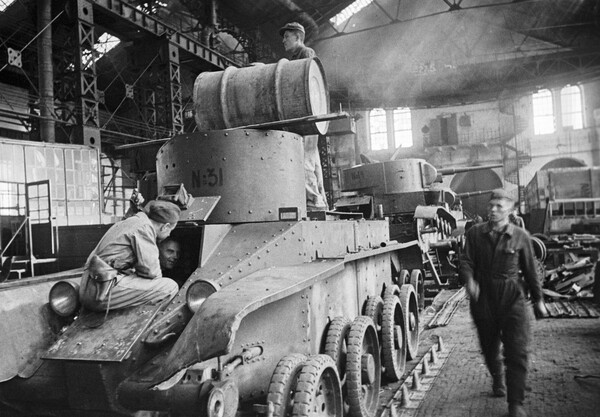
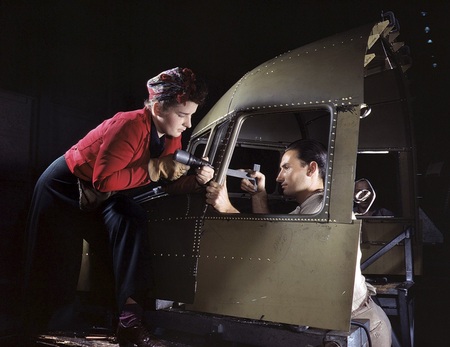
Yakov Khalip. The Zaitsev brothers' crew repairs tanks heading to the front. Odessa. September 1941. Alfred Palmer. NAA riveters work on the cockpit of a C-47 aircraft. Inglewood, California. 1942.
«If your pictures aren’t good enough, you weren’t close enough.» That is what Robert Capa, one of the greatest war photojournalists, said, and his phrase became famous precisely because it reflects the personal experience of countless photojournalists around the world—not just war correspondents. The concept of photography itself is firmly associated with truth, with the reality it depicts. But it is not merely a «truthful word,» nor just a universally understood language.
Georgy Lipskerov. A meeting between a Red Army lieutenant and a young woman in Stalingrad. 1943
The photograph claims not to be a copy of life, but life itself. The photographer distinguishes themselves from others by their ability to discover what already exists yet remains hidden within reality. Photography is akin to archaeological excavation, a process in which the faculty of sight is intensified, and a concealed object is extracted from its context, isolated, and granted autonomy. It is this isolation of the image that renders the object visible—bringing it closer to the subject, making it visually magnified. It frees the object from energetic dispersion in the surrounding space, intensifying and making the visual reconstruction more real than the physical original.
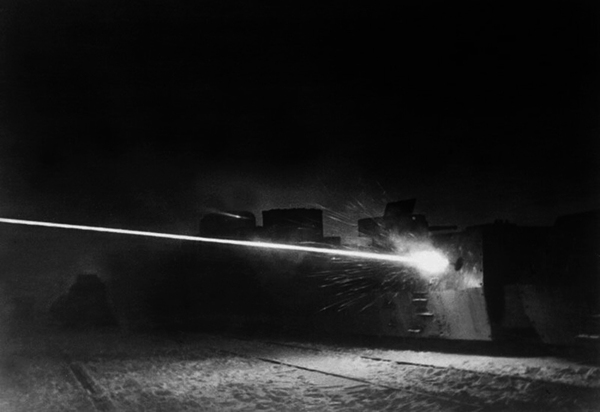
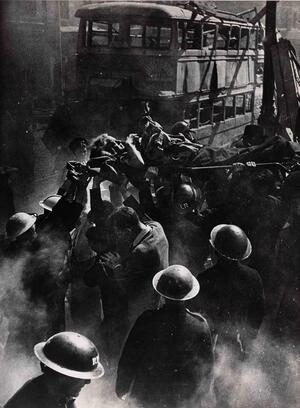
Arkady Shaykhet. Spear of Fire. 1941 George Rogers. Woman Saved from a Bomb-Damaged Home. London. 1943
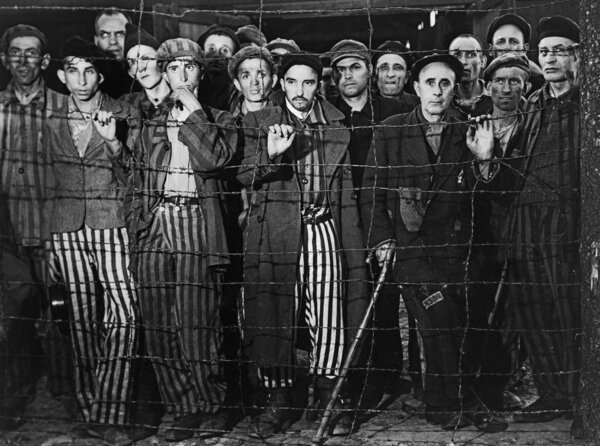
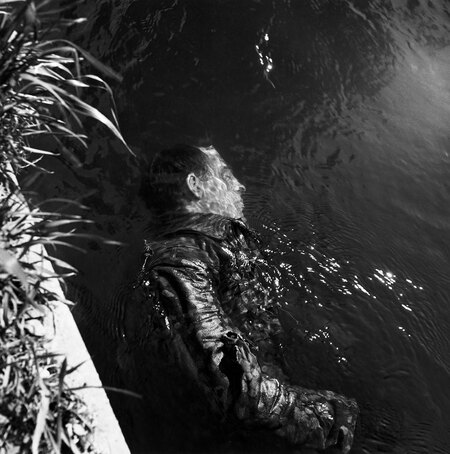
Margaret Bourke-White. Prisoners at the Buchenwald concentration camp near Weimar, Germany. April 1945. Lee Miller. The body of an SS guard floating in a canal. Dachau, Germany. 1945.
A photograph cannot steal the soul from the subject, but it imparts an effect of reality. A person only occasionally experiences a feeling of fullness in life. After all, in such moments, he connects the entire «surface» of his being with the entire «surface» of the world, and such a complete contact requires immense energy expenditure. Photography not only reduces the «surface of contact”—it separates the effect of reality from reality itself. With its help, this effect attains a human scale and absolute mobility; it can be reproduced any number of times, anywhere, at any time, without any danger to the subject. Thus, with the advent of photography, it becomes clear that man does not need reality itself, but a substitute that reproduces the effect of direct real contact.
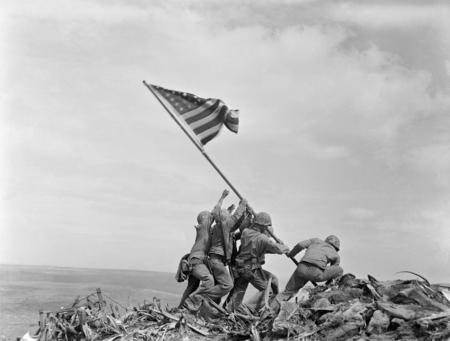
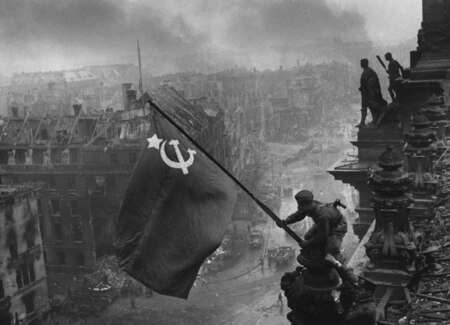
Joe Rosenthal. Raising the Flag on Iwo Jima, Japan. February 23, 1945. Evgeny Khaldei. Raising the Flag over the Reichstag. Berlin. May 2, 1945.
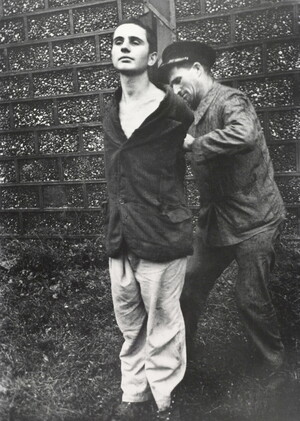
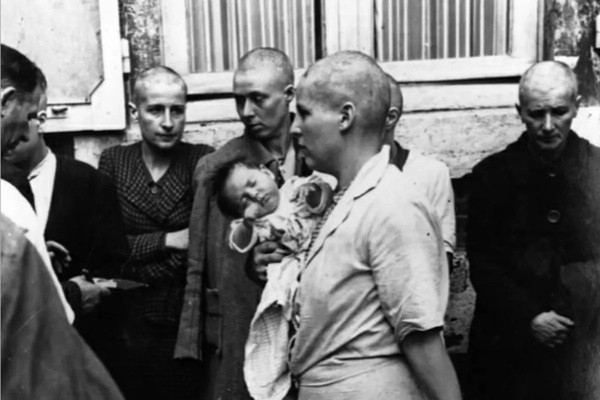
Carl Maydan. A young man convicted for collaborating with the Germans. Grenoble, France. September 1944 Robert Capa. A collaborator with a child from a German. Chartres, France. August 1944
War, much like photography, is a substitute for life—albeit of a different kind. It intensely heightens life’s experiences, threatening human existence with annihilation. In war, a person gains the capacity to manipulate every moment of their life, to constantly feel its weight, its boundaries, and its value—as if viewing it in its entirety. It could even be argued that life contracts into a photograph here. The greater the danger—the greater the reality. And for the war photojournalist, being closer means not just bearing clearer witness, but also subjecting one’s life to extreme risk, experiencing intense emotions—and, consequently, capturing better images.
Olga Ignatovich. Portrait of Red Army Soldiers. Forst, Germany. April 1945
War grants this profession maximum expressiveness—a quality almost unattainable in everyday life. It fuses mortal danger, the impact of reality, and photographic quality into an unbreakable whole. Because the photo professional engages in intense contact with reality and, consequently, «loses energy,» this energy transfers directly and proportionally into their photographs, shielding ordinary members of society from undue hardship while simultaneously sustaining in them an illusion of contact with reality.
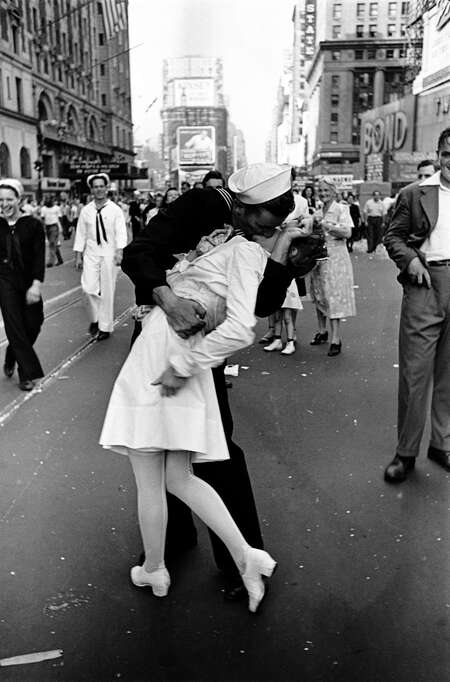
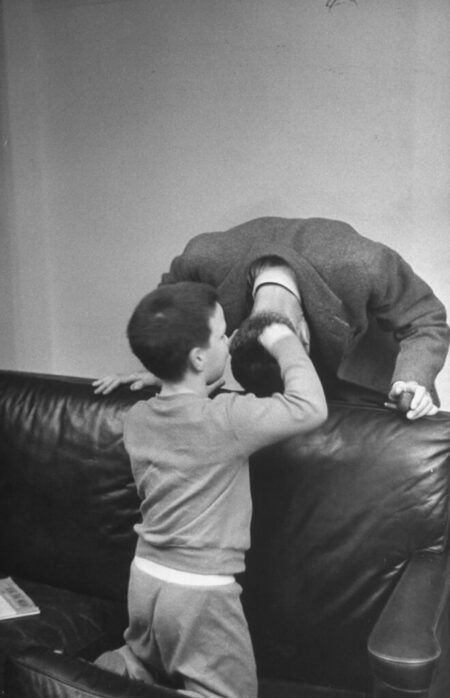
Alfred Eisenstaedt, Kiss on Times Square (New York) on Victory over Japan Day. August 14, 1945 Alfred Eisenstaedt. J. Robert Oppenheimer with his son Peter at home. Princeton, New Jersey, USA. 1949
Henri Cartier-Bresson. Secretary to Mahatma Gandhi watches the first tongues of his funeral pyre. Delhi, India. 1948.
Cartier-Bresson. The Final Days of Gomindang (Market Crash). Shanghai, China. December 1948 — January 1949
During wartime, a soldier protects civilians from physical harm in the same way a photojournalist protects them from energy drain. Modern society can no longer function without the technological reproduction of reality, without the deeply ingrained mass media. Radio does not so much transmit the word as it teleports the intimacy between a leader (or mediating announcer) and the ordinary citizen. Photography and cinema perform an analogous operation on imagery: the disappearance of the picture that has become the «worldview» would now be unambiguous proof of death.
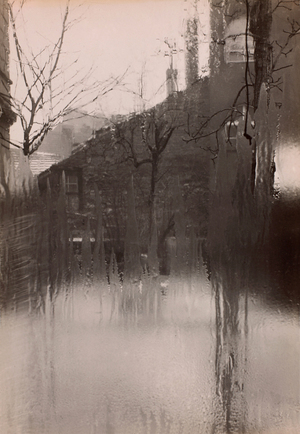
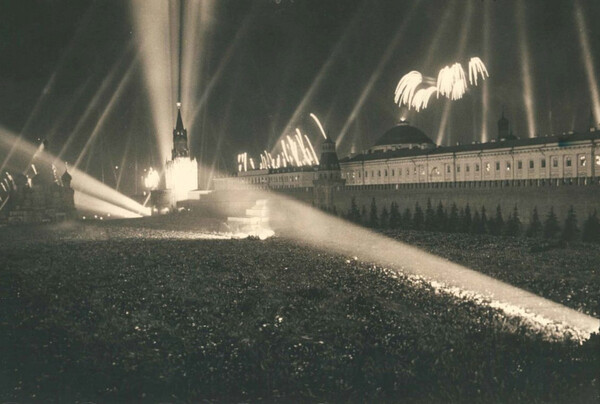
Joseph Sudek. Window of My Workshop. OK. 1940–1950 Yakov Khalip. Red Square, Moscow. May 9, 1945
This is particularly true during times of war, and even more so regarding totalitarian ideology, for which war becomes the ultimate expression of reality—the intense flame of life that totalizing ideologies always lack in peacetime. Under militarism, every social imperative transforms into mobilization. The functionality of the photographic profession is framed as heroic duty. The photojournalist dissolves into public service; their work unequivocally shifts from the sphere of information to the realm of propaganda. Propaganda entirely reconstructs reality in accordance with its own objectives. Thus, it appropriates the status of genuine art, creating a true picture of the world. Other narratives continue to exist and develop, but their status remains relatively marginal. And as long as the war’s ecstasy persists, this situation cannot significantly change.
Vladimir Levashov. Photovek. A brief history of photography over the last 100 years. Moscow, 2016
https://monovisions.com/bill-brandt-exhibition-2021/ (13.06.2026)
https://cameralabs.org/12705-front-i-tyl-velikoj-otechestvennoj-na-snimkakh-14-ti-voennykh-fotografov (13.06.2026)
https://upload.wikimedia.org/wikipedia/commons/7/7c/USMC_infantryman_Terry_Moore_May_1945.jpg (13.06.2026)
https://www.photographer.ru/columnists/9171.htm (13.06.2026)
https://cameralabs.org/12705-front-i-tyl-velikoj-otechestvennoj-na-snimkakh-14-ti-voennykh-fotografov (13.06.2026)
https://cameralabs.org/12705-front-i-tyl-velikoj-otechestvennoj-na-snimkakh-14-ti-voennykh-fotografov (13.06.2026)
https://artblart.com/wp-content/uploads/2009/07/capa-american-soldiers-landing-on-omaha-beach-1944-web.jpg (13.06.2026)
https://cameralabs.org/12705-front-i-tyl-velikoj-otechestvennoj-na-snimkakh-14-ti-voennykh-fotografov (13.06.2026)
https://cameralabs.org/12705-front-i-tyl-velikoj-otechestvennoj-na-snimkakh-14-ti-voennykh-fotografov (13.06.2026)
https://www.nytimes.com/2015/02/08/sunday-review/surviving-the-nazis-only-to-be-jailed-by-america.html (13.06.2026)
https://upload.wikimedia.org/wikipedia/commons/b/b0/Raising_the_Flag_on_Iwo_Jima%2C_larger_-_edit1.jpg (13.06.2026)
https://time.com/3880210/robert-capa-reveals-an-ugly-side-of-liberation-in-wwii-france/ (13.06.2026)
https://www.jacksonfineart.com/artists/alfred-eisenstaedt/vj-day-kiss-in-times-square-1945/ (13.06.2026)
https://www.mutualart.com/Artwork/Gandhi-s-secretary-watches-the-first-fla/05FE6CB269CCB5FD (13.06.2026)
https://www.artsy.net/artwork/henri-cartier-bresson-the-last-days-of-the-kuomintang-market-crash-shanghai-china (13.06.2026)
https://artblart.com/wp-content/uploads/2016/09/sudek-la-fenc3aatre-de-mon-atelier-vers-1940e280931948-web1.jpg (13.06.2026)