Topics
- Concept
- Categorization
- Urban Advertising as a Medium
- From Media Consumption to Parasocial Intimacy
- From Parasocial Relationships to Collective Media Production
- Beyond the Screen: Urban Media Carriers
- The Visual Image of the Celebrity as a Message
- Media Circulation and Social Relations
- Congratulation as a Tool of Media Communication
- Conclusion
Concept
In South Korea, fans of actors and idols frequently commission celebratory advertisements that are placed directly within the urban environment. Rather than promoting a product, these ads congratulate celebrities or fandoms on birthdays or mark other significant life dates. I am interested in how affection formed through media becomes the impetus for creating a new media message, and why out-of-home advertising is chosen.
The selection of this topic stems from the fact that fan advertising in South Korea is interesting as an unusual form of media communication. Fans utilize public advertising spaces to express their personal attachment to celebrities, transforming their own feelings into full-fledged public messages.
One of the key aspects of this research is parasocial relationships. This is the feeling of closeness to a person whom the viewer primarily knows through a screen. The fandom community serves as the bridge between personal attachment and the commissioning of an advertisement. Participants pool resources and coordinate the design. The advertisement is viewed as the result of collaborative media production, rather than solely as an expression of personal feeling.
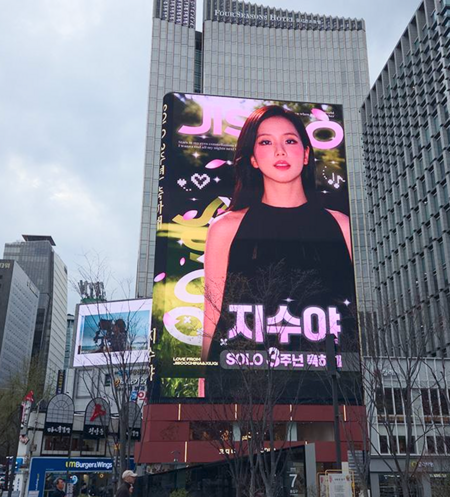
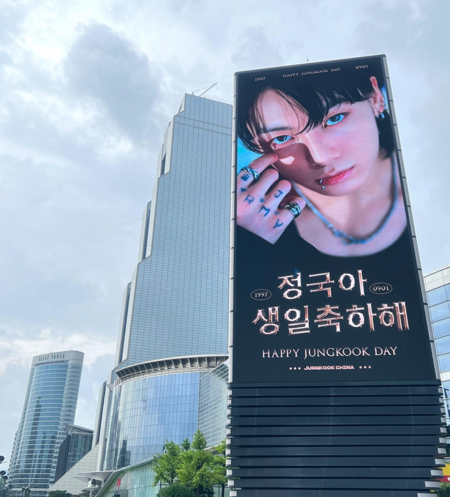
The primary materials for this research will be fan campaigns for South Korean actors and K-pop performers. The date, initiators, and placement locations of the imagery will be taken into account. I will compare subway posters, bus advertisements, bus stops, building facades and digital screens, as well as temporary event spaces. I will analyze composition, color, text, community symbols, and the unique characteristics of the medium to understand why a specific design is chosen for different venues, how information is distributed, and what details make a greeting recognizable. I will also compare select examples with commercial advertisements for the same celebrities.
The principle of categorization is structured as follows: first, celebrity imagery and parasocial attachment are examined, followed by the organization of fan communities and the media content they produce. Subsequently, urban carriers and the visual language of these messages, as well as their diffusion between physical and digital environments, are analyzed. The concluding section investigates how these modes of communication are used to support celebrities and extend beyond fan culture. Sources are selected from professional research on parasocial relationships, fan communities, participatory culture, visual semiotics, and urban media. The work is based on the theories of Horton, Wohl, Jenkins, McQuaire, and Fedorenko.
The central question of this research is how parasocial relationships and fan community activities shape urban media communication in South Korea.
It can be hypothesized that media possess the capacity to foster such strong parasocial attachments to celebrities that fans begin to seek ways to express this attachment beyond conventional digital platforms. By uniting into communities, they find opportunities to create public appeals using urban advertising.
The goal of this research is to examine how contemporary media culture influences forms of social interaction and collective self-expression. Using the example of fan advertising in South Korea, we explore how an individual’s relationship with a media image can become the foundation for uniting people, establishing shared values, and generating new forms of public communication. The study aims to identify the role media plays in the transition from individual emotional experience to collective cultural practices.
City Advertising as a Medium
In South Korea, fans of actors and musical performers rent advertising space on subways, at bus stops, on buses, and on city screens. These spaces are used to display birthday wishes, debut anniversaries, or announcements for new projects. Such banners appear in the same locations as regular commercial advertisements.
Fans fund these displays themselves by organizing fundraising drives. Through posters, billboards, and screens featuring congratulatory photos and videos, they show their support for the celebrity, offer thanks, or wish them well. Thus, messages that were once circulated primarily within fan communities on social media become part of the urban media landscape.
From Media Consumption to Parasocial Intimacy
Initially, fans recognize the actor or performer from TV series, music videos, interviews, and social media posts. Over time, they develop a specific perception of the celebrity, tied to their roles, performances, and interaction with their audience. Therefore, the photograph on the congratulatory poster serves as the main compositional element—a reminder to the fans of the person whose work they follow.
Parasocial relationships emerge when regularly viewing media creates a sense of familiarity with a media personality without actual personal contact. The viewer memorizes the voice, gestures, and manner in which the person addresses the audience. The feeling of closeness is experienced individually, even though the persona is designed for a large number of people, and the degree of this closeness varies among different fans.Looking into the lens, close-up shots, personal address, and regular broadcasts can create the illusion of direct interaction. Fanbase interactions in public spaces develop this dynamic. Now, fans address the celebrity through their public image. The congratulation becomes a reciprocal message within a relationship that was previously maintained through a screen.




Interest in an artist can evolve into a part of an individual and group identity over time. Recognizing dates, storylines, songs, and symbols unites people into a community and also distinguishes the devoted from the casual audience. This knowledge manifests in advertising design through signatures, color codes, and references that are only understood by a specific fandom.