Distorted Portrait of Power: Celtic Coins as a Means of Self-Declaration or Unconscious Imitation
The term «distortion» in the title is used as a descriptive flourish regarding visual alteration, not as a judgment on a decline in skill.
Navigator
1. Rationale for Topic Selection
2. Research Goal and Concept
3. Chronology and Geography
4. Original Greek Models: The Coin as a Sign of Power
5. Celtic Imitations: Appropriation and Local Adaptation
6. Comparative Visual Analysis
7. Power, Identity, and Everyday Life on Coins
8. Conclusion and Hypothesis Analysis
Justification for Topic Selection
The coin—one of the few ancient artifacts capable of richly reflecting human life. People received them for service, used them in trade, and kept them as valuables. I became interested in the moment when a culture doesn’t merely borrow a foreign image but begins to process it to suit itself, thereby reflecting its own vision of power. Celtic imitations of the coins of Philip II of Macedon clearly illustrate this process of reflection: the Greek head of the god and the reverse figure are initially copied entirely, but then gradually change in proportion, become fragmented, and take on ornamental forms. Comparing the Greek and Celtic coins raises the question of how a community asserts its power, prestige, and cultural identity through the imagery on its currency. This leads to a broader question: if the coin already features a recognizable and significant image, why would local artisans alter it?
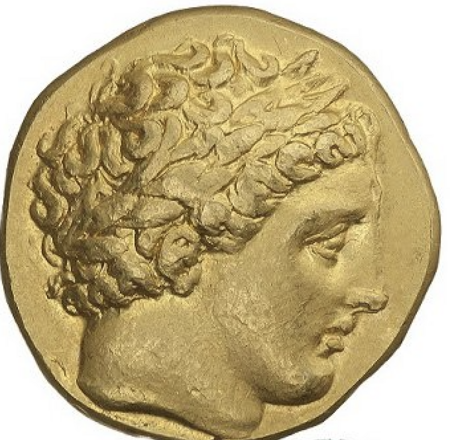
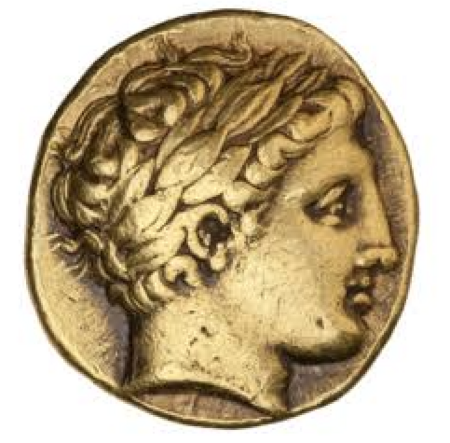
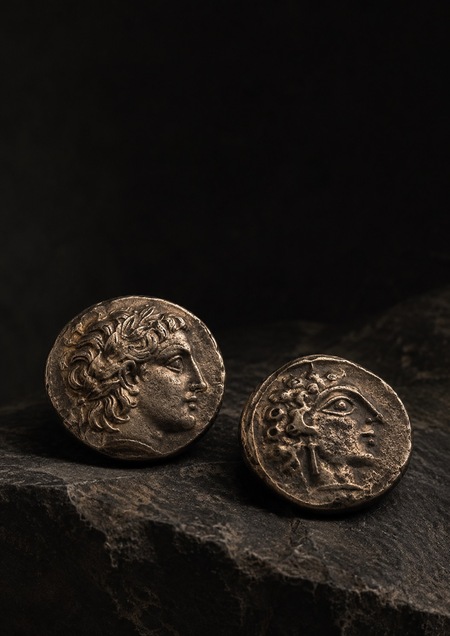
Starter. Macedonia. Philip II (source: https://ru.wikipedia.org/wiki/Coins_of_Philip_II_of_Macedonia) and Celtic Coins — Gallic Gold Philipppus (source: https://www.monetnik.ru/obuchenie/istoriya/celtic-peoples/)
Research Goal and Concept
This study examines how the imagery on coins of Philip II of Macedon and Celtic imitations transformed when transitioning between different cultural contexts. The focus is not merely on the visual differences between Greek and Celtic coinage, but also on how the coin functioned to convey power and belonging to a specific community. The comparison is drawn based on concrete visual features: the depiction of the head, hair, and wreath; the figure of a rider or chariot; the legends, symbols, and material. The objective is to compare the coin types of Philip II of Macedon with Celtic imitations. We aim to trace how the borrowed imagery evolved in new regions and how these changes might correlate with power, prestige, and cultural distinctions—without trying to prove that every change was rooted in a conscious political agenda. Rather, it is important to illustrate the process of adaptation itself and to define the boundaries within which we can speak confidently about it. The central research question is: what happens to the image of power when a coin type created in Macedon is adopted by Celtic communities and gradually changes in form, composition, and symbolism?
Hypothesis: Celtic artisans likely did not simply mechanically copy Greek coins. Instead, they preserved recognizable elements of the prestigious type while adapting them to the local artistic environment, minting techniques, and monetary practices. However, the degree of image alteration does not allow us to automatically assert that every transformation was a deliberate political statement.
Timeline and Geography
The main period spans the 3rd–1st centuries BCE; Greek coin types are examined starting from the mid-4th century BCE.
The geographical focus is Macedonia, the origin point for the selected coin types, as well as the territories of the Celtic world: Gaul, Central Europe, and the Danube basin.
Original Greek Examples: Coinage as a Symbol of Power
Gold Stater: Apollo and the Chariot The gold staters associated with Philip II’s minting typically feature the head of Apollo on one side and a two-wheeled chariot (biga) with a driver on the other. This type is confirmed, for instance, by the catalogs of the Metropolitan Museum of Art and the British Museum. Visually, the profile of the deity is rendered so that the image remains legible on the small metallic surface. The wreath, hair, and facial contour create a recognizable likeness. The chariot alludes to competition, movement, and prestige. The connection of this coin type to royal power should be understood within the context of Macedonia and its political culture, but each element should not be reduced to a single meaning. There is one detail I initially overlooked, and it is crucial for the chronology. The gold staters featuring Apollo and the biga were minted not only during Philip’s lifetime. Le Ridder (1977) demonstrated that minting in Pella ceased around 315 BCE, and in Amphipolis—around 295/4 BCE. This means that the coins found primarily in Gaul were largely posthumous issues, not those struck by the king himself. Furthermore, according to B. Fisher (1991), the first Celtic imitations did not appear before the last third of the 4th century BCE—meaning almost immediately after Macedonian minting stopped, rather than a century later. This changes the narrative: the imitations arise not as a «later echo, ” but as a rather rapid response to the disappearance of the familiar coinage.
Macedonian Kingdom. Philip II of Macedon (359–336 BCE), father of Alexander the Great. Stater, Pella, 340–328 BCE. Catalog Note: «Bust of Apollo in a diadem, facing right.» Object Note: «Bigas with charioteer, facing right, in the exergue, 'FILIPPOY'.» Gold, Greek, Condition XF. Le Rider G. The silver and gold coinage of Philip II struck in Macedon (source: https://www.auctionimperia.ru/wdate.php?t=offline&i=111344)
Silver Tetradrachm: Zeus and the Rider On Philip II’s tetradrachms, the head of Zeus is typically depicted, and on the reverse, there is a rider—in some versions, the rider holds a palm branch. This type became one of the important models for imitation in the Danube region. The British Museum explicitly notes that coins featuring Zeus and the rider were copied by Celtic communities along the Danube. The figure of the rider connects the coin to the horse, movement, and military prestige. However, its significance depends on the specific type and historical context—one should not automatically assume that every image of a rider is a portrait of the ruler or a direct illustration of a specific victory.
Tetradrachm, silver 342–336 BCE. Mint: Pella (source:https://ancientrome.ru/ac/coin.htm?id=935&utm_source=Pinterest&utm_medium=organic)
Coinage as a Reflection of Human Life Coin minting had a practical function: coins were used for payments, savings, and trade. The Metropolitan Museum indicates that the minting under Philip II helped finance the army and attract mercenaries, and the coins themselves were circulated far beyond Macedonia. This allows us to connect visual imagery with military organization, economic contacts, and human movement. *However, it cannot be assumed that every person used coins regularly in the same way. The scope of circulation and the functions of specific issues varied.
Celtic Imitations: Borrowing and Local Adaptation