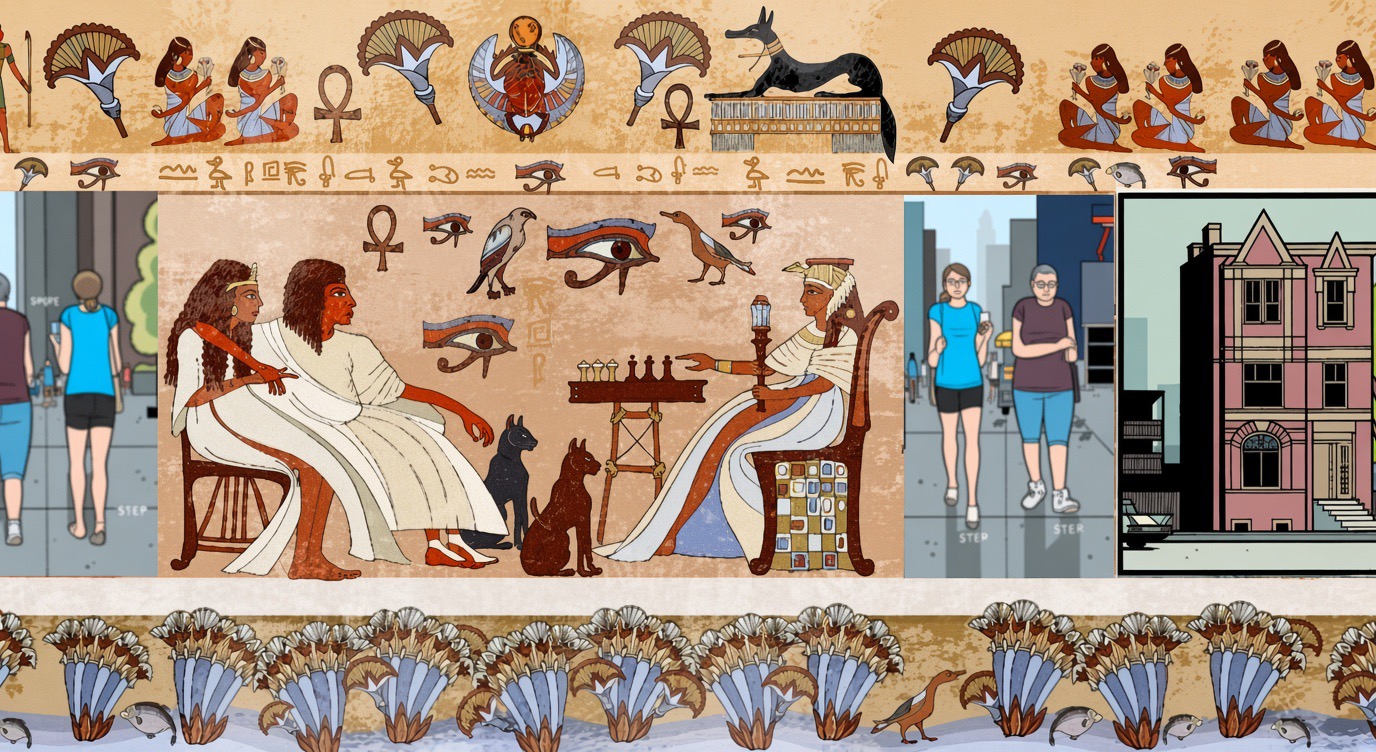
Concept
Chris Ware, a 21st-century American artist, is known for his schematic style and his skillful ability to convey human thoughts, inner worlds, and emotions, despite his rigorous and restrained aesthetic. While a casual viewer might not notice it, there is an often-overlooked connection between the works of this contemporary master and ancient frescoes. The kinship between Ware’s creative output and the art of ancient Egypt is not easily discernible—but what if his pieces represent a modern iteration of ancient Egyptian visual language? This theme is relevant for anyone interested in observing patterns in paintings from vastly different eras and the visual transformations that occur within them. The study will address the evolution of artistic techniques across millennia.
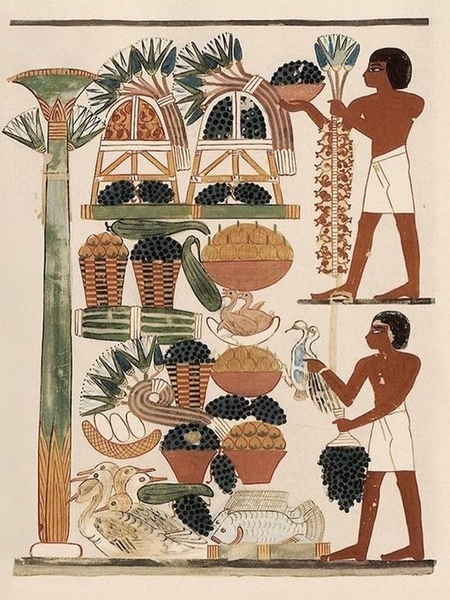

1. «Offering of Gifts» (or «Altar and Supporting Offerings») from the tomb of Nakhtha, c. 1400–1390 BCE. 2. Chris Ware, «I Guess We’re Here, ” 2019
Multiple criteria inform the principles for selecting visual material for research. High quality—all visual materials are selected based on their level of quality so that every fine detail and accent is clearly discernible upon examination. Variety—visual materials are chosen to accurately describe all artistic solutions, without skimping on supplementary sources of information in the form of illustrative visual examples. Correspondence to text—each visual material is carefully selected based on its complete alignment with the described artistic techniques: if we are discussing a specific work by Chris Ware and its specific methods, that work is presented as a separate image for example.
The visual study will be divided into three parts:
- Fundamentals of Ancient Egyptian Schematic Painting: The first and introductory section of the visual study will involve immersing oneself in the core canons of ancient Egyptian graphic writing. This in-depth analysis will allow for a deeper understanding of the origins of schematic representation and the reasons for its appearance in ancient Egypt.
- Visual Evolution of Graphic Writing: The second, main section will present a series of examples illustrating how and in what ways the artistic techniques of ancient Egyptian painting evolved in the works of a contemporary American comic artist.
- Answering the Hypothesis and Conclusion: The final section will provide a direct answer to the hypothesis question, presented below, along with a conclusion that synthesizes all the arguments previously presented.
Sketch of a mural from the northern wall of the tomb of Khnumhotep II, circa 19th century BCE.
Textual sources for research are selected across several levels. Historical academic studies—these allow for a detailed analysis of the origins of schematic ancient Egyptian painting and enable the study of its canons. Articles—these sources of information, which analyze a contemporary artist’s style, will greatly assist in understanding and more accurately describing their technique, as well as identifying which specific elements of ancient Egyptian art were adapted in their work. Interviews—these will provide insight into the personal motivations underpinning Chris Ware’s creative process.
Why do Chris Ware’s illustrations evoke ancient Egyptian painting? Why are these works not considered mere schematic drawings? And why is the connection between the two eras so difficult to perceive? Yet, upon closer examination, one realizes that the essence underlying this art is fundamentally the same. The hypothesis posits that despite visual shifts, the artist’s work demonstrates the evolution of artistic techniques employed by painters in ancient Egypt.
Part One. Foundations and Canons of Egyptian Schematic Painting.
«Agricultural Scenes» (Eastern wall, south side of the Nakht funerary chapel) from the Tomb of Nakht, c. 1400–1390 BCE.
A defining characteristic of Ancient Egyptian art was its devotion to religion and culture, reflecting a deep belief in the afterlife. A vast majority of the works were created to prepare individuals for the journey into the afterlife or to glorify the deified pharaoh.
«Funerary Ritual in the Garden» from the Minnate Tomb, circa 1479–1425 BCE.
Ancient Egyptian painting adhered to strict canons; from its inception, it was intended less for passive viewing and more for conducting religious rites, serving as a vessel for eternal life. Examples of these canons include imposing scale, monumentality, and a sense of static rhythm and repetition. Despite its solemnity, the art of ancient Egypt maintained a reserved quality.
The primary objective for the artists was the informational content of the artwork: the reliefs and paintings depicted the earthly life of the pharaoh, and they were intended to serve as a chronicle for the god of death, Anubis, detailing the events that occurred to the buried person before their death. Art pursued no other goals; it was merely pictorial writing, serving to recount the status of the person who was alive previously. This is why Ancient Egyptian painting lacks lyrical landscapes and emotional narratives.
«Sennedjem and his wife Iinenfert in the Fields of Ialu, ” circa 1295–1213 BCE
One of the primary reasons for the geometric and schematic nature of this type of painting is the absence of perspective and its replacement with aspect perspective (from the word «aspect»)—the maximum objectification of an event and its transmission. The Egyptians did not emphasize subjectivity; rather, they sought to bring the painting as close as possible to human perception of the world. They depicted the world as it truly was, simplifying and in some places exaggerating details for greater contrast and monumentality.
For the surface drawing intended for painting, a precise grid composed of 18 squares was overlaid to bring the work as close as possible to geometric accuracy. Each body part was presented from its most advantageous view: the head in profile, the shoulders frontally, and the legs spaced out and shown in profile, like the head. The Egyptians depicted the essence of a person when representing beings that were not human. The surrounding environment also underwent certain «distortions» due to the use of aspect, a prime example of which is the fresco of the garden and pool in Nebamun’s estate: the pool is shown from above, the fish in profile, and the trees are also drawn from the side relative to the viewer.
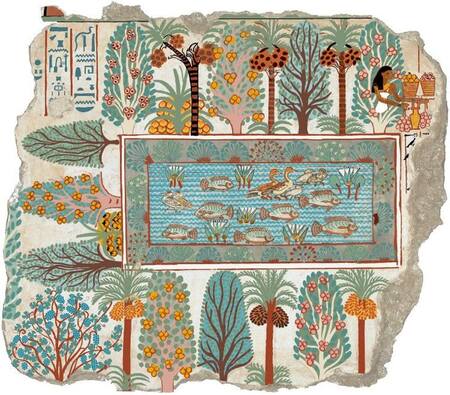
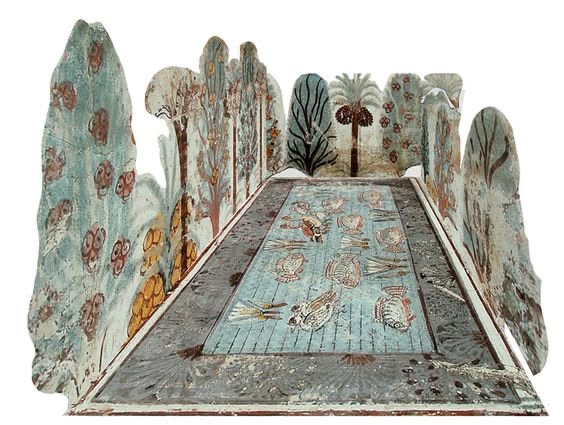
1. «Garden in the Estate of Nebamun» (c. 1350 BCE or the Eighteenth Dynasty era, Thebes) 2. An example of the «Garden in the Estate of Nebamun» within the context of perspective
Consequently, Ancient Egyptian painting did not emphasize lyrical narratives—it conveyed only the essence, focusing on the human figure and its perception of the world. All events depicted were drawn from reality or religious beliefs. Moreover, beyond being the artist, the creator also functioned as a scribe, documenting the life events of the pharaoh, much like a narrative. The creator subtly indicated their detachment from the events shown in the artwork; these combined factors resulted in a unique, schematic style of painting renowned worldwide.
Part Two. The Visual Evolution of Graphic Writing. Identification of Common Features and Analysis of Transformations.
Over time, many characteristics that once distinguished ancient Egyptian art from all others have transformed and «evolved, ” adopting a fresh new form in the work of the renowned 21st-century artist, Chris Ware—known for his schematic illustrations and elaborate narratives rendered in a restrained, geometric style.
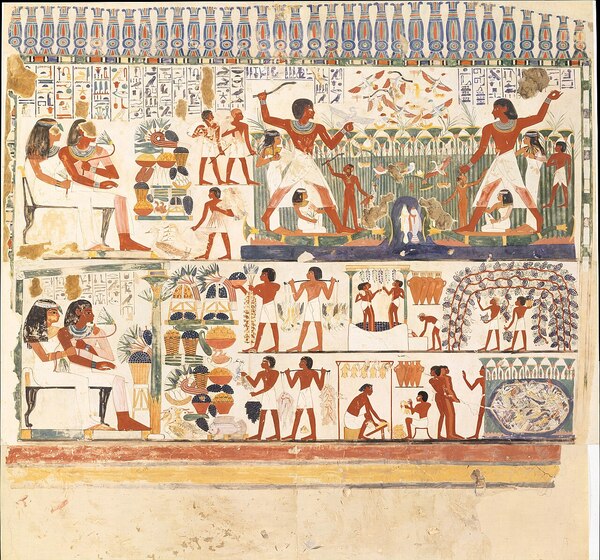
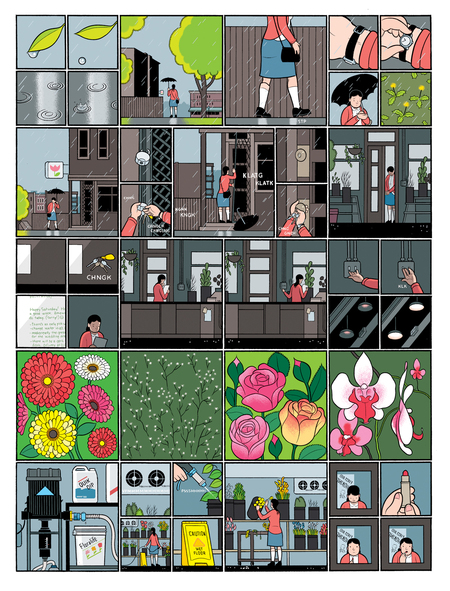
1. «Nakht with Family Hunting and Fishing» (mural painting on the northern half of the western wall of the mortuary in Nakht’s tomb), circa 1400–1390 BCE. 2. Chris Ware «Building Stories,» 2012
First, after millennia, axonometry gave way to a perspective already familiar to the modern viewer. Despite this significant shift, geometric quality remains a defining feature of the work from both eras: Ware’s project «Building stories» serves as an excellent example—on one page, you can notice hints of axonometry in the flat arrangement of products on a shelf. This was done to emphasize the supermarket’s location and enhance the contrast between the shots that feature close-ups of flowers and the characters looking at them.
Chris Ware, «Building Stories,» 2012
This project also features footage where walls are literally «cut away» from the building to illustrate both the structure and the activities within it, examining the very essence of the house. One can notice that Chris Ware, much like the ancient Egyptians, was driven by the intention to convey the most crucial elements of the object, as if presenting it to someone who has never seen anything like it. Like people in ancient Egypt, the artist strove to reflect a «view from scratch» of certain things, presenting objects from a more contrasting perspective.
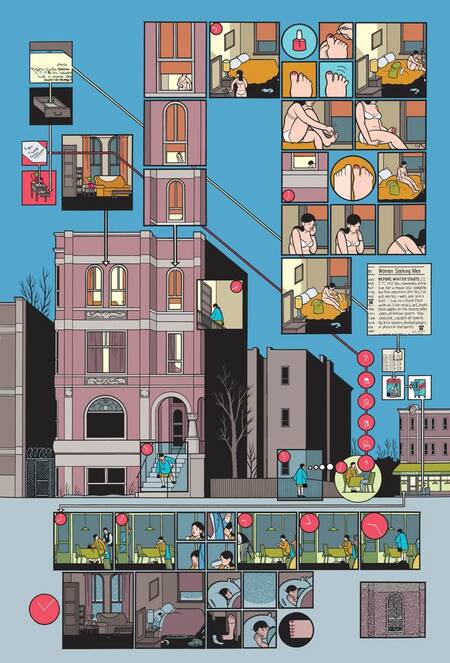
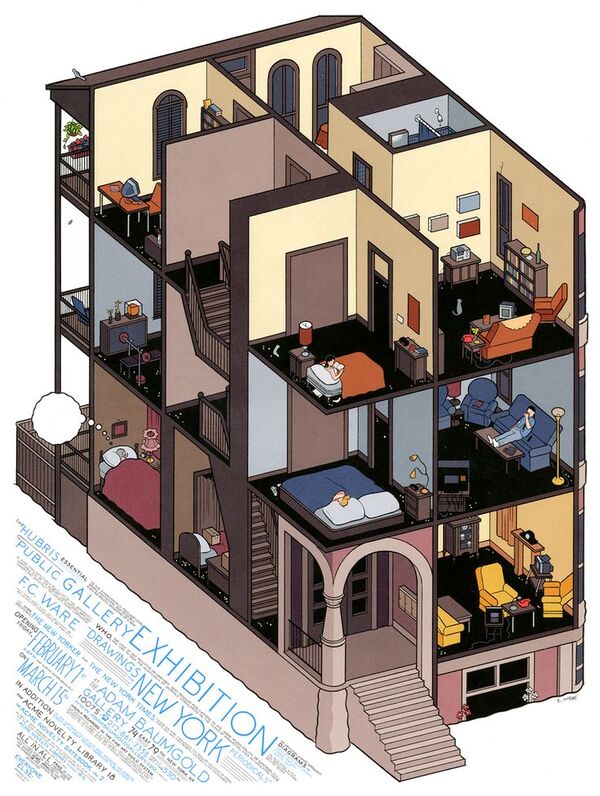
Chris Ware, «Building Stories,» 2012
Secondly, the autonomous segments on which the narrative was written evolved into a comic, unifying each frame under a single plot. In the 21st century, historical and religious narratives are being replaced by stories originating from the imagination and sequences of action—frames continue one another; they cease to be independent narratives and transform into numerous parts of a larger work, forming a comic. If one looks closely, early hints of the comic form can be discerned in ancient Egyptian frescoes.
For instance, the fragment from the Book of the Dead by singer Amon Gauthshen (a scene depicting the offering of gifts and libations to the god Osiris), in its structure, is similar to Weir’s already familiar «Building Stories”—the drawings describe events, and the text surrounding the image provides supplementary information, becoming part of a unified narrative.
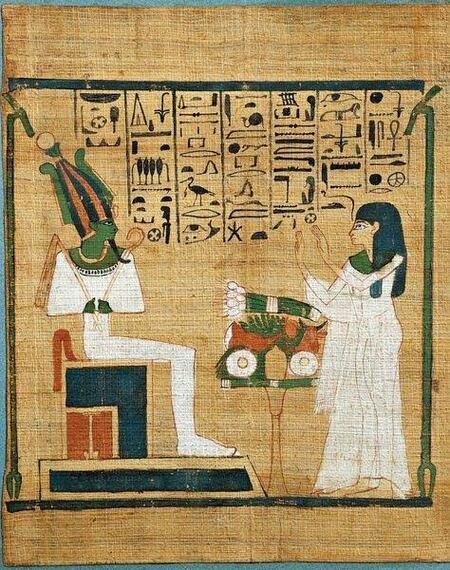

1. Fragment from Amon Gouthshen’s «Book of the Dead» (a scene of offering gifts and libations to the god Osiris), circa 1000 BCE. 2. Chris Ware, «Building Stories, ” 2012