How did the ancient Egyptians make power visible? Visual codes of the royal image from the Narmer Palette to the Amarna Period
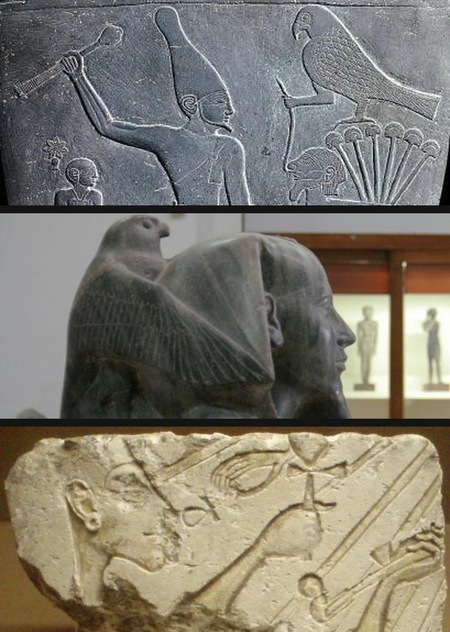
Three royal images, created centuries apart: the Narmer Palette, the statue of Khafre, and the relief from the Amarna era. How did Egyptian masters show that the figure before the viewer was not just a person, but a pharaoh? What remains constant in these mediums, and what changes along with the era, genre, and religion?
Sofya Denisovna Gorkhova, B26UKI03
Concept
Research Concept Why I Chose This Topic. This question arose for me at the British Museum in London while observing Egyptian royal statues and reliefs: the portrayals of pharaohs from different eras appeared similar in their solemnity yet distinct from one another. I wanted to understand exactly what united them and how they differed. Egyptian representation adhered to a canon; it served not as a portrait but as a formula reinforcing the order of the world. Therefore, the royal image is an ideal subject for tracing the boundary between established tradition and its evolution. The topic aligns with the curriculum—it pertains to the art of the Ancient Near East (North Africa) and necessitates an analysis of the visual elements above all else: scale, posture, regalia, and composition.
Frameworks, key questions, hypothesis
Scope. The study covers the period from around 3100 BCE (the unification of the Egyptian state, the Narmer Palette) to the mid-14th century BCE (the Amarna period, when Akhenaten’s religious reform altered the depiction of the god and the pharaoh). The region is Ancient Egypt, North Africa. Chronology and geography are within the scope of the course. Key Question: What visual means did Ancient Egyptian art use to convey the special status of the pharaoh, and how did the methods of his depiction change across different historical and religious contexts? Hypothesis: The pharaoh’s connection to the divine world remains a constant theme in royal iconography, but the manner in which this connection is depicted evolves: on the palette and in the Khafre reliefs, it is expressed through the falcon of Horus, while in the Amarna reliefs, it is shown through the rays of Aten terminating in hands.
Goal and Objectives
Objective: to identify the visual means through which ancient Egyptian art represented the king’s special status, and to trace how these representations evolved across three historical contexts. Tasks: 1) to describe these elements on the Narmer Palette; 2) to describe them in the statues of Khafre; 3) to analyze how the king’s connection to the divine is expressed in the reliefs of the Amarna Period; 4) to compare these monuments while accounting for genre differences and test the hypothesis.
Material Selection Principle.
I have selected three monuments from different periods, each with a distinct semantic core regarding the royal image: action (the Narmer Palette), a static image (the statue of Khafre), and the connection to divinity (the relief from the Amarna period). Since two of these monuments are reliefs and one is sculpture, some of the differences may be attributable to the genre. To account for this, a comparative piece has been added to each main monument: to the palette, the relief of Ramses III from Medinet Habu (a scene of enemy defeat, created nearly two thousand years later); to the statue of Khafre, the Colossus of Akhenaten from Karnak (a sculpture bearing similar symbols of power but from a different era); and to the fragment from San José, the domestic altar from Berlin (a complete composition featuring the Aten disk, which is absent in the fragment).
The Principle of Rubrication.
The work is divided into four sections: three chronological sections (one for each major monument) and a comparative analysis. Within each section, I analyze the same features: the scale and positioning of the ruler, the regalia, the pose, the composition, and the relationship to the divine. Each object is accompanied by three parts of commentary: what is visible in the image (observation), how it is interpreted (interpretation), and what is controversial about this interpretation. At the end, there is a «place in the context”—explaining why this object is necessary for testing the hypothesis. A close-up of the specific part of the monument being discussed is placed next to the description.
Principles of Selecting and Analyzing Textual Sources.
I draw facts about the monuments (dimensions, find location, dating, material) from museum catalogs: the Egyptian Museum in Cairo, the State Museums of Berlin, the Museum of Fine Arts in Boston, and the Metropolitan Museum of Art. Interpretations come from reviews by Egyptologists and art historians (Smarthistory) and from the UCLA Encyclopedia of Egyptology reference article. Social media and search engine results were not used as sources. Image analysis is my own work: I use sources for factual data and for comparing interpretations, and all external theses are cited with footnotes. Where sources disagree, I indicate this in the text.
On Dating and Drawing Boundaries.
Absolute dates in Egyptology are conditional. Smarthistory dates the Narmer Palette to 3000–2920 BCE, while other descriptions date it to around 3150–3100 BCE. The reign of Khafre in the Egyptian Museum catalog is listed as approximately 2472–2448 BCE, but other publications show dates of around 2570, 2558–2532, and 2520–2494 BCE. Akhenaten’s reign is given in catalogs as approximately 1353–1336, 1351–1334, or 1349–1336 BCE. I use the dates of around 3100, around 2558–2532, and around 1353–1336 BCE; these differences do not affect the conclusions regarding the visual codes. The main objects are official royal images—this is not the master’s handwriting, but a canonical representation. The conclusions drawn from these three artifacts do not automatically extend to all Egyptian art.
Section 1. Narmer’s Palette: Power in Action
The palette was discovered by the British archaeologist J. Quibell in the late 1890s in Hierakonpolis, within the Temple of Khnum, and is currently housed in the Egyptian Museum in Cairo. This ceremonial object, standing 63.5 cm tall, is covered in relief carvings on both sides; it is generally associated with Narmer’s assertion of power over the entire country. I am dissecting a fragment depicting a scene of enemy defeat in detail: each close-up is accompanied by text describing the specific part it illustrates.
Unknown master. Narmer Palette (fragment: king and captive), c. 3100 BCE.
What is visible. The scene captures a single tableau: the imposing figure of a king, a small prisoner at his feet, a servant behind him, and a falcon above the papyrus reeds. Everything revolves around a single act: the king is about to strike his enemy.
Place in the sequence. This is the first object in the series, and the only one where power is presented as an action. I will analyze it in detail next, and then locate the same characteristics in Khafre and Akhenaten.
Unknown master. Narmer Palette (detail: king figure), c. 3100 BCE.
What is visible. The king is shown in profile: his head and legs are turned to the side, while his torso faces the viewer. With one hand, he raises a mace; with the other, he grabs the captive by the hair. The figure fills the entire height of the scene.
How it is read. This is the formula of «enemy defeat»: the king is not fighting, but performing an action whose outcome is predetermined. According to Calvert, such stable combinations of poses and regalia developed specifically in the early dynastic period.
Position in the sequence. Here, the attribute of «pose» is established. In Hafré's work, the action pose is replaced by a static seated posture, whereas in Ramesses III, the formula of enemy defeat returns.
Unknown master. Narmer Palette (detail: king’s head, crown, and mace), circa 3100 BCE.
Visual Description. The king’s head in profile, wearing a tall white crown with a rounded finial; a beard is visible under the chin. A hand holding a mace is raised above the shoulder, whose finial is round. Interpretation. The white crown is associated with Upper Egypt, and the pallette of Narmer appears in a red crown on the reverse; two crowns belonging to one ruler signify authority over both parts of the country. The crown and the weapon are presented in a single gesture: the first indicates status, and the second indicates power. This is my reading of the combination; sources address the crown and the pose separately. Context in Series. This close-up covers the sign of a «regalia»: based on this collection of signs, I will later look for the king among Khafre (nemes, beard, uraeus) and Akhenaten (the signs are not preserved on the fragment).
Unknown master. Narmer Palette (detail: servant behind the king), circa 3100 BCE.
What is visible. Behind the king stands a noticeably smaller figure. She holds items referred to in the descriptions as the king’s sandals; a round vessel is also visible.
How it is read. The figure’s size depends on their rank, not on real proportions: the higher the position, the larger the depiction (hierarchical scale). The attendant with the sandals emphasizes the king’s special status; according to one theory, he is indicating that the king is treading on sacred ground.
Place in the lineup. Here, the attribute of «scale and position» is established. I will look for this same trait in Khafrá and Akhenaten.
Unknown Master. Narmer Palette (detail: captive), c. 3100 BCE.
What is visible. The enemy is bent over, knees drawn up, one free arm extended outward, and his head is cradled in the king’s hand. His figure is small compared to Narmer and pressed against the bottom edge of the scene. How it is interpreted. The contrast between the king’s upright figure and the contorted enemy suggests not a battle, but an assertion of order. Calvert notes that more recent research links the motifs of the palette to the balance between order (Ma’at) and chaos (Isfet)—meaning a depiction of the world—rather than a chronicle of an event. What is debatable. Whether the scene records a real victory or serves as a ritual formula—this is discussed further below, in the «Event or Formula» section. Place in the sequence. The captive illustrates the king’s distinction from the others: he is the only one standing erect and actively engaged.
Unknown master. Narmer Palette (detail: Horus falcon above papyrus reeds), c. 3100 BCE.
Visual Description. To the right of the captive is a falcon standing above a fan of papyrus stalks; a human head emerges from the reeds. Interpretation. The falcon represents Horus, the god with whom the Egyptians associated royal power. In the catalog of the University of Saskatchewan Museum of Antiquities, Horus is not merely present but actively participates in the subjugation of Narmer’s enemies. Papyrus is typically associated with Lower Egypt. Here, the connection to the deity is shown as the god intervening in the action—the god acts as a co-participant in the victory. Points of Debate. Descriptions vary on how to interpret individual elements (specifically, what connects the falcon and the head in the reeds). I adhere to the most conservative reading: Horus supports the pharaoh. Contextual Placement. This is one of the first representations of the deity in the scene: an animal accompanying the king. I will compare it to the falcon accompanying Khafre and the rays of Aten accompanying Akhenaten.
What is not visible in the fragment: the top of the palette and the reverse side
Two important parts of the composition did not fit in the frame. At the top of both sides of the palette are faces with bull horns, which are typically associated with the goddess Hathor; between them are serpents, a frame with the king’s name: signs of Soma and the adze. On the reverse side, Narmer, wearing a red crown, marches in procession toward rows of headless enemies. These parts are necessary to draw conclusions about the connection to the deity and to «both lands, ” which is why I am providing the entire palette.