Navigation
I. The sign next to the image in Uruk
II. The name within the image in Lagash
III. Text and body: Naram-Sin, Gudea
IV. The Code of Hammurabi
V. Text overlaid on the image in Ashur
VI. The unreadable sign of power. Behistun
Concept
Cuneiform is typically studied as the history of writing: how the signs emerged, how they were deciphered, and what is recorded on the tablets. This study examines a different question: why in some Mesopotamian artifacts the inscription «lies» alongside an image, while in others it is positioned on the body of a statue or cuts across the relief figures? When viewing cuneiform from the perspective of visual art, it becomes not only text but also a component of the composition. The starting point was the publication by the Pushkin State Museum of Art, «Cuneiform: An Ancient Writing System»30; it compels the reader to see the signs and tablets themselves as objects. However, answering the research question required additional work on how text and image relate in monumental sculpture. The primary foundation was Claudia Sutter’s monograph on Gudea, where text and image are compared as two distinct means of expression1.Key Question: How did the relationship between image and inscription evolve in Mesopotamian art over three millennia? Hypothesis: The inscription was not a caption to the image; it gradually became an integral part of it. Material Selection. For this research, artifacts that retain both text and imagery—published by museums and representing various surfaces—were selected: tablets, stelae, statues, reliefs, and rock carvings.
I. The Sign Beside the Image in Uruk
The end of the fourth millennium BCE. Writing emerges as an accounting tool, while imagery lives a separate life.
Early Tablets
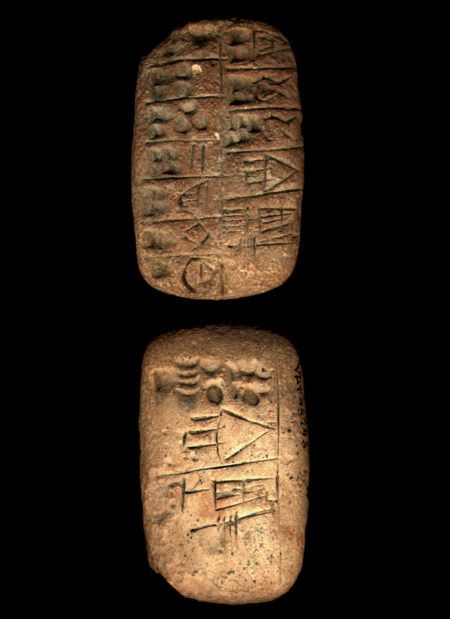
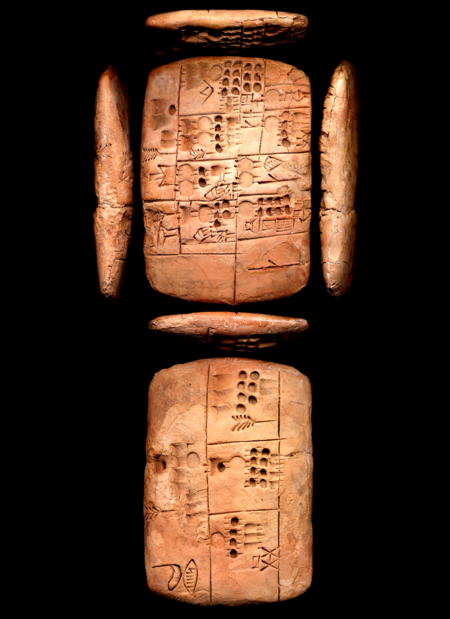
Around 3300 BCE, tablets began appearing in southern Mesopotamia, where pictograms and numbers recorded economic transactions. Signs were inscribed into the clay with a pointed stick, and numbers were impressed with a round stylus14. Today, about six thousand such tablets and fragments are known, primarily from Uruk2. There is no formed grammar in these records—only nouns, numbers, and a few adjectives15. So far, this is an accounting practice, not a record of speech.Image: Administrative tablet from Uruk, Uruk III period, Berlin, Near Eastern Museum, VAT 15245. Source: Cuneiform Digital Library Initiative
Impression and Sign on a Single Clay Surface
A tablet from the Metropolitan Museum collection (c. 3100–2900 BCE, likely from Uruk) records barley inventory. However, before the signs were inscribed, a cylinder seal was rolled across its surfaces and edges, and only then were the marks applied14. The seal’s design—a male figure with two dogs on leashes, wild boars, and reeds—also conveys information14. The figure is generally called the «king-priest»; he acts as a protector of the herd. Here is an important point for investigation: the image and the sign lie on the same surface but follow different rules. The image is repeated through impression, while the sign is written.3D model of a plaque from the Metropolitan Museum collection. Source: metmuseum.org.
Restored impression print on a plaque (template), Metropolitan Museum of Art. Source: metmuseum.org
Uruk Vase and the Image Without Text
The alabaster vase, approximately a meter tall and originating from the Uruk temple complex, is structured in three registers: water and plants at the base, animals above, and a procession of bearers approaching the goddess Inanna at the top26. It contains no inscriptions. Deniz Schmidt-Besser reads the vase as a continuous narrative, where the registers progress from bottom to top3. Signs and images in Uruk existed simultaneously, but the narrative on the vase is conveyed solely through composition.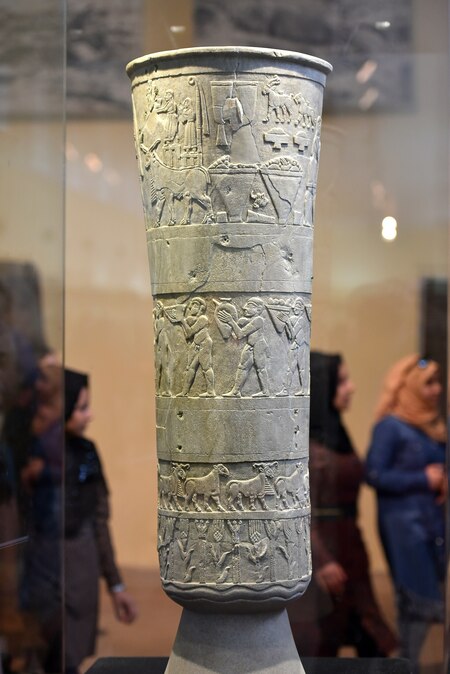
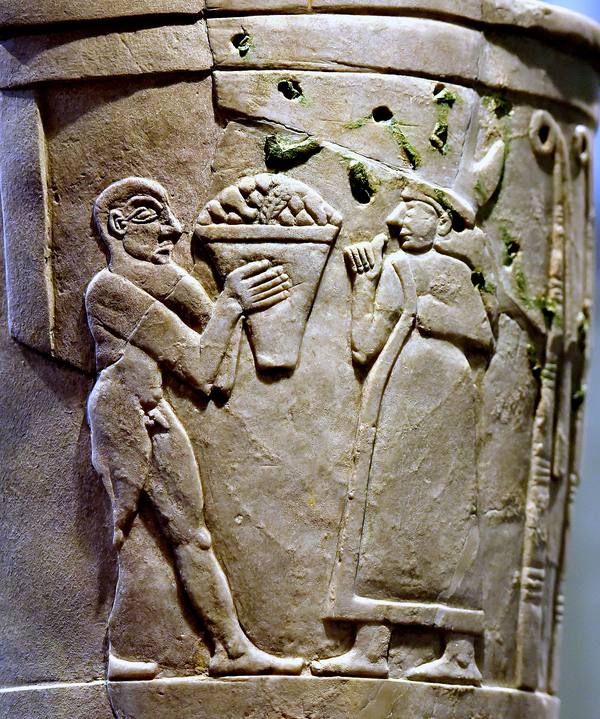
Vase from Warka (Uruk Vase), National Museum of Iraq, Baghdad // Inanna receiving offerings on the Uruk Vase (upper register). Source: Wikimedia Commons
Signs Made of Pictures
A head shaded in the mouth area is read as «mouth» or «eat, ” and a woman combined with the sign for horns is read as „slave“ („woman from the horns“)—all of these are combinations of proto-cuneiform signs. In other words, a new word is born not from a new picture, but from the joining of two old ones. Thus, the boundary between image and sign turns out to be fluid. The sign at Uruk is still related to a drawing, so combining them is not difficult.Image: Administrative plaque, Ur III, Berlin. Source: Cuneiform Digital Library Initiative.Chapter Summary
On the sign from the Metropolitan Museum, two «languages» coexist: the graphic representation and strings of characters. They are not blended; the image frames the text, and the characters are inscribed in the empty spaces. The characters have not yet conveyed grammar15, and the image does not require a caption.
The next step—when the character begins to name what is depicted and resides within the composition.
II. The Name Within the Image in Lagash
Mid-third millennium BCE. Speech begins to be fixed, and names are recorded.
By the first half of the third millennium BCE, cuneiform was capable of conveying the Sumerian language, and its sphere of application expanded—written poetry emerged. The symbols became abstract; their form was determined not by drawing, but by pressing a reed stylus into the clay. The inscription could now be read aloud, meaning it could be placed on an object—for example, on a statue or a stele.
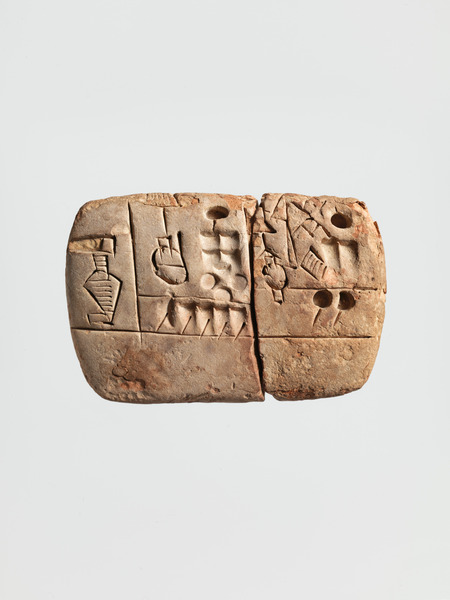
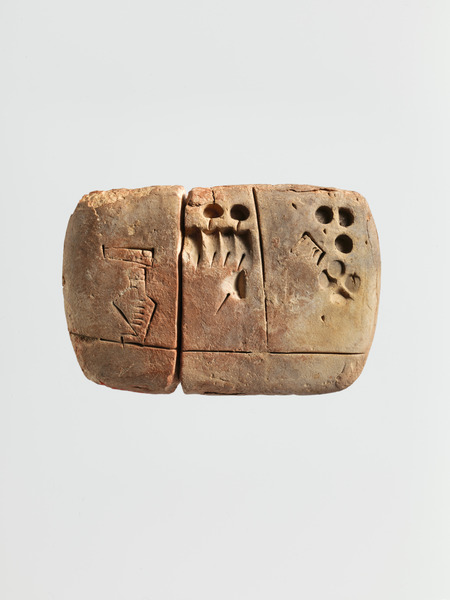
Plaque detailing barley and barley groats (both sides), Metropolitan Museum of Art. Source: metmuseum.org
Stela of the Vultures
A fragmented limestone stele, approximately 1.8 meters high and 1.3 meters wide, was discovered in Tell (ancient Girsu) in the 1880s and is currently housed in the Louvre. It was erected to commemorate the victory of Enannatum, ruler of Lagash, over Ush, ruler of Umma; the estimated date of its creation is around 2450 BCE.25 The text on the stele is Sumerian cuneiform, and its publication and translation have long been available9, 10. On the fragment depicting Enannatum in a chariot, the king’s name is inscribed in two vertical columns of signs before his head25. This is not a modern signature: the signs are situated within the composition, in the open space, and link the figure to a specific individual. Thus, the inscription transforms the image into a portrait. The density of the cuneiform indicates that in the preserved fragments, the signs fill the background between the figures. The image and the text share the surface without dividing it into a «picture» and a «signature.»Stela of the Vultures, fragment, Louvre, Paris. Source: Wikimedia Commons.
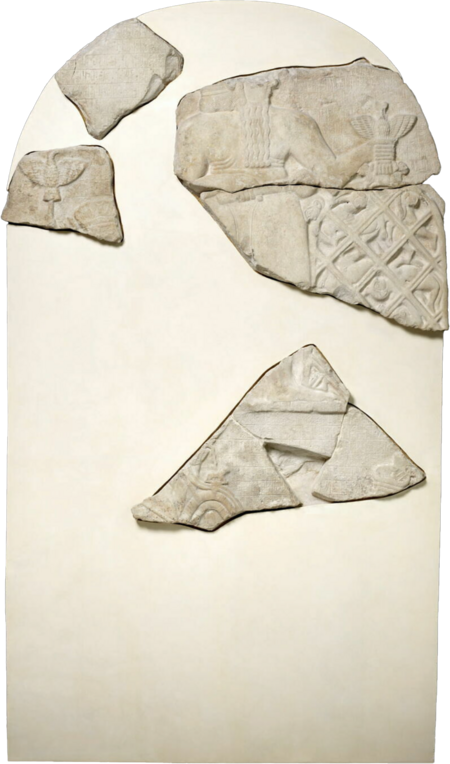
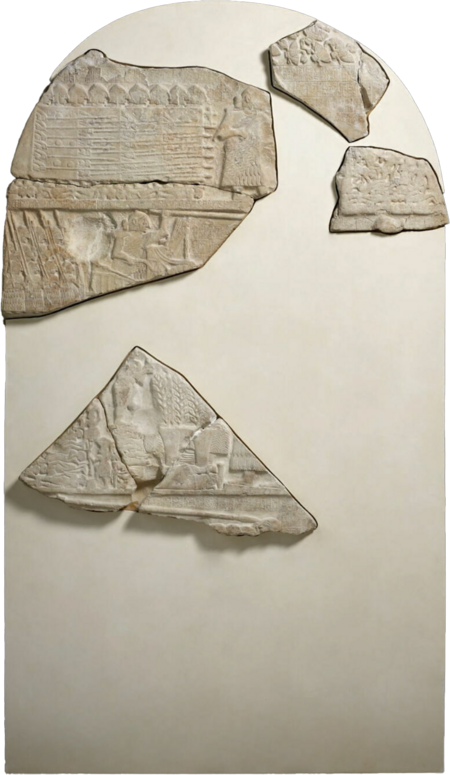
Stele of Vultures, Louvre, Paris. Source: Wikimedia Commons.
One side of the stele depicts a military procession: the Eannatum leads a phalanx both on foot and in a chariot, and vultures circle above the slain enemies$^{\text{25}}$. The reverse side features a mythological scene where the god Ningirsu holds a net filled with captives$^{\text{25}}$. The first side describes the event, while the second explains its meaning—the victory is granted by a god. The composition is structured in registers, the scale is hierarchical, and the background functions as a field for signs.
Stela of the Vultures, fragment, Louvre, Paris. Source: Wikimedia Commons.
Chapter Summary
In Lagash, text and image combine for the first time in a single composition. The name is incorporated into the image, anchoring it to a specific individual, while cuneiform fills the background. However, at this stage, neither the inscription defines the figure’s appearance, nor does the figure’s appearance depend on the inscription.
The next step is when the inscription begins to define the image itself—its material and function.
Text and Body: Naram-Suen, Guda
23rd–21st centuries BCE. The inscription is overlaid on the image.
Stele of Narām-Sîn
A stele, approximately two meters tall, commemorates the victory of the Akkadian king Narām-Sîn over the Lullubi people. The king, wearing a horned helmet, ascends a slope, with stars above him18. The image tells the story, and the Akkadian inscription remains partially preserved without disrupting the composition19.
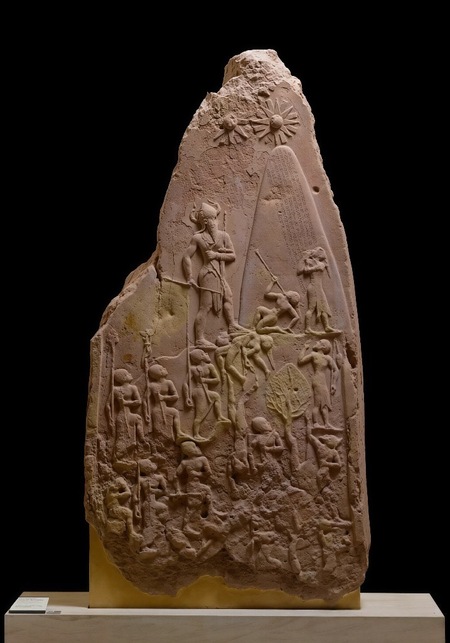
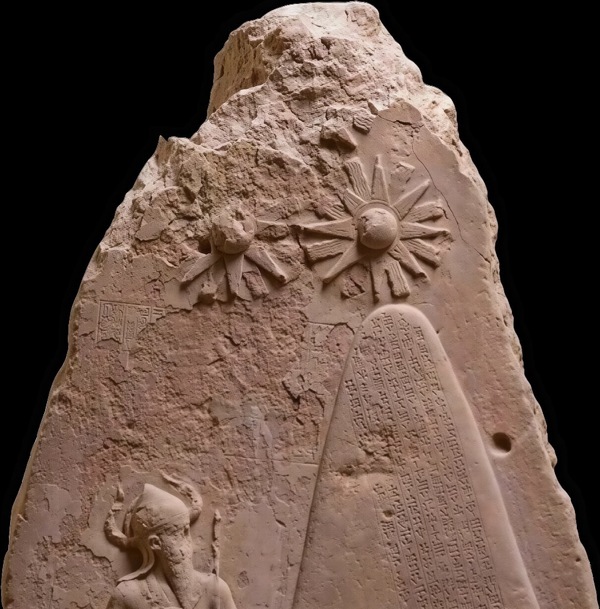
Triumphal Stele of Naram-Suna, Louvre. Source: louvre.fr
In the 12th century BCE, the Elamite king Shutruk-Nahhunte transported a stela to Susa and inscribed his own text $\text{18}$ directly onto the depiction of the mountain $\text{19}$. The new inscription alters the meaning without changing the imagery.