Navigation
- Introduction
- The Birth of the Impossible: Animation as the Art of Reality Violation
- A World Without Physical Laws: Deformation and Metamorphosis
- The Logic of Dreams: Absurd Spaces and Impossible Events
- Animated Matter: Objects, Bodies, and Anthropomorphism
- From Comedic to Surreal: Absurdity as an Independent Artistic Language
- Conclusion
Introduction
What happens to an image when it is no longer obligated to retain a once-established form? This question lies at the foundation of this visual study. Working with films by Emil Kohl, James Stewart Blackton, and Winsor McCay, the piece examines how the violation of the customary properties of the body, object, and space becomes not only a source of comedy but also a method of constructing an independent cinematic reality. The focus is not on a catalogue of technical innovations, but on the structure of specific episodes: what appears impossible, what technique creates this effect, and what connections allow the viewer to comprehend what is happening. The goal of the study is to trace how the animation of drawing, metamorphosis, deformation, spatial instability, and anthropomorphism alter the relationship between recognizable things. The analysis is organized around these techniques, rather than as a sequence of creators' biographies. The working hypothesis is that animated absurdity is not equivalent to the absence of logic. On the contrary, it can emerge from the systematic application of a specific rule: the body allows for disassembly, the image becomes an object, and verbal metaphor is executed literally. It is important to determine when such a violation remains a separate joke and when it dictates the development of the entire film. Furthermore, the concept of surrealism is used with historical nuance. Breton’s Manifesto was published in 1924, so the similarity of earlier films to the logic of dreams should not automatically be considered a result of surrealism as a movement’s influence. The study proposes comparing the ways images are organized without attributing a single overall program to the creators. Its concept lies in examining the impossible as an artistic tool: it is not just how strange the event looks that matters, but what that strangeness allows us to see differently.
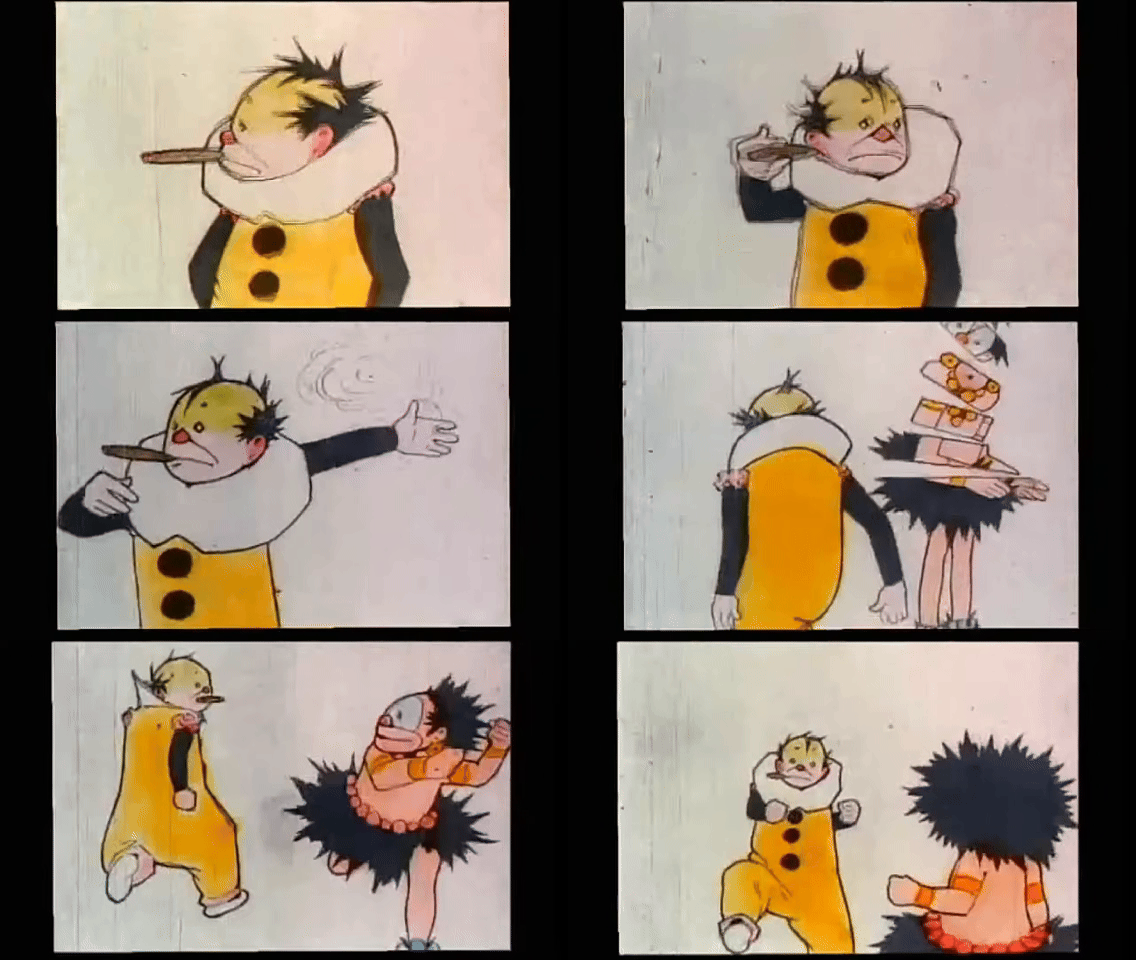
Winsor McCay. «Little Nemo.» 1911
The Birth of the Impossible: Animation as the Art of Disrupting Reality
In James Stuart Blackton’s «Comical Phases of Funny Faces» (1906), the faces drawn on the board begin to move, while in Emil Kol’s «Phantasmagoria» (1908), several white lines coalesce into characters that constantly change appearance. When viewing these two films side-by-side, a difference emerges between two methods of portraying the impossible: animating an existing image or presenting its existence as a sequence of transformations. In the former case, the autonomy of the drawing is astonishing; in the latter, the stability of any depicted object is called into question.
Emile Colin. Fantasmagorie. «Phantasmagoria.» 1908
From Optical Toys to Screen Focus
Experiments with moving drawings began long before the advent of these films: in the 19th century, the phenakistoscope allowed viewers to observe a sequence of images on a rotating disk as a brief, repeating motion. The motion did not necessarily reproduce everyday gestures; for example, on one of the disks in the Cooper Hewitt Museum collection, a human face alternates between stretching and widening, only briefly returning to normal proportions. This example is important for understanding early animation: the technical capability to connect static images was used not only to simulate life but also to demonstrate things that cannot be seen in real life. Another precursor was the stage trick of «flashing drawings»: the artist performed before the audience, rapidly creating and altering images, and the first screen versions of such acts supplemented the performance with camera stops and other tricks. In Blackton’s «The Enchanted Drawing, ” registered in 1900, the stage act was already combined with stops in filming, allowing the drawn objects to seemingly come to life. The drawn bottle and glass transform into real objects in the performer’s hands, and the face on the paper changes expression, reacting to his actions. Here, however, it is necessary to distinguish between trick substitution and frame-by-frame animation. The Library of Congress regards „The Enchanted Drawing“ as a precursor to animation, rather than as an animation film in the strict sense. A camera stop allows a drawing or object to be replaced between two segments of filming; frame-by-frame work, conversely, allows motion to be constructed from individual, sequentially altered images. This distinction is crucial for analyzing the impossible. It is one thing to show an object disappearing; it is another to make the viewer follow how it loses its former shape.
Simon von Stampfer. Phenakistoscope with a distorted face. 1833.
Drawing begins to take effect
In «Comical Phases of Funny Faces, ” Blackton combines chalk drawings on a board with cut-out insertions, which allows parts of the image to be moved without constant redrawing. The artist’s hand signifies the initial situation: we see a drawing someone is creating, yet the depicted faces then begin to move without their direct involvement. Therefore, the main event is not a specific grimace, but the shift in the image’s status. What was just the trace of another’s gesture is now perceived as an active participant. The episode where a man blows smoke toward a woman, and her expression changes in response to what is happening, is particularly vivid. Within this short scene, a completely understandable everyday causality is maintained: one character’s action provokes irritation in another. The limitation lies not in the situation itself, but in its material execution. Several chalk lines behave as if they can smoke, see, and feel annoyance. This method of animation is still close to the device of focus. The artist presents a static image, then demonstrates a disruption of the recently established order: the drawing no longer requires the drawing hand. The apparent simplicity of the technique enhances the effect. To consider the image alive, only a small change in the position of the eyes or the outline of the mouth is necessary; detailed anatomy and a believable environment prove optional. However, the technical aspects of the film do not completely disappear behind the illusion: noticeable flickering is related to uneven exposure during manual frame-by-frame shooting. It should not be automatically interpreted as an intentional artistic device. Rather, it is useful here to distinguish between a production quirk and its possible visual effect: the instability of the image might further suggest that what we are witnessing is not observation of a finished world, but its sequential creation.
James Stuart Blackton. «The Comic Phases of Funny Faces.» 1906
Transformation instead of a static object
In «Phantasmagoria, ” Kolya achieved the external resemblance to chalk drawings differently: the artist drew with India ink on white paper, and the print, with inverted tones, yielded white lines on a black background. To sequentially change the images, Kolya used a surface illuminated from below, upon which a camera was positioned. Therefore, the similar screen appearance of Blackton and Kolya does not imply an identical workflow. The „chalky“ line could have been a photographic effect achieved intentionally, rather than a trace of chalk.
In the film, Kolya’s small clown, Phantosh, and the figures surrounding him are involved in a series of metamorphoses; film historian Isabelle Marinon connects these transformations to ruptures in narrative logic. Visually, extreme economy of drawing is crucial here: the character is delineated by a few light lines, not by a voluminous body with a detailed surface. This contour can be viewed as a temporary agreement with the viewer. As the lines coalesce into a recognizable figure, we see a specific being or object; changing their relationship allows us to read the same image anew.
Unlike the Blackton scene discussed, a commonplace explanation is insufficient for understanding Kolya’s transformations. The question of „why did this happen?“ yields to the question of „what will this turn into?“ The connection between events can be sought not only in the characters’ actions but also in the drawing itself: the image continues even though the object it denotes is already changing. This generates a unique conviction in the impossible. The transformation does not have to be plausible, provided the viewer can follow its visual trajectory.
Furthermore, it would be inaccurate to consider such illogicality a lack of artistic presuppositions. Kolya worked in satirical graphic art and was part of the groups „Hydrophytes“ and „Inconsistent, ” and his visual gags relied on parody and pictorial play. This allows us to link the absurdity of „Phantasmagoria“ not only to the new technology but also to an existing culture of deliberate incongruity. The camera provided this play with an additional dimension: the contradiction could now be not merely depicted, but unfolded through time.
Emile Colin. «Phantasmagoria.» 1908
Where Focus Becomes Absurd
For this study, it is useful to distinguish between an impossible event and an absurd mode of image organization. The focus violates expectation yet usually retains a recognizable framework: the performer presents a miracle, and the spectator notices a substitution of the familiar order. Absurdity begins where such a disruption ceases to be an exception and becomes a condition of what is happening. It is no longer only important that the drawing has come to life, but also whether it is obliged to remain itself afterward. Concurrently, the early works of Blackton and Quay cannot be classified as Surrealism as a historical movement without qualification: both films in question appeared before the publication of André Breton’s «Manifesto of Surrealism» in 1924. In this case, it is more accurate to speak of the possibility of a surrealistic reading rather than the proven affiliation of the directors with this movement. The similarity of techniques does not yet establish a shared set of artistic objectives. Comparing the films allows us to trace a transition from demonstrating a living drawing to depicting an image for which transformation becomes a way of existing. This should not be understood as a simple progression from a «primitive» experience to a more refined one: Blackton focuses attention on the boundary between the hand and its creation, while instability of the form becomes particularly productive in Quay’s work. It is here that the foundation for a further analysis of absurdity emerges: the impossible is interesting not only as a spectacular trick but also as a condition of a world in which a recognizable thing can cease to be itself at any moment.
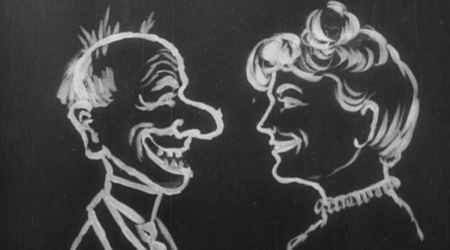
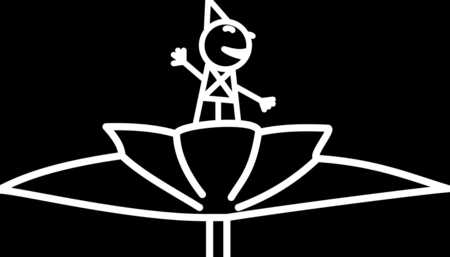
James Stuart Blackton. «Comical Phases of Funny Faces.» 1906 | Émile Kohl. «Phantasmagoria.» 1908
A World Without Physical Laws: Deformation and Metamorphosis
The Body Controlled by Gesture
In the animated sequence of «Little Nemo, ” Nemo manipulates the proportions of Flip and Imp: he makes their bodies stretch and compress by controlling the movements of their arms. Deformation does not occur spontaneously here. It has a visible director, and because of this, the change in form is perceived as a small performance within the film: one character demonstrates control over the drawing, and the other two become material for his exercises. Of course, what we are seeing is deformation, not complete metamorphosis. Flip and Imp retain their recognizable likenesses, even as their proportions change dramatically. This is a crucial distinction for analysis: transforming one being into another requires redefining who is before us, whereas stretching invites us to observe how far a familiar figure can be altered. The comedy stems from the tension between the character’s stability and the instability of their body. However, McKay does not limit himself to treating the characters as flat outlines: the somersaults, turns, and stretches are combined in the film with the conveying of weight and movement into depth. It is this combination that makes the scene expressive. If the image were perceived only as a line ornament at all times, the change in proportions would not challenge our expectations. But the sense of corporeality has already been established, and now the film allows the body to be treated as if it were made of pliable material. In another episode, Nemo draws the Princess himself, after which she comes to life; later, they travel together inside the gaping maw of a dragon. Drawing becomes an action of the character itself here, rather than merely the author’s hidden work. Within the created world appears someone who is also capable of augmenting it. This results in a kind of doubling of artistic authority: the drawn character interacts with other images almost as freely as the artist interacts with them.
Winsor MacKay. «Little Nemo.» 1911
Deformation with Consequences
In the film «How a Mosquito Works, ” a massive insect penetrates a sleeping person and repeatedly drains their blood until its swollen abdomen causes an explosion. Here, the change in form is no longer a separate spectacle that can be stopped with a wave of the hand. It accumulates and leads to the climax: each new bite brings the body closer to its breaking point. It is particularly important that the swelling of the abdomen affects the mosquito’s behavior: once satiated, it struggles to maintain its balance and can no longer move with its previous ease. Thus, McKay violates the permissible scale of change but does not abandon the link between volume, weight, and movement. On the contrary, it is the preservation of this connection that helps make the exaggeration palpable. The viewer sees not just an expanding oval, but a creature struggling to cope with its own body. This is where the ambiguity of the episode arises. It can be read as a comical story about insatiability, but the image also allows for a more unsettling experience: the growth of one body is achieved through penetration of another. The repetition of the bites transforms a familiar nocturnal annoyance into a drawn-out procedure, and the deformation becomes its visible outcome. The humorous and the troubling do not alternate here; they coexist—the mosquito is absurd precisely because its excess is shown to be physically convincing. Comparing it with „Little Nemo“ helps clarify that plasticity does not necessarily mean invulnerability. In that work, the change in proportions is subordinate to demonstrating the possibilities of drawing; here, it has an irreversible consequence. For analyzing early animation, this provides a useful boundary: the flexibility of form can promise freedom from physical constraints, or, conversely, make the destruction of the body the central event.
Winsor McCay. «How the Mosquito Works.» 1912
Insatiable Appetite and Convincing Weight
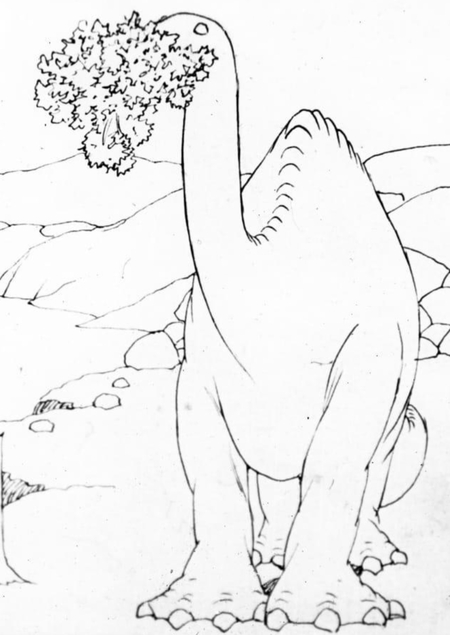
In Gertie’s «Dinosaur, ” the heroine eats a tree, clashes with a mammoth, and drinks water from a lake. However, this film should not be described as just another sequence of continuous metamorphoses. Gertie is interesting to the chapter’s theme for almost the opposite reason: her body maintains a recognizable structure while actions venture beyond plausibility. McKay emphasizes her mass by referencing her limbs, and in a resting scene, he shows her ribcage rising and falling with her breath. These details are necessary not only for similarity to a living animal. They establish a measure of physical believability, against which the excessive appetite becomes particularly striking. To be surprised by the impossible action, one must first believe in at least some properties of the one performing it. The lake episode can be viewed as a disruption of the relationship between the body and the absorbed volume: Gertie drains the entire body of water. Unlike a mosquito, whose saturation sequentially becomes a bodily problem, here the focus shifts to the disappearance of the water. Two different models of exaggeration emerge. In one, the absorbed substance forces the shape to change; in the other, the scale of the appetite itself is more important than calculating its physical consequences. At the same time, Gertie is not reduced to a mechanism for stunts: she gets distracted, she is stubborn, she cries after being scolded, and she dances. Therefore, her actions can be perceived not only as a display of authorial license but also as manifestations of character. Absurdity gains behavioral motivation: the impossible happens not simply because the artist is capable of drawing it, but because the heroine is curious, gluttonous, or absorbed in play.
Winsor MacKay. «The Gertie Dinosaur.» 1914