Category
- Concept
- Who is eligible to sit at the table?
- Who prepares breakfast?
- How to divide a single serving?
- Who is the table set for?
- Conclusion
concept
visual material selection principle
principle of selecting and analyzing textual material
The principle of rubrication
Conclusion
[01]Who is eligible to sit at the table?
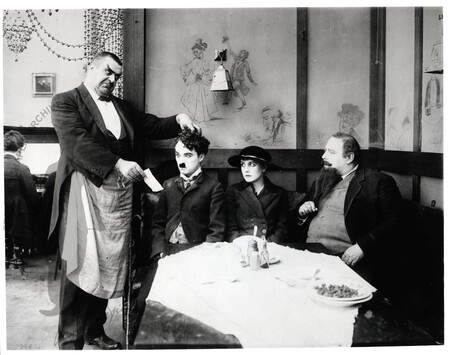
A person already seated at a table may have no guarantee that they will be allowed to finish their meal. This is the exact position of the protagonist in «The Immigrant»: he ordered food, only to discover he has lost his coin. In «Our Hospitality, ” the situation is almost the opposite. While Willy is in danger, as long as he remains in the home as a guest, the hosts feel obligated to postpone revenge. In both films, a person finds themselves at someone else’s table and realizes the power that an occupied place holds. Georg Simmel noted that the communal meal brings together even people who share no other common interests. The limits of such closeness are particularly evident in these two comedies.Chaplin places a seated patron next to a standing waiter. Keaton and Blaystone seat mortal enemies for a family dinner where everyone observes a single custom. The comparison begins with the seating arrangement and ends at the doorway—it is there that it becomes clear on whose terms the protagonist can stay and what awaits him when he rises from the table.
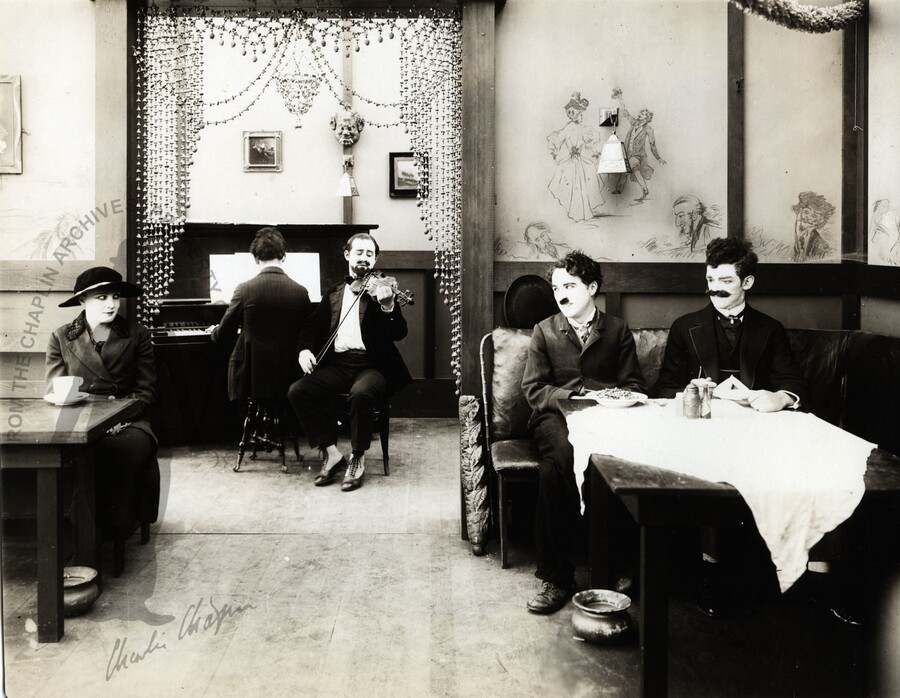
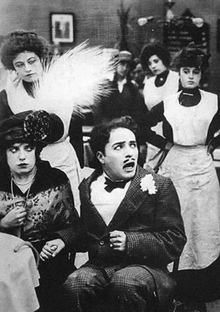
Stills from the film «The Immigrant.» Dir. Charlie Chaplin, 1917.
In the Brodyaga restaurant, he and his companion sit shoulder to shoulder. A white tablecloth sets their table apart from the aisle, while the chair backs and the dark wall panel seem to enclose it on three sides. In the background, a pianist and a violinist are visible. The lunch appears as meticulously arranged as the music played for patrons here.
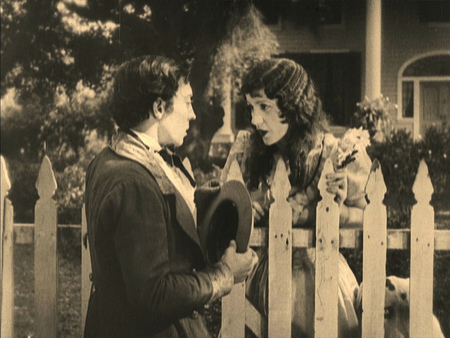
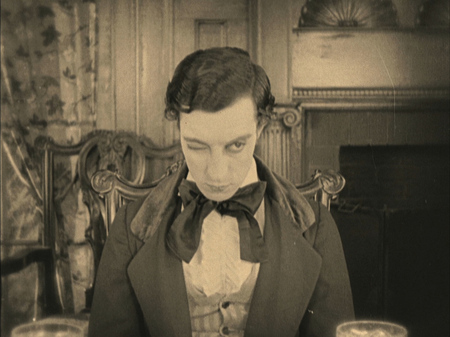
1. A still from the film «Our Hospitality.» Directed by Buster Keaton and John Blaiston, 1923. 2. A still from the film «Our Hospitality.» Directed by Buster Keaton and John Blaiston, 1923.
At Keaton’s, Willie’s introduction to the Canfield family begins at the fence. Virginia leans toward him over the picket fence; he holds his hat in his hands. A barrier remains between the figures—a barrier the girl’s invitation allows him to overcome. Once inside the house, during the prayer before dinner, Willie lowers his head but keeps one eye open. By bringing the guest’s face closer, Keaton makes visible the high cost of perfect manners. To behave at the table like everyone else, Willie must simultaneously pay attention to those sitting next to him.
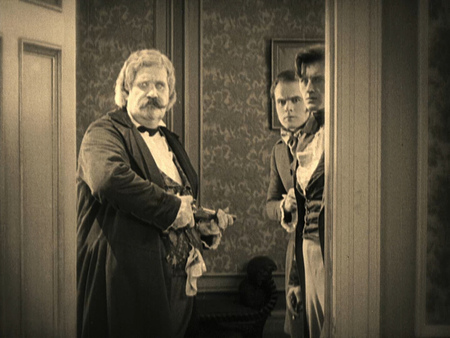
1. Stills from the film «The Immigrant.» Directed by Charlie Chaplin, 1917. 2. Stills from the film «Our Hospitality.» Directed by Buster Keaton, John Blairston, 1923.
A waiter at Chaplin’s grips the Tramp by the hair. In his other hand, he holds a narrow slip of paper—and it is this small object that explains why the server can treat the man he just served this way. For Keaton, the power of the host is represented by the doorway. The men occupy it almost edge-to-edge. While Willie is a guest, family custom shields him even from these people. Comparing the two shots gives the word «place» a literal meaning. It is important which side of the table or door a person stands on when they are the one making the decision.
[02]Who makes breakfast?
In «Malyush, ” the child is positioned at the stove. In „Navigator, ” a wealthy adult receives breakfast in bed. At first glance, both scenes depict the convenience of domestic life—someone is there to bake pancakes or serve food. However, if you trace where the person responsible for the breakfast is located in each case, the similarity disappears. The toddler works in the room where they will soon eat. In Rollo’s bedroom, the person serving the finished dish is visible, while the entire kitchen remains outside the frame. For one character, breakfast enters life as a routine task; for the other, it arrives as a familiar service.
A frame from the film «The Kid.» Dir. Charlie Chaplin, 1921.
In the archival photograph, the toddler sits at a table, holding food with both hands. The adult has lowered themselves almost to the child’s eye level. Behind the child, a stove is visible, and the distance between the two figures is slightly more than an outstretched arm. Charles Silver notes that the boy himself is preparing the stack of pancakes for breakfast. The image allows us to see the domestic side of this self-sufficiency. Here, one room encompasses both the kitchen and a gathering space. The one who prepared breakfast only needs to turn to their neighbor.
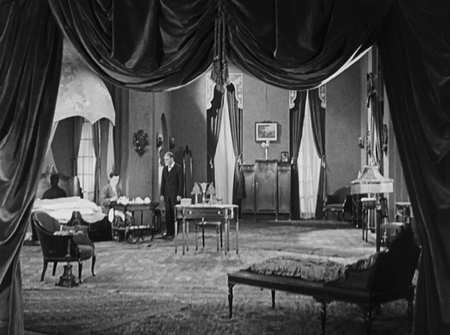
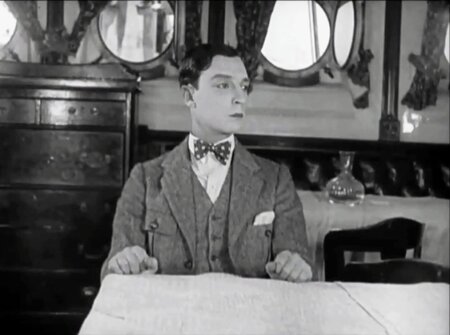
1. A still from the film «The Navigator.» Directed by Buster Keaton and Donald Crisp, 1924. 2. A still from the film «The Navigator.» Directed by Buster Keaton and Donald Crisp, 1924.
Rollo’s bedroom is arranged differently for meal service. The bed and a servant with a small table are placed on the left, leaving a significant portion of the opulent room open. The distances are large, but Rollo has nothing to cross. On the liner, a white tablecloth is once again before the protagonist. He is already sitting upright, resting his hands on the edge of the table. Other empty chairs are visible behind him. The visitor’s familiar posture remains, but now it seems strange: there is no one nearby to respond to this silent waiting.
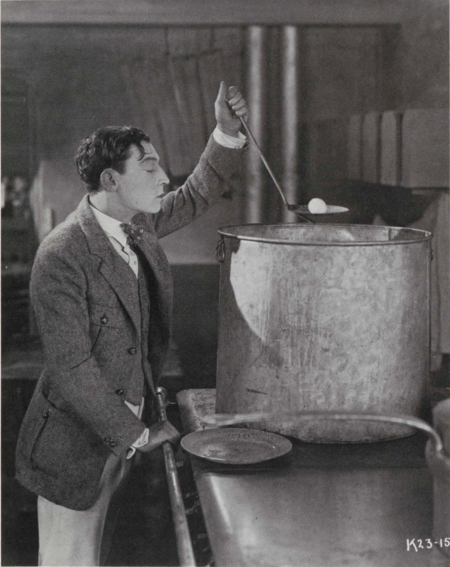
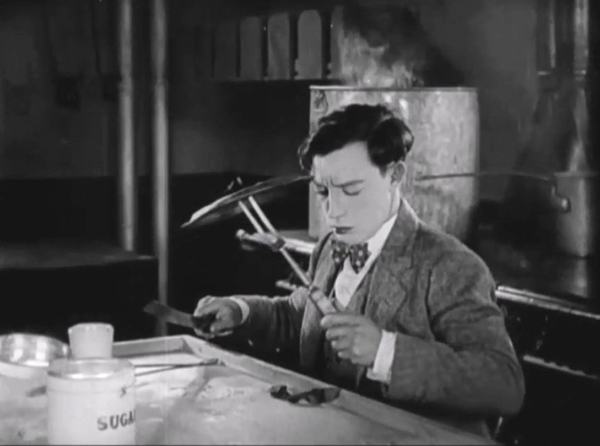
1. A frame from the film «Navigator.» Directed by Buster Keaton and Donald Crisp, 1924. 2. A frame from the film «Navigator.» Directed by Buster Keaton and Donald Crisp, 1924.
Rollo holds an egg over a round cauldron on a long spoon. Luis Giannetti notes that the shot distance allows the egg and the size of the cauldron to be distinguished simultaneously. The protagonist’s elbow is raised almost to eye level. For a single serving, he has to make a motion designed for the galley of an entire vessel. Later, Keaton brings the protagonist back to the table holding utensils. This familiar pose now has a backstory: before sitting down, the two aboard had to figure out how to serve themselves.
[03]How to split one serving?
Shared food has a curious characteristic: people sit at one table, but each piece can go to only one person. Georg Simmel paid attention to this feature, linking it to the very nature of the meal. A personal plate signifies one person’s portion; a shared dish leaves open the question of who gets how much. In silent comedy, this distinction can easily be turned into action. It is enough to shift a plate, divide a stack of pancakes, or offer a neighbor one of two known unequal parts.In three Chaplin episodes, the distance between people is small: in all cases, one only needs to reach out to receive their share. However, the reasons why the food ends up with one person or another are different. On the ship in «The Immigrant, ” the deckhand seems to be managing the portions. In „The Tramp, ” the two people for whom the breakfast was prepared share it. In „The Gold Rush, ” two hungry men also have to decide what is actually edible. In every scene, the movement of one item changes the relationship between the neighbors at the table.
A still from the film «The Immigrant.» Dir. Charlie Chaplin, 1917.
The photographer positioned himself near the end of the table. Rows of diners extend toward the two nearest passengers, but each person’s hands are occupied with their own food. The vagrant sits sideways on a wooden crate, one elbow resting on the tabletop, a cane under the other arm, and a stranger’s plate nearby. The archival photograph preserves the seating arrangement. The gag itself describes Jeffrey Vance: the strongman makes the plate slide between the vagrant and his neighbor. Where other diners have their own portions, these two have to share the time they can reach the food.
A still from the film «The Kid.» Dir. Charlie Chaplin, 1921.
There is a different rhythm at the home desk. In front of Brodnyaga and Malysho stand two separate mugs, but one person is pouring. One of his hands holds the dishware, the other steadies the lid. The child’s gaze is directed down at the table. The same logic is repeated with the pancakes: the boy prepares an entire stack, after which he carefully divides it into two portions.
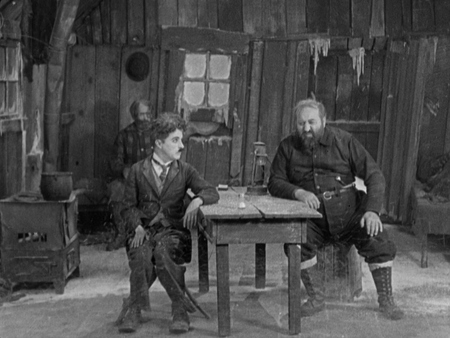
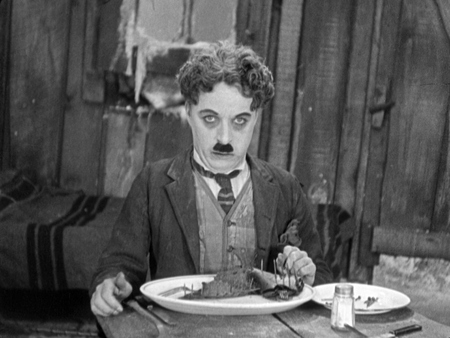
1. A still from the film «The Gold Rush.» Dir. Charlie Chaplin, 1925. 2. A still from the film «The Gold Rush.» Dir. Charlie Chaplin, 1925.