Navigator
Concept The Mask as Spectacle Order and Repetition Individuality within the Mass When the Mass Becomes a Threat Bibliography Image Sources
Concept
The multitude of people on the stairs of the Babylonian palace underscores the monumental scale of the architecture. On the set of a musical, the dancing figures form a strict geometric pattern. In the factory space, the repetitive movements of the workers are governed by the rhythm of the machinery. In front of the prison gates, the gathering of townspeople morphs into a threat. In all these instances, a mass appears on screen, but its artistic function shifts depending on how the image is organized.
For film, it is important not only the number of participants in a mass scene but also the distance between them, their positioning relative to an individual protagonist, the overall trajectory of movement, and the camera’s chosen point of view. A crowd is capable of filling space, forming an autonomous composition, or singling out one person against a multitude.
The choice of theme is rooted in the fact that the mass scene allows for the simultaneous exploration of multiple cinematic possibilities: a multitude of human figures can define spatial dimensions, create rhythmic patterns, or alter the positioning of an individual character within the composition. Depending on the method of depiction, the group becomes not only a participant in the action but also a means of expressing order, contradiction, tension, or a sense of community.The period from the 1910s through the 1930s is particularly compelling due to the diversity of American cinema forms. During these decades, methods for staging large-scale compositions evolved, cinematography and editing techniques grew more complex, and the advent of sound film opened up new avenues for working with collective rhythm. Comparing different genres and artistic approaches allows one to see how similar techniques generate diverse meanings.
How do composition, scale of the image, angle, movement, and editing define the visual function of crowds in Hollywood cinema of the 1910s–1930s?
In Hollywood cinema of the 1910s–1930s, the crowd functions not merely as a backdrop to the narrative but as an independent means of artistic expression. Depending on the methods of visual organization, a multitude of people could create spectacle, convey order, emphasize the status of an individual, or embody a collective threat.
The research is divided into four visual functions of the crowd: spectacle creation, expression of order and repetition, designating an individual’s position within the mass, and forming an image of collective threat. At the heart of each section is the question of how the organization of human figures alters the meaning of screen space and action.The mass scene is capable of simultaneously creating a spectacle, establishing a specific rhythm, and underscoring human solitude. Therefore, the analysis is built upon comparing composition, shot size, angle, density, and the direction of movement of figures, light, and editing transitions. In cases where meaning is determined by the development of the event, the sequence of images is considered.
Textual sources are selected primarily based on their applicability to visual analysis. Priority is given to scholarly research that offers concepts for describing composition, mise-en-scène, shot size, cinematography, rhythm, and editing.
Mask as Spectacle
In historical epics, the crowd doesn’t merely fill space; through the multitude of figures, the viewer can gauge the height of the walls, the dimensions of the plazas, and the scope of the event. The mass scene becomes an independent spectacle within the narrative—a manifestation of a spectacular quality that endures in narrative film. [4]
In «Intolerance,» people are lost at the base of the Babylonian towers and among the colossal columns. The repetition of architectural forms creates a rigid framework, while the movement of the crowd allows the viewer to sense the depth of the space. Babylon becomes a vivid backdrop, immersing the viewer in the atmosphere of that era. [1]
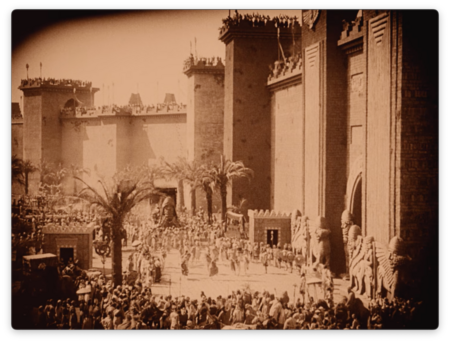
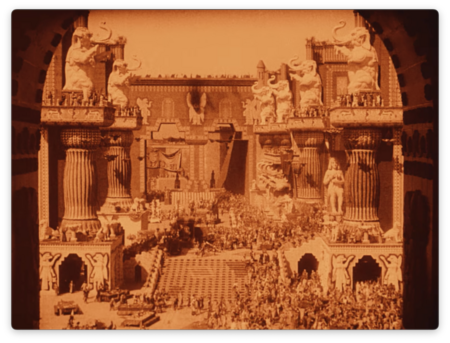
«Intolerance,» 1916
The Babylonian procession connects the foreground and background: the movement of people follows the lines of stairs and streets, guiding the viewer’s eye into the depth of the image. Conversely, the blue-toned scene has the opposite effect—the human figures become a small chain against an expansive, empty space. In both instances, scale is created by the relationship between mass and its environment.
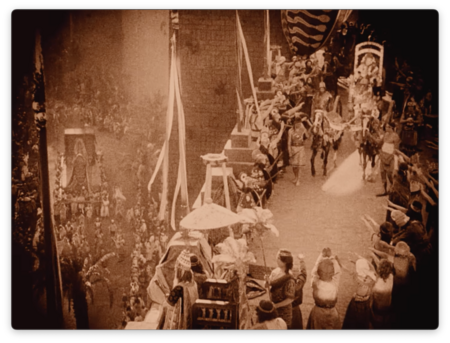
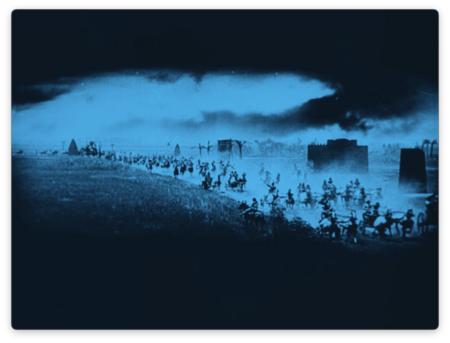
«Intolerance,» 1916
In «Ben-Gurion,» the city procession transforms the street into a current of synchronously moving figures. The arena is structured differently: on the general plan, the spectators fill the stands with a solid mass that frames the much smaller racetrack. The human multitude conveys the grandeur of the competition even before the rapid action begins. [6]
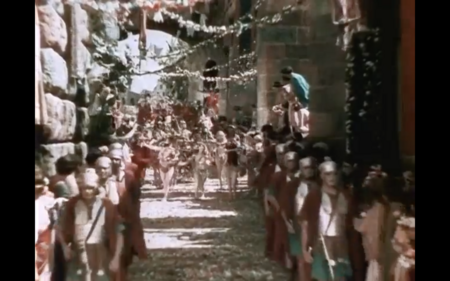
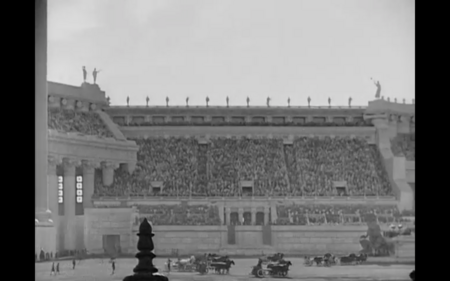
«Ben-Gurion, ” 1925
As the scene transitions from a broad arena panorama to the clash of chariots, the spectacle shifts in character. Dust, wheels, and moving bodies fill the frame, while closer shots emphasize speed and danger. The editing connects the sweeping scale of the mass scene with the tension of individual episodes.
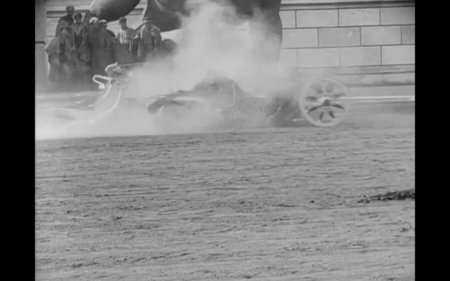
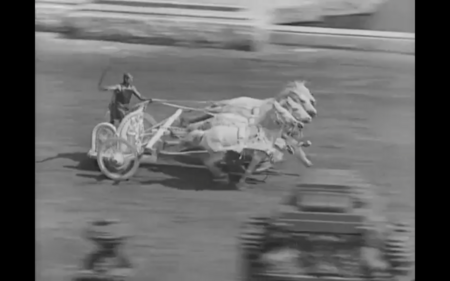
«Ben Gur, ” 1925
Both films transform the crowd into a compositional tool, but they utilize it differently. In Intolerance, the multitude primarily reveals the monumentality of the space, whereas in Ben-Hur, it establishes the scale of the spectacle, which then unfolds through movement and scene changes.
Order and Repetition
Repetition transforms individual human figures into a unified visual composition. In 42nd Street, the consistency of movement creates a spectacle, while New Times depicts the order of factory labor. The external similarity of these systems allows us to perceive the fundamental difference: who controls the collective rhythm, and what place the individual occupies within it. [5]
The overhead shot in the music number «I’m Young and Healthy» transforms groups of dancers into concentric circles and radiating lines. Faces recede into the background, and the synchronized movement becomes the main substance of the scene. Human bodies coalesce into a dynamic «ornament of mass.» [10]
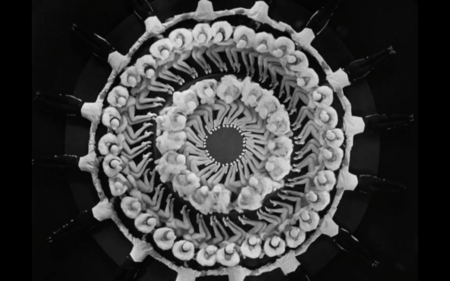
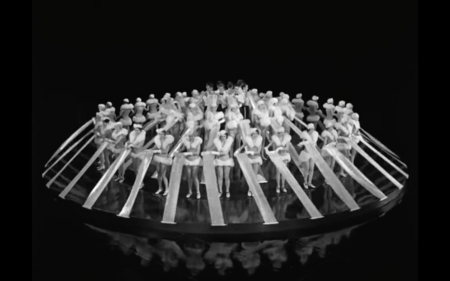
«42nd Street, ” 1933
A series of simultaneously raised legs forms a rhythmic pattern even without depicting faces. The overall shot restores integrity to the figures, yet it emphasizes the same repetition—a singular gesture transforms into a form created by the entire group. Changing the scale allows one to see the same principle of organization on two levels.
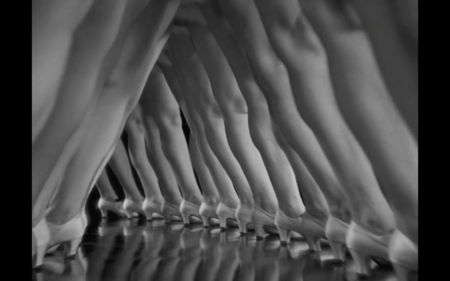
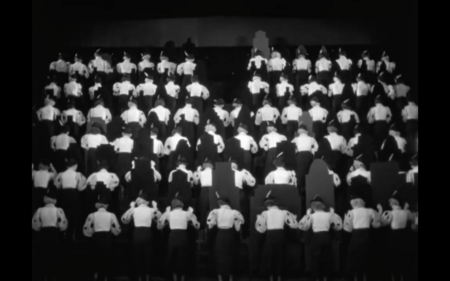
«42nd Street, ” 1933
At the start of «New Times,» the montage juxtaposes a flock of sheep with the flow of people heading to work. This similar direction of movement transforms the cluster of figures into an image of everyday submission to a shared route.
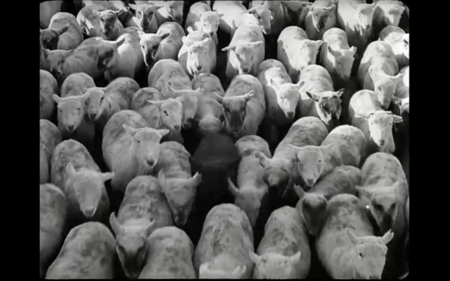
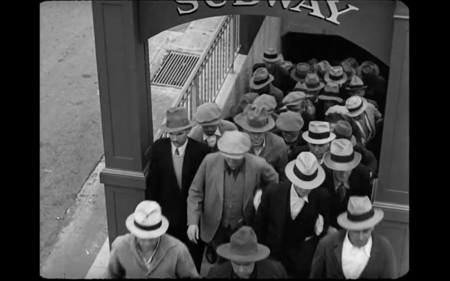
«New Times,» 1936
On the assembly line, repetition becomes even more rigid: the machine dictates the speed, and the worker must adjust their movements to it. The massive face of the supervisor on the screen sharply contrasts with the small figure of the worker. The difference in scale makes the production hierarchy visible: control occupies the center of the image, while the human figure is in a subordinate position. [1]
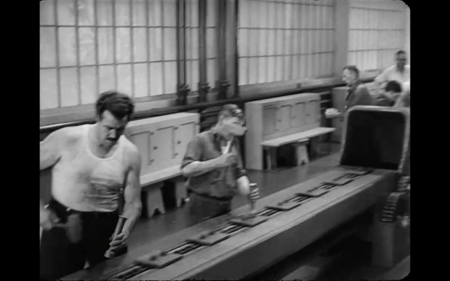
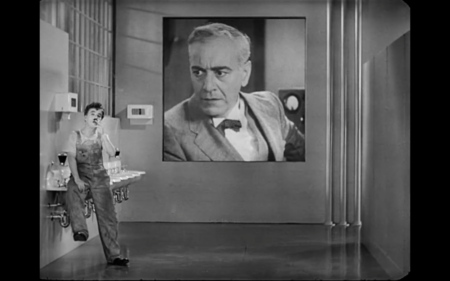
«New Times,» 1936