Concept
Space in painting appears natural: we recognize near and distant objects, the volume of figures, and the depth of interiors, even though we are looking at a flat surface. However, this sense of depth arises from specific pictorial techniques. Italian painting from the late 13th to the first half of the 14th century allows us to examine how artists employed these techniques before the establishment of linear perspective, which was theoretically formalized in the 15th century.This study is not about the «invention of perspective» by a single master, nor is it about the gradual disappearance of the gold ground. Its focus is on the methods by which painters made the depicted space visually convincing: arranging figures behind one another, depicting a throne or room at an angle, modeling body volume with light and shadow, and directing architectural lines into the distance. Important is not only the result of each technique, but also how they are combined within a single work.
How did artists create the illusion of depth on a flat surface before the advent of linear perspective?
The research hypothesis posits that spatial convincingness emerged not from a single discovery, but through several parallel artistic solutions. Even when the background remained golden and schematic, the figures and objects could already possess volume. Conversely, the presence of an architectural interior did not always imply that all its elements were subservient to a single geometric system. Therefore, the contrast between «plane and depth» should not be understood as a rigid boundary between two epochs, but as a set of interacting visual properties.
To test this hypothesis, works by Chimabue, Duccio, Giotto, Pietro, and Ambrogio Lorenzetti were selected. This selection does not claim to be a complete history of Italian painting. Rather, it unites works that allow for a comparison of similar objectives: depicting a seated figure, constructing a throne, arranging characters relative to one another, and organizing the architectural environment. Of particular significance are the works that allow one to examine a single motif across different artists or several spatial techniques within one composition.
What artistic techniques transform a flat image into space?
The material is organized thematically, not by artists' biographies, but by methods of representing space. The first chapter examines the overlap of figures and the division of composition into planes. The second chapter addresses techniques for conveying bodily volume through light and shadow, drapery, and figure positioning. The third chapter is dedicated to architecture as the setting for action: how rooms, walls, openings, and ceilings help the viewer understand the characters' spatial location. The fourth chapter explores the direction of floor lines and architectural elements that create a sense of receding distance from the viewer.
The research method is comparative visual analysis. The works are examined in their entirety and through enlarged fragments—the shapes of a throne, the edges of clothing, the relationships between figures, and the details of interiors. These comparisons allow for the separation of purely visual observations from general historical characteristics. Each section concludes with a finding regarding the specific problem addressed by each technique and any limitations that technique retains.
Does greater image depth always necessitate abandoning medieval conventions?
The relevance of this topic lies in the ability to see that space within an image is not a neutral «copy» of reality. It is an artistic construction dependent upon the artist’s choice, tradition, and the work’s intended purpose. This study seeks not to demonstrate the superiority of more «realistic» paintings over more conventional ones, but rather the diversity of ways artists of the 13th–14th centuries organized the viewer’s gaze and created a sense of depth on a flat surface.
Chapter 1. Space Within the Plane.
In 13th-century Italian painting, spatial depth was not necessarily conveyed through a unified perspective system. Artists utilized figure overlapping, shifts in positioning, and the depiction of architectural elements in angular foreshortening. These techniques are particularly evident in images of the Madonna on the throne. Despite the conventional gold background, the throne and surrounding figures allow the viewer to distinguish several spatial planes.
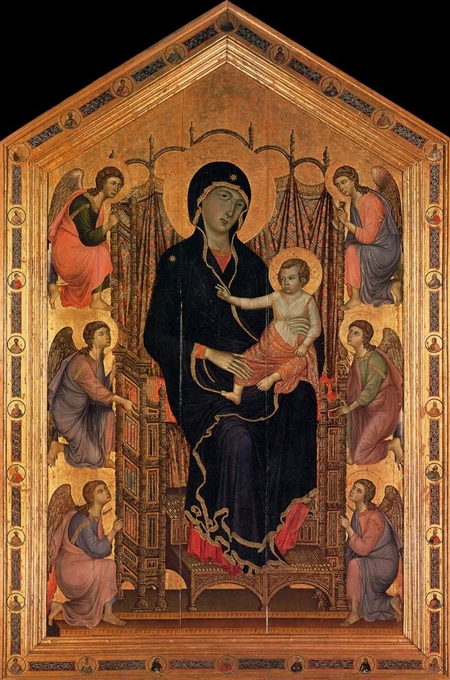
Duccio di Buoninsegna, «Madonna of Rucellai,» c. 1285
Depth without perspective.
In «Madonna of Rucellai,» Duccio evokes a sense of depth despite the absence of a real spatial environment. The golden background lacks a horizon line, making it impossible to gauge the distance to the depicted objects.The primary spatial element is the Virgin Mary’s throne. Its sides are rendered at an angle, allowing the viewer to conceptualize the structure as a three-dimensional object. Angels positioned alongside the throne partially overlap the throne’s elements, intensifying the sense of multiple planes.However, the angels' figures do not adhere to a unified spatial system and appear to float against the golden background. Thus, one image coexists between the conventions of religious iconography and an attempt to create a convincing three-dimensional form.Intermediate conclusion: the sensation of depth can arise from localized spatial devices even when the entire composition does not constitute a singular, realistic space.
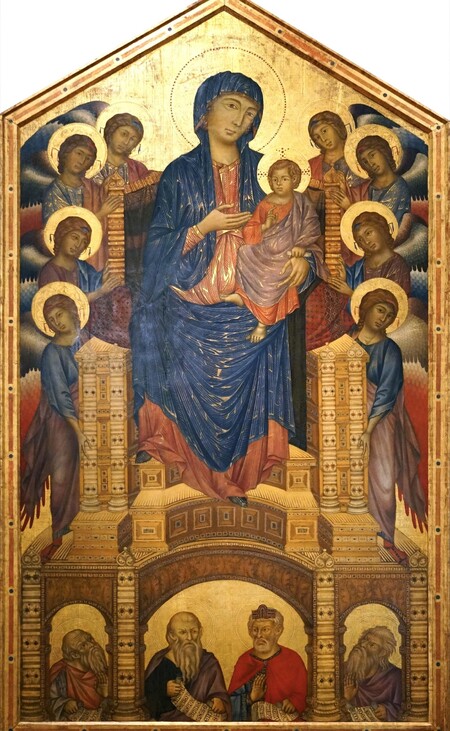
Chimabue, «Madonna of Santa Trinity, ” c. 1290–1300
Architecture that creates depth.
In Chimamanda Ngozi Adichie’s «Madonna of Santo Trinity,» the throne becomes a crucial instrument for organizing space. Its massive structure, steps, and architectural openings create several levels of depth.
The lower part of the composition is particularly interesting. Four prophets are depicted within arched openings beneath the throne. This treatment allows the structure to be perceived not as a flat decorative element, but as an architectural edifice with an internal space.
Angels are placed on either side of the throne, partially overlapping one another. This arrangement helps distinguish several spatial planes, even though the golden background still does not denote a specific earthly setting.
Thus, Adichie connects the conventionality of medieval religious iconography with techniques that make objects and figures spatially convincing.
Two thrones—two ways to create space.
In both works, the gold background maintains a conventional sense of space, yet the artists organize the depiction of the throne differently. In Duccio’s work, the throne is angled, and its side elements help convey the depth of the structure. Six angels support the throne, positioned on either side of the Virgin Mary. Their placement suggests multiple planes but does not form a unified space. Chimabue’s throne, in contrast, is depicted more frontally and features a complex architectural structure. Arched openings in the lower part of the composition create additional spatial levels, within which the figures of the prophets are situated. Thus, Duccio emphasizes depth through the rotation of the throne, while Chimabue achieves it through the architectural segmentation of the structure. Both artists create a spatial illusion while remaining faithful to the gold background and the conventions of medieval painting.
Conclusion of Chapter One.
In 13th-century Italian painting, a sense of depth could emerge without a single perspective system. The rotation of architectural elements, the overlapping of figures, and the division of the composition into spatial planes allowed artists to combine the volume of individual objects with the conventionality of a gold background.
Chapter 3. Architecture as a Space for Action.
In 14th-century Italian painting, architecture gradually ceases to serve a purely decorative function. Artists begin to use walls, openings, doors, and interior furnishings to depict the spatial arrangement of characters. The depicted room becomes integral to the narrative—it dictates the placement of figures, separates zones of action, and helps the viewer perceive the depth of the scene. This technique is particularly evident in the works of Giotto and Pietro Lorenzetti, where architecture does not merely surround the characters but actively participates in organizing the composition.
Duccio di Buoninsegna. «Madonna of the Rucellai.» c. 1285. Uffizi Gallery, Florence. https://www.uffizi.it/en/artworks/virgin-and-child-enthroned-surrounded-by-angels-known-as-the-rucellai-madonna [Accessed: November 16, 2026.]
Cimabue. «Madonna of Santa Trinita.» c. 1290–1300. Uffizi Gallery, Florence. https://www.uffizi.it/en/artworks/virgin-and-child-enthroned-and-prophets-santa-trinita-maesta [Accessed: November 16, 2026.]