INDEX
01 — Introduction 02 — Body and Sin 03 — The Ancient Ideal of Beauty 04 — The Body as Reality 05 — The Body as Ideal 06 — The Symbolism of Female Nudity 07 — The Transformation of the Female Image 08 — Research Findings
CONCEPT
This study analyzes how female nudity was depicted in European art during the 15th century, comparing the approaches of the Northern and Italian Renaissance. We trace the evolution of the perception of the female body—from its role in religious symbolism to its recognition as an aesthetic ideal.Using examples from the works of Masaccio, Jan van Eyck, Hans Memling, Albrecht Dürer, and Sandro Botticelli, we investigate the influence of religion, classical culture, and new artistic techniques on the interpretation of female nudity.The religious, didactic, and aesthetic meanings of female nudity in the 15th century did not replace one another but existed in parallel.
Key research question: How and why did representations of female nudity transform in the art of the Northern and Italian Renaissance during the 15th century, and how did this impact its symbolic content?
BODY AND SIN
Previously, the nude female body appeared most frequently in religious narratives. Nudity served as a symbol of human innocence.However, over time, following the Fall, its meaning shifted. It now signified shame, vulnerability, and a loss of harmony. The female body could occasionally function as an aesthetic motif, but rarely.Such imagery could help illuminate biblical stories and the moral frameworks of the era.
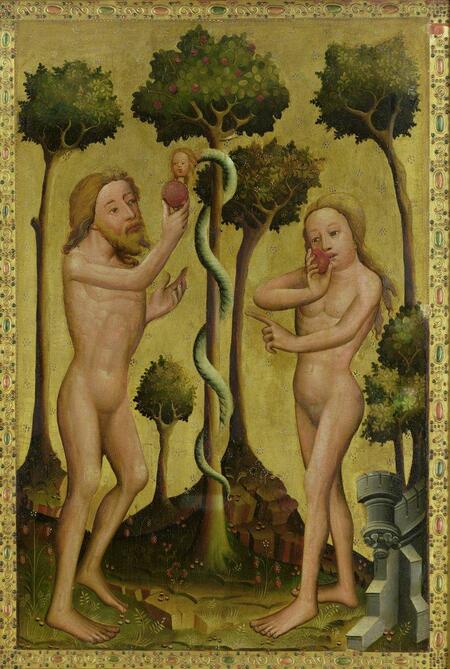
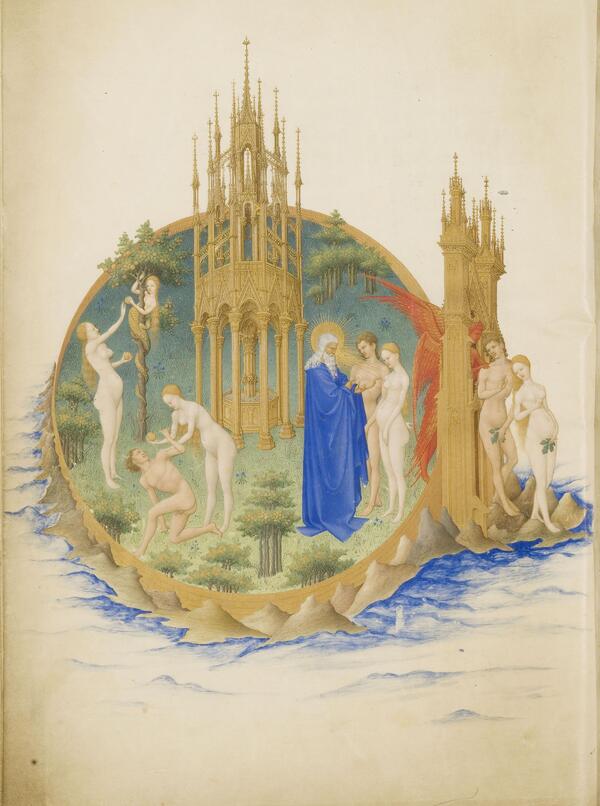
01. The Fall of Man. Master Bertram. Fragment of the Grabovsky Altar, circa 1379–1383. 02. The Garden of Eden. Limburg Brothers. «The Magnificent Horologium of Duke Berry, ” circa 1411–1416.
In medieval art, the body was not depicted with as much detail. Artists did not strive for minute rendering of skin features. Instead, they focused on conveying the figure’s meaning, paying more attention to its symbolic significance. However, much began to change by the early 15th century. Female figures were drawn with volume. Movements became more nuanced. Emotions started to be conveyed through poses and gestures.
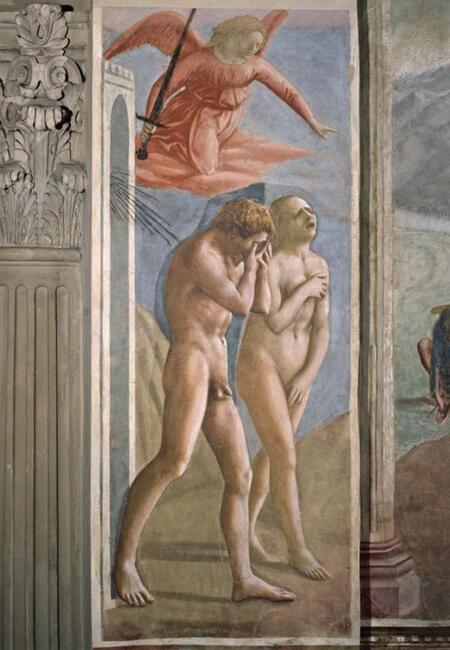
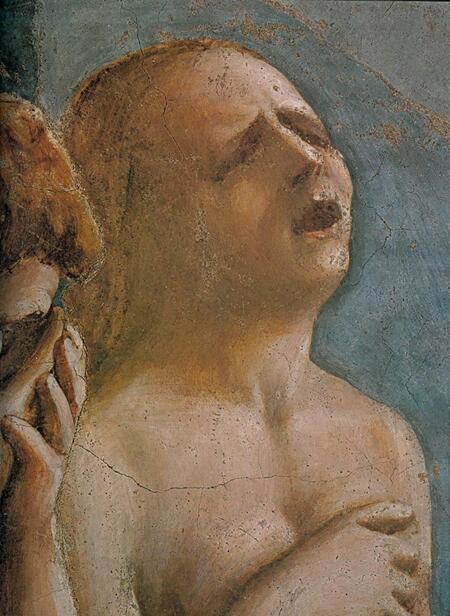
01. Mazzucco. «Expulsion from Paradise,» c. 1425–1427. 02. Mazzucco. «Expulsion from Paradise.» Fragment: Face of Eve.
Eve’s image powerfully conveys emotion. She is depicted in motion. Her shoulders are tense, her head is thrown back, and her arms are pressed against her body. In this fresco, Masaccio utilizes the volume of the figure and the specifics of the body. He employs chiaroscuro for these effects.
Eve conveys physical believability. After all, other medieval depictions present only conventions—they lack such detail. Much attention is paid to the facial expression. Her open mouth and tilted head signify despair and suffering.
Morgan Manuscript Book 366. «David and Virsavia (Virsavia Bathing).» c. 1470. Miniature from the Book of Hours, fol. 88r.
The depiction of female nudity is not limited to the story of the Fall of Man. For instance, in the miniature «David and Versavia,» a naked woman is shown bathing. When compared to the image of Eve, the portrayal of Versavia conveys ideas about human desire and its moral consequences. Ultimately, the symbolic meanings can be vastly different, depending on the narrative. Nudity does not always express innocence and shame; it also becomes a significant element in stories about human actions.
ANCIENT REPRESENTATIONS OF FEMININE BEAUTY
Divine beauty and harmony have been depicted in the female nude since ancient art.
«Aphrodite of the Capitol.» Roman sculpture, 1st–2nd centuries CE. The Metropolitan Museum of Art, New York.
This sculpture is based on the ancient type of Aphrodite, who covers her body with her arms. Later, similar ancient images of Venus begin to appear in Italian Renaissance art.
BODY AS REALITY
Naturalism and the individuality of the female form.
The characteristics of the Northern Renaissance lie in the fact that during the 15th century, new approaches to depicting the human body began to form in the Netherlands and Germany. Artists sought not just to portray human figures, but also their individual characteristics and natural proportions. They employed oil painting techniques, which helped render light and shadow, skin texture, and volume. When compared to Italian art—specifically the classical ideal—the Northern Renaissance placed greater emphasis on natural landscapes, which helped convey greater physical realism while maintaining a sense of religious devotion.
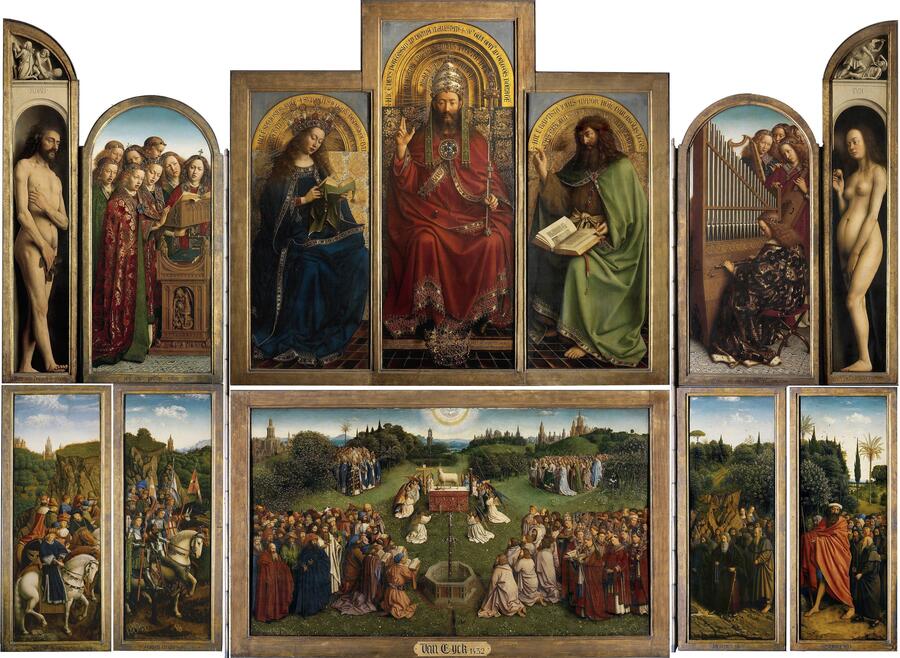
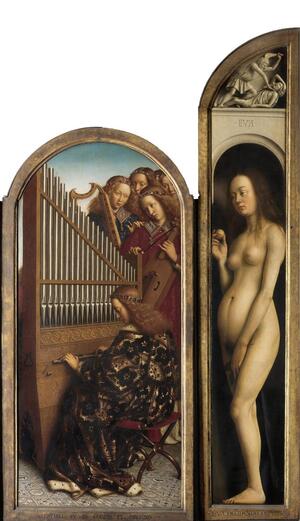
Hubert and Jan van Eyck. «The Ghent Altarpiece» («Adoration of the Mystic Lamb»). Completed in 1432. Oil, wood. St. Bavo’s Cathedral, Ghent, Belgium
Jan van Eyck displays a level of anatomical detail in his depiction of Eve that was astonishing for his time. He does not aim to showcase an ancient ideal of beauty; instead, he seeks to emphasize the natural qualities of the figure, the realism of the skin, and individual characteristics. The painting gains volume because of the subtle transitions of light. The portrayal of Eve conveys powerful physical believability.
Jan van Eyck. «Eve.» Fragment of the Ghent Altarpiece, 1432. Detail: the forbidden fruit.
At first glance, it might seem as though a piece of the Ghent Altarpiece depicts an apple. However, Eve is holding a citrus fruit in her hand. Researchers identify it as a citron. This detail helps convey an observation of nature and religious symbolism.
This unusual element emphasizes attention to natural forms. The fruit serves as a reference to the story of the Fall of Man, with its connection to bitterness recalling the consequences of disobeying God’s will.
Jan van Eyck and the Workshop. «The Last Judgment» Circa 1440–1441.
In the Northern Renaissance, the achievement considered was how artists managed to depict the human body through oil painting. Jan van Eyck combined both translucent and opaque layers by applying paint in multiple layers. These translucent layers of paint played a crucial role, as they helped create smooth transitions and deep hues. It is thanks to this technique that the softness of the skin, the naturalism of the body, and individual features were conveyed.
Hugo van der Goes. «The Fall of Man» Late 1470s. Left panel of the Vienna Diptych. Oil on wood. Museum of Art History, Vienna, Austria.
In Hugo van der Goes' painting, Eve is depicted in the moment she plucks a fruit from a tree. The serpent tempter stands beside her. This serpent possesses a feminine face and the body of a fantastic creature. One can also observe the detailed rendering of nature and the naturalism of the figures. This also contributes to the study of changes in North European naturalism, albeit through the example of another artist.

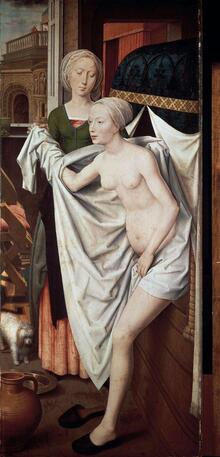
01. «Vanity» Hans Memling, circa 1485. Part of the polyptych «Earthly Vanity and Heavenly Salvation.» Musée des Beaux-Arts, Strasbourg, France. 02. «Virsaia After a Bath» Hans Memling, circa 1485. Staatliche Galerie Stuttgart, Germany.
In Hans Memling’s work, female nudity takes on different meanings depending on the subject matter.If we examine «Vershaill After Bathing, ” the body is presented as the central element of a biblical narrative, as the artist depicts her in a mundane setting, focusing on her individual physical characteristics while paying close attention to the surrounding details.However, in „Allegory of Vanity, ” female nudity acquires a different, didactic meaning. There, the woman gazes at her reflection in the mirror, thus illustrating self-admiration.Comparing these two works, one can conclude that in the art of the Northern Renaissance, the female body not only attracted attention with its beauty but also conveyed various moral ideas.