Categories
Concept
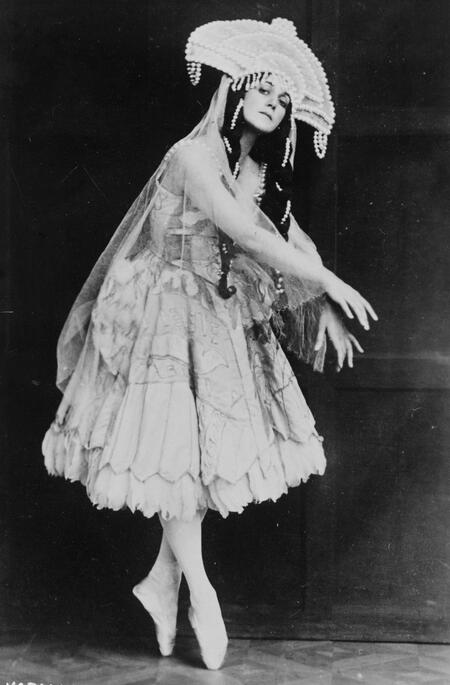
The choice of the kokoshnik as a subject stems from its capacity to explore the process by which a traditional object transforms into an element of international mass culture, with the silhouette of the headdress spreading as a result of several societal demands. Visually, the kokoshnik retains a recognizable form that begins to exist outside its original Russian context. The study examines the kokoshnik not as an item of national costume, but as a visual sign that moves across various cultural environments. The Ballets Russes introduced European audiences to an artistically reinterpreted image of Russia, and following the 1917 Revolution, a prominent Russian émigré community formed in Paris, which also contributed to embedding this cultural code within the European environment. Concurrently, Western fashion was evolving: in the years after World War I, there was a growing interest in exotic cultures, simple geometric shapes, and new ways of constructing the female image.
Hypothesis
The proliferation of the kokoshnik image in European culture during the 1910s and 1920s was not a mere passing fascination with Russian exoticism by high society, but part of a broader cultural shift: satiated European fashion was searching for a new visual language, and the kokoshnik arrived at this moment through two distinct channels. Diaghilev’s Ballets Russes offered a ready-made, unfamiliar image to the Parisian public via the stage. Meanwhile, in real life, the Russian court was already commissioning tiaras in the traditional form from French jewelers, and after 1917, the nobility who emigrated to Paris brought with them authentic artifacts and craftsmanship, which fashion houses subsequently cemented as the code of new fashion. The transformed kokoshnik reflects not only a new vision of a traditional headdress but also a change in the cultural demands of European society: the Russian image, evolving from an ethnic sign, gradually transformed into the international visual code of that era.
The central research question
Why is the kokoshnik—a feature that was once an ethnic element of Russian costume—transforming and becoming sought after by European culture, and what institutions, people, and communication channels transformed it from a national and theatrical motif into the visual code of a new era?
Objectives
— Compare how the meaning of the kokoshnik evolved at each stage: from theatrical exoticism to fashionable code. — Determine what the Parisian public was demanding in the early 20th century—what was causing fatigue with the classical French style. — Describe the Ballets Russes as an institution and analyze the stage image of the kokoshnik: what image of Russia did Diaghilev and Bakst present to the European public. — Identify the intermediaries who transitioned the image from the stage to fashion and jewelry, and demonstrate what objectives each pursued. — Study the role of Russian émigré communities after 1917: how houses like Kitmir, Russian craftswomen, and aristocrats became new carriers and «sellers» of the image. — Determine what societal shifts in the 1920s made «kokoshnik-like» forms desirable, establishing it as one of the symbols of the Art Deco era.
Tired Audience: How Overdone Classical European Style Has Become
«Gibson Girl,» Charles Dana Gibson, turn of the 19th and 20th centuries, Life magazine (November 1894 issue), the ideal of female beauty of that era