The Decapitated Head as Object: The Evolution of Visual Violence from Antiquity to the Gothic and Its Reception in Contemporary Art
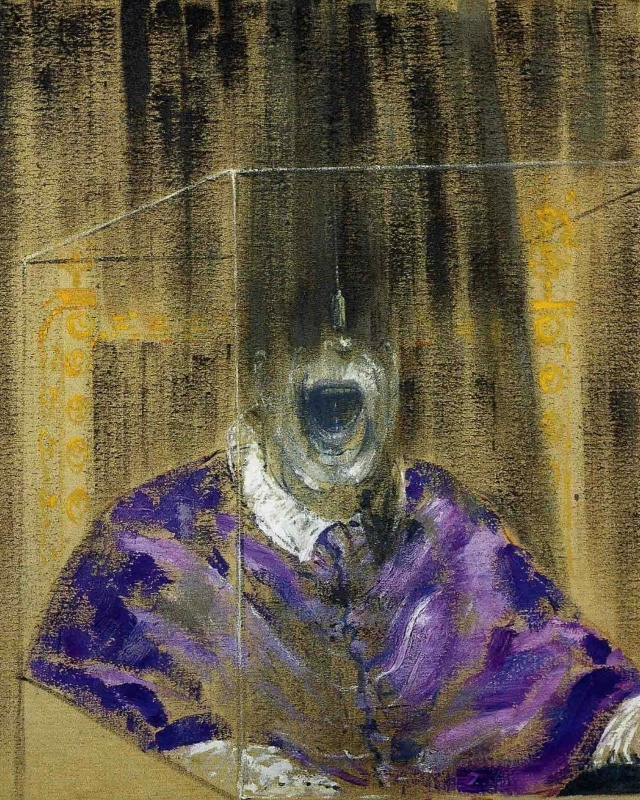
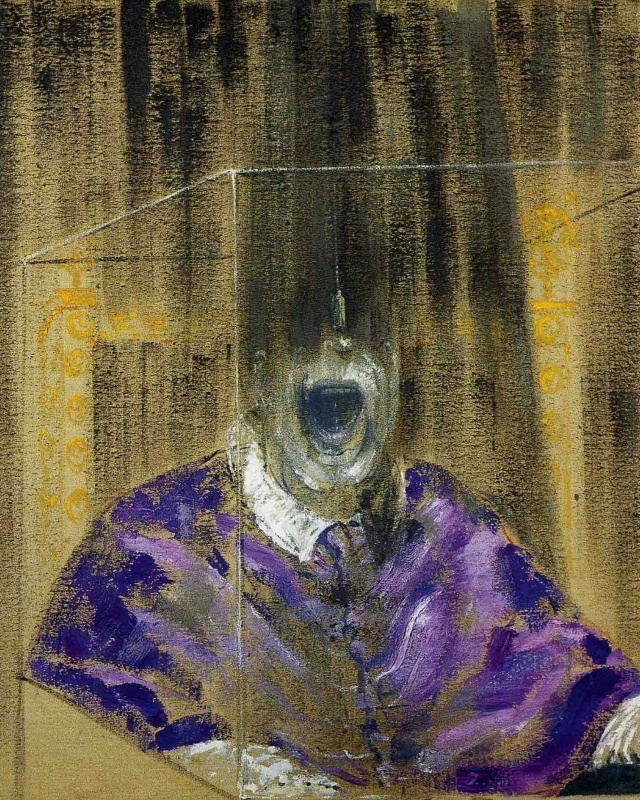
Francis Bacon. Study for the Portrait of Pope Innocent X. 1953. Canvas, oil. Private collection.
Concept
Violence and death are humanity’s most ancient companions and one of the primary drivers of the visual arts. I have always been fascinated by how artists convey agony, suffering, and the transition from life into nothingness. My interest in this subject is not merely aesthetic curiosity, but a desire to understand where the language of physical violence originates in contemporary visual culture—from cinema to current art and my own artistic projects related to bodily trauma. I chose the motif of the severed head because it is the quintessence of physical violence. It is a point of no return, where the body ceases to be whole, and the human becomes an object. Investigating how the depiction of this act has changed allows one to trace the evolution of human consciousness: from ancient myth to Christian sacrifice and Gothic hyperrealism.
The material was selected based on the principles of iconographic and emotional representativeness. The research focuses exclusively on works of Western European art (sculpture, painting, miniatures, vase painting) created from Antiquity through the 14th century. A key selection criterion was the presence of a visual motif depicting decapitation or physical mutilation. In addition to historical material, contemporary artworks from the 20th and 21st centuries are utilized to prove the relevance of the theme—these works employ embodiment as a tool for shock and psychological impact.
The structure of the work is organized chronologically and thematically, allowing us to trace the evolution of the visual language of pain. The research is divided into four chapters. The first chapter is dedicated to Antiquity, where violence is aestheticized and mythologized. The second chapter examines the early Christian and Byzantine periods, in which pain becomes evidence of faith and religious sacrifice. The third chapter analyzes the Gothic era, marking a transition toward the physiological and hyperrealism in the depiction of mutilated flesh. The fourth chapter serves as a bridge to modernity, focusing on the reception of historical images of violence in contemporary art.
The theoretical foundation of this research is built upon works in art history, iconography, and psychoanalysis. The selection of sources is based on their capacity to explain not only the formal aspects but also the deep psychological underpinnings of violence in imagery. Particular attention is paid to the works of Erwin Panofsky, as well as studies dedicated to embodiment in medieval and Renaissance art. To analyze the contemporary context, texts from the philosophy of art and trauma psychology are employed, allowing for a connection between past visual representations and modern perception.
Key question: How has the visual language of physical violence against the body evolved from Antiquity to the 14th century, and why do images of the dismembered and suffering body remain compelling and shocking in contemporary art?
The evolution of the severed head image reflects a shift from sacralization and symbolism toward hyperrealism and physiognomy. I posit that contemporary art has not reinvented violence, but rather has reinterpreted and capitalized on ancient archetypes. The depiction of a mutilated body continues to evoke shock because it appeals to the same primordial mechanisms of fear and catharsis found in the works of Ancient and Gothic masters.
Chapter 1. Antiquity: Trophy and Monster.
To understand how the visual language of physical violence functioned in the Ancient period, one must examine the worldview of the ancient Greeks and Romans. Unlike modern individuals, for whom human life is the highest value and any physical suffering is a trauma, the ancient world operated within a paradigm of constant violence. War, slavery, gladiatorial combat, and public executions were integral to daily life. Death and pain were inherent parts of the cosmic order.
However, paradoxically, ancient figurative art hardly strived for a physiological or naturalistic depiction of agony. Ancient Greek vase painters, sculptors, and mosaic artists created a unique visual code where physical violence against the body was aestheticized, mythologized, and translated into a language of symbols. There is hardly any blood depicted on ancient artifacts. The absence of naturalistic scenes of dismemberment is not due to censorship, but to the very principle of ancient aesthetics: art was meant to depict harmony, not ugly physiology, even if that harmony was achieved through death. In Antiquity, the body was, above all, a beautiful vessel. And if this vessel was destroyed, the artist focused not on pieces of flesh, but on the moment of transition itself—on the symbol of that transition. This is precisely why the severed head in ancient art is not so much a piece of bloody flesh as it is a trophy, proof of strength, a magical amulet, or a metaphor.
The most vivid and visually expressive example of headless representation in Antiquity is the myth of Medusa the Gorgon. According to the myth, Perseus beheads the monster, and a winged horse, Pegasus, is born from Medusa’s neck. Subsequently, Perseus gives the severed head to the goddess Athena, who places it on her shield. From this moment on, Medusa’s head becomes an apotropaic symbol.
Fig. 1. Gorgon (Medusa). Terracotta antefix (architectural roof ornament), Italy, c. 500 BCE. British Museum, London.
A striking illustration that Medusa’s severed head was perceived as a magical amulet in Antiquity is the function of this artifact. Before us is a terracotta antefix, created around 500 BCE and currently housed in the British Museum. This image was once affixed to the roof of an ancient Roman or Greek temple or house. It served not merely as decoration but fulfilled a specific protective function—warding off evil spirits from the dwelling. This is precisely why the Gorgon’s face on the artifact is depicted with such frightening, grotesque expression. The artist intentionally exaggerated her features, creating an image of absolute, paralyzing terror. The severed head of the monster, placed on the pediment, was intended to «stare» at anyone approaching the home with ill intent. This example clearly demonstrates how, in ancient culture, physical violence (the severing of a head) was transformed from an act of cruelty into a sacred symbol of protection. There is no blood, no flesh—only an eternal, frozen gaze directed toward the world.
Over time, the image of Medusa has transformed. While in the archaic period she was depicted as a monster with ugly facial features, in the Classical and Hellenistic eras, her face takes on traits of ideal beauty, sometimes even resembling the face of Apollo. This is the so-called «Beautiful Medusa.» She no longer terrifies; rather, she captivates. The severed head of this beautiful creature becomes an aesthetic object. This transition from horror to beauty is an important milestone in the evolution of the visual language of violence. Death and pain are masked by the ideal.
Another significant narrative that reveals the ancient attitude toward physical violence is the myth of Orpheus. This great singer, whose music could tame wild beasts and make stones weep, was torn apart by the Maenads—followers of the god Dionysus.
Fig. 2. Hermonac. The Death of Orpheus (fragment of the stamnos painting). Circa 470 BCE. Louvre, Paris.
In this frame from Hermonecta, we see the moment of Menade’s assault on Orpheus. It is important to notice how the ancient artist depicts violence: Orpheus sits in a relaxed, almost theatrical pose, holding his lyre. The blade raised over him is not accompanied by physiological details—no blood, no wounds. Orpheus’s body remains beautiful even in the moment of agony. This clearly demonstrates that ancient art did not aim to shock the viewer with naturalism; rather, it aestheticized violence, transforming physical pain into a mythological symbol. For the ancient mind, the body was merely a temporary vessel, while art and the soul were immortal. The absence of blood in these scenes underscores the triumph of spirit over the physical shell. This is the clearest example of how ancient art rejects physiological depiction in favor of symbolism.
The visual tradition of depicting a severed head as a trophy is reflected in biblical narratives, which in early Christian and Byzantine traditions inherited ancient aesthetics. The story of David and Goliath is a classic example of the weak overcoming the strong.
Fig. 3. David returning with Goliath’s head, and David before King Saul. Miniature from the «Bible of the Crusaders» (MS M.638, fol. 29r), Paris, c. 1244–1254. Held in: Morgan Library, New York.
David, armed only with a sling, defeats the massive Philistine warrior Goliath. He decapitates him and brings the head to Jerusalem. In the miniature from the «Knights Bible» (13th century), we see David proudly carrying the giant’s severed head on his shoulder. The head here is not a piece of flesh, but a military trophy—proof of valor. This scene completely lacks physiological detail—there is no blood, no wounds. The young hero treads upon the enemy like an ancient emperor. This image clearly demonstrates how early Christian culture borrowed the antique language of violence: the pain and death of the enemy do not inspire terror; instead, they serve to establish a new, divine order.
Analyzing these images, one can understand that in Antiquity and early Christianity, bodily violence was not viewed as something horrifying. It was part of the myth, of history, a component of the world order. There was no blood because the emphasis was placed on the symbol. The body suffered, but the suffering was not physiological—it was aesthetic.
Chapter 2. Early Christianity and Byzantium: Blood as Sacrifice.
The transition from Antiquity to Christianity marked a radical shift not only in worldview but also in the visual language of art. Where the ancient Greek viewed the body as a beautiful vessel and physical pain as an unfortunate but inevitable disruption of harmony, for the Christian, bodily suffering takes on an entirely different, sacred meaning. Pain ceases to be merely punishment or part of a spectacle; it becomes sacrifice, a path to salvation, and the ultimate proof of faith.
In the early Christian and Byzantine periods, the severed head and mutilated body cease to be the trophy of a warrior or a magical amulet. They become a testament to martyrdom. The visual language of art shifts from ancient bodily harmony to sacred terror. Artists no longer attempt to conceal violence behind mythological narratives; they lay it bare—not for the savoring of cruelty, but to demonstrate the strength of the spirit triumphing over mortal flesh. The martyr’s blood becomes the seed from which the Church grows.
The decapitation of John the Baptist occupies a central place in early Christian iconography. The story—how Salome, incited by her mother Herodias, demanded the prophet’s head from King Herod, and subsequently received it on a platter—becomes one of the most visually expressive and tragic subjects.
Fig. 4. Beheading of John the Baptist. Miniature from a manuscript, BnF Grec 74 (fol. 28v), Byzantium, 11th century. National Library of France, Paris.
A visual analysis of the miniature from the Byzantine manuscript reveals a composition typical of this period. The scene of the beheading unfolds across several registers, much like a theatrical performance. The executioner raises his sword, yet the artist deliberately avoids physiological detail—we see neither blood spatter nor agonized facial expressions. John’s head, resting on a platter, visually resembles a sacred vessel—it transforms into a liturgical object. The prophet’s head is depicted with half-closed eyes, creating the effect of his unseen presence and the continuation of his preaching even after death. Violence here is entirely sacralized. The martyr’s body is being dismantled, but this destruction is necessary for the triumph of faith. Blood recedes into the background in the face of divine miracle.