INDEX
- Research Concept
- Beyond the Possible
- Reality in Question
- Institute of Special Technologies
- Inside Sasha’s Mind
- Becoming Someone Else
- Conclusion
CONCEPT
«Vita Nostra» is a story about a person who confronts unknown laws of reality and is forced to change along with their own perception of the world. The research is built upon a sequential analysis of three processes: the dismantling of familiar reality, the heroine’s psychological resistance, and the transformation of her consciousness. Through an examination of the novel’s creation story, the authors' biographies, and an analysis of the first two books, it is explored how fantasy helps convey fear, loneliness, growing up, and the loss of one’s conventional identity. For visual interpretation, three surrealist artists were chosen: René Magritte, Dorothea Tanning, and Remedios Varo. Their works allow for the depiction of different facets of Sasha’s experiences: doubt regarding the authenticity of the surrounding world, internal anxiety, and the alteration of human nature.
The paintings are used not as literal illustrations of the plot, but as independent artistic imagery that reveals the philosophical ideas of the work.
Chapter 1. Beyond the Possible
What happens to a person when the surrounding world ceases to obey familiar laws? Can one trust their own perceptions if a lifetime of knowledge proves insufficient to understand reality?These very questions lie at the heart of «Vita Nostra.» Through the story of Alexandra Samokhina, the authors explore not only the fantastic potential of humanity but also the fear of change, the freedom of choice, and the nature of human consciousness.
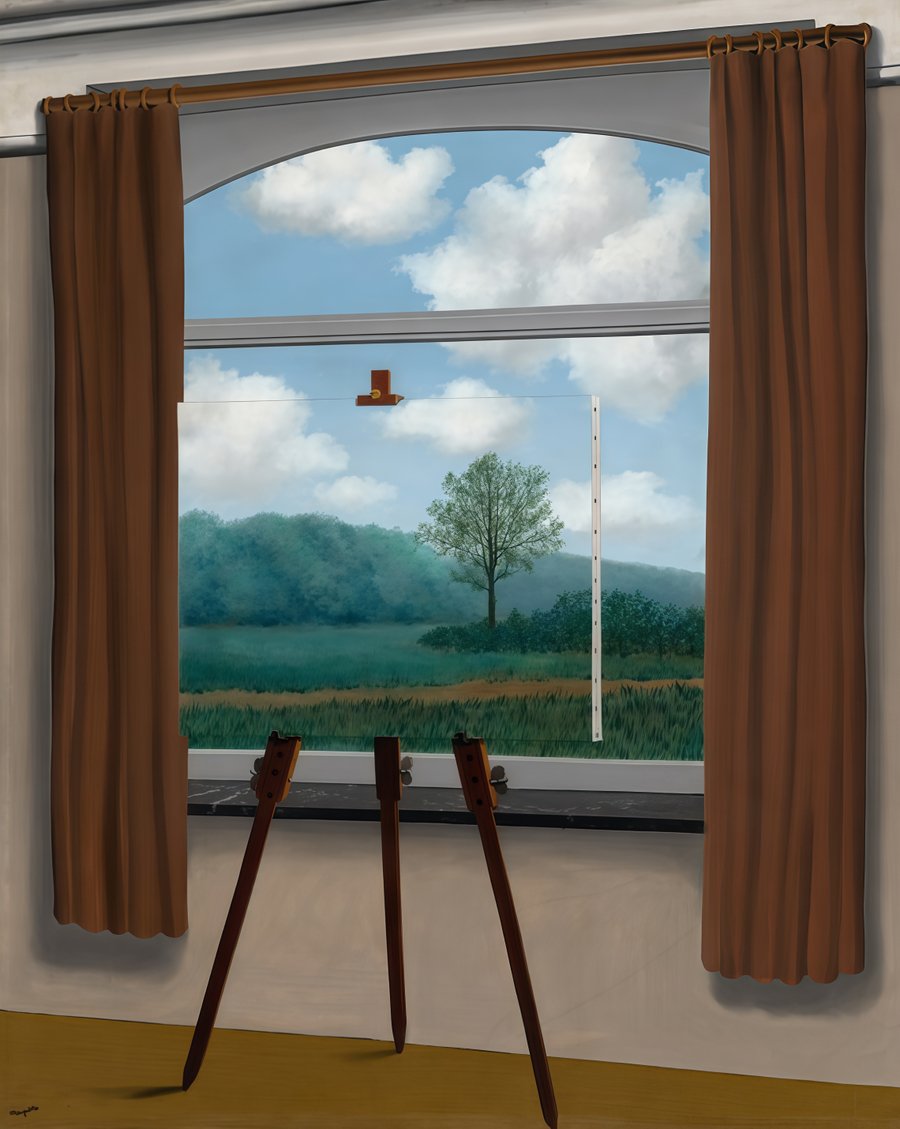
«The Conditions of Human Existence,» 1933 — René Magritte
Magritte’s painting depicts an easel before a window. The landscape on the canvas almost perfectly matches the one outside, so the viewer does not immediately notice the boundary between the representation and reality. This technique becomes a metaphor for Sasha’s perception. She was accustomed to considering the world around her understandable, but she gradually discovers that her knowledge reflects only a portion of reality.
Marina and Sergei Dyachenko — portrait photography of writers.
Marina and Sergey Dyachenko are Ukrainian science fiction writers who began their collaborative literary work in the 1990s. Sergey Dyachenko (1945–2022) practiced medicine, psychiatry, and film dramaturgy. Marina Dyachenko (b. 1968) received acting training.
Their diverse professional backgrounds offer a fascinating lens through which to view their joint creations. In the Dyachenko novels, fantastical events are closely interwoven with the characters' psychology, their internal conflicts, and their moral choices.
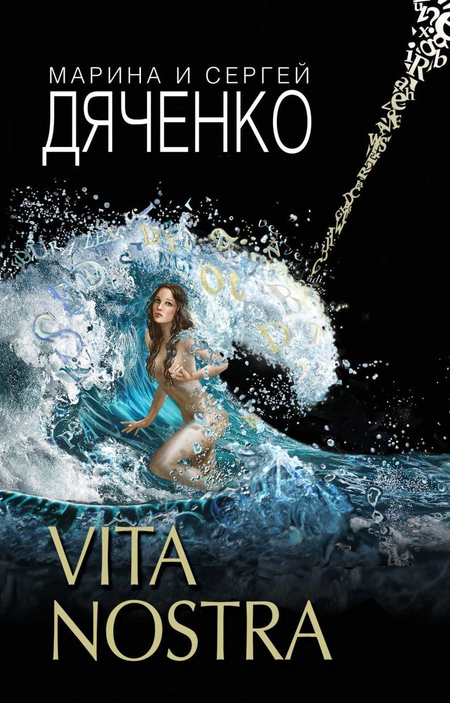
The novel «Vita Nostra» was published in 2007. Its title refers to the Latin phrase «Vita nostra brevis est”—“Our life is short”—which is known from the student anthem „Laudaes te Dominus.“The image of education is particularly significant here: the learning is not simply about acquiring knowledge, but about transforming the very nature of humanity.
Chronology of Book Publications:
2007 «Vita Nostra»
2021 «Vita Nostra: Working on Mistakes»
2024 «Vita Nostra: Gathering Fragments»
«Vita Nostra» blends elements of philosophical science fiction, fantasy, and a bildungsroman. The authors utilize the familiar setting of an unconventional educational institution, but gradually transform it into a meditation on the boundaries of human cognition. Unlike works where science fiction is built around technological breakthroughs, the primary object of inquiry here is consciousness. Therefore, the novel can be considered within the context of the history of philosophical science fiction, although by its authorial genre definition, it belongs to literary fantasy.
«Portrait, ” 1935 — René Magritte.
In Magritte’s «The Portrait,» he depicts a typical still life, yet a human eye appears in the center of a slice of ham. This subtle disruption of the familiar reality completely transforms the perception of the composition.This principle is close to the artistic methodology of Dyachenko. The fantastic emerges within a recognizable world, rather than in a separate fairy-tale reality. Because of this, inexplicable events are perceived with particular intensity.
«The Treachery of Images, ” 1936 — René Magritte.
In the painting «Clairvoyance, ” the artist looks at an egg, yet portrays a bird on the canvas. It is as if he sees not the object before him, but the possibility of its future transformation. The painting helps reveal the vital idea of „Vita Nostra“: that knowledge alters the boundaries of what a person is capable of imagining. For Sasha, however, this kind of development becomes not only a discovery of new possibilities but also a painful trial.
The main fantastic element of the novel is the human being itself.
Chapter 2. Reality in Question
At the beginning of the novel, Sasha Samokhina leads a normal life. She is unaware that meeting Farit Kozhennikov during a summer vacation will completely change her future.
What is particularly important is how the fantastic invades everyday reality. The streets, people, and objects around her remain familiar, but Sasha gradually loses her sense of security.
«Empire of Light, ” 1953–1954 — René Magritte.
In «Empire of Light,» Magritte juxtaposes a nocturnal landscape with a brilliant daytime sky. Each segment of the image appears realistic, yet their combination defies the conventional laws of nature.This contradiction mirrors the beginning of Sasha’s story. On the surface, the world remains unchanged, though its structure no longer aligns with her perceptions.
«Little Nocturne, ” 1943 — Dorothea Tangney.
In Tanning’s painting, two girls are depicted in a hotel corridor alongside an enormous sunflower that disrupts the familiar scale of the space. It is unclear what exactly happened, but the atmosphere is filled with anxiety. Sasha experiences a similar feeling after meeting Kozhennikov. She senses a threat whose source and nature she cannot comprehend.
«Blistered Time, ” 1938 — René Magritte.
Mysterious assignments, golden coins, and threats against loved ones force Sasha to acknowledge the existence of an unknown force. She cannot refuse what is happening and loses the ability to control her own life.
Much like the steam train emerging from the fireplace in a Magritte painting, the fantastic unexpectedly invades the familiar space, dismantling its internal logic.
«Very Happy Picture, ” 1947 — Dorothea Tangney.
One of the most important features of «Vita Nostra» is the absence of a conventional boundary between safe, everyday life and fantastical threat.For Dyachenko, fear does not arise from monsters or ruined cities. What frightens her protagonist is the inability to grasp the rules that now govern her life.
Psychological State Change Diagram:
Distrust — Fear — Submission