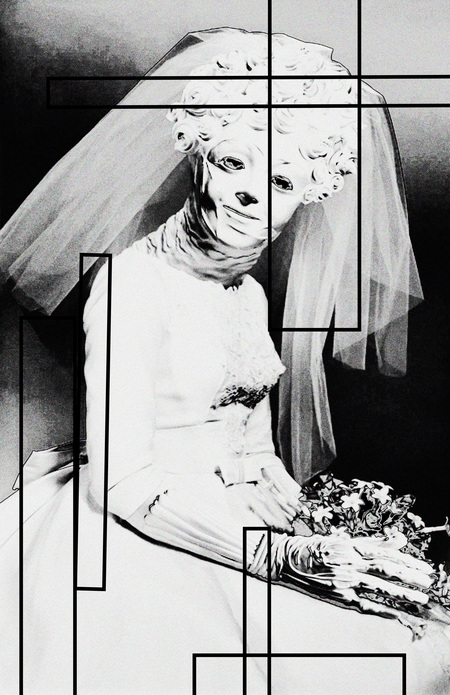
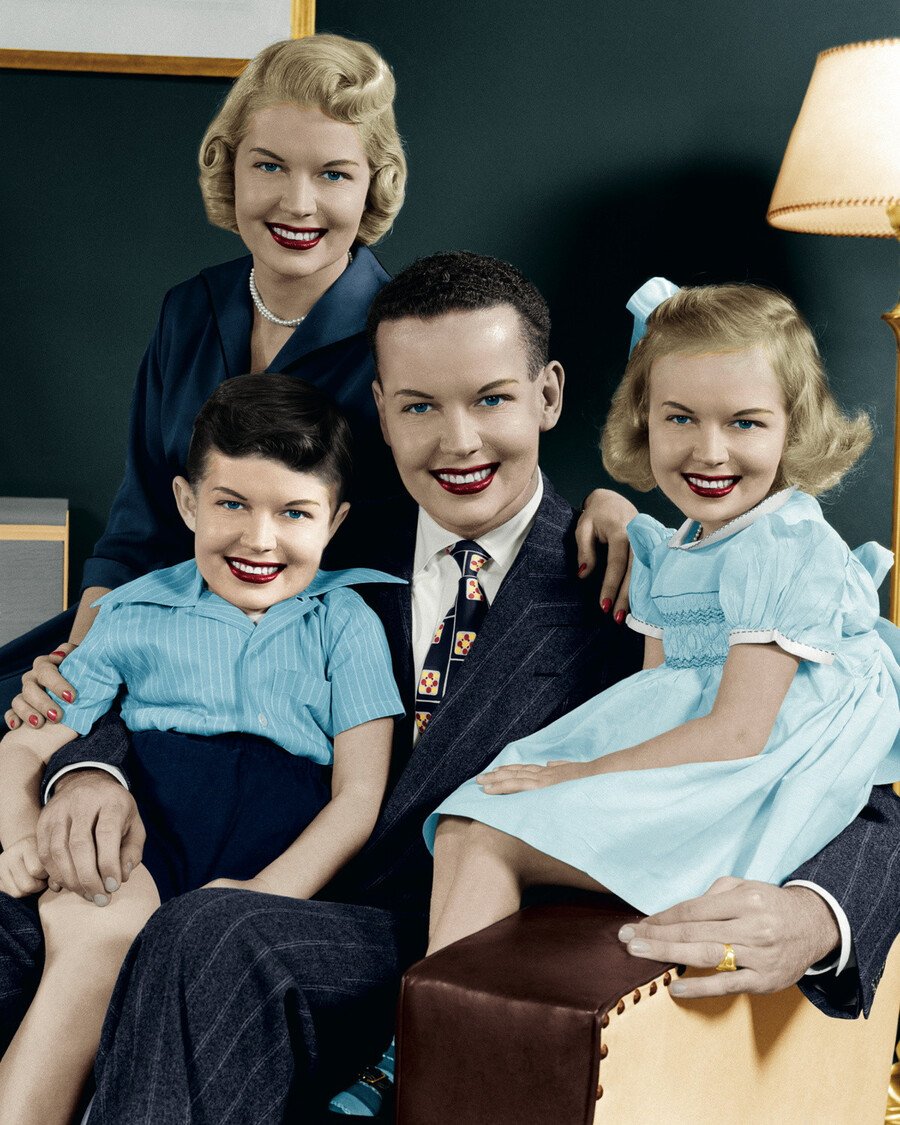
Weronika Gęsicka, from the «Traces» project, 2016
Do you feel uncomfortable looking at this photo?
Eight out of ten respondents answered positively.
In the 21st century, photography has acquired a new visual aesthetic that focuses not on documenting trauma, but on evoking a sense of psychological tension and anxious anticipation in the viewer. Unlike documentary or reportage photography, where fear is elicited by a direct depiction of suffering, contemporary artists generate anxiety even in the absence of visible danger. This paradox confirms the existence of a system of techniques capable of activating our innate danger-warning mechanisms—mechanisms that primarily respond to visual cues.
So, feelings of internal discomfort, the release of adrenaline, and the «fight or flight» response can be triggered not only by a real threat but also by the visual simulation of that threat’s image, even in a static image.
21st-century photographers deliberately exploit this aspect of human psychology, crafting images that provoke anxiety without resorting to themes of violence or disaster. This fundamentally distinguishes the contemporary «aesthetics of anxiety» from traditional photography, which captured horrific events where the emotional impact was built upon the documentary nature and recognizability of frightening incidents.
.[тревога]
At the core of this study lies the concept of anxiety. This is a state that arises in the viewer when looking at a photograph, where they sense an impending, yet-to-occur negative event, leaving them in a state of suspension because they cannot know for certain what to expect.
The difference between anxiety and fear is that fear implies an obvious threat, whereas in a state of anxiety, the threat is invisible but its approach feels inevitable. Photographers purposefully create precisely this sensation to impress the viewer, using the visual elements of their work to achieve it.
[◦]Select Period
The period spanning the late 20th century to the present was selected for several reasons. By the end of the 20th century, photography was fully recognized not just as a documentation of reality, but also as a vehicle for artistic expression capable of constructing, rather than merely capturing. Furthermore, the turn of the 20th and 21st centuries coincides with the digital revolution in photography—the emergence of new digital cameras and post-processing software removed technical limitations and allowed for experimentation with color, composition, and montage. Photographers gained the ability to deliberately distort the image and use this distortion as part of a visual language.
[◦]Image Selection
The image selection process unfolded in several stages. Initially, I studied a large volume of work found on photographers' social media accounts, as well as in online archives from exhibitions and journals. Primarily, I focused on eliciting a feeling of discomfort during viewing. Subsequently, I presented the curated material to ten respondents and approved the photographs if more than 50% of the participants reported a feeling of unease while looking at them.
[◦]Source Selection
When selecting textual sources, I prioritized academic articles on psychology, literature concerning expressive elements in photography, and articles from photo journals to substantiate the hypothesis regarding the connection between visual techniques and the emergence of anxiety.
.[гипотеза]
The research hypothesis posits that photography from the late 20th to the early 21st century has moved beyond merely documenting event-based fear to actively constructing a state of pervasive anxiety through a variety of visual devices. The viewer’s sense of unease arises not from witnessing something frightening, but because the composition, framing, and character archetype leave them suspended in a perpetual generation of possibilities—what to feel, what to anticipate, and when to expect it.
[◦]Objective
The primary goal of this research is to visually analyze photographs that evoked feelings of anxiety in viewers, to discover the correlation between the visible and the perceived, and to find an answer to the question of what all the selected images have in common.
To cover all aspects of the visual characteristics of the shots, I divided the research into sections:
[1]. Composition, Framing [2]. Space in the Frame [3]. Character [4]. Moment
For each theme, I formulated a question that arises in the viewer when considering the works. The arrangement of the sections traces an ascending gradient of feelings of anxiety and hopelessness evoked by the photographs.
кадрирование, композиция
.[1]
.[1.1]
— Cropping a part of a character’s body
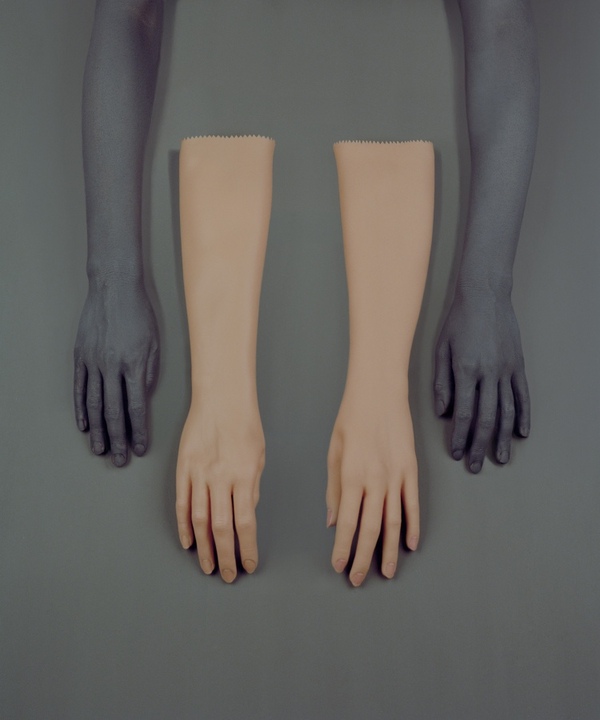
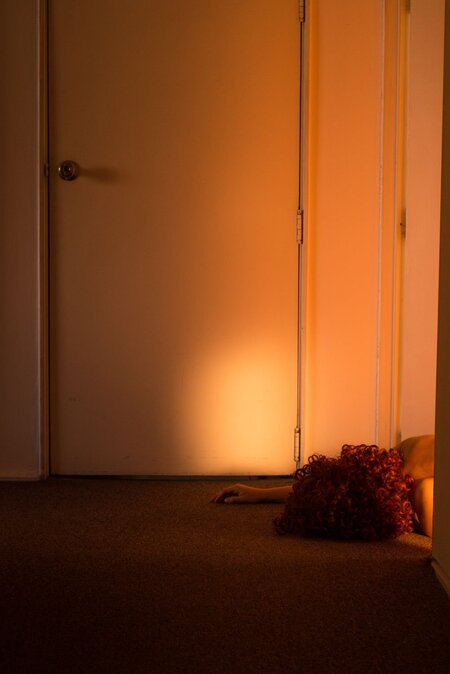
1. Weronika Gęsicka, from the series «I Remember My Birth,» 2018 2. The Door from the series Our Life In Shadows, Tania Franco Klein, 2016
Due to the cropping in the first photo, the character’s identity and motivations remain ambiguous, placing the viewer in a state of confusion.
In the composition of the second photo, the parallel lines on the wall are significant; the viewer’s gaze moves along these lines toward the character’s head, seemingly stumbling over it as an extraneous circular object within the geometry of straight lines. The artist has only included the immobilized head and arm in the frame. Without seeing the rest of the body, the viewer cannot know what happened to the character or if they are alive. The brain begins to generate the missing parts of the image and possible scenarios. This disruption of order and lack of understanding about the events provokes a sense of anxiety.
Weronika Gęsicka, from the «Traces» project, 2016
In this case, the absence of part of the character in the frame creates a feeling of ongoing motion—a tense anticipation that the girl might drift away, like a balloon.
.[1.2]
◦ Framing is wider than the character’s field of view
Gregory Crewdson, «Untitled,» from the «Twilight» series, 2001
In a shot composition, the audience may be shown more than the character. By seeing what threatens the protagonist, the viewer experiences an anxious anticipation for the resolution.
Anxiety is born from misunderstanding what is happening in the frame and the lack of precise information about the character’s future trajectory. The viewer sees more than the protagonist—and in a state of «held breath"—tries to answer themselves the question: «What should I be feeling?»